Operationalizing the Toronto Urban Evolution Model: From Formal Model to Empirical Propositions
Abstract
The Toronto Urban Evolution Model (TUEM) offers a formal language for generat- ing empirical claims about urban evolution. Its basic unit is the formeme: information about how space is physically organized for particular activities and groups. This paper operationalizes a limited observable subset of TUEM through linked histori- cal evidence for U.S. census tracts and metropolitan areas, combining road-network trajectories, census and ACS resident composition, and formal-establishment activity profiles from federal business records. The analysis asks what can be learned when TUEM signatures are translated into measured physical, group, and activity traces. TUEM is treated here as a claim-generating model: the empirical task is to determine which formal terms can be represented by available proxies, which claims become descriptive regularities, which are sensitive to measurement choices, and which lose support when translated into observable tests. The paper separates four evidentiary tasks: constructing classifications, describing empirical patterns, testing measurement sensitivity, and evaluating a deliberately nar- row selection implication. The strongest findings are measurement and classification results. Road histories form recurrent terrain families, and those terrain families can be crossed with retained, activity-profile-moving, group-moving, and coupled P-G-A histories. Physical form is often durable, with durability varying by component and pathway. Activity-profile movement within low-moving road containers is recurrent, providing a bounded trace of possible recoding while leaving zoning, ownership, building reuse, and lived meaning outside the present data. Additional high-coverage, county-validation, threshold, and held-out prediction checks support using the activity layer as a formal-establishment proxy while showing modest and uneven predictive gains from bundled context. The most mechanism-like test, activity saturation selecting substitute or hybrid forms, receives little support. The contribution is a reproducible empirical translation of TUEM into observable propositions and a clearer account of where current proxy evidence can support, narrow, or reject formal model claims.
Full Text
Operationalizing the Toronto Urban Evolution Model
From Formal Model to Empirical Propositions
AI Author: OpenAI GPT-5 Codex
Prompter: Daniel Silver
Correspondence: dan.silver@utoronto.ca
Submitted: May 31, 2026
Abstract
The Toronto Urban Evolution Model (TUEM) offers a formal language for generat- ing empirical claims about urban evolution. Its basic unit is the formeme: information about how space is physically organized for particular activities and groups. This paper operationalizes a limited observable subset of TUEM through linked histori- cal evidence for U.S. census tracts and metropolitan areas, combining road-network trajectories, census and ACS resident composition, and formal-establishment activity profiles from federal business records. The analysis asks what can be learned when TUEM signatures are translated into measured physical, group, and activity traces. TUEM is treated here as a claim-generating model: the empirical task is to determine which formal terms can be represented by available proxies, which claims become descriptive regularities, which are sensitive to measurement choices, and which lose support when translated into observable tests. The paper separates four evidentiary tasks: constructing classifications, describing empirical patterns, testing measurement sensitivity, and evaluating a deliberately nar- row selection implication. The strongest findings are measurement and classification results. Road histories form recurrent terrain families, and those terrain families can be crossed with retained, activity-profile-moving, group-moving, and coupled P-G-A histories. Physical form is often durable, with durability varying by component and pathway. Activity-profile movement within low-moving road containers is recurrent, providing a bounded trace of possible recoding while leaving zoning, ownership, building reuse, and lived meaning outside the present data. Additional high-coverage, county-validation, threshold, and held-out prediction checks support using the activity layer as a formal-establishment proxy while showing modest and uneven predictive
gains from bundled context. The most mechanism-like test, activity saturation selecting substitute or hybrid forms, receives little support. The contribution is a reproducible empirical translation of TUEM into observable propositions and a clearer account of where current proxy evidence can support, narrow, or reject formal model claims.
Keywords: urban evolution; urban signatures; urban trajectories; formeme; model testing;
road networks; formal establishments
1. Introduction
Urban science has made major progress in describing regularities of city size, spatial structure, and network organization (Batty 2008; Bettencourt et al. 2007; Bettencourt
2013; Boeing 2019). A central open problem remains evolutionary: explaining how urban
arrangements emerge, persist, are reused, and are transformed over time (Silver, Adler, and
Fox 2022; Mehmood 2010; Marshall 2009; Scheer 2017). This problem cannot be solved by
physical morphology alone. A road pattern can survive while users and activities change;
conversely, rapid physical extension can occur with continuity in social composition or local activity (Jacobs 1969; Duranton and Puga 2001; Fischer 1975). An evolutionary account
therefore needs a unit that links material form to the uses and users through which form
is carried and changed.
The Toronto Urban Evolution Model (TUEM) was developed to define that unit and to provide a formal basis for empirical testing (Silver, Adler, and Fox 2022; Fox, Silver, and
Adler 2022; Silver, Fox, and Adler 2022; Fox, Silver, Silva, and Zhang 2022). TUEM’s core
unit is the formeme: information for physically organizing space for particular activities and
groups. A formeme is not a street pattern alone, a land-use class alone, or a demographic profile alone. It is a relational unit joining physical organization, activities, and groups.
TUEM calls the time-stamped bundle of this information in a place its signature, and treats signatures as comparable through distance and trajectory logic (Fox, Silver, and Adler
2022; Fox, Silver, Silva, and Zhang 2022). TUEM is a claim-generating model as well as a descriptive vocabulary. It specifies
families of possible mechanisms–variation, selection, retention, recoding, and trajectory–
and therefore generates claims that should be supported, narrowed, deferred, or rejected
with evidence (Silver, Fox, and Adler 2022). This paper operationalizes a limited observable
subset of TUEM claims in a single linked dataset, separates classification from validation
and mechanism tests, and returns the resulting supported, fragile, and unsupported claims to the model, in line with broader calls for explicit model-to-evidence bridges in social
theory (Stinchcombe 1987; Brown 2013).
The dataset links three evidence layers across U.S. census tracts and metropolitan areas. The physical layer is drawn from CHRONEX-US, a historical road-network expansion
dataset, and linked built-maturity registers (Uhl, Burghardt, and Leyk 2025). The group
layer is drawn from the Longitudinal Tract Database (LTDB), decennial census records, and the American Community Survey (ACS) (Logan, Xu, and Stults 2014). The activity layer is drawn from ZIP Code Business Patterns (ZBP) and County Business Patterns
(CBP), which provide establishment and employment structure by industry (U.S. Census
Bureau 2024a, 2024b). These activity data are best read as a formal-establishment proxy: they observe registered economic organizations well, but not all informal, household,
visitor, institutional, or online activity.
The empirical argument proceeds through six named claims, but the claims do not carry
the same evidentiary status. The first three are primarily measurement and classification claims: whether road histories can be classified as trajectories, whether physical, group,
and activity components differ in relative movement, and whether expansion and recombi-
nation are empirically separable. The fourth and fifth are descriptive interpretation claims:
whether similar physical terrains carry different group and activity histories, and whether
stable physical containers are paired with establishment-profile or resident-composition movement. The sixth is a mechanism-like selection claim: whether activity saturation
selects substitute or hybrid forms. The answer is mixed in an informative way. Trajectory
classification is useful, expansion and recombination are distinguishable, and low-moving
road containers are often paired with establishment-profile movement. Physical durabil- ity is real but conditional rather than universal. The same-terrain result is a descriptive
classification result rather than a sorting-mechanism result. The saturation-to-substitution
claim is not supported as a broad mechanism in these data.
The contribution is both substantive and methodological, but it is deliberately bounded. Substantively, the paper shows that present physical form is an incomplete label for observed urban trajectories: similar road terrains can be paired with different resident-
composition and formal-establishment histories, and low-moving road containers can be
associated with changing establishment profiles. Methodologically, it shows how a formal
urban-evolution model can be translated into observable claims, evaluated against linked
historical evidence, and narrowed when the evidence is descriptive, measurement-sensitive,
or negative rather than confirmatory.
2. Background and Related Work
2.1 Urban Regularities and the Problem of Evolution
Urban science has produced strong evidence on recurrent city patterns, including scaling
regularities, network effects, and built-form structure (Batty 2008; Bettencourt et al. 2007;
Bettencourt 2013; Boeing 2019). Parallel work in urban complexity and self-organization
has emphasized that macro-order can emerge from local interaction and path-dependent
adaptation (Portugali 2000; Portugali 2012; Batty 2007). These traditions made cities com-
parable across places and scales, but they also sharpened a harder historical problem: how
urban characteristics emerge, persist, and change function through time.
Several precursor literatures point toward that evolutionary problem but do not resolve
it in a unified empirical framework. Stage and ecology traditions describe urban succession and differentiation, but often under-specify mechanisms linking material form, social groups, and activities (Silver, Adler, and Fox 2022). Urban DNA and path-dependence approaches identify durable signatures and lineage-like dynamics, but frequently treat
social and functional recoding indirectly or at coarser abstraction (Wilson 2008; Delmelle
2016; Sorensen 2015). Planning-oriented evolutionary metaphors are similarly productive
but heterogeneous in mechanism precision (Mehmood 2010; Marshall 2009; Scheer 2017).
Street networks and built form provide durable traces of these processes, but durability
creates an interpretive problem. The same physical container can host very different groups
and activities across periods. A road pattern can persist while economic routines change; a
building type can endure while social meaning shifts; a neighborhood can be recomposed by new combinations of users and uses without full replacement of its physical scaffold
(Jacobs 1969; Duranton and Puga 2001). An evolutionary account therefore needs to explain
physical persistence and functional recoding together.
2.2 TUEM as a Model of Urban Evolution
TUEM addresses this problem through a four-paper model architecture. Part I defines
the context and the need for an evolutionary approach to urban form (Silver, Adler, and
Fox 2022). Part II formalizes the formeme as information about physical organization for activities and groups (Fox, Silver, and Adler 2022). Part III specifies variation, selection, retention, and trajectory mechanisms (Silver, Fox, and Adler 2022). Part IV formalizes signature distance for longitudinal and transversal comparison (Fox, Silver, Silva, and
Zhang 2022). This architecture matters because it turns broad evolutionary language into explicit
model objects. A signature is a time-stamped bundle of physical form, activities, and groups.
Distance compares signatures. Trajectory compares sequences of signatures through time.
Mechanisms such as variation, selection, retention, recoding, longevity, fidelity, and fecun-
dity become testable only when these objects are measured consistently.
TUEM’s contribution is a disciplined unit-of-analysis strategy as well as a conceptual synthesis. It aligns with Darwinian sociocultural accounts that require explicit replica-
tor/vehicle or reproduction/selection logic in social domains while avoiding direct biolog- ical reductionism (Blute 2010; Mesoudi, Whiten, and Laland 2004; Dawkins 1982; Hull
1981; Wilkins and Bourrat 2022). In urban terms, this means claims must be written so that
potential variation sources, selection conditions, and retention channels can be observed
and compared.
2.3 From Model Terms to Observable Claims
This paper asks whether TUEM terms can be made empirically accountable. The bridge is
the observable claim. Each claim must specify the model statement, the expected empirical pattern, the required data, the evidence rule, and the implication for the model if the
pattern is supported, narrowed, or rejected. Proxy-based evidence is therefore treated as part of theory evaluation rather than as a preliminary defect to be hidden: the empirical
task is to determine what the available traces can and cannot carry. The empirical structure follows TUEM’s mechanism families. Signature claims test whether physical-only comparison is sufficient. Variation claims test recombination and
pathway entry. Selection claims test whether density, saturation, proximity, scope, content
similarity, and frequency alter pathway outcomes. Retention claims test persistence, recod- ing, and reproduction mechanisms. Trajectory claims test classification, speciation, role
ecology, and scale dependence. This claim structure gives mixed and negative results a defined scientific role. They
identify where mechanism statements are over-broad, under-measured, or scale-bound. A
claim may therefore be retained, narrowed, split, deferred, or rejected under the measure-
ments available for it.
The next section explains how model terms are translated into empirical measures and
how the main analysis evaluates claim results.
3. Data and Methods
Section 2 defined the problem as a translation from TUEM’s model terms to empirical claims. This section describes that translation. No single archive observes a complete
TUEM signature, because physical form, groups, and activities are recorded by different
institutions, at different spatial scales, and at different time intervals. The paper therefore
constructs a linked evidence system that approximates signatures by observing physical
form, formal establishments, and resident social composition together, over time, at tract
and metropolitan scales. These records do not exhaust the meaning of urban form. They allow several central claims generated by the model to be evaluated through observable
traces.
3.1 Units, Sources, and Scope
The main local unit is the census tract, a small statistical geography used by the U.S. Census Bureau to report neighborhood-scale population and housing data. Tracts are nested in core-based statistical areas (CBSAs), the Census Bureau’s metropolitan and
micropolitan labor-market areas. The analysis uses 16,808 tract histories across 401 CBSAs
in the trajectory-terrain analysis, with narrower samples where a claim requires stricter
temporal alignment or complete model covariates. The physical component, P, comes primarily from CHRONEX-US and linked built-
maturity records. CHRONEX-US estimates historical road-network expansion from con-
temporary road geometries and historical built-up areas, allowing the analysis to describe
road-cohort structure, road-kilometer growth, branch shares, connector and infill shares, outward extension, grid and loop inheritance, and built maturity (Uhl, Burghardt, and
Leyk 2025). These measures make road form a strong proxy for the physical component
of a signature. They do not observe every parcel, building, zoning, transit, ownership, or
institutional change. The group component, G, comes from the LTDB, decennial census data, and ACS
sample-period data. These sources measure resident social composition: tenure, age struc-
ture, race and ethnic composition, education, occupation, poverty, foreign-born population, and related diversity measures. They are appropriate for tract social context, but they do not directly observe all users of a place, including commuters, visitors, proprietors,
landlords, institutional actors, or temporary populations.
The activity component, A, comes from ZBP and CBP. These federal business records
describe formal establishments, employment size classes, payroll, and industry categories
by ZIP/ZCTA, county, and metropolitan geography. In this paper, they are used to measure
establishment density, broad industry-family composition, activity diversity, local services,
office and knowledge services, retail and hospitality, logistics, production and distribution,
manufacturing, construction, infrastructure, and institutional services. The term activity
therefore has a precise scope: it means observed formal-establishment activity, not the full
range of human practice in urban space. Because activity and tract geographies do not coincide perfectly, the activity layer is
crosswalked from ZCTA and county records to tract and CBSA frames where the evidence
design requires it. The annual ZBP panel covers 1994-2023. In the tract-ZCTA frame, median high-coverage tract-year support is 95.9 percent and median high-or-usable support is 97.7 percent. In the allocation used for the analysis, 97.0 percent of records have at least
95 percent areal support, and the median largest single-ZCTA share is 96.9 percent. CBP
county and CBSA checks show close agreement with the constructed activity profiles: in matched county records, the median establishment ratio is 0.998 and weighted profile
correlations for major activity families range from 0.938 to 0.986; in matched CBSA records, the median establishment ratio is 0.973 and weighted profile correlations range from
0.941 to 0.986. These checks support the activity layer as a usable proxy, while leaving its
substantive scope explicit.
Analysis Samples Used in the Main Text
Evidence frame Main use Sample
Physical terrain histories Road-terrain
16,808 tract histories; 401 CBSAs
classification, expansion,
and recombination
Aligned P-G-A
Component durability,
16,574 tract histories; up to 400
movement histories
activity-profile
CBSAs
movement, and rich
trajectory types
Direct saturation
Activity saturation and
1,995 transitions; 146 CBSAs
transitions
substitute outcomes
Industry-code-consistent
Activity saturation and
2,083 rows; 368 CBSAs
saturation rows
substitute-or-hybrid
outcomes without
SIC/NAICS period
mixing
Alternative saturation
Sensitivity check for the
2,085 rows; 369 CBSAs
specification
saturation result
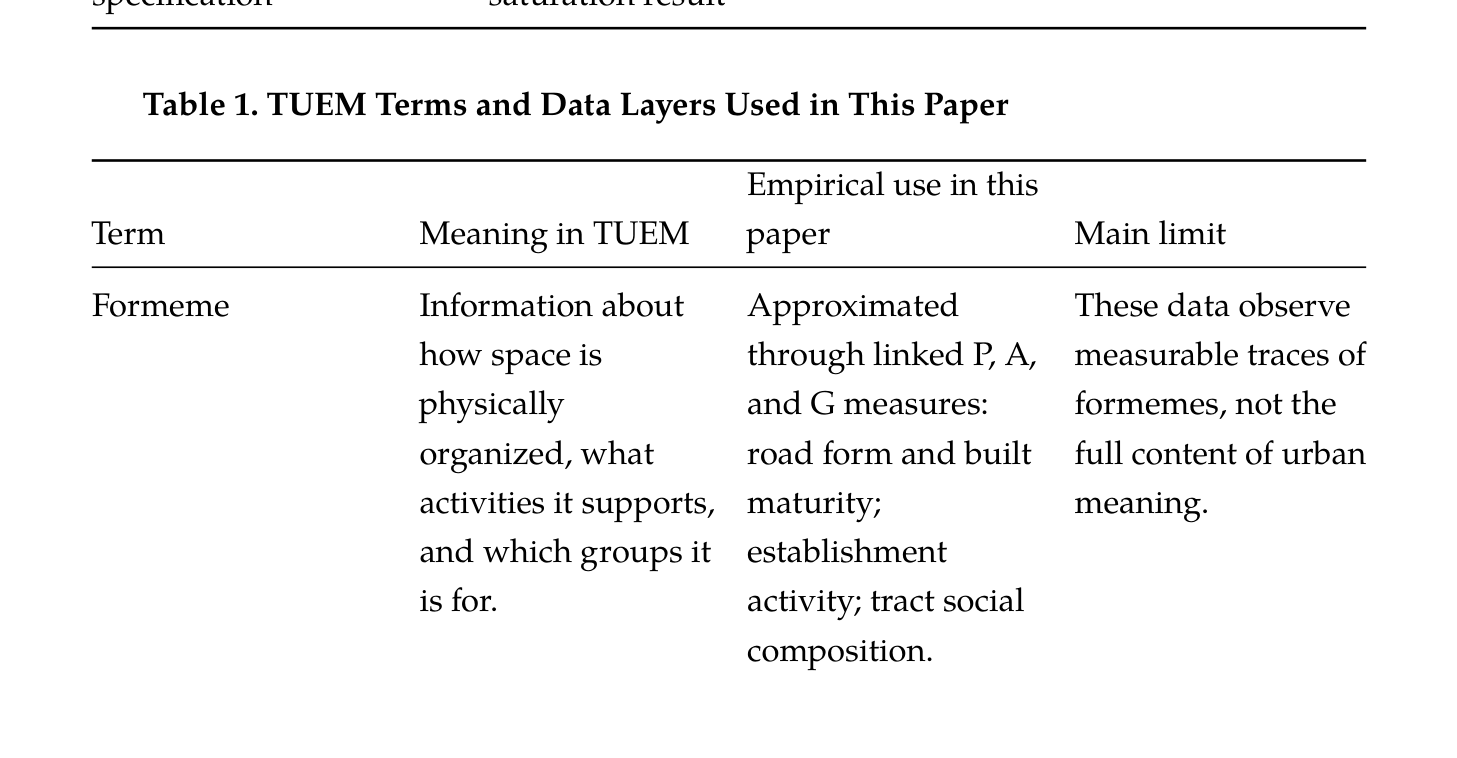
Table 1. TUEM Terms and Data Layers Used in This Paper
Empirical use in this
Term Meaning in TUEM
paper Main limit
Formeme Information about
Approximated
These data observe
how space is
through linked P, A,
measurable traces of
physically
and G measures:
formemes, not the
organized, what
road form and built
full content of urban
activities it supports,
maturity;
meaning.
and which groups it
establishment
is for.
activity; tract social
composition.
Empirical use in this
Term Meaning in TUEM
paper Main limit
Built as a
Signature The representation
Component timing
time-stamped
of a spatial area at a
differs, so some
time, locating
signatures are
bundle of road form,
formemes in both
aligned across
formal
space and time.
nearby windows
establishments, and
resident social
rather than perfectly
composition for
co-observed.
tracts and CBSAs.
Physical form, P How space is
Measured through
Strongest for road
materially
road age, road
networks and built
organized.
length, intersection
timing; parcels,
density, dead-end
buildings, zoning,
transit, utilities,
and terminal shares,
connector and infill
ownership, and
shares, gridness,
institutional form
orientation, and
are undermeasured.
built maturity.
Captures formal
Activities, A What the space is
Measured through
establishments
for and what people
ZBP and CBP
or organizations do
establishment and
better than informal,
there.
employment
household, visitor,
records, broad
online, or
sector mix, activity
institutional activity.
diversity, and
activity-family
profiles.
Groups, G Who the space is for
Measured through
Describes resident
and which users or
LTDB, census, and
populations better
social groups are
ACS variables
than all users,
associated with it.
describing resident
visitors, owners,
social composition.
workers, or
institutions.
3.2 From Signatures to Trajectories
A signature is a time-stamped bundle of P, G, and A. A trajectory is a sequence of such
bundles. The analysis therefore uses two kinds of distance. A transversal distance compares
two places at one time or window. A longitudinal distance compares one place across two times or windows. Both distances matter because TUEM claims address similarity at a
point in time and movement through signature space.
The main P-G-A movement summaries align signature states around 1994, 2000, 2010, and 2015, using the nearest available observations when components are not recorded on exactly the same schedule. The physical component is built from road-history and built-maturity measures; the group component from decennial census, LTDB, and ACS
resident-composition measures; and the activity component from the 1994-2023 ZBP/CBP formal-establishment panel. Component distances are standardized within the relevant comparison frame before they are added or converted into shares, so the reported P, G, and A shares describe relative movement within the measured signature, not raw
kilometers, population percentages, or establishment counts. A zero or near-zero physical share therefore means that road-form measures changed little relative to the measured
group and activity components in that tract history. The first translation problem is classification. A road-network measure can identify
outward extension, subdivision branching, stitched infill, grid/loop inheritance, branch- and-stitch hybrids, and mixed incremental change. These terrain families are physical
trajectories: they describe how road building extends, branches, connects, or inherits prior
structure. The terrain family is not yet a full urban-evolution interpretation, because two
tracts with the same physical terrain can differ in social and establishment histories.
The second translation problem is component movement. For each tract history with
aligned measures, physical, group, and activity movement are scaled within their compar- ison frame and converted into shares of total observed movement. The resulting P-G-A trajectory family identifies whether the observed path is retained/stable, activity-led,
group-led, physically led, or coupled across components. This classification is descriptive:
it tells which part of the observed signature moved most in the measured interval. It does
not by itself identify a causal driver. Retained/stable movement is assigned before component dominance is evaluated: a
tract with a short total path is classified as retained/stable even if one component accounts for most of that small amount of movement. Activity-led, group-led, and physical-led
movement identify the component with the largest share of observed movement after that total-path screen. Coupled movement identifies cases where more than one component
moves substantially. These labels are descriptive. They identify which part of the observed
signature moved most, not what caused the movement. The third translation problem is claim testing. In this paper, testing means studying
observable implications. A claim is not treated as proven because a concept can be named
in the data; it becomes empirically accountable only when the model statement implies a
measurable pattern. Each claim in Section 4 is therefore evaluated by specifying the model
statement, observable implication, measurement strategy, empirical result, and implication
for TUEM. A result supports a claim when the measured pattern matches the observable
implication under the relevant design. A result narrows a claim when support appears only
under particular spatial scales, data resolutions, or eligibility rules. A result counts against
a broad claim when the eligible comparison moves in the opposite direction. A question
remains untested when the required data are unavailable at the needed resolution.
3.3 Inference and Limits
The paper’s claims are descriptive and model-evaluative rather than causal. The central tests ask whether observable patterns are consistent with selected TUEM implications:
whether physical terrain families become more informative when crossed with group and
activity histories, whether component pace differs across P, G, and A, whether expansion and recombination form distinguishable pathways, whether stable physical containers
carry changed group or activity profiles, and whether one deliberately narrow saturation
implication predicts substitute or hybrid pathways. These are tests of observable implica-
tions, not estimates of exogenous treatment effects or requirements that TUEM reduce to a
single mechanism.
Several limits follow directly from the data structure. CHRONEX-US supports long-run
road and built-maturity analysis but cannot observe all physical transformations. Census and ACS data describe residents, not all groups that use or control urban space. ZBP
and CBP describe formal establishments, not all activities. These limits are not incidental;
they define what the evidence can and cannot mean. The analysis therefore avoids claims
about mechanisms that require unobserved zoning, ownership, parcel, building, informal
activity, visitor, or institutional data. The empirical design keeps each claim at the level supported by its measures. Com- ponent durability is specified as a question about relative movement among physical,
group, and activity components. Recoding is treated as a theoretical interpretation of low
physical movement paired with higher group or formal-establishment movement, not as
direct observation of building reuse, zoning change, ownership strategy, or lived meaning. The saturation test requires a positive relationship between prior formal-establishment
saturation and substitute or hybrid outcomes after physical-pathway context is included.
Persistence and reproduction are defined as distinct retention outcomes: persistence refers to survival of inherited physical structure, while reproduction alignment refers to later
development that continues a prior pattern.
Claim Structure
Claim Evidence type
implication Evidence used Result
Trajectory
Constructed
Road histories
Physical terrain
Supported as a
classification
classification
should form
histories
road-history
recurrent
classification,
pathway
not as
independent
families that are
mechanism
not reducible to
validation.
present
morphology
alone.
Conditional
Descriptive
Physical
Aligned P-G-A
Narrowed:
component
empirical
movement
movement
physical form is
durability
pattern
should often be
histories;
often stable, but
lower than
component
no universal
group or
shares;
slowest-
activity
robustness
component law
movement, but
checks
is supported.
the slowest
component
may vary by
pathway and
window.
Road-terrain
Supported as a
Expansion
Constructed
Outward
measures and
terrain
versus
classification
extension,
recombination
subdivision
terrain mix by
classification.
branching,
movement
family
stitched infill,
inherited
connected
layouts, and
hybrid cases
should have
different
road-terrain
profiles.
Claim Evidence type
implication Evidence used Result
Descriptive
A physical
Same terrain,
Supported only
Rich trajectory
as descriptive
types and
classification
terrain family
different
plus null
should appear
bundled
classification;
shuffled-
benchmark
with more than
histories
the shuffled
context
one
benchmark
permutation
group/activity
does not
check
movement
support a
history; a
strong terrain-
to-context
stronger sorting
sorting
claim would
mechanism.
require
observed
association
beyond
shuffled
context.
Activity-profile
Descriptive
Stable or
Component-
Supported with
movement
association and
low-moving
movement
scope limits;
within stable
construct-
road containers
families, rich
interpreted as a
containers
validity target
should
trajectory types,
trace consistent
sometimes be
illustrative
with recoding,
paired with
lineages,
not direct
substantial
activity-
evidence of
resident-
geography
reuse
composition or
checks
mechanisms.
formal-
establishment
movement.
Claim Evidence type
implication Evidence used Result
Not supported
Direct
Activity
Mechanism-
Prior formal-
as a broad
transition and
saturation and
like selection
establishment
mechanism.
industry-code-
substitution
test
saturation
consistent
should
saturation
positively
models
predict
substitute or
hybrid
outcomes after
physical-
pathway
context is
included.
4. Analysis
The analysis follows the claim structure above. It begins with trajectory classification because the paper’s central measurement problem is whether urban evolution can be represented as histories rather than present physical forms alone. It then asks whether P, G, and A differ in relative movement; whether expansion and recombination form
distinct physical pathways; whether similar terrain can carry different histories; whether stable physical containers are associated with activity-profile or resident-composition
movement; and whether activity saturation selects substitute or hybrid forms. The sequence is cumulative, but the evidentiary status changes across sections: trajectory and terrain claims are classification claims, same-terrain and stable-container claims are descriptive
interpretations with sensitivity checks, and the saturation test is a mechanism-like selection
test.
4.1 Trajectory Classification: Road Histories Are Not Static Morphologies
TUEM’s trajectory logic states that places with similar present signatures can have differ- ent evolutionary meanings. A present road pattern is therefore an insufficient object of classification unless it is connected to the path by which it formed and to the group and activity histories that accompanied it. The observable implication is straightforward: a
trajectory classification should reveal recurrent physical pathways and should show that
those pathways are not reducible to one static morphology.
The measure begins with road-network histories. Each tract is assigned to a physical terrain family using the relative presence of branching, strict subdivision-style terminal
structure, connector/infill stitching, outward extension, and inherited grid or loop structure.
Figure 1 is read as a first map of physical evolutionary pathways. The bars show how many
tract histories fall into each terrain family; the labels summarize what the family means in
ordinary road-building terms.
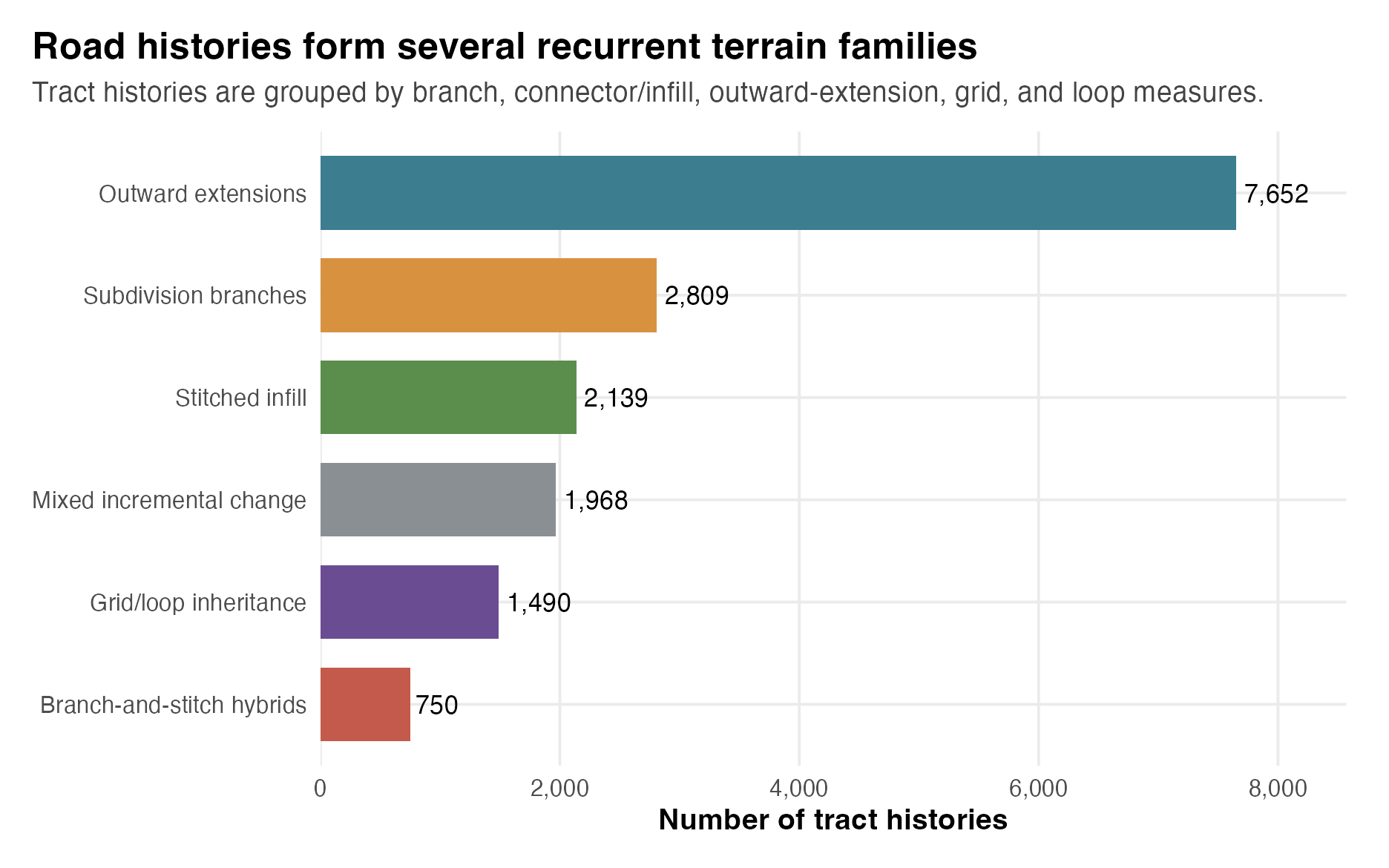
Figure 1. Physical trajectory terrain families. The figure classifies tract road histories
into six terrain families. Outward extensions are the largest family, but subdivision branches, stitched infill, grid/loop inheritance, branch-and-stitch hybrids, and mixed incremental
change are all large enough to matter empirically.
The terrain classification identifies a differentiated physical field. Outward extensions
are the largest family, with 7,652 tracts across 397 CBSAs and a median outward share of 0.767. Subdivision branches include 2,809 tracts across 312 CBSAs and have the highest median branch share, 0.669. Stitched infill includes 2,139 tracts across 192 CBSAs and has a median stitching share of 0.816. Grid/loop inheritance includes 1,490 tracts across 253 CBSAs; branch-and-stitch hybrids include 750 tracts across 196 CBSAs; and mixed
incremental change includes 1,968 tracts across 319 CBSAs. These counts support the first
step of the trajectory claim: road-network evolution appears as a set of recurrent pathways

rather than a single continuum from old to new.
Table 2. Physical Terrain Families in the Trajectory Sample
Terrain
stitching
outward
family Tracts CBSAs
branch share
share
share
Outward
7,652 397 0.285 0.233 0.767
ext.
Subdivision
2,809 312 0.669 0.477 0.523
branches
Stitched
2,139 192 0.375 0.816 0.184
infill
Mixed
1,968 319 0.551 0.551 0.449
incremen-
tal
Grid/loop 1,490 253 0.359 0.575 0.425
Branch-
750 196 0.579 0.658 0.342
stitch
The implication for TUEM is that trajectory classification is empirically useful before mechanism claims are specified more tightly. TUEM’s trajectory vocabulary does not simply rename existing morphology; it organizes observed histories into road-building
pathways that can then be crossed with group and activity movement. The next test asks
whether the three components in that crossed signature move at different rates.
4.2 Conditional Durability: Physical Form Often Persists, But Not as a Universal Hierar-
chy
TUEM gives physical form a special role because streets and inherited built structure
can persist after social composition or activity patterns change. The empirical question is
whether that durability appears as a universal temporal hierarchy or as a pathway-specific
pattern. When P, G, and A are observed together, the test asks how often each component
is the most durable part of the signature.
The measure uses aligned tract histories and computes the share of observed movement associated with physical form, group composition, and formal-establishment activity. A
tract with a low physical share and a high activity share has a comparatively stable road
container and a changing establishment profile. A tract with a high group share has social- context movement that exceeds physical and activity movement. Figure 2 is read as a typology of component movement, not as a causal explanation of why the movement
occurred.
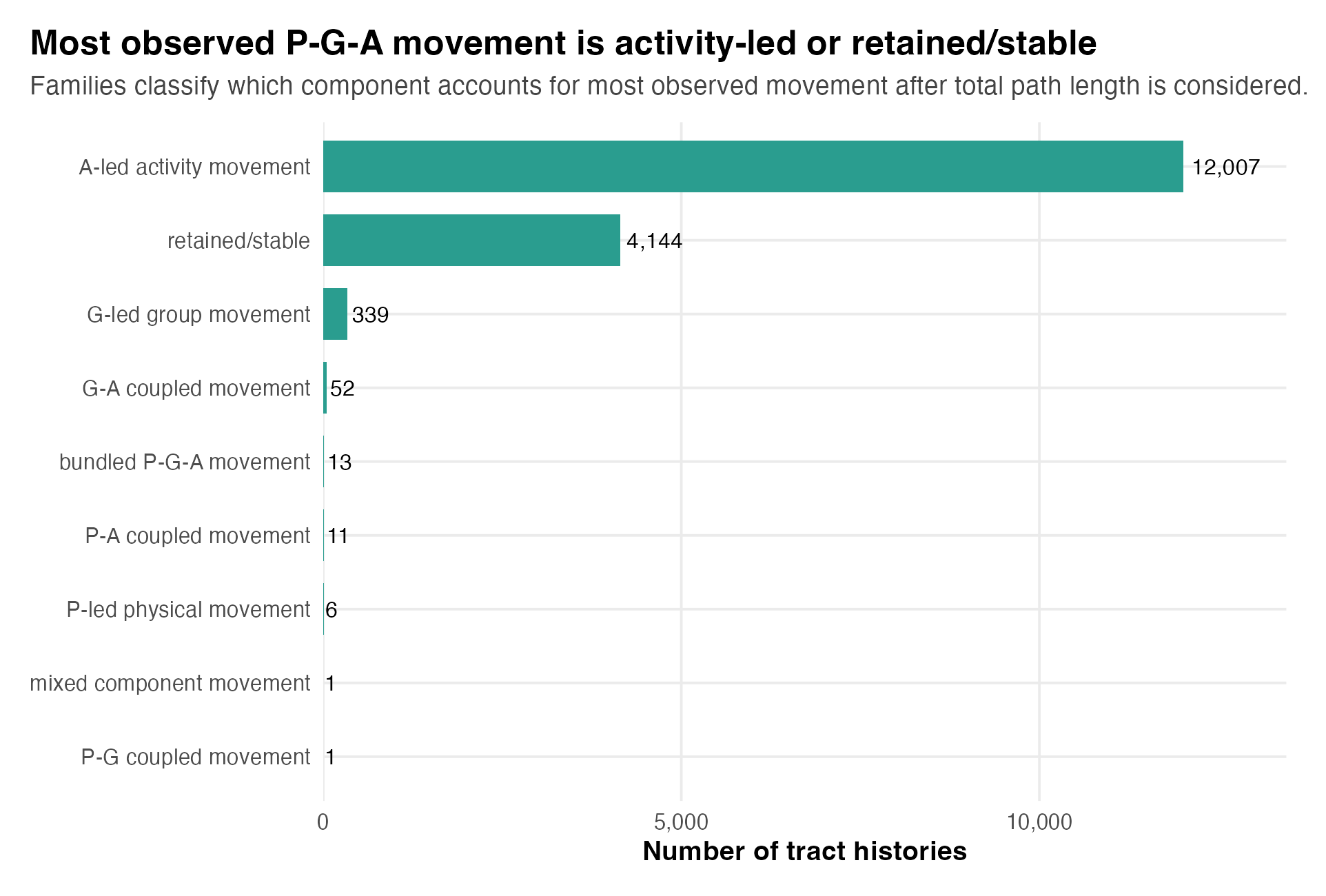
Figure 2. P-G-A trajectory families. The figure classifies tract histories by which com- ponent accounts for most observed movement. The activity-led category is the largest family, retained/stable pathways form the second largest family, and group-led or cou- pled movement appears in smaller but interpretable families. The labels are descriptive
component-movement labels, not causal driver labels. The observed trajectories do not support a universal physical-slowest rule, although
they preserve the importance of physical durability. The activity-led category is the largest
family, with 12,007 tracts across 400 CBSAs. Its median path has a physical share of 0.000, a group share of 0.252, and an activity share of 0.735. Retained/stable pathways include
4,144 tracts across 382 CBSAs and have a shorter median path, 0.044, compared with 0.076
for the activity-led category. Group-led movement is much smaller, with 339 tracts across 122 CBSAs, but it has the highest median group share, 0.544. Coupled P-G-A, P-A, and
physical-led pathways are rare in the national tract sample.
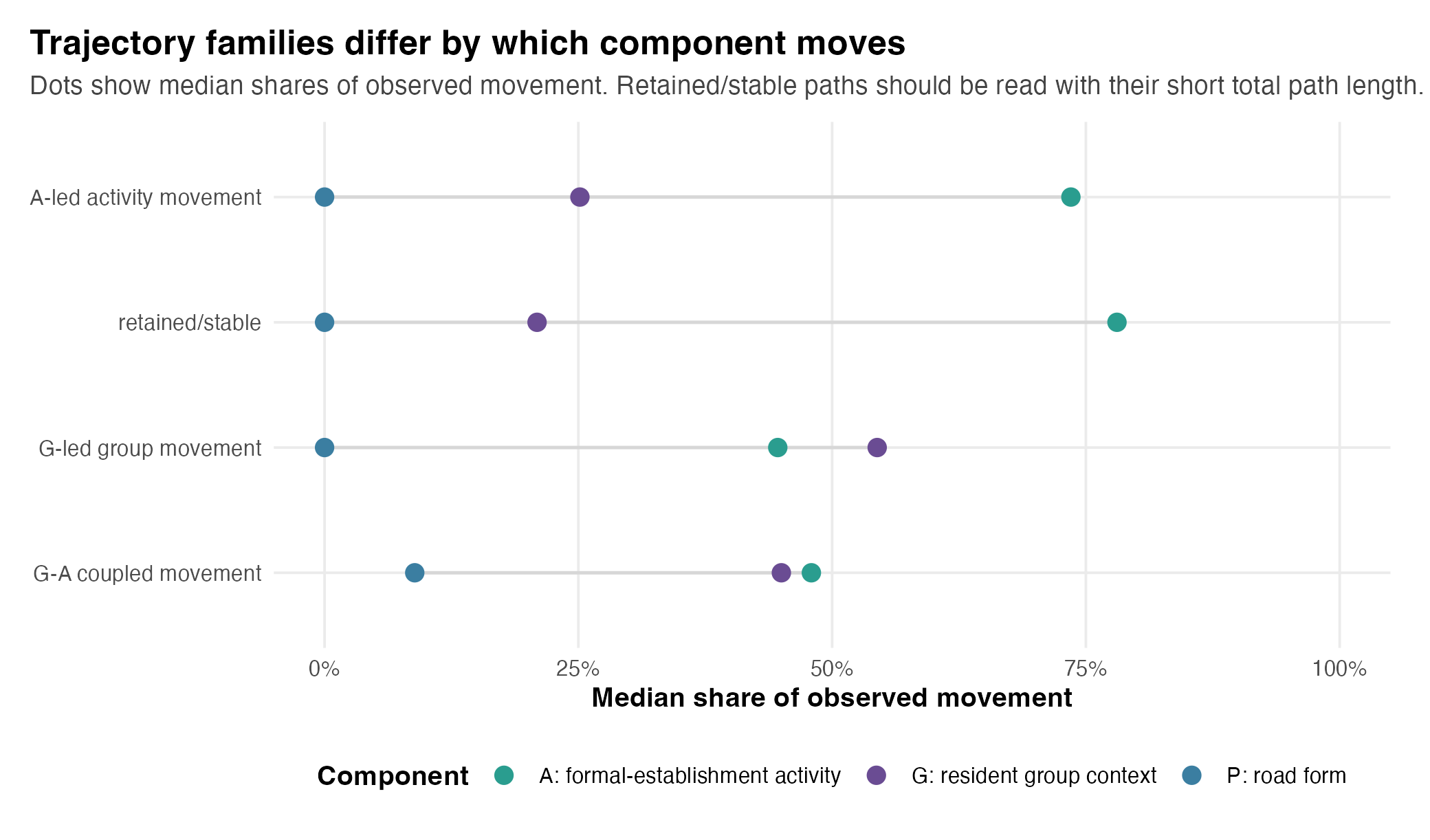
Figure 3. Component movement profiles by trajectory family. The figure shows how
much observed movement is physical, group, or activity movement for the main readable families. It should be read together with total path length: retained/stable tracts have a
high activity share only because their total movement path is short.
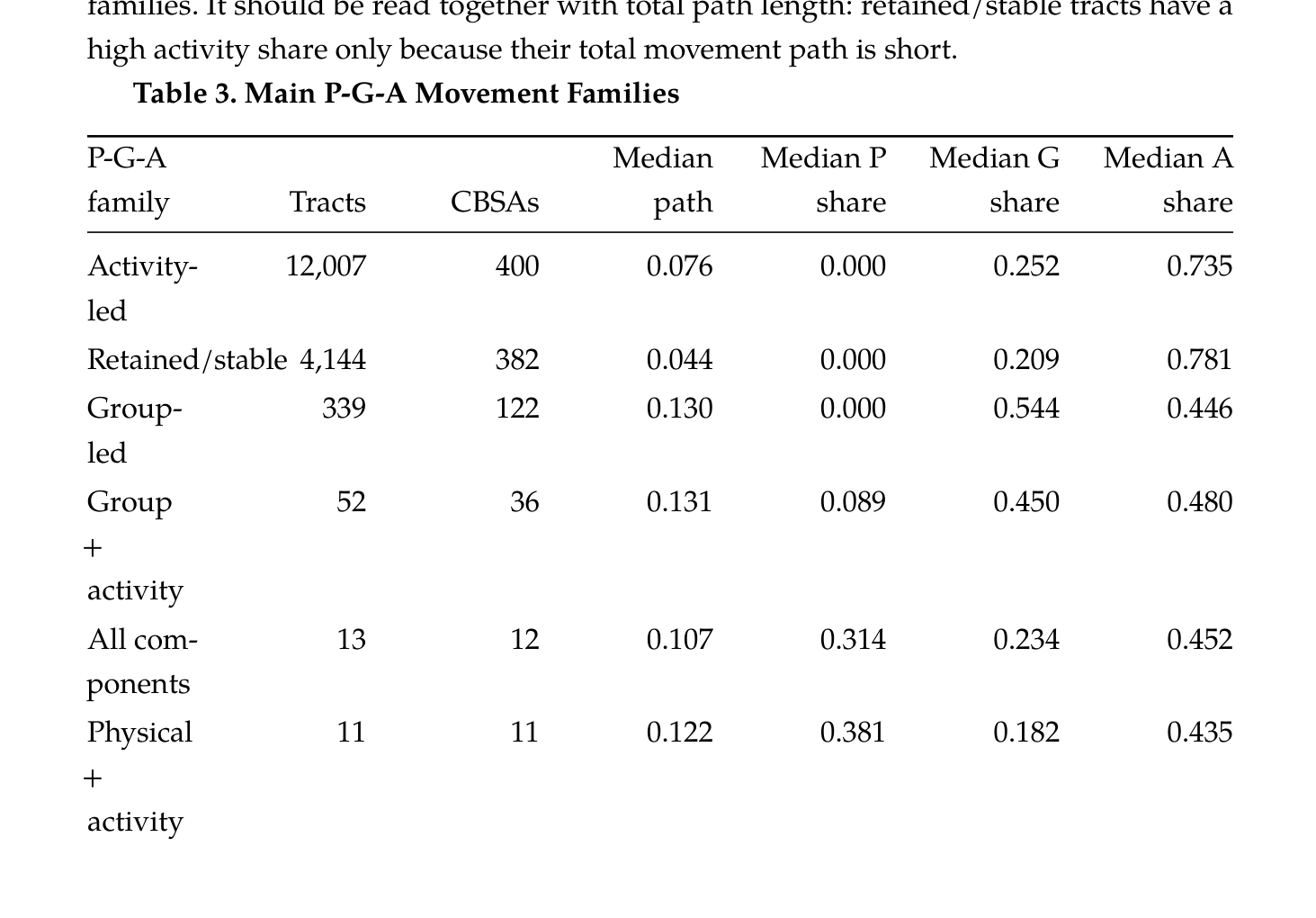
Table 3. Main P-G-A Movement Families
P-G-A
Median P
Median G
Median A
family Tracts CBSAs
path
share
share
share
Activity-
12,007 400 0.076 0.000 0.252 0.735
led
Retained/stable 4,144 382 0.044 0.000 0.209 0.781
Group-
339 122 0.130 0.000 0.544 0.446
led
Group
52 36 0.131 0.089 0.450 0.480
+
activity
All com-
13 12 0.107 0.314 0.234 0.452
ponents
Physical
11 11 0.122 0.381 0.182 0.435
+
activity
family Tracts CBSAs
path
share
share
share
Physical-
6 5 0.171 0.550 0.088 0.305
led
Note: retained/stable is assigned by short total path before component dominance is evaluated. Component shares in that row therefore describe shares of a small total
movement path. Two one-tract residual categories, mixed component movement and P-G coupled
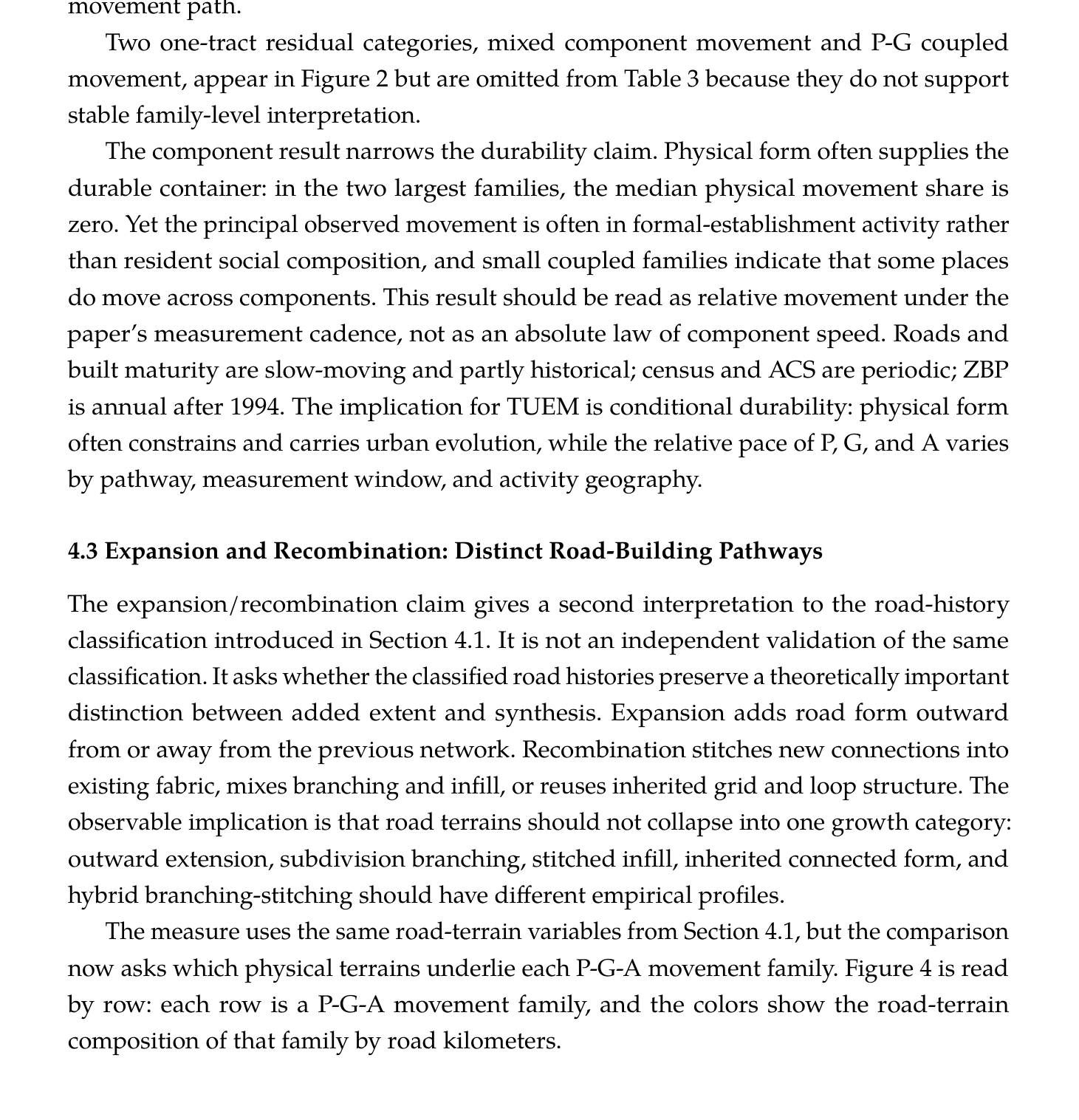
movement, appear in Figure 2 but are omitted from Table 3 because they do not support
stable family-level interpretation.
The component result narrows the durability claim. Physical form often supplies the durable container: in the two largest families, the median physical movement share is
zero. Yet the principal observed movement is often in formal-establishment activity rather than resident social composition, and small coupled families indicate that some places
do move across components. This result should be read as relative movement under the paper’s measurement cadence, not as an absolute law of component speed. Roads and built maturity are slow-moving and partly historical; census and ACS are periodic; ZBP is annual after 1994. The implication for TUEM is conditional durability: physical form
often constrains and carries urban evolution, while the relative pace of P, G, and A varies
by pathway, measurement window, and activity geography.
4.3 Expansion and Recombination: Distinct Road-Building Pathways
The expansion/recombination claim gives a second interpretation to the road-history classification introduced in Section 4.1. It is not an independent validation of the same
classification. It asks whether the classified road histories preserve a theoretically important distinction between added extent and synthesis. Expansion adds road form outward from or away from the previous network. Recombination stitches new connections into
existing fabric, mixes branching and infill, or reuses inherited grid and loop structure. The
observable implication is that road terrains should not collapse into one growth category:
outward extension, subdivision branching, stitched infill, inherited connected form, and
hybrid branching-stitching should have different empirical profiles.
The measure uses the same road-terrain variables from Section 4.1, but the comparison
now asks which physical terrains underlie each P-G-A movement family. Figure 4 is read by row: each row is a P-G-A movement family, and the colors show the road-terrain
composition of that family by road kilometers.
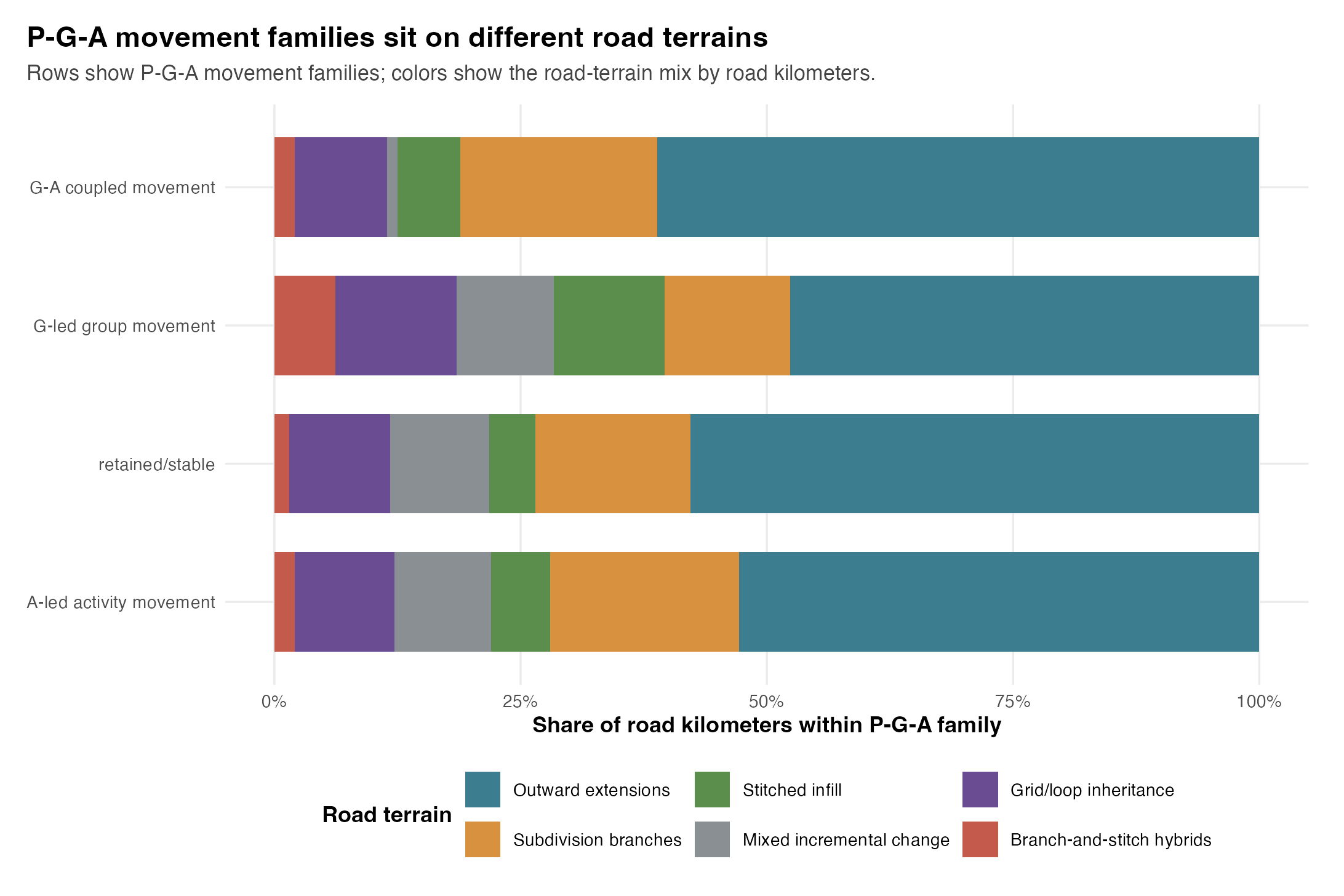
Figure 4. Road-terrain mix by P-G-A family. The figure shows the physical terrain
associated with each P-G-A movement family. It helps separate expansionary paths from
recombinatory and hybrid paths, while also showing that activity-led movement appears
across several physical terrains.
The terrain families support the expansion/recombination distinction. Outward exten-
sions are defined by a high median outward share, 0.767, and comparatively low stitching,
0.233. Stitched infill reverses that profile, with median stitching 0.816 and outward share
0.184. Subdivision branches show high branching, 0.669, while branch-and-stitch hybrids
combine substantial branch and stitching shares, 0.579 and 0.658. Grid/loop inheritance is
neither simple outward growth nor pure infill: it has a median stitching share of 0.575 and
identifies places where connected layouts persist or are repeated. Figure 4 adds a second reading: the same P-G-A movement family can sit on several road terrains, but the terrain mix is not identical across movement families. Activity-led
movement is distributed across outward extensions, subdivision branches, stitched infill, mixed incremental change, and grid/loop inheritance. Retained/stable paths are also dominated by outward extensions but retain visible shares of inherited grid/loop and mixed incremental terrain. The rarer group-led and group-activity coupled rows have
their own terrain mixes, though their small counts make them better treated as suggestive
classifications than as stable national proportions.
The result supports expansion and recombination as a classification distinction. Expan-
sion and recombination are empirically separable in the road record, and hybrid cases are
not noise; they are important because they mark tracts where subdivision-style branching
and later stitching coexist. The implication for TUEM is that its variation vocabulary should distinguish added extent from recombined fabric. The next section asks what happens
when these physical pathways are crossed with group and activity histories.
4.4 Bundled Histories: The Same Terrain Can Carry Different Activity and Group
Movement
The same-terrain claim states that similar physical form can encode different formemes when group or activity context differs. In trajectory terms, the claim becomes sharper:
the same physical terrain can carry retained, activity-moving, group-moving, or coupled
histories. This test can show whether physical terrains map one-to-one onto P-G-A histories;
it cannot by itself show that terrain sorts those histories. The observable implication is that the richest trajectory types should cross physical terrain families with P-G-A movement
families rather than lining them up one-to-one. The measure forms a rich trajectory type by combining the road-terrain family with
the P-G-A movement family. Figure 5 is read as a distribution of these combined histories.
If physical terrain determined the whole urban-evolution path, one or two combinations would dominate and the rest would be marginal. If physical terrain is incomplete as a
signature label, the same terrain should appear with multiple movement histories.
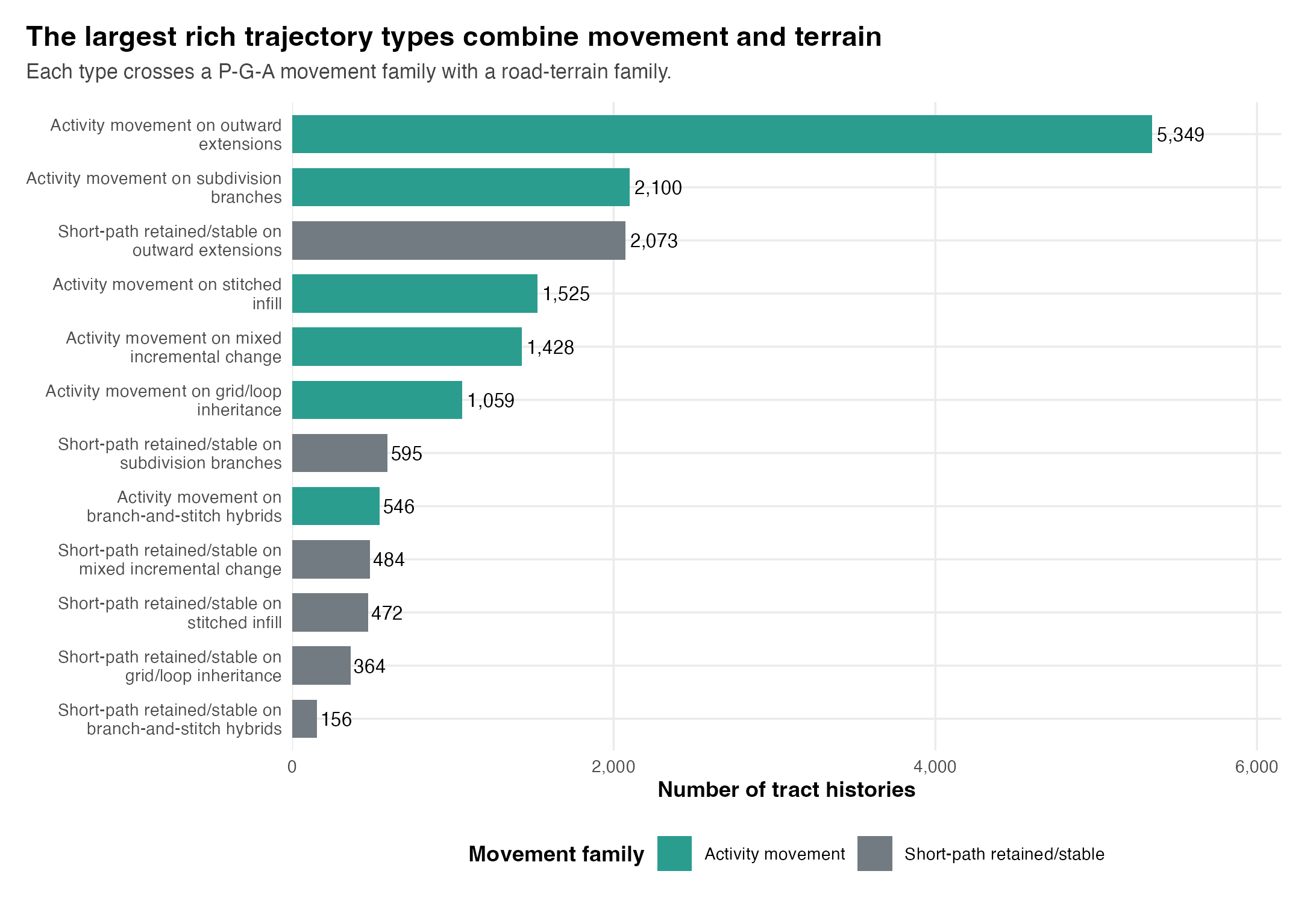
Figure 5. Rich trajectory type counts. The figure combines physical terrain families
with P-G-A movement families and shows the largest combined types. The largest types
are activity-led movement on outward extensions, activity-led movement on subdivision
branches, retained/stable packages on outward extensions, and activity-led movement on
stitched infill. The combined typology shows why physical terrain alone is incomplete. The largest
type is activity-led movement on outward extensions, with 5,349 tracts across 390 CBSAs,
32.3 percent of the rich-trajectory sample. The second is activity-led movement on subdi-
vision branches, with 2,100 tracts across 291 CBSAs, 12.7 percent. The third is a different history on the same broad expansionary terrain: retained/stable packages on outward
extensions, with 2,073 tracts across 326 CBSAs, 12.5 percent. Activity-led movement also
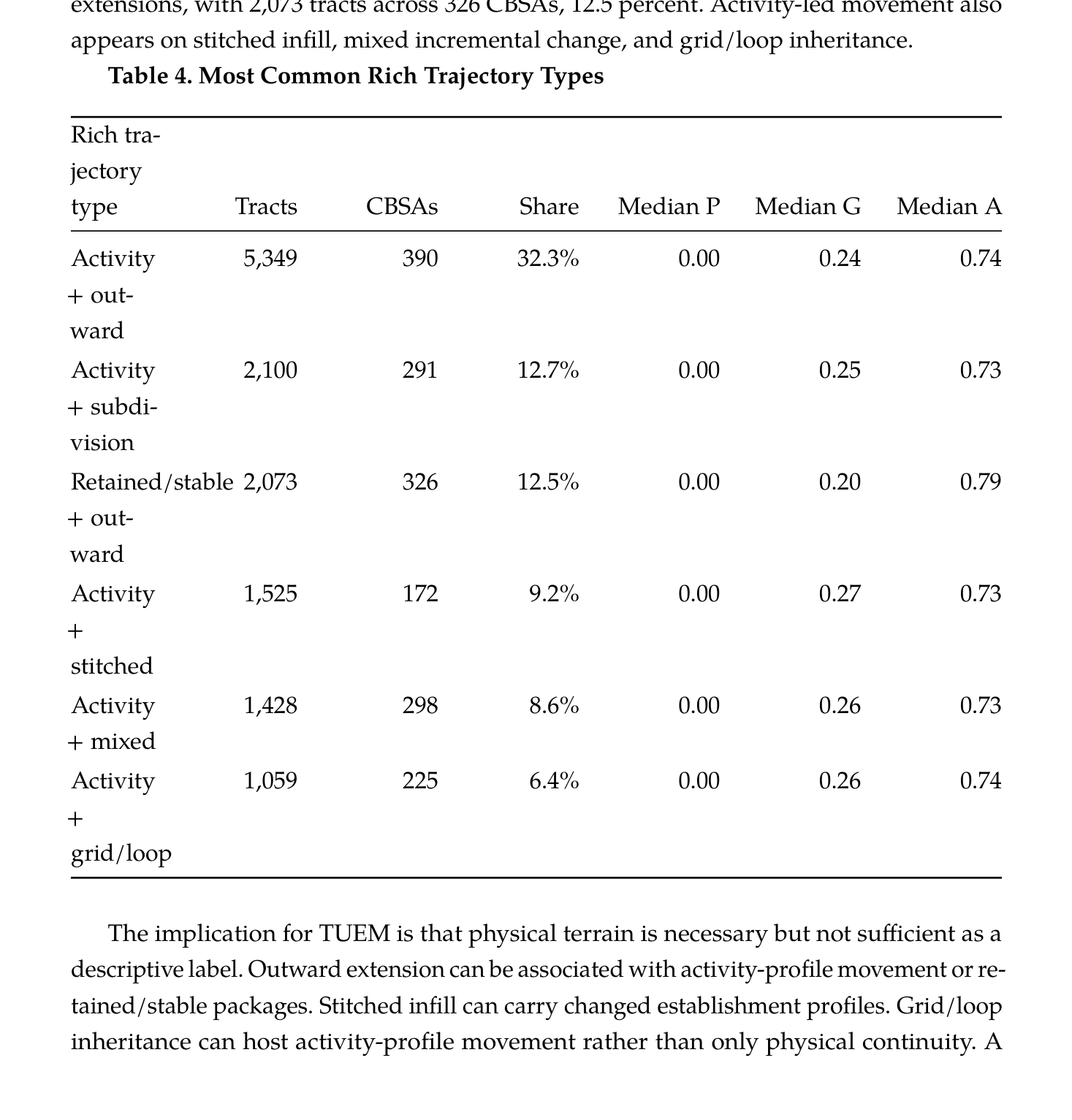
appears on stitched infill, mixed incremental change, and grid/loop inheritance.
Table 4. Most Common Rich Trajectory Types
Rich tra-
jectory
type Tracts CBSAs Share Median P Median G Median A
Activity
5,349 390 32.3% 0.00 0.24 0.74
+ out-
ward
Activity
2,100 291 12.7% 0.00 0.25 0.73
+ subdi-
vision
Retained/stable
2,073 326 12.5% 0.00 0.20 0.79
+ out-
ward
Activity
1,525 172 9.2% 0.00 0.27 0.73
+
stitched
Activity
1,428 298 8.6% 0.00 0.26 0.73
+ mixed
1,059 225 6.4% 0.00 0.26 0.74
Activity
+
grid/loop
The implication for TUEM is that physical terrain is necessary but not sufficient as a
descriptive label. Outward extension can be associated with activity-profile movement or re-
tained/stable packages. Stitched infill can carry changed establishment profiles. Grid/loop inheritance can host activity-profile movement rather than only physical continuity. A
permutation check qualifies the inference: the observed off-dominant share within physical
clusters, 51.7 percent, is close to the shuffled-context baseline of 53.1 percent, so this result should not be read as a strong sorting effect beyond the classification itself (Appendix
D). The supported claim is therefore intentionally modest: similar physical forms can be
paired with different observed group and formal-establishment histories, but the present
test does not identify a distinct sorting mechanism that assigns those histories to terrains.
4.5 Stable Road Containers and Activity-Profile Movement
The retention and recoding claim asks how inherited physical form constrains change while also making reuse possible. In TUEM terms, retention has two sides: inherited
physical structure can limit what changes, while new group or activity patterns can become
absorbed into an existing urban container. The observable data cannot directly see adaptive reuse, zoning decisions, property strategy, building conversion, institutional control, or
lived meanings. The empirical claim is therefore narrower: stable P paired with changing
G or A is a measured trace that is consistent with recoding, but recoding as a mechanism
requires additional local evidence. The observable implication is that stable or low-moving physical containers should
appear with substantial group or activity movement. The clearest national evidence comes
from activity-profile movement, because the activity layer has annual formal-establishment
records after 1994 and because activity-moving paths are large enough for comparison. The
result establishes a recurrent association between physical persistence and establishment- profile change. A causal account of why those paths form would require additional evi-
dence about ownership, zoning, building reuse, and institutional decision-making. The quantitative basis for the stable-container interpretation is the combination of component movement and terrain crossing. In the aligned P-G-A movement sample, activity-profile-moving histories include 12,007 tracts across 400 CBSAs with a median physical movement share of 0.000 and a median activity movement share of 0.735. Re-
tained/stable pathways add another 4,144 tracts across 382 CBSAs with short median total path length. In the rich trajectory types, activity-profile movement appears on outward
extensions, subdivision branches, stitched infill, mixed incremental change, and grid/loop inheritance. This is therefore not a single morphology; it is a relationship between low
measured physical movement and higher measured activity or group movement. Figure 6 gives a place-based reading of the typology. Each line traces an exemplar through P-G-A signature space. The vignettes were selected to make the main activity- moving pattern visible across different physical terrains while also retaining contrast
cases for group-moving, physical-moving, and bundled movement. The lineages make the
abstract classification visible: some tracts move mainly in activity, some mainly in group,
some in coupled ways, and a few in physical form. The figure is read as a lineage diagram
rather than as a map; it shows how the same vocabulary can describe different histories.
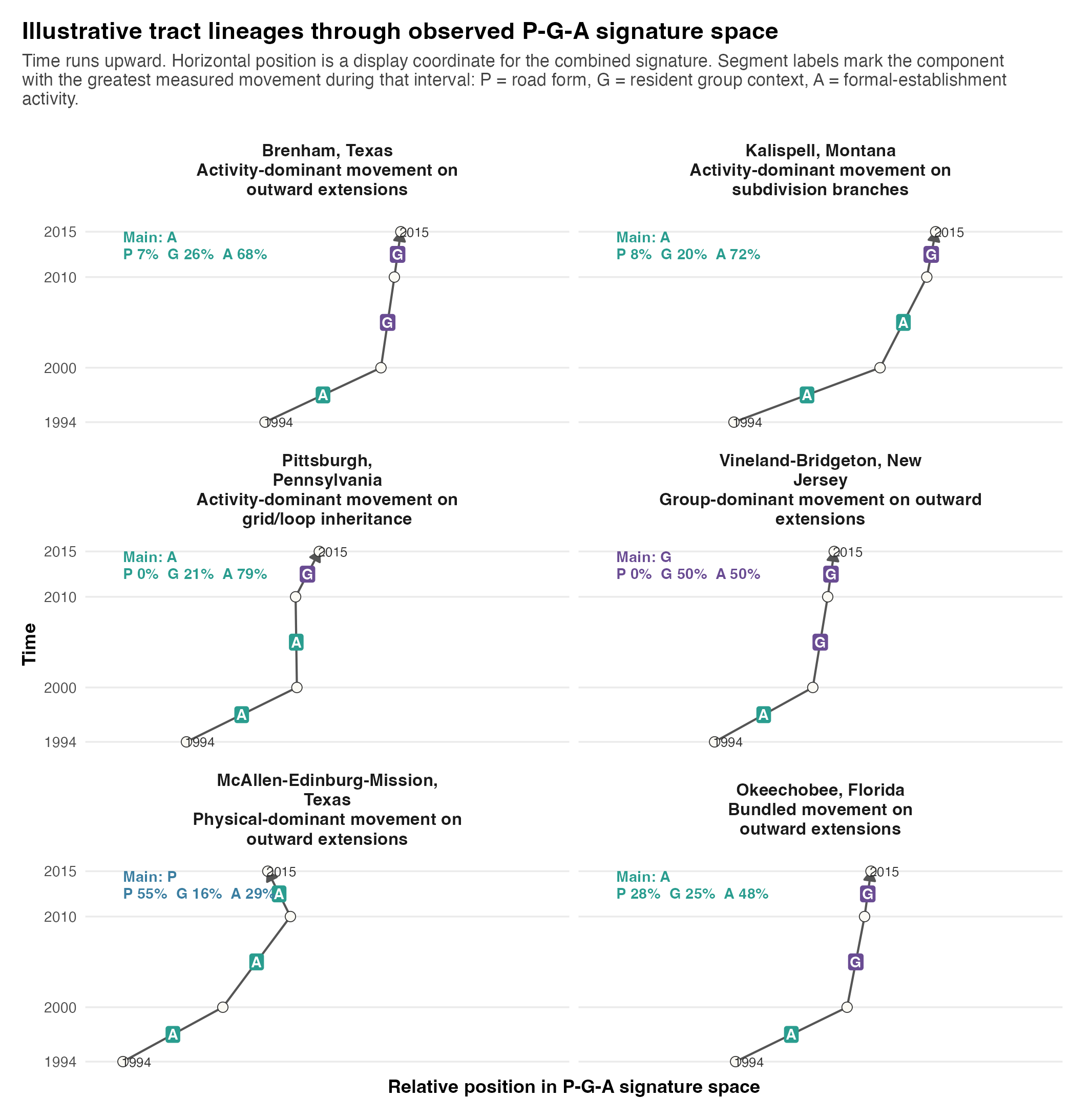
Figure 6. Vignette lineages through signature space. The lineages show selected tracts moving through P-G-A signature space. Brenham, Kalispell, and Pittsburgh illustrate
activity-profile movement in different physical containers; Vineland-Bridgeton illustrates
group movement; McAllen-Edinburg-Mission illustrates a rare physical-movement case.
The vignettes clarify the stable-container result. Brenham, Texas, is classified as activity- led movement in an outward road container, with movement shares of 0.07 for P, 0.26
for G, and 0.68 for A. Kalispell, Montana, shows activity-led movement on a subdivision fabric, with shares of 0.08, 0.20, and 0.72. Pittsburgh, Pennsylvania, shows activity-led
movement on inherited grid and loop fabric, with shares of 0.00, 0.21, and 0.79. These are not interchangeable places. They show that the same component movement family can
appear in different physical terrains, and that different terrains can serve as containers for
changed formal-establishment profiles. The implication for TUEM is a bounded stable-container claim. TUEM’s retention language is useful because it distinguishes physical survival from full signature stabil- ity. A stable road container can be associated with changing establishment activity or
changing resident composition; that is the empirical basis for interpreting possible reuse and recoding. The claim is bounded because the evidence observes road form, resident composition, and formal establishments. It does not directly observe property regimes, zoning decisions, institutional control, building-level reuse, or lived meanings. Those
mechanisms are plausible routes of recoding, but they require additional data before they
can be treated as tested.
4.6 Measurement and Prediction Checks
Because classification alone is insufficient evidence, the analysis uses three sensitivity
checks to ask how much of the result survives beyond the preferred typology.
The first sensitivity check concerns the activity proxy. Tract-level activity is allocated
from ZIP/ZCTA business records, so the paper checks whether the main activity-moving
classification is confined to poor geography matches. It is not. Across trajectory classifica-
tions grouped by tract-ZCTA quality, the activity-led share is 74.1 percent in high-coverage
cases, 74.7 percent in lower-coverage cases, and 71.7 percent where coverage is unavailable; retained/stable shares are 23.6, 22.4, and 25.8 percent respectively. A stricter geography-
support frame, requiring total tract-area coverage of at least 0.95 and largest single-ZCTA overlap of at least 0.90, contains 1,949 rows across 276 CBSAs, with median tract-area coverage and median largest-ZCTA support both at 100.0 percent. These checks do not
prove building-level activity, but they reduce the concern that the activity result is only an
artifact of diffuse ZCTA allocation.
The second sensitivity check concerns threshold dependence. The P-G-A classification was recalculated across retained path-length cutoffs of 20, 25, 30, and 33 percent and
activity-share cutoffs of 0.45, 0.50, 0.55, and 0.60. Across the 16 combinations, the activity- led share ranges from 41.4 percent to 73.7 percent and the retained/stable share ranges
from 25.0 percent to 50.0 percent. This is a real sensitivity, not a nuisance detail. The robust
statement is that activity-profile movement and retained/stable histories remain the two
dominant families across plausible cutoffs, while their exact shares should not be treated
as natural constants. The third sensitivity check asks whether bundled P-G-A context improves held-out
prediction over physical-only baselines. The outcomes are shares or share-like differences on a 0-1 scale, so the RMSE changes are small in absolute units but still interpretable as percentage improvements over the baseline error. In county-blocked high-coverage
checks, bundled signatures improve RMSE for the persistence-reproduction gap by 0.0174,
about 2.8 percent, and for persistence share by 0.0165, about 3.2 percent. Reproduction
alignment does not improve. In the stricter activity-geography valid-built-maturity frame,
direct-gap predictive gains are not positive. The predictive evidence therefore strengthens the paper only in a bounded way: it shows modest incremental information from group
and formal-establishment context in some high-coverage retention/gap comparisons, but
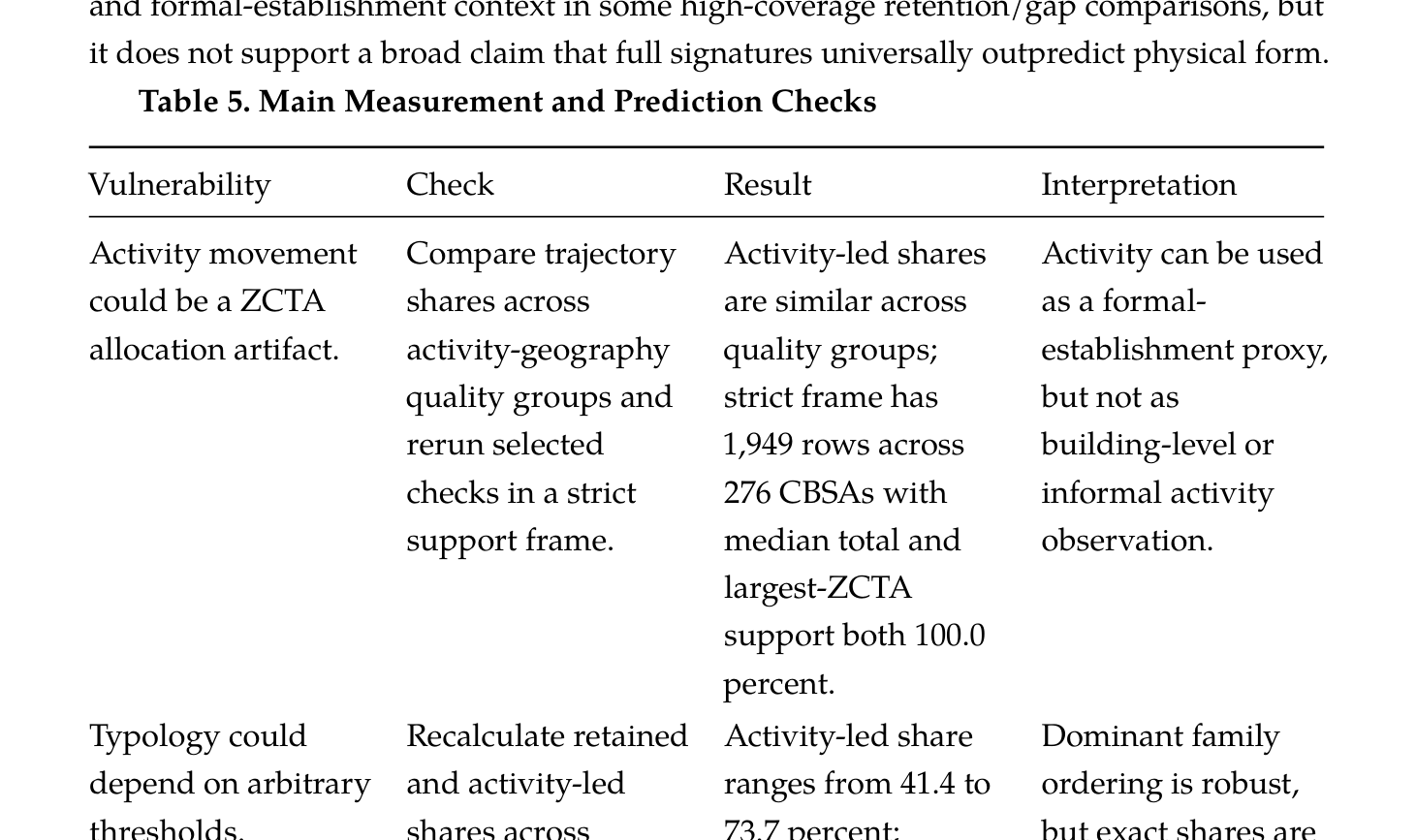
it does not support a broad claim that full signatures universally outpredict physical form.
Table 5. Main Measurement and Prediction Checks
Vulnerability Check Result Interpretation
Activity movement
Compare trajectory
Activity-led shares
Activity can be used
could be a ZCTA
shares across
are similar across
as a formal-
allocation artifact.
activity-geography
quality groups;
establishment proxy,
quality groups and
strict frame has
but not as
rerun selected
1,949 rows across
building-level or
checks in a strict
276 CBSAs with
informal activity
support frame.
median total and
observation.
largest-ZCTA
support both 100.0
percent.
Activity-led share
Dominant family
Typology could
Recalculate retained
ranges from 41.4 to
ordering is robust,
depend on arbitrary
and activity-led
73.7 percent;
but exact shares are
thresholds.
shares across
retained/stable
threshold-
retained cutoffs of
share ranges from
dependent.
20-33 percent and
25.0 to 50.0 percent.
activity-share
cutoffs of 0.45-0.60.
Vulnerability Check Result Interpretation
Predictive
Bundled P-G-A
Compare held-out
High-coverage
context might add
prediction against
county-blocked
increment is modest
no independent
physical-only
RMSE gains are
and conditional, so
information.
baselines.
0.0174 for the
prediction is a
persistence-
sensitivity check
reproduction gap
rather than a central
and 0.0165 for
validation claim.
persistence share;
reproduction
alignment and strict
direct-gap
prediction are not
positive.
4.7 A Failed Selection Claim: Activity Saturation Does Not Broadly Predict Substitution
The final test examines a more specific selection claim: saturated activity packages should
weaken same-form reproduction and select substitutes or hybrid forms. Saturation means prior formal-establishment concentration or density in the observed activity profile. A substitute outcome means later movement away from the prior activity package rather
than reproduction of that package. A hybrid outcome means a later package that combines inherited and alternative activity patterns rather than simply repeating or replacing the
prior form. The intuition is plausible: where an activity profile is already dense or saturated,
later development might be more likely to shift into substitute or hybrid forms rather than
reproduce the same package. The observable implication is a positive association between
activity saturation and substitute or hybrid outcomes after the relevant physical-pathway
context is included.
The results do not support that broad implication. In the tract transition design using
1,995 transitions across 146 CBSAs, the coefficient for saturation on the substitute outcome is negative, -0.304, with p = 0.006. For the broader substitute-or-hybrid outcome, the
coefficient is -0.052 with p = 0.534. The observed share of substitute-or-hybrid outcomes
falls from 0.434 in the first saturation quartile to 0.345 in the fourth quartile. In the industry- code-consistent trajectory specification, which avoids comparisons across incompatible
SIC and NAICS periods, the saturation coefficient is 0.070 with p = 0.737, while inherited
physical pathway structure is far more predictive. An alternative competing specification

gives a similarly null saturation estimate, 0.057 with p = 0.612.
Table 6. Activity Saturation and Substitute/Hybrid Outcomes
Saturation
pathway
Test frame Sample
estimate
estimate Result
Direct
1,995 transitions;
Substitute:
Not focal in
No broad
transition
146 CBSAs
-0.304, p =
this summary
positive
0.006;
saturation
substitute-or-
effect.
hybrid: -0.052,
p = 0.534
Industry-code-
2,083 rows; 368
0.070, p =
Base
Physical
consistent
CBSAs
0.737
connector:
pathway
-1.082, p <
dominates
0.001
saturation.
Alternative
2,085 rows; 369
0.057, p =
Base connector
Null
specification
CBSAs
0.612
share: 0.371, p
saturation
< 0.001
result persists.
The saturation claim is therefore not supported as a general mechanism in these data. Saturation may still matter in narrower activity families, in specific regulatory environ-
ments, or at building, parcel, or corridor scales that this paper cannot observe. The broad claim that formal-establishment saturation selects substitute or hybrid tract outcomes is not sustained by the tract-level tests, so the mechanism requires narrower formulation
before it can function as an empirical selection claim.
5. Discussion
The analysis supports the value of TUEM as a claim-generating model while narrowing several of its claims. The main lesson is that trajectory classification provides a tractable operationalization and a way to learn from proxies, not a full validation of the model. Physical road histories can be grouped into meaningful terrain families, and those ter- rain families do not determine the whole urban-evolution interpretation. Once group and formal-establishment activity histories are added, outward extensions, subdivision
branches, stitched infill, inherited grids, and hybrid terrains cross with retained, activity-
profile-moving, group-moving, and coupled paths. This finding deepens the meaning of the formeme while also disciplining what can
be claimed from the data. A formeme is not a road shape with demographic and activity variables appended after the fact. It is a relational unit in which physical organization,
activities, and groups jointly define the urban object being compared. The evidence shows
why that matters: activity-profile movement on outward extensions, retained/stable pack-
ages on outward extensions, and activity-profile movement on stitched infill have different descriptive meanings even when they share parts of the same physical vocabulary. The
evidence does not, by itself, show the local mechanisms that produced those histories.
The component-durability findings also refine TUEM. Physical form is often durable, and in the two largest trajectory families the median physical movement share is zero.
Durability is nevertheless not a universal hierarchy. Activity and group components can
be the principal observed movement in a tract history, and coupled movement appears in
smaller families that merit more detailed study. The resulting formulation is conditional:
physical form often constrains and carries urban evolution, while the relative pace of P, G,
and A depends on pathway, period, measurement cadence, and scale.
The expansion/recombination result gives TUEM a sharper empirical vocabulary for
variation. Outward extension, subdivision branching, stitched infill, grid/loop inheritance,
and branch-and-stitch hybrids are not merely visual types. They are measurable pathways
through which road form is extended, connected, repeated, or recombined. This distinc-
tion matters because activity-profile or resident-composition movement can occur within several of those pathways. A tract can change its formal-establishment profile without a large measured road-form movement, and the same physical terrain can carry different group and activity histories. The permutation result keeps this claim at the right level: it supports a descriptive classification of cross-cutting histories, not a strong claim that
physical terrain sorts group and activity trajectories.
The unsupported saturation claim is equally important. In a claim-generating model, plausible mechanisms are not confirmed by plausibility alone. The activity-saturation claim is theoretically intelligible, but the broad tests do not show that saturation selects
substitute or hybrid tract outcomes. In these data, inherited physical pathway structure is
more informative than the broad saturation measure. This result returns a more constrained
research question to TUEM: saturation may need to be specified by activity family, spatial scale, regulatory setting, or local market structure before it becomes a testable selection
mechanism.
The sensitivity checks also change the weight placed on the evidence. High-coverage
and county-level checks support the activity layer as a usable formal-establishment proxy,
but they do not validate address-level activity or informal use. Threshold checks show that
the broad ordering of activity-profile-moving and retained/stable histories is robust, while
exact family shares remain design-dependent. Held-out prediction supplies only modest
and inconsistent incremental gains. These results define the paper’s inferential contribution: they show where the operationalized claims are robust, bounded, or unsupported. The paper points toward a larger claim space without treating this first operationalization as decisive. TUEM is not a closed list of hypotheses. It is a way to generate claims from
a formal language of physical organization, group context, activity content, signature
distance, trajectory, selection, retention, recoding, and scale. A mature empirical program
can systematically explore the possibility space allowed by TUEM’s formal structure.
6. Limitations and Future Directions
The tests in this paper are necessarily proxy-based. That is not unusual in urban research, where physical form, activity, and social composition are observed through different institutions and at different spatial and temporal resolutions. In this design, proxy use is also part of the object of inquiry: the paper asks what happens when TUEM concepts
are forced into available empirical traces. The results should therefore be read as tests of observable traces of TUEM signatures, not as direct observation of complete formemes. The physical component is strongest for road networks and built timing, but it does not
fully observe parcels, buildings, zoning, transit, utilities, ownership, infrastructure quality,
or design form. The group component describes residents better than all users, workers,
owners, visitors, institutions, or political actors. The activity component describes formal establishments better than informal work, household routines, visitor activity, online
activity, institutional practice, or the meanings attached to places by users. The activity layer deserves special caution because it carries much of the empirical
movement in the main typology. ZBP and CBP provide unusually broad repeated evidence on formal establishments, and the paper reports tract-ZCTA support and county and metropolitan validation checks. Those checks make the activity proxy usable, but they do not remove every ecological and scale problem. ZIP and ZCTA geographies are not
tract geographies, and strong county or CBSA agreement does not prove that every tract- level activity profile is observed without error. Future work should validate the activity component against independent local land-use, parcel, licensing, employment, mobility,
or establishment-register data in selected metropolitan areas. The paper’s strongest supported claims are classification and measurement claims. Road histories form meaningful terrain families; P-G-A movement histories distinguish
retained, activity-led, group-led, physical-led, and coupled paths; and the crossed typology
shows why physical terrain alone is incomplete. These results are useful, but they should not be mistaken for causal identification. Some findings also depend on the construc-
tion of the typology. For example, activity-profile movement is defined from component movement shares, and the recoding interpretation then rests on reading that classifica-
tion against stable physical containers. The paper therefore treats recoding as a bounded association between low measured physical movement and higher measured group or
establishment-profile movement, not as proof of the mechanisms that produced reuse.
Measurement cadence is another limit. Roads and built maturity are slow-moving and
partly historical; census and ACS data are periodic; ZBP is annual only from 1994 onward.
These differences can make physical form appear more durable and activity more mobile. The robustness checks show that the broad activity-led and retained/stable distinction
survives several threshold choices, but the exact family shares remain threshold-dependent. Future work should test the same claims in designs where physical, social, and activity
observations are more closely synchronized, and should report classification uncertainty around each trajectory family rather than treating the preferred labels as fixed natural
kinds.
The same-terrain result is intentionally modest. The crossed typology shows that the
same road terrain can appear with different group and activity histories, but the shuffled-
context check does not support a strong terrain-to-context sorting mechanism. That result
is still useful because it prevents a physical-only interpretation of urban evolution, but it is not evidence that particular terrains systematically select particular group or activity
trajectories. A stronger test would need predictive or out-of-sample designs: for example, asking whether road terrain improves prediction of future activity or group movement after baseline metropolitan context, prior activity mix, and tract social composition are
included.
Several extensions follow directly from these limits. First, richer parcel, building, zoning,
transit, ownership, tax-assessment, business-license, and mobility data would allow more direct tests of physical and regulatory mechanisms. Second, saturation and substitution should be tested within specific activity families and institutional settings rather than through one broad formal-establishment saturation measure. Third, rare coupled and
physically led trajectories require finer lineage studies because national tract counts are too
small for stable family-level interpretation. Fourth, selected case validations could compare
the typology against known redevelopment corridors, industrial conversions, commercial
suburbanization, or downtown reinvestment episodes. Fifth, comparative datasets outside the United States would show whether similar observable-implication tests hold under
different planning regimes, property systems, and urban histories. These directions preserve the main lesson of the paper. TUEM is most useful when
it disciplines empirical work: define the model claim, specify the observable implication,
measure the available traces, test the pattern, and then narrow or reject claims that the data
do not support. Proxies do not make such tests invalid; they make the scope of inference
explicit. The next stage is to join the broad national evidence used here with deeper local
evidence that can test the mechanisms behind the classifications.
7. Conclusion
This paper operationalized central features of the Toronto Urban Evolution Model by translating them into observable claims about signatures and trajectories. The main evi-
dence came from linked physical, group, and formal-establishment activity records for U.S.
census tracts and metropolitan areas. The analysis asked whether present physical form is enough to classify urban evolution, whether components differ in relative durability, whether expansion and recombination are distinct pathways, whether similar physical
terrains can carry different group and activity histories, whether stable physical containers
are paired with activity-profile or resident-composition movement, and whether activity
saturation selects substitute or hybrid outcomes.
The results support a trajectory-centered descriptive interpretation. Road histories form
recurrent terrain families, but those physical pathways are crossed by different group and
activity histories. Activity-profile movement is widespread across several physical terrains;
retained/stable pathways are visible but not identical to full signature immobility; group- led and coupled movement appear as smaller families; and stable physical containers can carry changed formal-establishment profiles. The same-terrain result is descriptive rather than a strong sorting-mechanism finding. Physical form is often durable, but its
durability is conditional. Activity-proxy and threshold checks strengthen the measurement
case while confirming that exact family shares and predictive gains remain bounded. The
broad saturation-to-substitution claim is not supported.
The paper’s larger claim is that TUEM becomes scientifically useful when it is treated as
a claim-generating model whose claims can fail, narrow, or become merely descriptive un-
der available evidence. Its concepts make empirical demands: define the formeme, measure
the signature, classify the trajectory, specify the observable implication, distinguish classi-
fication from validation, and accept narrowing or rejection when the evidence requires it.
That discipline is what allows urban evolution to be studied neither as a loose metaphor
nor as a physical morphology alone, but as a linked history of material form, groups, and
activities. The contribution is to make that chain explicit: model terms are translated into
proxies, tested against observable patterns, and narrowed when the evidence requires it.
Appendix A. Claim Sequence Used in the Main Text
This appendix restates the paper’s main claim sequence in compact form. The claims are the ones that the linked road, resident-composition, and formal-establishment evidence
can evaluate directly in this manuscript.
Claim Evidence type Theory claim
implication Result
Road histories
Trajectory
Constructed
Places with
Supported as a
should form
classification
classification
similar present
road-history
recurrent
signatures can
classification,
trajectory
have different
not as
evolutionary
independent
families that are
meanings.
mechanism
not reducible to
validation.
one present-
morphology
continuum.
Conditional
Descriptive
Physical form is
Physical
Narrowed:
component
empirical
movement
durable but
physical form is
durability
pattern
should often be
partial.
often stable, but
lower than
no universal
group or
slowest-
activity
component law
movement, but
is supported.
the test allows
the slowest
component to
vary by
pathway and
window.
Expansion
Constructed
Road
Outward
Supported as a
versus
classification
connector/infill
extension,
terrain
recombination
synthesis
subdivision
classification:
differs from
branching,
outward
terminal or
stitched infill,
extension,
outward
inherited
stitched infill,
expansion.
connected
subdivision
layouts, and
branching, and
hybrid cases
hybrid paths
should have
are empirically
different
separable.
road-terrain
profiles.
Claim Evidence type Theory claim
implication Result
Descriptive
Similar
Supported only
Same terrain,
A physical
as descriptive
classification
physical forms
different
terrain family
plus null
can be paired
classification:
bundled
should appear
benchmark
with different
permutation
histories
with more than
checks do not
one P-G-A
observed group
support a
movement
and activity
history, while a
histories.
stronger terrain-
sorting claim
to-context
would require
sorting claim.
association
beyond
shuffled
context.
Stable
Descriptive
Existing
Stable or
Supported with
containers with
association and
physical form
low-moving
scope limits:
activity-profile
construct-
can restrict
road containers
activity-profile
movement
validity target
change, absorb
should
movement
new
sometimes be
through stable
group/activity
paired with
road containers
patterns, or
substantial
is recurrent, but
become
group or
mechanisms
decoupled from
activity
such as zoning,
changing G/A.
movement.
ownership, and
building-level
reuse are not
directly
observed.
Claim Evidence type Theory claim
implication Result
Not supported
Activity
Activity
Mechanism-
Saturated
as a broad
saturation
saturation and
like selection
activity
mechanism:
should be
substitution
test
packages
saturation
positively
should weaken
coefficients are
associated with
same-form
substitute or
reproduction
null or contrary,
hybrid
and select
while physical
outcomes after
substitute or
pathway
physical-
hybrid forms.
context is more
pathway
predictive.
context is
included.
The sequence keeps the paper’s empirical burden clear: classify trajectories; compare component movement; distinguish physical pathways; cross physical pathways with group and activity histories; interpret possible recoding within stable containers only
as a bounded trace; and test a more specific selection claim that fails under the observed
design.
Appendix B. Activity Proxy and Alignment Support
The activity layer is built from ZIP Code Business Patterns (ZBP) and County Business
Patterns (CBP), which observe formal establishments and employment by industry. These records are used because TUEM requires an activity component and because federal
business registers provide repeated, comparable, geographically linkable observations of
establishment activity. The measure does not observe informal work, household routines,
visitor behavior, online activity, institutional practice outside establishment records, or the
meaning that users attach to places. At the tract-ZCTA level, the annual panel covers 1994-2023. Median high-coverage tract-year support is 95.9 percent, and median high-or-usable support is 97.7 percent. In
the tract allocation used for the analysis, 97.0 percent of tract-ZCTA records have at least
95 percent areal support, with a median largest single-ZCTA share of 96.9 percent. These
figures indicate that most tract records are linked to a dominant ZCTA geography rather
than being assembled from highly diffuse overlaps.
County and metropolitan checks compare constructed activity-family profiles against
CBP records at coarser geographies where direct federal records are available. The CBSA
validation includes 391 metropolitan or micropolitan records. Weighted correlations are 0.981 for the local-service profile, 0.958 for the production/distribution profile, 0.977 for the office profile, and 0.941 for activity entropy. The county validation includes 3,129
matched counties for profile measures and 606 retention-frame counties. In the retention frame, weighted correlations are 0.986 for the local-service profile, 0.973 for the produc-
tion/distribution profile, 0.985 for the office profile, and 0.938 for activity entropy.
Table B1. Activity-Proxy Validation Summary
Validation check Sample Main readout Interpretation
Annual
1994-2023; median 16,807
The annual
tract-ZCTA panel
tracts and 401 CBSAs per
high-coverage
activity panel has
year
share 95.9%;
broad coverage
median
across the tract
high-or-usable
frame.
share 97.7%
Tract-ZCTA areal
16,808 tracts; 401 CBSAs 97.0% of records
Most tract activity
support
have at least 95%
allocations are not
areal support;
highly fragmented
median largest
across ZCTAs.
ZCTA share 96.9%
CBSA profile
391 CBSAs Weighted
Constructed CBSA
validation
correlations
activity profiles
0.941-0.981 for
align closely with
main profile and
CBP benchmarks.
entropy measures
County profile
3,129 matched counties Weighted
County
validation
correlations
comparisons
0.923-0.991 for
support the
main profile and
activity-family
entropy measures
construction.
The subset used
Retention-frame
606 counties Weighted
for
county validation
correlations
retention-related
0.938-0.986 for
checks retains
local-service,
strong
produc-
activity-profile
tion/distribution,
alignment.
office, and entropy
profiles
The paper therefore uses activity claims with three restrictions. First, activity means formal-establishment activity unless otherwise specified. Second, local annual activity timing begins in 1994, so earlier local activity claims are not inferred from ZBP. Third, activity movement is interpreted at the scale of the available crosswalk, not as a direct
observation of building-level use.
Appendix C. Trajectory Construction and Classification
The trajectory-terrain analysis uses 16,808 tract histories across 401 CBSAs. Its source
records are a tract signature panel, a longitudinal P-G-A distance panel, and a multiyear
tract-ZCTA activity panel. The physical terrain classification is built from road-history mea-
sures that describe how new road length relates to the prior network: branch share, strict
subdivision-style branching, connector/infill stitching, outward extension, and inherited
grid or loop structure. A physical terrain family is an empirical summary of road-building history. The in- puts are road-kilometer-weighted measures: branch_share is the broad terminal or
branching share; strict_subdivision_share is the short-terminal subdivision proxy;
stitching_share is the connector and infill share; outward_share is the clipped
sum of edge extension and isolated leapfrog share; grid_fragment_share is the grid-
fragment proxy; and loop_mesh_share is the loop or mesh proxy. The classification rule
is:
[] if branch_share >= 0.58 and strict_subdivision_share >= 0.10: terrain_family = "Subdivision branches" else if stitching_share >= 0.72 and branch_share < 0.55: terrain_family = "Stitched infill" else if outward_share >= 0.55 and stitching_share < 0.55: terrain_family = "Outward extensions" else if grid_fragment_share >= 0.30 and loop_mesh_share >= 0.45: terrain_family = "Grid/loop inheritance" else if branch_share >= 0.55 and stitching_share >= 0.60: terrain_family = "Branch-and-stitch hybrids" else: terrain_family = "Mixed incremental change"
The families therefore describe observed road-network pathways rather than neigh- borhood types. Outward extensions have high outward shares. Stitched infill has high
connector/infill shares. Subdivision branches have high branch shares and subdivision- style terminal structure. Grid/loop inheritance identifies connected layouts that persist
or recur. Branch-and-stitch hybrids combine substantial branching with substantial later
stitching. Mixed incremental change identifies tracts without one dominant road-building
form.
P-G-A movement families are constructed after physical, group, and activity distances
are aligned within a comparison frame. The generic component-share calculation is:
[] P_share_i = P_distance_i / (P_distance_i + G_distance_i + A_distance_i) G_share_i = G_distance_i / (P_distance_i + G_distance_i + A_distance_i) A_share_i = A_distance_i / (P_distance_i + G_distance_i + A_distance_i)
where the distances are scaled within the relevant comparison frame before shares
are interpreted. Retained/stable classification uses total path length as well as component
shares. A retained/stable row can therefore have a high activity share if the total movement
path is short. In the main results, retained/stable rows have a median path length of 0.044,
compared with 0.076 for the activity-led category.
The component-family rule is:
[] total_component_path_i = P_distance_i + G_distance_i + A_distance_i P_share_i = P_distance_i / total_component_path_i G_share_i = G_distance_i / total_component_path_i A_share_i = A_distance_i / total_component_path_i suddenness_i = maximum single-period step_i / total signature path_i path_intensity_i = quartile(total signature path_i)
if total signature path_i <= 25th percentile: movement_family = "retained/stable" else if A_share_i >= 0.50: movement_family = "A-led activity movement" else if P_share_i >= 0.50: movement_family = "P-led physical movement" else if G_share_i >= 0.50: movement_family = "G-led group movement" else if P_share_i >= 0.25 and A_share_i >= 0.25 and G_share_i >= 0.20: movement_family = "bundled P-G-A movement" else if P_share_i >= 0.30 and A_share_i >= 0.30: movement_family = "P-A coupled movement" else if G_share_i >= 0.30 and A_share_i >= 0.30: movement_family = "G-A coupled movement" else if P_share_i >= 0.30 and G_share_i >= 0.30: movement_family = "P-G coupled movement" else: movement_family = "mixed component movement"
The retained/stable rule is evaluated before component-dominance rules, so tracts with
short total paths are not classified as activity-led or group-led only because one component
has a large share of a very small denominator. The suddenness and path-intensity measures
describe trajectory shape and magnitude; they are not used to change the family labels in
the main typology.
The classification is descriptive rather than causal. It states which observed component
accounts for most measured movement, not why that movement occurred. For example, the activity-led category identifies tract histories in which formal-establishment activity
moves more than road form or resident composition. It does not assert that establishments
caused the road container to persist.
Table C1. Main Trajectory Classification Ingredients
Reader
Classification object Unit Main ingredients
interpretation
Describes how the
Physical terrain
Tract history Branch share, strict
road network
family
subdivision share,
changed.
connector/infill
share, outward
share, grid/loop
inheritance
P-G-A movement
Tract history with
Scaled physical,
Describes which
family
aligned components
group, and activity
part of the observed
distances; total path
signature moved
length
most.
Rich trajectory type Tract history Physical terrain
Describes how road
family crossed with
history and
signature movement
P-G-A movement
combine.
family
Vignette lineage Selected tract Sequence of P-G-A
Shows how the
states and
typology appears in
component-
concrete places.
dominant segments
Appendix D. Robustness and Sensitivity Checks
The robustness checks are designed around the claims made in the main text. They do not convert the paper into a causal design. They ask whether the descriptive classifications
and evidentiary conclusions are fragile to obvious measurement objections.
The first check concerns conditional component durability. Raw distances make physical
form appear slowest in 69.7 percent of rows, while group context is slowest in 11.0 percent
and activity in 19.3 percent. After standardized calibration, the slowest-component shares
become more balanced: physical form 37.9 percent, group context 28.6 percent, and activity
33.5 percent. This is why the main text reports physical durability as real but not universal. Direct physical-persistence checks point in the same direction: in lineage states, median
relative road-kilometer change is 0.15 percent, 83.7 percent of cases have road-kilometer
change under 5 percent, and connector, loop, and grid shares are all under 5 percentage-
point change in the checked cases. The second check concerns threshold sensitivity. The trajectory classifications were
recalculated across retained path-length cutoffs of 20, 25, 30, and 33 percent and activity-led
share cutoffs of 0.45, 0.50, 0.55, and 0.60. Across the 16 combinations, the activity-led share ranges from 41.4 percent to 73.7 percent and the retained/stable share ranges from 25.0 percent to 50.0 percent. The broad conclusion is stable: activity-led and retained/stable pathways remain the two dominant families, although their exact shares depend on the
chosen cutoffs. This supports the qualitative classification while preventing the paper from
treating one threshold as a natural law.
The third check concerns same-terrain classification. If physical terrain alone organized
the bundled history, most observations within a physical cluster would fall into the same P-
G-A movement family. The observed off-dominant share is 51.7 percent, meaning that just
over half of observations fall outside the dominant bundled family for their physical cluster. A shuffled-context null gives an off-dominant share of 53.1 percent, normalized mutual
information of 0.399, and variation of information of 2.860, compared with observed values
of 0.427 and 2.720. The observed classification therefore shows cross-cutting histories, but it
does not exceed the shuffled baseline enough to support a strong terrain-to-context sorting
claim. This is why the same-terrain result is reported as descriptive classification evidence
rather than as an independent mechanism test.
The fourth check concerns ZCTA activity-geography quality. Trajectory classification shares are similar across high-coverage and lower-coverage tract-ZCTA groups. High- coverage cases have an activity-led share of 74.1 percent and a retained/stable share of 23.6 percent. Lower-coverage cases have an activity-led share of 74.7 percent and a
retained/stable share of 22.4 percent. Coverage-unavailable cases have an activity-led share
of 71.7 percent and a retained/stable share of 25.8 percent. The main trajectory distinction
is therefore not driven only by the highest-coverage ZCTA matches. The fifth check uses a stricter activity-geography support frame. This frame requires
median tract-ZCTA area coverage of at least 0.95, total tract-area coverage of at least 0.95,
and largest single-ZCTA overlap of at least 0.90. It contains 1,949 rows across 276 CBSAs,
equal to 29.7 percent of high-activity-coverage rows, with median tract-area coverage and
median largest single-ZCTA support both at 100.0 percent. In that strict frame, common-
frame retention models still show positive base-connector estimates for persistence share, reproduction alignment, and the persistence-reproduction gap, but held-out predictive increments are not consistently positive. This supports activity matching as usable for
formal-establishment profiles while preventing the paper from using prediction as a central
validation claim.
The sixth check asks whether P-G-A context improves held-out prediction over physical-
only baselines. In county-blocked high-coverage checks, bundled signatures improve RMSE for persistence share by 0.0165, about 3.2 percent, and for the persistence-reproduction
gap by 0.0174, about 2.8 percent; reproduction alignment does not improve. In direct-gap
checks using stricter activity geography and valid built-maturity rows, predictive gains
are not positive. The implication is that bundled P-G-A context contains some incremental information in selected high-coverage retention/gap comparisons, but the paper should
not claim universal out-of-sample superiority over physical form.
Table D1. Robustness Summary for the Main Trajectory Claims
Implication for the
Issue Check Main result
paper
Component pace
Raw and
Raw
Component
scale
standardized
physical-slowest
durability is stated
slowest-component
share 69.7%;
conditionally, not as
shares
standardized
a universal
physical-slowest
physical-slowest
share 37.9%
law.
Direct physical
Road-kilometer and
Median relative
Physical persistence
persistence
connec-
road-km change
is visible in direct
tor/grid/loop
0.15%; 83.7% under
road measures.
5% road-km change
stability
Trajectory
Retained cutoffs
Activity-led and
The typology is
thresholds
0.20-0.33;
retained/stable
useful, but exact
activity-led cutoffs
remain dominant,
family shares are
but shares vary by
threshold-
0.45-0.60
cutoff
dependent.
Same-terrain
Shuffled-context
Observed
The same-terrain
classification
permutation check
off-dominant share
result is descriptive
51.7%; null 53.1%;
classification
observed NMI 0.427;
evidence, not a
null NMI 0.399
strong
sorting-mechanism
result.
Activity-geography
High-coverage
Activity-led share
Main trajectory
74.1% in
classification is not
quality
versus
lower-coverage
high-coverage cases
confined to the
and 74.7% in
cleanest
ZCTA support
activity-geography
lower-coverage
cases
matches.
Implication for the
Issue Check Main result
paper
1,949 rows across
Strict activity
Total tract-area
Activity matching
276 CBSAs; median
geography
coverage >= 0.95
can be defended as
total and
and largest
a formal-
largest-ZCTA
single-ZCTA
establishment proxy,
support >= 0.90
support both 100.0%
but not as
building-level
activity observation.
Held-out prediction County-blocked and
High-coverage
Prediction is a
CBSA-blocked
county-blocked
sensitivity check,
comparisons against
RMSE gains are
not a central
modest for
validation claim.
physical-only
persistence share
baselines
and persistence-
reproduction gap;
strict direct-gap
prediction is not
positive
Appendix E. Activity Saturation Models
The saturation models test whether saturated activity packages select substitute or hybrid
forms. The claim expects saturation to be positively associated with substitute or hybrid outcomes after relevant physical-pathway context is included. In simplified form, the
model is:
[] Substitute_or_hybrid_i = alpha + beta_1 saturation_i + beta_2 physical_pathway_i + gamma X_i + epsilon_i
where saturation_i measures prior formal-establishment saturation, physical_pathway_i records inherited road-pathway context, and X_i contains the additional covariates used in the relevant specification. The claim expects beta_1 > 0. Across the direct
transition design, the industry-code-consistent specification, and the alternative competing
specification, beta_1 is null or contrary. The result is therefore classified as unsupported
rather than weakly supported.
Table E1. Activity Saturation and Substitute/Hybrid Outcomes
Saturation
pathway
Test frame Sample
estimate
estimate Result
Direct
1,995 transitions;
Substitute:
Not focal in
No broad
transition
146 CBSAs
-0.304, p =
this summary
positive
0.006;
saturation
substitute-or-
effect.
hybrid: -0.052,
p = 0.534
Industry-code-
2,083 rows; 368
0.070, p =
Base
Physical
consistent
CBSAs
0.737
connector:
pathway
-1.082, p <
dominates
0.001
saturation.
Alternative
2,085 rows; 369
0.057, p =
Base connector
Null
specification
CBSAs
0.612
share: 0.371, p
saturation
< 0.001
result persists.
The negative or null saturation coefficients do not imply that saturation is irrelevant in
every urban context. They show that the broad tract-level formal-establishment saturation
measure does not select substitute or hybrid outcomes in the tested designs. Future tests should specify saturation by activity family, spatial scale, regulatory environment, and
building or parcel context.
The model information needed to evaluate this negative result is summarized here be-
cause the selection claim is the most mechanism-like test in the paper. The direct-transition frame uses eligible tract transitions with complete saturation, outcome, and physical-
pathway information. The industry-code-consistent frame restricts the comparison to rows that avoid mixing incompatible SIC and NAICS periods. The alternative specification
keeps the same broad selection question but changes the physical-pathway control from
categorical connector context to a continuous base-connector-share specification. All three
tests evaluate whether the saturation coefficient is positive after physical-pathway context
is included; none provides that support.
Table E2. Saturation Model Specification Summary
Test frame Outcome Estimator
predictors Sample rule
readout
Regression
Saturation is
Direct
Substitute
Prior formal-
Complete
negative for
model for
transition
outcome;
eligible
establishment
tract
substitute
substitute-
direct
saturation
transition
and null for
or-hybrid
transitions
and transi-
outcome
substitute-
outcome
with
tion/pathway
or-hybrid.
observed
context
prior
saturation
and later
outcome;
1,995
transitions
across 146
CBSAs
Industry-
Substitute-
Regression
Prior formal-
Rows that
Saturation is
code-
or-hybrid
model for
establishment
avoid
null; base
consistent
outcome
trajectory
saturation
SIC/NAICS
connector is
row
and
period
strongly
outcome
inherited
mixing;
associated
physical
2,083 rows
with the
pathway,
across 368
outcome.
including
CBSAs
base
connector
Alternative
Substitute-
Rival
Prior formal-
Alternative
Saturation is
specification
or-hybrid
regression
establishment
complete
null; base
outcome
specification
saturation
frame; 2,085
connector
and base
rows across
share
connector
369 CBSAs
remains
share
predictive.
The table does not make the saturation analysis causal. It clarifies the estimand and
sample restrictions behind the reported negative result. A stronger future test would add
spatially explicit controls, regulatory and parcel covariates, and standard errors clustered
by metropolitan system or another defensible dependence structure.
Appendix F. Evidence Sources for Figures and Tables
This appendix identifies the evidence sources that support the main displays and appendix
claims. The supplementary manifest lists the source files and checksums. This appendix
summarizes which sources support each main figure, table, and appendix claim.
• Figure 1 and Table 2 use the terrain-family summary and the physical-terrain figure to support the physical-terrain counts and definitions used for trajectory classification
and the expansion/recombination distinction.
• Figure 2 and Table 3 use the P-G-A trajectory-family profile summary and the P-G-A
family count figure to support the component-movement counts used for conditional
durability and trajectory classification.
• Figure 3 uses the component-movement profile figure to show median P, G, and A
movement shares by P-G-A family for the conditional durability claim.
• Figure 4 uses the road-terrain mix figure to show how physical terrain varies across
P-G-A movement families for the expansion/recombination claim.
• Figure 5 and Table 4 use the rich-trajectory type summary and rich-trajectory count figure to support the crossed physical-terrain and P-G-A histories used for the same-
terrain claim.
• Figure 6 uses the lineage-state, segment, and component-movement summaries to support the place-based lineage examples used for the stable-container and activity-

profile movement claim.
• Table 6 and Appendix E use the direct-transition and industry-code-consistent trajectory
summaries to support the unsupported saturation-to-substitution claim.
• Appendix B uses ZBP annual coverage, tract-ZCTA support, CBSA validation, and
county validation summaries to support activity-proxy scope and alignment.
• Appendix D uses component-pace, direct physical-persistence, trajectory-threshold,
same-terrain permutation, and ZCTA-quality summaries to support conditional dura-
bility, same-terrain classification, and trajectory classification.
Data and Materials Availability
A curated reproducibility package accompanies this manuscript as supplementary material. The package includes derived analytical inputs, reproduction scripts, source-data docu-
mentation, reference results, and a file manifest with checksums. It is designed to support evaluation of the manuscript figures, tables, statistical summaries, and appendix results
from cleaned and derived files. It does not rebuild every upstream raw-data extraction from
the original public sources. Raw source datasets are documented in the source-data mani-
fest, including CHRONEX-US, LTDB, Census/ACS, ZIP Code Business Patterns, County
Business Patterns, TIGER tract/ZCTA boundaries, and their access conditions.
References
Batty, Michael. 2007. Cities and Complexity: Understanding Cities with Cellular Automata,
Agent-Based Models, and Fractals. Cambridge, MA: MIT Press.
Batty, Michael. 2008. “The Size, Scale, and Shape of Cities.” Science 319 (5864): 769-771.
https://doi.org/10.1126/science.1151419. Bettencourt, Luis M. A. 2013. “The Origins of Scaling in Cities.” Science 340 (6139):
1438-1441. https://doi.org/10.1126/science.1235823. Bettencourt, Luis M. A., Jose Lobo, Dirk Helbing, Christian Kuhnert, and Geoffrey B. West. 2007. “Growth, Innovation, Scaling, and the Pace of Life in Cities.” Proceed- ings of the National Academy of Sciences of the United States of America 104 (17): 7301-7306.
https://doi.org/10.1073/pnas.0610172104.
Blute, Marion. 2010. Darwinian Sociocultural Evolution: Solutions to Dilemmas in Cultural
and Social Theory. Cambridge: Cambridge University Press. https://doi.org/10.1017/CBO9780511804755.
Boeing, Geoff. 2019. “Urban Spatial Order: Street Network Orientation, Configuration,
and Entropy.” Applied Network Science 4 (1): 67. https://doi.org/10.1007/s41109-019-0189-1.
Brown, Robert. 2013. Explanation in Social Science. Abingdon, UK: Routledge. Originally
published 1963.
Dawkins, Richard. 1982. “Replicators and Vehicles.” In Current Problems in Sociobiology, edited by King’s College Sociobiology Group, 45-64. Cambridge: Cambridge University
Press.
Delmelle, Elizabeth C. 2016. “Mapping the DNA of Urban Neighborhoods: Clustering
Longitudinal Sequences of Neighborhood Socioeconomic Change.” Annals of the American
Association of Geographers 106 (1): 36-56. https://doi.org/10.1080/00045608.2015.1096188. Duranton, Gilles, and Diego Puga. 2001. “Nursery Cities: Urban Diversity, Process
Innovation, and the Life Cycle of Products.” American Economic Review 91 (5): 1454-1477.
https://doi.org/10.1257/aer.91.5.1454.
Fischer, Claude S. 1975. “Toward a Subcultural Theory of Urbanism.” American Journal
of Sociology 80 (6): 1319-1341. https://doi.org/10.1086/225993.
Fox, Mark S., Daniel Silver, and Patrick Adler. 2022. “Towards a Model of Urban Evolu-
tion: Part II: Formal Model.” Urban Science 6 (4): 88. https://doi.org/10.3390/urbansci6040088. Fox, Mark S., Daniel Silver, Thiago Silva, and Xinyi Zhang. 2022. “Towards a Model
of Urban Evolution Part IV: Evolutionary (Formetic) Distance - An Interpretation of Yelp
Review Data.” Urban Science 6 (4): 86. https://doi.org/10.3390/urbansci6040086. Hull, David L. 1981. “Units of Evolution: A Metaphysical Essay.” In The Philosophy of
Evolution, edited by U. J. Jensen and R. Harre, 23-44. Brighton: Harvester Press.
Jacobs, Jane. 1969. The Economy of Cities. New York: Random House.
Logan, John R., Zengwang Xu, and Brian J. Stults. 2014. “Interpolating U.S. Decennial
Census Tract Data from as Early as 1970 to 2010: A Longitudinal Tract Database.” Professional
Geographer 66 (3): 412-420. https://doi.org/10.1080/00330124.2014.905156.
Marshall, Stephen. 2009. Cities Design and Evolution. Abingdon, UK: Routledge.
Mehmood, Abid. 2010. “On the History and Potentials of Evolutionary Metaphors in
Urban Planning.” Planning Theory 9 (1): 63-87. https://doi.org/10.1177/1473095209346495.
Mesoudi, Alex, Andrew Whiten, and Kevin N. Laland. 2004. “Perspective: Is Human
Cultural Evolution Darwinian? Evidence Reviewed from the Perspective of The Origin of
Species.” Evolution 58 (1): 1-11. https://doi.org/10.1111/j.0014-3820.2004.tb01568.x.
Portugali, Juval. 2000. Self-Organization and the City. Berlin: Springer. https://doi.org/10.1007/978-
3-662-04099-7. Portugali, Juval. 2012. “Complexity Theories of Cities: Achievements, Criticism and
Potentials.” In Complexity Theories of Cities Have Come of Age, edited by Juval Portugali, Han
Meyer, Egbert Stolk, and Ekim Tan, 47-62. Berlin: Springer. https://doi.org/10.1007/978-3-
642-24544-2_4.
Scheer, Brenda Case. 2017. The Evolution of Urban Form: Typology for Planners and Archi- tects. 1st ed. New York: Routledge. Originally published 2010 by the American Planning
Association. https://doi.org/10.4324/9781351179751.
Silver, Daniel, Patrick Adler, and Mark S. Fox. 2022. “Towards a Model of Urban Evolu-
tion: Part I: Context.” Urban Science 6 (4): 87. https://doi.org/10.3390/urbansci6040087.
Silver, Daniel, Mark S. Fox, and Patrick Adler. 2022. “Towards a Model of Urban Evolu-
tion: Part III: Rules of Evolution.” Urban Science 6 (4): 89. https://doi.org/10.3390/urbansci6040089. Sorensen, Andre. 2015. “Taking Path Dependence Seriously: An Historical Insti- tutionalist Research Agenda in Planning History.” Planning Perspectives 30 (1): 17-38.
https://doi.org/10.1080/02665433.2013.874299. Stinchcombe, Arthur L. 1987. Constructing Social Theories. Chicago: University of
Chicago Press. Originally published 1968. Uhl, Johannes H., Keith A. Burghardt, and Stefan Leyk. 2025. “CHRONEX-US: City- Level Historical Road Network Expansion Dataset for the Conterminous United States.”
arXiv:2506.16625. https://arxiv.org/abs/2506.16625. U.S. Census Bureau. 2024a. “2022 County Business Patterns Now Available.” June 27, 2024. https://www.census.gov/newsroom/press-releases/2024/county-business-
patterns.html.
U.S. Census Bureau. 2024b. “County Business Patterns APIs.” Accessed May 28, 2026.
https://www.census.gov/data/developers/data-sets/cbp-zbp/cbp-api.html. Wilkins, John S., and Pierrick Bourrat. 2022. “Replication and Reproduction.” In The
Stanford Encyclopedia of Philosophy, edited by Edward N. Zalta and Uri Nodelman, Winter
2022 edition. https://plato.stanford.edu/entries/replication/.
Wilson, Alan. 2008. Urban and Regional Dynamics-3: “DNA” and “Genes” as a Basis for Con-
structing a Typology of Areas. CASA Working Paper 130. London: Centre for Advanced Spatial
Analysis, University College London. https://www.ucl.ac.uk/bartlett/publications/2008/feb/casa-
working-paper-130.
📝 About this HTML version
This HTML document was automatically generated from the PDF. Some formatting, figures, or mathematical notation may not be perfectly preserved. For the authoritative version, please refer to the PDF.