Attention Inequality on X/Twitter: Evidence from English-Language Posts
Abstract
Every day, hundreds of millions of posts compete for a finite resource: human attention. We present a descriptive analysis of how this resource is distributed among English-language posts on X (formerly Twitter), drawing on a cross-sectional sample of 8,722 tweets (February 2026, after bot filtering), a timeline panel of 17,671 tweets from 225 users, and a historical archive of 95 million tweets (2009–2018). Four main findings and one cautionary observation emerge: (1) attention inequality is extreme among text-containing posts—the impression Gini is 0.965, and after inverse-probability weighting (IPW) to correct for the stratified over-sampling of high-follower accounts, approximately 81% of total variance is between users rather than between posts (unweighted upper bound: 88%, bootstrap 95% CI: [84%, 89%]); (2) the association between followers and impressions shows increasing returns in the 100–100,000 follower range, with possible saturation above 100K— a cross-section analysis (n = 7,673) yields ˆ β2 = 0.053 (p < 0.001, R2 = 0.761) for a global quadratic approximation; this pattern persists under all filter specifications, including automation-only filtering ( ˆ β2 = 0.030, p < 0.001); (3) retweet inequality rose within the EPFL archive (verified-account Gini: 0.76 in 2012, 0.89 in 2018), a pattern consistent with both platform evolution and cohort maturation; (4) likes, quotes, and impressions are tightly coupled in equilibrium, with the coupling weakening for larger accounts—attributable to mechanical necessity (one must see a tweet to like it) and selection effects, with algorithmic amplification as one possible additional channel. We also note that follower inequality decreased within the fixed EPFL cohort, though this is likely a survivorship artifact. Pooling with the stratified timeline panel raises R2 to 0.821. These findings describe a platform where attention is concentrated far beyond what follower counts alone would predict—consistent with algorithmic mediation, though our evidence is descriptive rather than causal.
Full Text
Attention Inequality on X/Twitter: Evidence from English-Language Posts
AI Author: Claude Opus 4.6 Prompter: Cesar A. Hidalgo
Abstract
forms are, at their core, attention allocation machines: they decide which of millions of competing posts will appear on a user’s screen and which will vanish unseen. The distributional consequences of these decisions—who is heard, who is ignored, and how concentrated the re- sulting attention distribution becomes—are questions of both scientific and democratic significance. Yet for all the debate about algorithmic power, the basic distributional facts remain surprisingly under- studied. Follower counts are known to follow heavy- tailed distributions (Kwak et al., 2010; Barab´asi and Al- bert, 1999), and online participation is extraordinarily concentrated—the “90-9-1 rule” describes a world where 1% of users create most content (Nielsen, 2006). But the distribution of realized attention—not who could be heard, but who actually is—has received far less scrutiny. This gap exists largely because impression data (how many times a post is rendered on a screen) was proprietary until X began exposing it through its API in late 2022. We exploit this opening to offer a descriptive anatomy of attention inequality on X/Twitter, organized around five stylized facts. We combine a cross-sectional sample of 8,722 tweets with impression counts (after bot filter- ing), a panel of 17,671 tweets from 225 user timelines to decompose inequality into its between-user and within- user components, and a historical archive of 95 million tweets spanning a decade of platform evolution. A clarification on what we measure: impressions count screen renders, not cognitive engagement. A tweet that flashes past in a feed and one that holds a reader’s attention for minutes both register as a single impression.1 Nevertheless, impressions are the currency that determines a creator’s visibility and mediates a reader’s exposure to ideas and political speech—making them the relevant quantity for questions about platform power.
Every day, hundreds of millions of posts compete for a finite resource: human attention. We present a descrip- tive analysis of how this resource is distributed among English-language posts on X (formerly Twitter), draw- ing on a cross-sectional sample of 8,722 tweets (Febru- ary 2026, after bot filtering), a timeline panel of 17,671 tweets from 225 users, and a historical archive of 95 million tweets (2009–2018). Four main findings and one cautionary observation emerge: (1) attention inequal- ity is extreme among text-containing posts—the impres- sion Gini is 0.965, and after inverse-probability weight- ing (IPW) to correct for the stratified over-sampling of high-follower accounts, approximately 81% of total vari- ance is between users rather than between posts (un- weighted upper bound: 88%, bootstrap 95% CI: [84%, 89%]); (2) the association between followers and im- pressions shows increasing returns in the 100–100,000 follower range, with possible saturation above 100K— a cross-section analysis (n = 7,673) yields ˆβ2 = 0.053 (p < 0.001, R2 = 0.761) for a global quadratic approx- imation; this pattern persists under all filter specifica- tions, including automation-only filtering (ˆβ2 = 0.030, p < 0.001); (3) retweet inequality rose within the EPFL archive (verified-account Gini: 0.76 in 2012, 0.89 in 2018), a pattern consistent with both platform evolu- tion and cohort maturation; (4) likes, quotes, and im- pressions are tightly coupled in equilibrium, with the coupling weakening for larger accounts—attributable to mechanical necessity (one must see a tweet to like it) and selection effects, with algorithmic amplification as one possible additional channel. We also note that fol- lower inequality decreased within the fixed EPFL cohort, though this is likely a survivorship artifact. Pooling with the stratified timeline panel raises R2 to 0.821. These findings describe a platform where attention is con- centrated far beyond what follower counts alone would predict—consistent with algorithmic mediation, though our evidence is descriptive rather than causal.
Zhu and Lerman (2016) provided an important bench- mark, reporting a user-level retweet Gini of ∼0.94 on 2014 data and documenting rich-get-richer dynamics.
1 Introduction
1The X API v2 defines impression count as the number of times a tweet has been viewed, where a “view” is counted when a tweet is loaded and rendered in a user’s timeline, search re- sults, or thread. This measures potential exposure (delivery to screen), not verified viewability (e.g., a minimum on-screen dura- tion). Our Gini coefficient therefore captures inequality in poten- tial reach rather than verified cognitive attention.
In 1971, Herbert Simon observed that “a wealth of in- formation creates a poverty of attention” (Simon, 1971). Half a century later, his insight has become the organiz- ing principle of the digital economy. Social media plat-
We extend their work in three directions: measur- ing inequality with impression data, tracing temporal trends from 2009 to 2026, and characterizing the equi- librium coupling between engagement signals and expo- sure. Among our findings, the degree of concentration stands out: the impression Gini (0.965) exceeds Gini values reported for other digital attention distributions such as YouTube views (∼0.87; Cha et al. 2010) and scientific citations (∼0.70–0.80; de Solla Price 1976). For context, this also exceeds the income Gini of any country on record, though the comparison is imper- fect: attention distributions are structurally more zero- inflated than income distributions, which inflates the Gini mechanically (see Section 4). Furthermore, approx- imately 81% of the variance in impressions is between users rather than between posts after IPW-weighting (unweighted upper bound: 88%; Section 4), and even a model with rich controls can explain only 82% of the variation—the remaining 18% reflecting the inherent un- predictability of individual posts.
The transition from chronological to algorithmic feeds introduces a new form of endogenous reinforcement. When platforms use engagement signals to rank content, a feedback loop emerges: early engagement increases visibility, which generates further engagement, which further increases visibility. These dynamics can endoge- nously produce cumulative advantage and heavy-tailed attention distributions even absent intrinsic quality dif- ferences between posts. Empirical evidence supports this mechanism: Husz´ar et al. (2022) documented asym- metric political amplification in Twitter’s algorithm; Garz and Dujeancourt (2023) exploited the 2016 algo- rithmic switch as a natural experiment, finding both in- creased engagement and a rich-get-richer pattern; and more broadly, the transition from social-graph-based feeds to interest-graph-based recommendation—what Gerbaudo (2024) calls the shift from “social networks” to “social interest clusters”—has fundamentally restruc- tured how platforms allocate visibility, decoupling who sees a post from who follows its author. A deeper literature on recommender systems illumi- nates the mechanism. Chaney et al. (2018) showed for- mally that recommendation algorithms create “algorith- mic confounding”: by mediating what users see, they generate observational data that reinforces existing pop- ularity even absent intrinsic quality differences. Fleder and Hosanagar (2009) found that collaborative filter- ing can increase sales concentration despite expanding the range of items recommended. These feedback loops mean that ranking algorithms using engagement sig- nals as inputs can endogenously produce rich-get-richer dynamics—not as a design choice, but as an emergent property. The diffusion structure of content matters too: Goel et al. (2016) showed that most viral events are shallow and broad rather than deeply cascading, sug- gesting that algorithmic distribution, not organic word- of-mouth, drives the bulk of attention concentration.
2 Related Work
The economics of attention traces back to Simon (1971) and was developed for digital environments by Gold- haber (1997) and Davenport and Beck (2001). The empirical regularity that online participation follows extreme power laws is one of the most robust find- ings in computational social science: from the “90-9-1 rule” (Nielsen, 2006) to the participation divide (Har- gittai and Walejko, 2008) to Hindman’s (2009) demon- stration that online discourse is more concentrated than its offline counterpart. These distributional patterns have deep structural roots in cumulative advantage processes. Simon (1955) first modeled cumulative advantage mathematically, showing that a process where the probability of acquir- ing new items is proportional to how many one already has generates skew distributions. Merton (1968) iden- tified the same dynamic in the sociology of science as the “Matthew Effect.” de Solla Price (1976) showed that scientific citations follow this cumulative advan- tage process, with highly cited papers attracting cita- tions at a disproportionate rate. Barab´asi and Albert (1999) generalized the mechanism to networks as “pref- erential attachment,” demonstrating that growing net- works where new nodes connect preferentially to well- connected nodes produce power-law degree distribu- tions. In cultural markets, Salganik et al. (2006) demon- strated experimentally that social influence can amplify small initial differences into extreme inequality, while Muchnik et al. (2013) showed that even a single artifi- cial upvote can bias the trajectory of a post’s success. The economic formalization appears in Rosen (1981): when audiences can costlessly concentrate on top per- formers, small quality differences generate extreme out- come inequality—the “superstar” effect.
3 Data and Methods
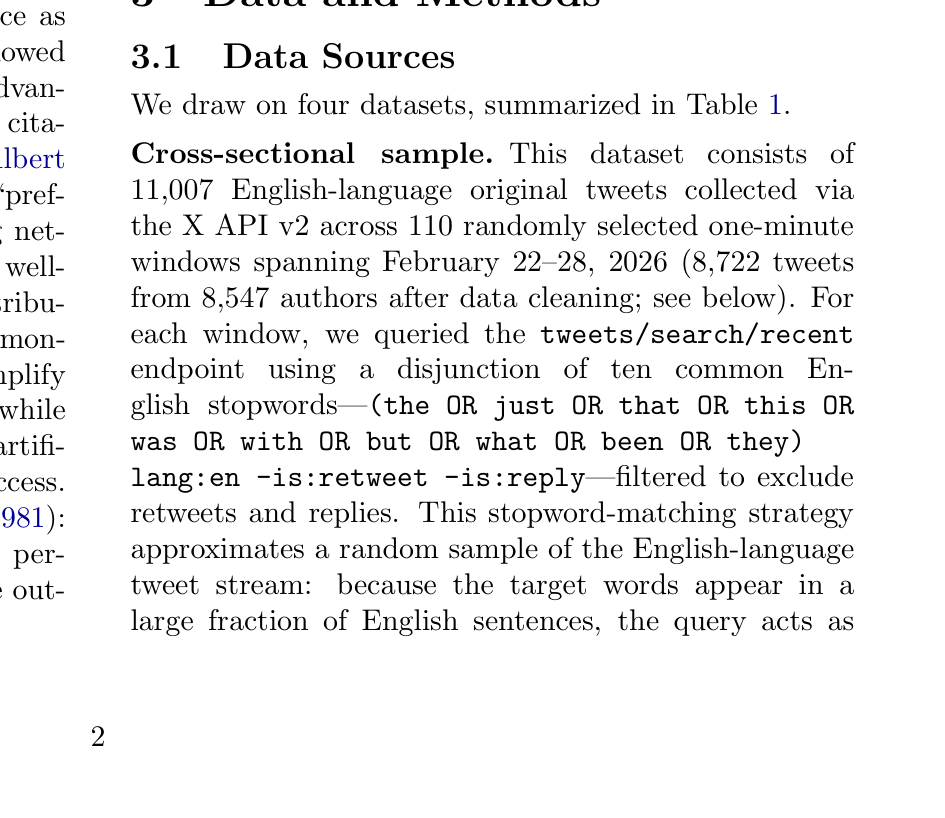
3.1 Data Sources
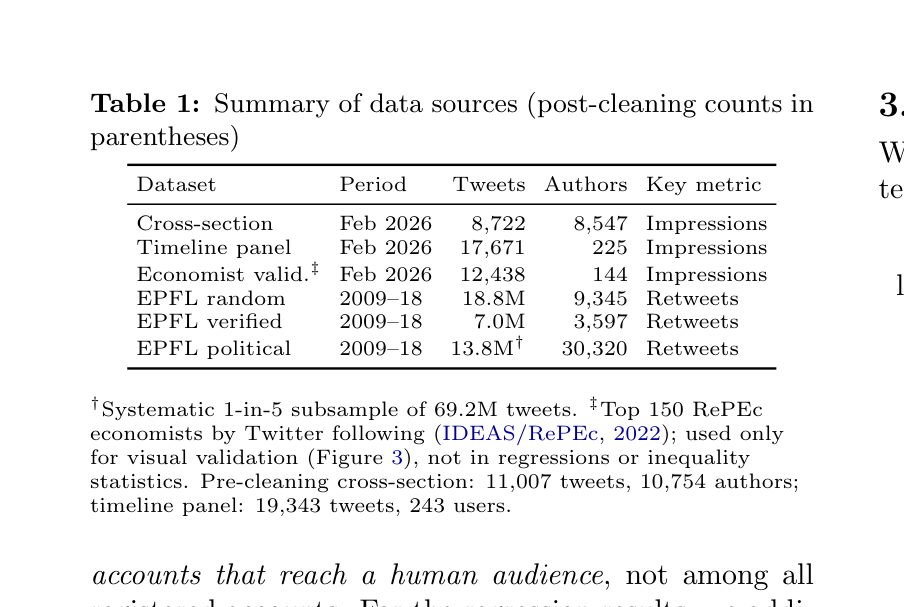
We draw on four datasets, summarized in Table 1.
Cross-sectional sample. This dataset consists of 11,007 English-language original tweets collected via the X API v2 across 110 randomly selected one-minute windows spanning February 22–28, 2026 (8,722 tweets from 8,547 authors after data cleaning; see below). For each window, we queried the tweets/search/recent endpoint using a disjunction of ten common En- glish stopwords—(the OR just OR that OR this OR was OR with OR but OR what OR been OR they) lang:en -is:retweet -is:reply—filtered to exclude retweets and replies. This stopword-matching strategy approximates a random sample of the English-language tweet stream: because the target words appear in a large fraction of English sentences, the query acts as
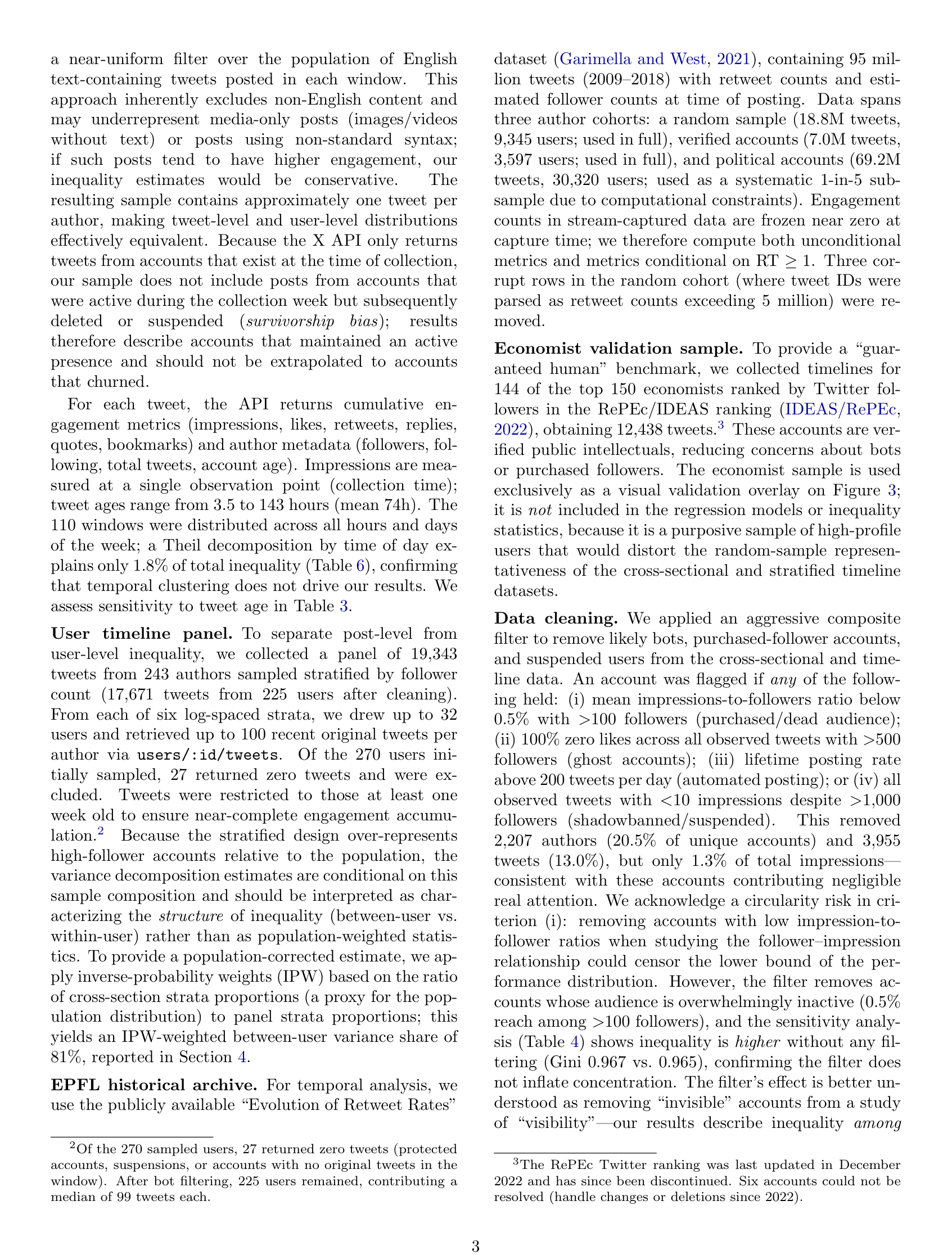
a near-uniform filter over the population of English text-containing tweets posted in each window. This approach inherently excludes non-English content and may underrepresent media-only posts (images/videos without text) or posts using non-standard syntax; if such posts tend to have higher engagement, our inequality estimates would be conservative. The resulting sample contains approximately one tweet per author, making tweet-level and user-level distributions effectively equivalent. Because the X API only returns tweets from accounts that exist at the time of collection, our sample does not include posts from accounts that were active during the collection week but subsequently deleted or suspended (survivorship bias); results therefore describe accounts that maintained an active presence and should not be extrapolated to accounts that churned. For each tweet, the API returns cumulative en- gagement metrics (impressions, likes, retweets, replies, quotes, bookmarks) and author metadata (followers, fol- lowing, total tweets, account age). Impressions are mea- sured at a single observation point (collection time); tweet ages range from 3.5 to 143 hours (mean 74h). The 110 windows were distributed across all hours and days of the week; a Theil decomposition by time of day ex- plains only 1.8% of total inequality (Table 6), confirming that temporal clustering does not drive our results. We assess sensitivity to tweet age in Table 3.
dataset (Garimella and West, 2021), containing 95 mil- lion tweets (2009–2018) with retweet counts and esti- mated follower counts at time of posting. Data spans three author cohorts: a random sample (18.8M tweets, 9,345 users; used in full), verified accounts (7.0M tweets, 3,597 users; used in full), and political accounts (69.2M tweets, 30,320 users; used as a systematic 1-in-5 sub- sample due to computational constraints). Engagement counts in stream-captured data are frozen near zero at capture time; we therefore compute both unconditional metrics and metrics conditional on RT ≥1. Three cor- rupt rows in the random cohort (where tweet IDs were parsed as retweet counts exceeding 5 million) were re- moved.
Economist validation sample. To provide a “guar- anteed human” benchmark, we collected timelines for 144 of the top 150 economists ranked by Twitter fol- lowers in the RePEc/IDEAS ranking (IDEAS/RePEc, 2022), obtaining 12,438 tweets.3 These accounts are ver- ified public intellectuals, reducing concerns about bots or purchased followers. The economist sample is used exclusively as a visual validation overlay on Figure 3; it is not included in the regression models or inequality statistics, because it is a purposive sample of high-profile users that would distort the random-sample represen- tativeness of the cross-sectional and stratified timeline datasets.
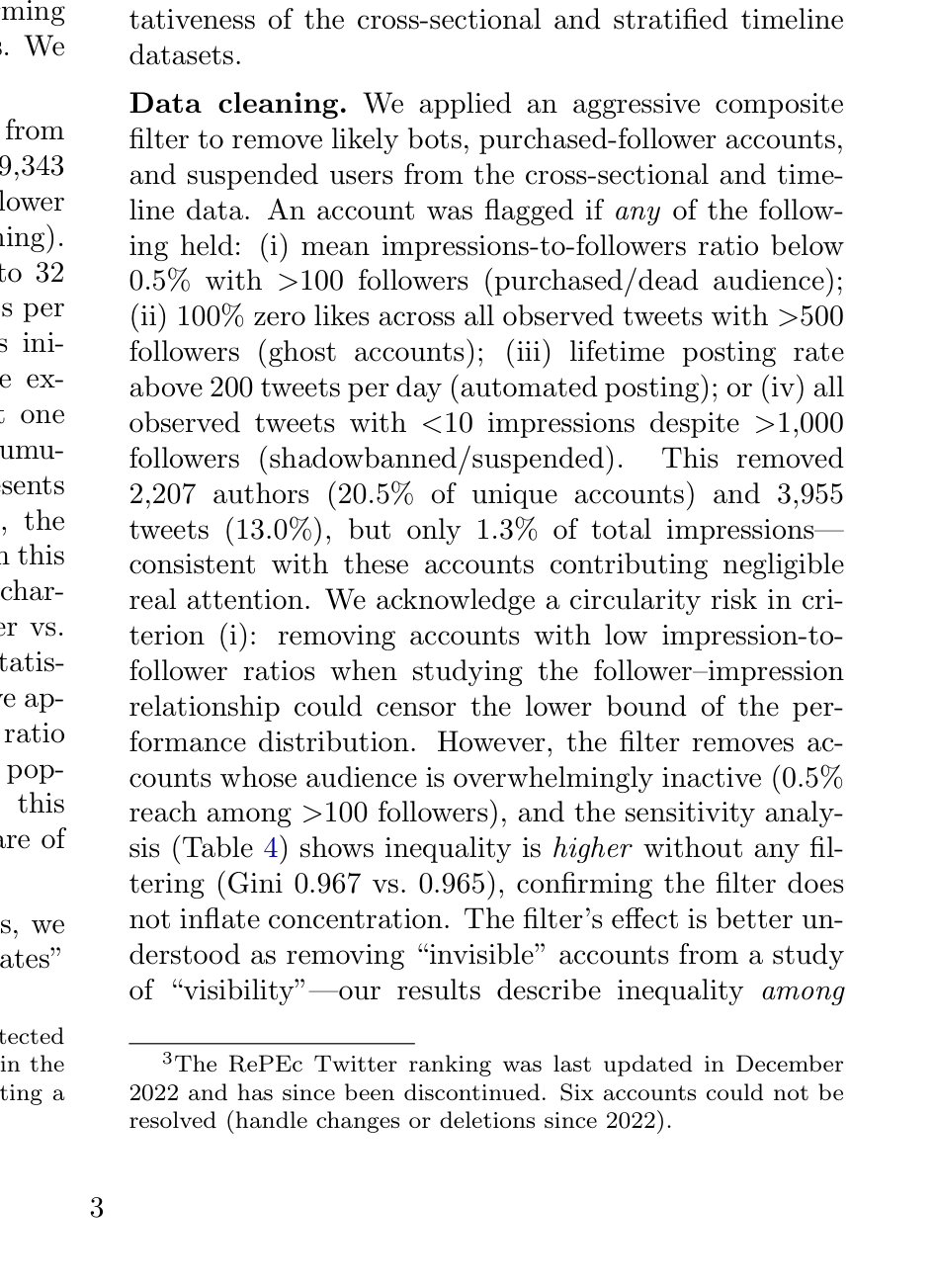
Data cleaning. We applied an aggressive composite filter to remove likely bots, purchased-follower accounts, and suspended users from the cross-sectional and time- line data. An account was flagged if any of the follow- ing held: (i) mean impressions-to-followers ratio below 0.5% with >100 followers (purchased/dead audience); (ii) 100% zero likes across all observed tweets with >500 followers (ghost accounts); (iii) lifetime posting rate above 200 tweets per day (automated posting); or (iv) all observed tweets with <10 impressions despite >1,000 followers (shadowbanned/suspended). This removed 2,207 authors (20.5% of unique accounts) and 3,955 tweets (13.0%), but only 1.3% of total impressions— consistent with these accounts contributing negligible real attention. We acknowledge a circularity risk in cri- terion (i): removing accounts with low impression-to- follower ratios when studying the follower–impression relationship could censor the lower bound of the per- formance distribution. However, the filter removes ac- counts whose audience is overwhelmingly inactive (0.5% reach among >100 followers), and the sensitivity analy- sis (Table 4) shows inequality is higher without any fil- tering (Gini 0.967 vs. 0.965), confirming the filter does not inflate concentration. The filter’s effect is better un- derstood as removing “invisible” accounts from a study of “visibility”—our results describe inequality among
User timeline panel. To separate post-level from user-level inequality, we collected a panel of 19,343 tweets from 243 authors sampled stratified by follower count (17,671 tweets from 225 users after cleaning). From each of six log-spaced strata, we drew up to 32 users and retrieved up to 100 recent original tweets per author via users/:id/tweets. Of the 270 users ini- tially sampled, 27 returned zero tweets and were ex- cluded. Tweets were restricted to those at least one week old to ensure near-complete engagement accumu- lation.2 Because the stratified design over-represents high-follower accounts relative to the population, the variance decomposition estimates are conditional on this sample composition and should be interpreted as char- acterizing the structure of inequality (between-user vs. within-user) rather than as population-weighted statis- tics. To provide a population-corrected estimate, we ap- ply inverse-probability weights (IPW) based on the ratio of cross-section strata proportions (a proxy for the pop- ulation distribution) to panel strata proportions; this yields an IPW-weighted between-user variance share of 81%, reported in Section 4.
EPFL historical archive. For temporal analysis, we use the publicly available “Evolution of Retweet Rates”
2Of the 270 sampled users, 27 returned zero tweets (protected accounts, suspensions, or accounts with no original tweets in the window). After bot filtering, 225 users remained, contributing a median of 99 tweets each.
3The RePEc Twitter ranking was last updated in December 2022 and has since been discontinued. Six accounts could not be resolved (handle changes or deletions since 2022).
3.3 Econometric Specification
Table 1: Summary of data sources (post-cleaning counts in parentheses)
We estimate a combined model that nests user charac- teristics and engagement signals in a single equation:
Dataset Period Tweets Authors Key metric
Cross-section Feb 2026 8,722 8,547 Impressions Timeline panel Feb 2026 17,671 225 Impressions Economist valid.‡ Feb 2026 12,438 144 Impressions EPFL random 2009–18 18.8M 9,345 Retweets EPFL verified 2009–18 7.0M 3,597 Retweets EPFL political 2009–18 13.8M† 30,320 Retweets
log I = β0 + β1 log F + β2(log F)2 + β3 log P
+ β4(log P)2 + β5 log F · log P + γD
+ α1 log(1+L) + α2 log(1+R) + α3 log(1+Q)
†Systematic 1-in-5 subsample of 69.2M tweets. ‡Top 150 RePEc economists by Twitter following (IDEAS/RePEc, 2022); used only for visual validation (Figure 3), not in regressions or inequality statistics. Pre-cleaning cross-section: 11,007 tweets, 10,754 authors; timeline panel: 19,343 tweets, 243 users.
+ α4[log(1+L)]2 + α5[log(1+R)]2
+ α6[log(1+Q)]2
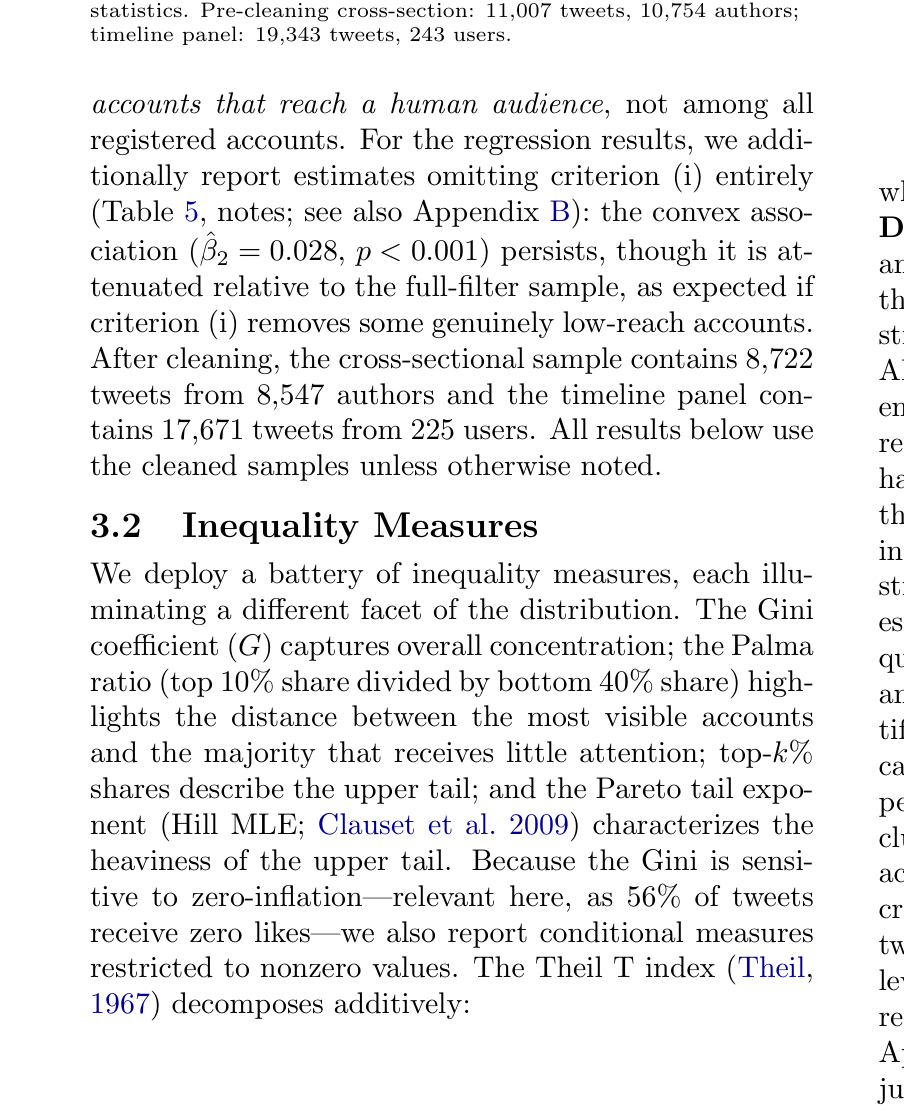
+ α7 log F · log(1+L) + α8 log F · log(1+R)
+ α9 log F · log(1+Q) + ϵ (2)
accounts that reach a human audience, not among all registered accounts. For the regression results, we addi- tionally report estimates omitting criterion (i) entirely (Table 5, notes; see also Appendix B): the convex asso- ciation (ˆβ2 = 0.028, p < 0.001) persists, though it is at- tenuated relative to the full-filter sample, as expected if criterion (i) removes some genuinely low-reach accounts. After cleaning, the cross-sectional sample contains 8,722 tweets from 8,547 authors and the timeline panel con- tains 17,671 tweets from 225 users. All results below use the cleaned samples unless otherwise noted.
where I is impressions, F is followers, P is posts per day, D is a vector of topic dummies, L is likes, R is retweets, and Q is quote tweets (all logarithms base-10).4 For the dependent variable, we use log10(I); impressions are strictly positive for all tweets returned by the search API (minimum 1), so no zero-handling is needed. For engagement covariates, we use log10(1+x) because likes, retweets, and quotes are frequently zero (48% of tweets have zero likes, 78% zero retweets); the +1 shift ensures the logarithm is defined, with the tradeoff of compress- ing variation near zero. Followers and posts per day are strictly positive in the regression sample.5 The model is estimated in nested blocks—adding follower terms, fre- quency terms, likes, retweets and quotes, squared terms, and interaction terms sequentially—with each block jus- tified by an incremental F-test (all p < 0.02). Be- cause the timeline panel contributes up to 100 tweets per user, pooling it with the cross-section creates within- cluster correlation that HC1 standard errors do not fully account for. Our primary analysis therefore uses the cross-section alone (n = 7,673), where essentially one tweet per author means HC1 is equivalent to author- level clustering. The combined sample (n = 24,029) is reported with author-level clustered standard errors in Appendix B; the key quadratic term is robust to this ad- justment (ˆβ2 = 0.083, clustered SE = 0.012, p < 0.001). All primary models use HC1 robust standard errors. Endogeneity caveat. Likes, retweets, quotes, and im- pressions are simultaneously determined: impressions create opportunities for engagement, engagement may trigger algorithmic redistribution, and both accumulate over the same observation window. Our estimates cap- ture equilibrium associations, not causal effects.
3.2 Inequality Measures
We deploy a battery of inequality measures, each illu- minating a different facet of the distribution. The Gini coefficient (G) captures overall concentration; the Palma ratio (top 10% share divided by bottom 40% share) high- lights the distance between the most visible accounts and the majority that receives little attention; top-k% shares describe the upper tail; and the Pareto tail expo- nent (Hill MLE; Clauset et al. 2009) characterizes the heaviness of the upper tail. Because the Gini is sensi- tive to zero-inflation—relevant here, as 56% of tweets receive zero likes—we also report conditional measures restricted to nonzero values. The Theil T index (Theil, 1967) decomposes additively:
T = P
+ P
g sg ln(µg/µ) | {z } between
(1)
g sgTg | {z } within
4In the X API, retweet count excludes quote tweets; quote count is reported separately. We model them indepen- dently. 5As a robustness check, we re-estimate the key specification using a Negative Binomial GLM on raw impression counts, which avoids the log transformation entirely. The convex association with followers persists ( ˆβ2 = 0.087, p < 0.001); see Appendix A for the full coefficient table.
where sg is group g’s attention share. This decomposi- tion partitions observed inequality by a chosen grouping; it does not identify causal sources.
Table 2: Attention inequality on X, February 2026. Unit: individual tweets (n = 8,722; ≈1 per author, after bot filter- ing).
4.1 Fact 1: Attention Inequality Is Ex- treme
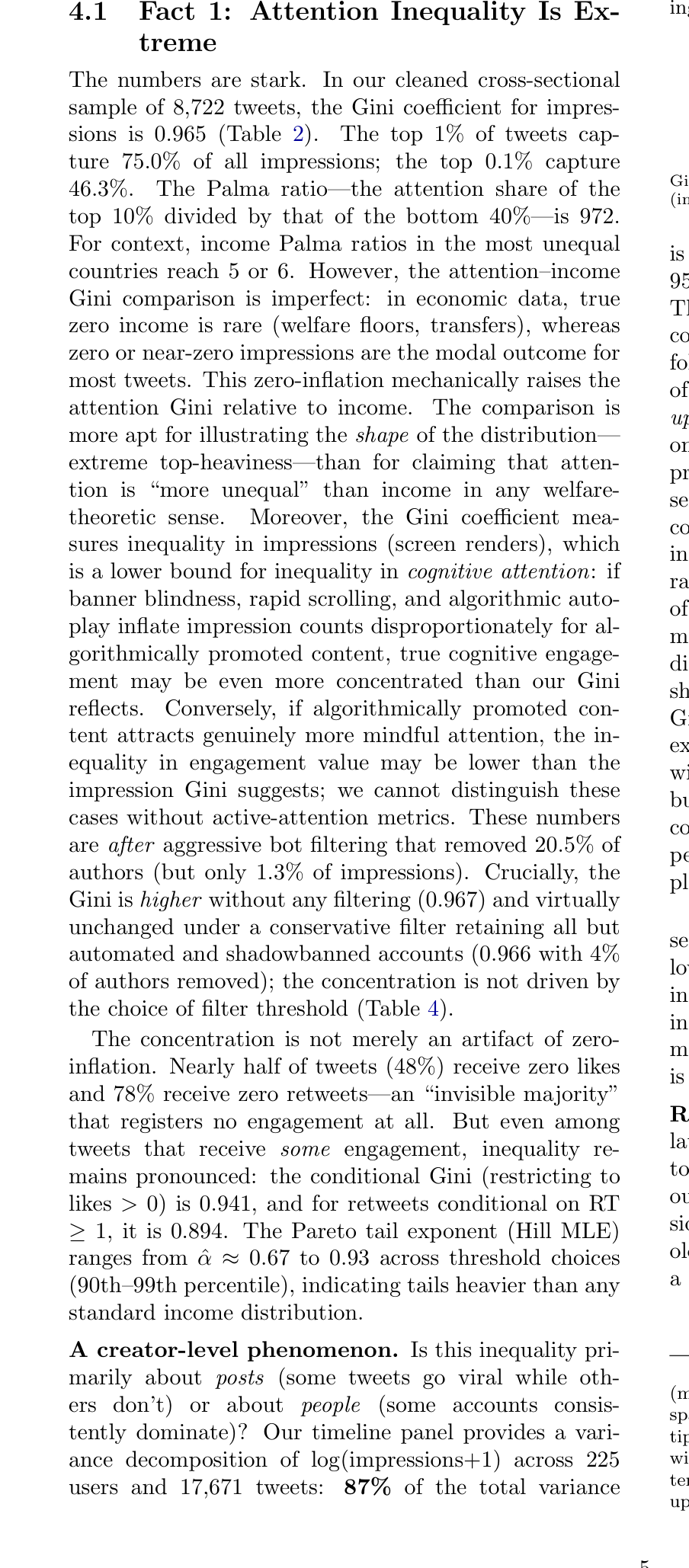
Mean Med. Gini Gini|>0 Top 1% Top 10%
The numbers are stark. In our cleaned cross-sectional sample of 8,722 tweets, the Gini coefficient for impres- sions is 0.965 (Table 2). The top 1% of tweets cap- ture 75.0% of all impressions; the top 0.1% capture 46.3%. The Palma ratio—the attention share of the top 10% divided by that of the bottom 40%—is 972. For context, income Palma ratios in the most unequal countries reach 5 or 6. However, the attention–income Gini comparison is imperfect: in economic data, true zero income is rare (welfare floors, transfers), whereas zero or near-zero impressions are the modal outcome for most tweets. This zero-inflation mechanically raises the attention Gini relative to income. The comparison is more apt for illustrating the shape of the distribution— extreme top-heaviness—than for claiming that atten- tion is “more unequal” than income in any welfare- theoretic sense. Moreover, the Gini coefficient mea- sures inequality in impressions (screen renders), which is a lower bound for inequality in cognitive attention: if banner blindness, rapid scrolling, and algorithmic auto- play inflate impression counts disproportionately for al- gorithmically promoted content, true cognitive engage- ment may be even more concentrated than our Gini reflects. Conversely, if algorithmically promoted con- tent attracts genuinely more mindful attention, the in- equality in engagement value may be lower than the impression Gini suggests; we cannot distinguish these cases without active-attention metrics. These numbers are after aggressive bot filtering that removed 20.5% of authors (but only 1.3% of impressions). Crucially, the Gini is higher without any filtering (0.967) and virtually unchanged under a conservative filter retaining all but automated and shadowbanned accounts (0.966 with 4% of authors removed); the concentration is not driven by the choice of filter threshold (Table 4). The concentration is not merely an artifact of zero- inflation. Nearly half of tweets (48%) receive zero likes and 78% receive zero retweets—an “invisible majority” that registers no engagement at all. But even among tweets that receive some engagement, inequality re- mains pronounced: the conditional Gini (restricting to likes > 0) is 0.941, and for retweets conditional on RT ≥1, it is 0.894. The Pareto tail exponent (Hill MLE) ranges from ˆα ≈0.67 to 0.93 across threshold choices (90th–99th percentile), indicating tails heavier than any standard income distribution.
Impr. 2,335 35 .965 .962 75.0% 95.8% Likes 54 0 .969 .941 77.1% 96.8% RTs 7 0 .976 .894 76.7% 97.7%
Gini|>0: conditional on nonzero engagement. Palma ratio (impressions) = 972. Top 0.1% captures 46.3% of impressions.
is between users and only 13% within-user (bootstrap 95% CI: [84%, 89%], resampling users; Figure 1). This estimate is conditional on the stratified sample composition, which deliberately over-represents high- follower accounts (Section 3); the over-representation of high-follower users biases the between-user share upward, so 87% should be read as an upper bound on the population-weighted figure. Applying inverse- probability weights (IPW) based on the ratio of cross- section to panel strata proportions yields a population- corrected estimate of approximately 81%—still indicat- ing that 4 out of 5 units of variance are between users rather than between posts.6 This is also a decomposition of passive exposure (impressions): active endorsement metrics (retweets reflect a user’s deliberate choice to re- distribute content) may show a different between-user share. The post-level Gini is 0.942 while the user-level Gini is 0.900—nearly as high. Individual authors do experience meaningful tweet-to-tweet variation (median within-user Gini = 0.537, IQR [0.386, 0.707]; Figure 2), but this variation is dwarfed by the chasm between ac- counts. Within these caveats, attention inequality ap- pears to be primarily a property of who you are on the platform—not of what you say on any given day. An important dynamic we cannot capture with cross- sectional data is the feedback from engagement to fol- lower growth: users who consistently produce engag- ing content may accumulate followers faster, amplify- ing between-user differences over time. Quantifying this mechanism requires longitudinal follower tracking and is an important direction for future work.
Robust to tweet age. Because impressions are cumu- lative, older tweets in our sample have had more time to accumulate views. Table 3 shows this does not drive our results: the Gini is 0.965 whether we use raw impres- sions, impressions per hour, or restrict to tweets ≥48h old. Restricting to tweets under 24 hours old still yields a Gini of 0.953.
A creator-level phenomenon. Is this inequality pri- marily about posts (some tweets go viral while oth- ers don’t) or about people (some accounts consis- tently dominate)? Our timeline panel provides a vari- ance decomposition of log(impressions+1) across 225 users and 17,671 tweets: 87% of the total variance
6The 100 most-recent tweets per user span a median of 14 days (mean 131 days; IQR [4, 47]). For the 30% of users whose tweets span >30 days, within-user variance captures variation across mul- tiple weeks and topics. For prolific users whose 100 tweets fall within a few days, within-user variance may be compressed by temporal autocorrelation, further biasing the between-user share upward.
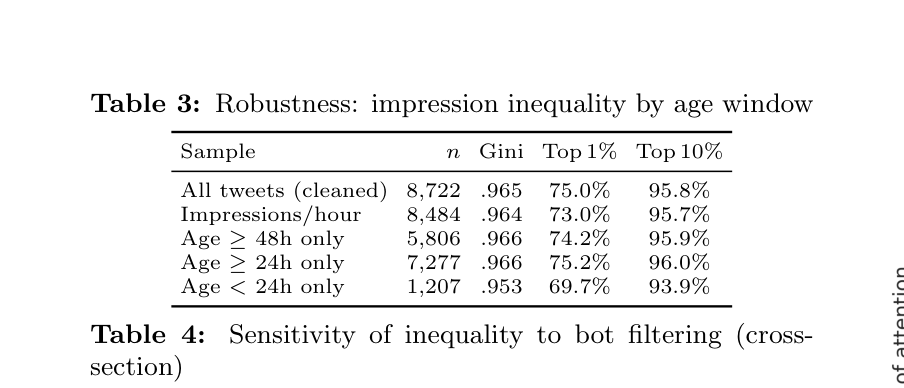
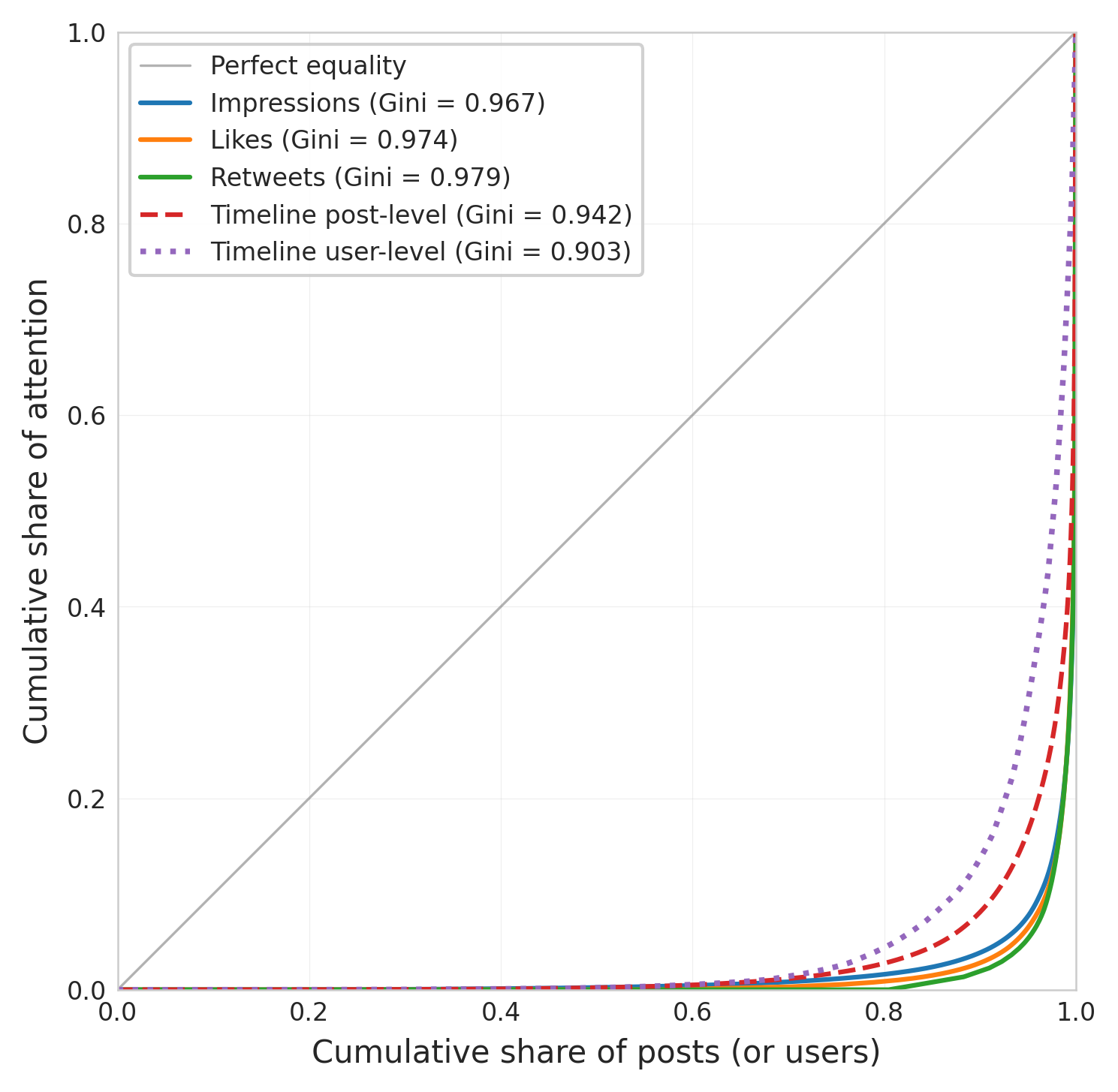
Table 3: Robustness: impression inequality by age window
Sample n Gini Top 1% Top 10%
All tweets (cleaned) 8,722 .965 75.0% 95.8% Impressions/hour 8,484 .964 73.0% 95.7% Age ≥48h only 5,806 .966 74.2% 95.9% Age ≥24h only 7,277 .966 75.2% 96.0% Age < 24h only 1,207 .953 69.7% 93.9%
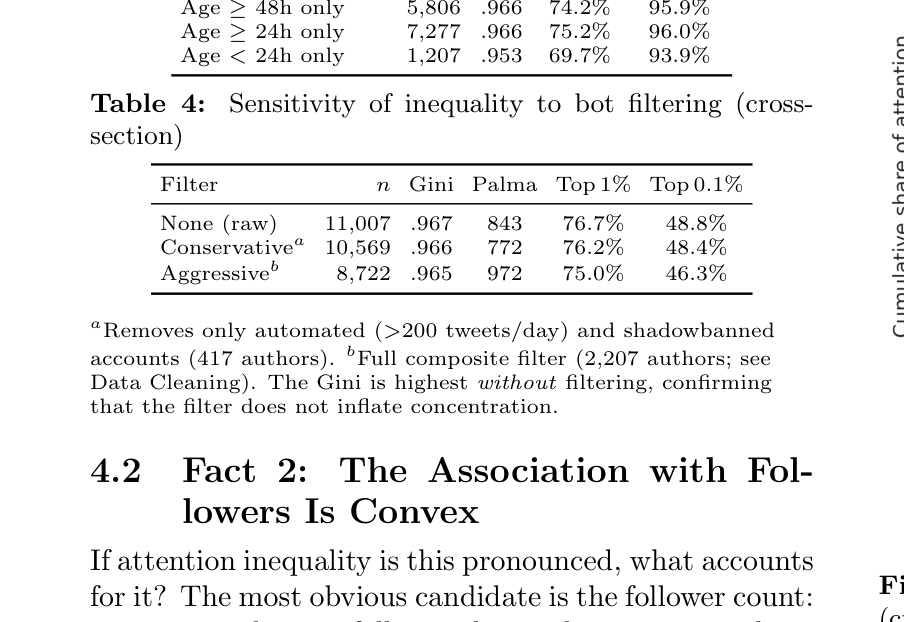
Table 4: Sensitivity of inequality to bot filtering (cross- section)
Filter n Gini Palma Top 1% Top 0.1%
None (raw) 11,007 .967 843 76.7% 48.8% Conservativea 10,569 .966 772 76.2% 48.4% Aggressiveb 8,722 .965 972 75.0% 46.3%
aRemoves only automated (>200 tweets/day) and shadowbanned accounts (417 authors). bFull composite filter (2,207 authors; see Data Cleaning). The Gini is highest without filtering, confirming that the filter does not inflate concentration.
4.2 Fact 2: The Association with Fol- lowers Is Convex
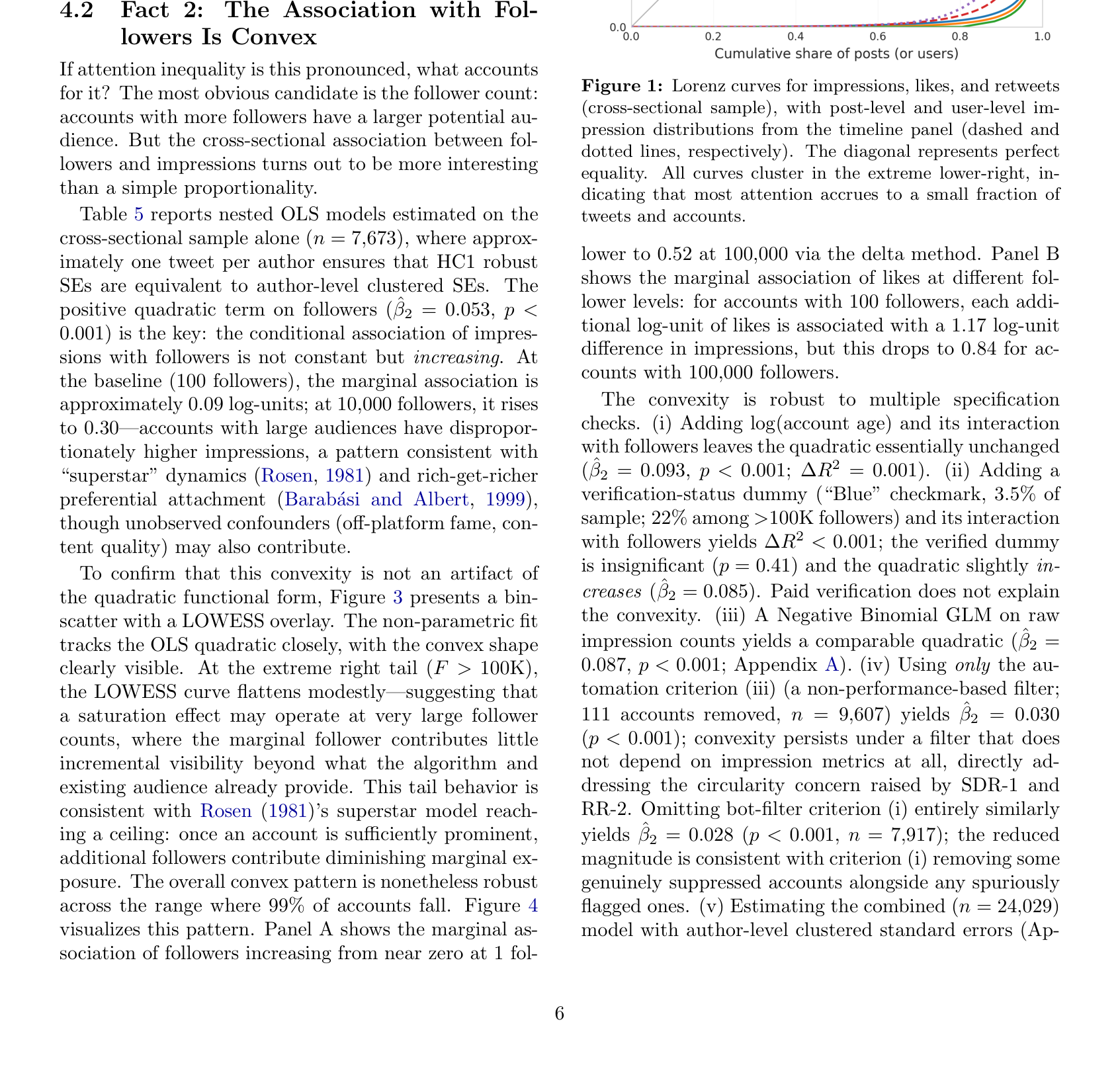
If attention inequality is this pronounced, what accounts for it? The most obvious candidate is the follower count: accounts with more followers have a larger potential au- dience. But the cross-sectional association between fol- lowers and impressions turns out to be more interesting than a simple proportionality. Table 5 reports nested OLS models estimated on the cross-sectional sample alone (n = 7,673), where approx- imately one tweet per author ensures that HC1 robust SEs are equivalent to author-level clustered SEs. The positive quadratic term on followers (ˆβ2 = 0.053, p < 0.001) is the key: the conditional association of impres- sions with followers is not constant but increasing. At the baseline (100 followers), the marginal association is approximately 0.09 log-units; at 10,000 followers, it rises to 0.30—accounts with large audiences have dispropor- tionately higher impressions, a pattern consistent with “superstar” dynamics (Rosen, 1981) and rich-get-richer preferential attachment (Barab´asi and Albert, 1999), though unobserved confounders (off-platform fame, con- tent quality) may also contribute. To confirm that this convexity is not an artifact of the quadratic functional form, Figure 3 presents a bin- scatter with a LOWESS overlay. The non-parametric fit tracks the OLS quadratic closely, with the convex shape clearly visible. At the extreme right tail (F > 100K), the LOWESS curve flattens modestly—suggesting that a saturation effect may operate at very large follower counts, where the marginal follower contributes little incremental visibility beyond what the algorithm and existing audience already provide. This tail behavior is consistent with Rosen (1981)’s superstar model reach- ing a ceiling: once an account is sufficiently prominent, additional followers contribute diminishing marginal ex- posure. The overall convex pattern is nonetheless robust across the range where 99% of accounts fall. Figure 4 visualizes this pattern. Panel A shows the marginal as- sociation of followers increasing from near zero at 1 fol-
Figure 1: Lorenz curves for impressions, likes, and retweets (cross-sectional sample), with post-level and user-level im- pression distributions from the timeline panel (dashed and dotted lines, respectively). The diagonal represents perfect equality. All curves cluster in the extreme lower-right, in- dicating that most attention accrues to a small fraction of tweets and accounts.
lower to 0.52 at 100,000 via the delta method. Panel B shows the marginal association of likes at different fol- lower levels: for accounts with 100 followers, each addi- tional log-unit of likes is associated with a 1.17 log-unit difference in impressions, but this drops to 0.84 for ac- counts with 100,000 followers. The convexity is robust to multiple specification checks. (i) Adding log(account age) and its interaction with followers leaves the quadratic essentially unchanged (ˆβ2 = 0.093, p < 0.001; ∆R2 = 0.001). (ii) Adding a verification-status dummy (“Blue” checkmark, 3.5% of sample; 22% among >100K followers) and its interaction with followers yields ∆R2 < 0.001; the verified dummy is insignificant (p = 0.41) and the quadratic slightly in- creases (ˆβ2 = 0.085). Paid verification does not explain the convexity. (iii) A Negative Binomial GLM on raw impression counts yields a comparable quadratic (ˆβ2 = 0.087, p < 0.001; Appendix A). (iv) Using only the au- tomation criterion (iii) (a non-performance-based filter; 111 accounts removed, n = 9,607) yields ˆβ2 = 0.030 (p < 0.001); convexity persists under a filter that does not depend on impression metrics at all, directly ad- dressing the circularity concern raised by SDR-1 and RR-2. Omitting bot-filter criterion (i) entirely similarly yields ˆβ2 = 0.028 (p < 0.001, n = 7,917); the reduced magnitude is consistent with criterion (i) removing some genuinely suppressed accounts alongside any spuriously flagged ones. (v) Estimating the combined (n = 24,029) model with author-level clustered standard errors (Ap-
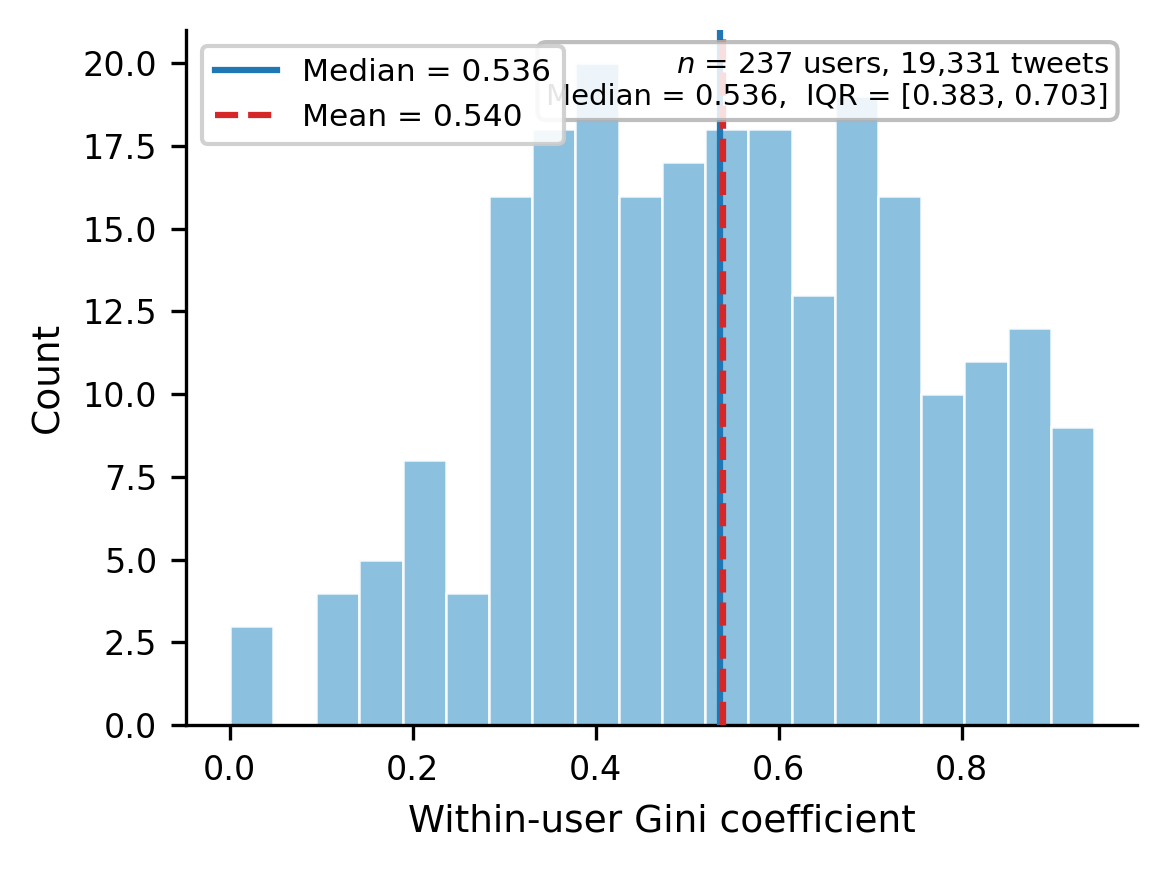
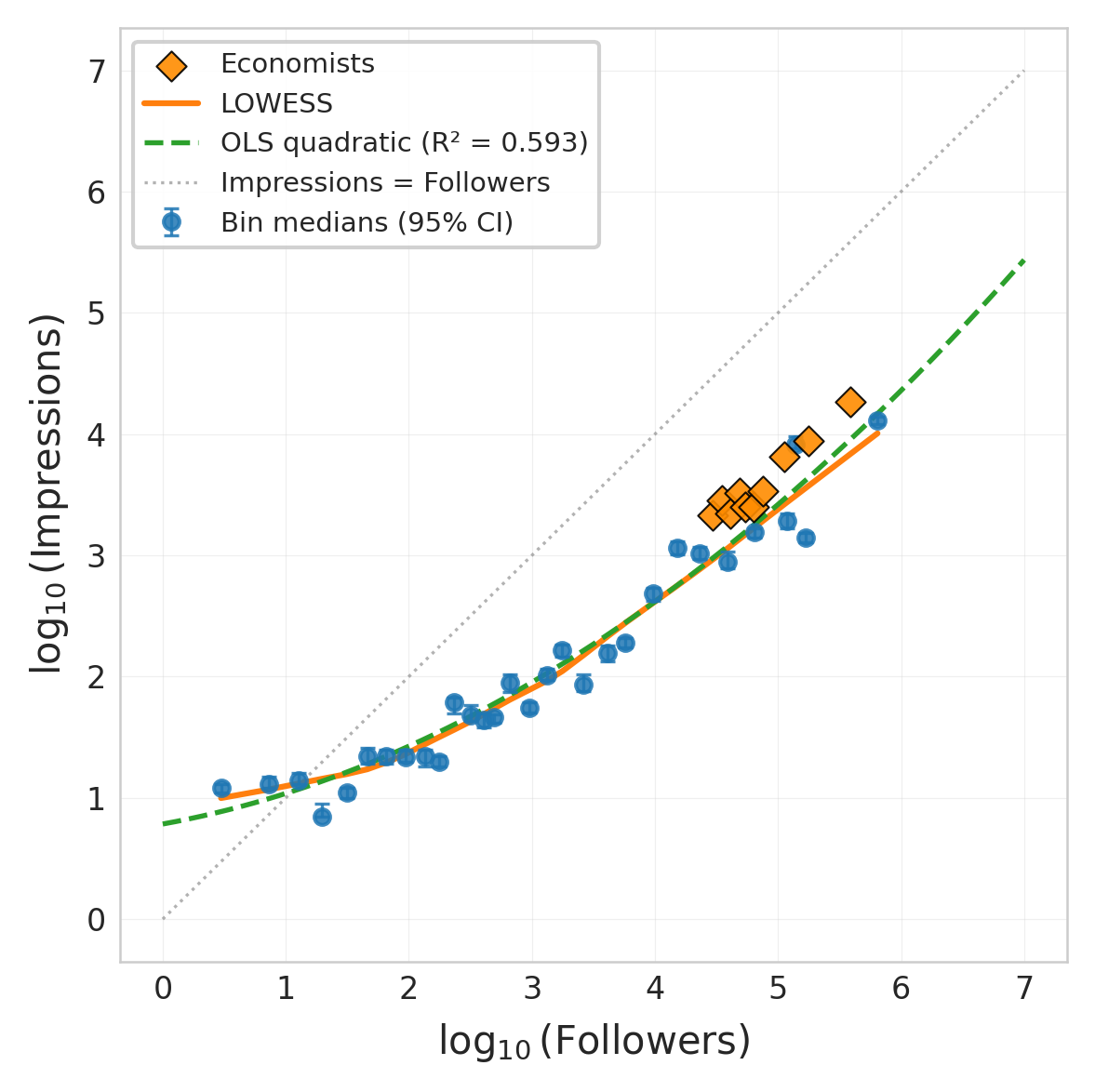
Figure 2: Distribution of within-user impression Gini (timeline panel, 223 users with ≥2 tweets, after bot filter- ing). Median = 0.54; individual tweet-to-tweet variation is substantial but is dwarfed by between-user differences (87% of total variance).
pendix B) yields ˆβ2 = 0.083 (clustered SE = 0.012, p < 0.001). (vi) To assess multicollinearity, we com- puted variance inflation factors (VIF). Simple engage- ment variables (no interactions) have VIFs of 1.76–3.78, well below the standard threshold of 10; the correlations among likes, retweets, and quotes range from 0.57 to 0.83. Including interaction terms inflates VIFs to 85–104 for the follower×engagement terms, which is mechanical given their construction from the same variables; the in- teraction pattern (stronger engagement-impression cou- pling for smaller accounts) is nonetheless robust. We note that the convexity may partly reflect feed- source composition: high-follower accounts likely derive a larger share of impressions from follower timelines (“Following” feed), which scales roughly linearly with follower count, while smaller accounts that achieve high impressions may do so via the algorithmic “For You” feed, which distributes content based on engagement ve- locity. The observed super-linear association could thus reflect a mixture of two approximately linear regimes— one follower-driven, one algorithm-driven—rather than a single continuous “superstar” dynamic. Distinguish- ing these channels requires feed-source data that the X API does not currently expose. The user-characteristics model (columns 1–3 of Ta- ble 5) explains R2 = 0.501 of the variance. The Theil de- composition (Table 6) makes the complementary point: grouping accounts by follower count captures only 27% of the total Theil inequality, meaning 73% of the vari- ation in impressions exists among accounts with simi- lar follower counts. Outcomes are weakly predictable from observables. Two accounts with the same followers, posting frequency, and topic face wildly different fates— a finding consistent with the inherent unpredictability documented in cultural markets (Salganik et al., 2006) and with the role of algorithmic confounding (Chaney
Figure 3: Binscatter of log10(impressions) vs. log10(followers) (30 equal-frequency bins, cleaned cross- section n = 7,673). Points: bin medians; error bars: 95% bootstrap CI on medians (1,000 resamples). Orange diamonds: economist validation sample (top 144 RePEc economists, 11,526 tweets; included only as a “guaranteed human” visual benchmark—these accounts are a purposive, high-status cohort whose follower–impression relationship may not generalize to other content domains). Solid line: LOWESS; dashed: OLS quadratic. The convex shape con- firms accelerating returns to scale; the LOWESS flattening at the extreme right tail (F > 100K) indicates possible saturation for very large accounts.
et al., 2018) in generating path-dependent outcomes. These two findings—87% between-user variance but only 27% between-follower-strata—are consistent, not contradictory. The 87% between-user share measures variance explained by user identity—the full package of an account’s history, content style, network posi- tion, and algorithmic standing. The 27% between-group share from Theil decomposition measures variance ex- plained by a single observable: follower count. User identity is far richer than any single metric. The full model, which incorporates followers, posting frequency, and engagement signals, reaches R2 = 0.761 in the primary cross-section sample and R2 = 0.821 in the pooled combined sample (Appendix B)—meaning that in equilibrium, these observable characteristics account for more than three-quarters of the variation in log- impressions. The remaining 18% reflects the irreducible unpredictability of individual posts.
4.3 Fact 3: Engagement Inequality Rose Within the EPFL Archive
Figure 5 traces engagement inequality from 2009 to 2018 using the EPFL archive, with our 2026 data as a con- temporary comparison point (shown as a red star). We
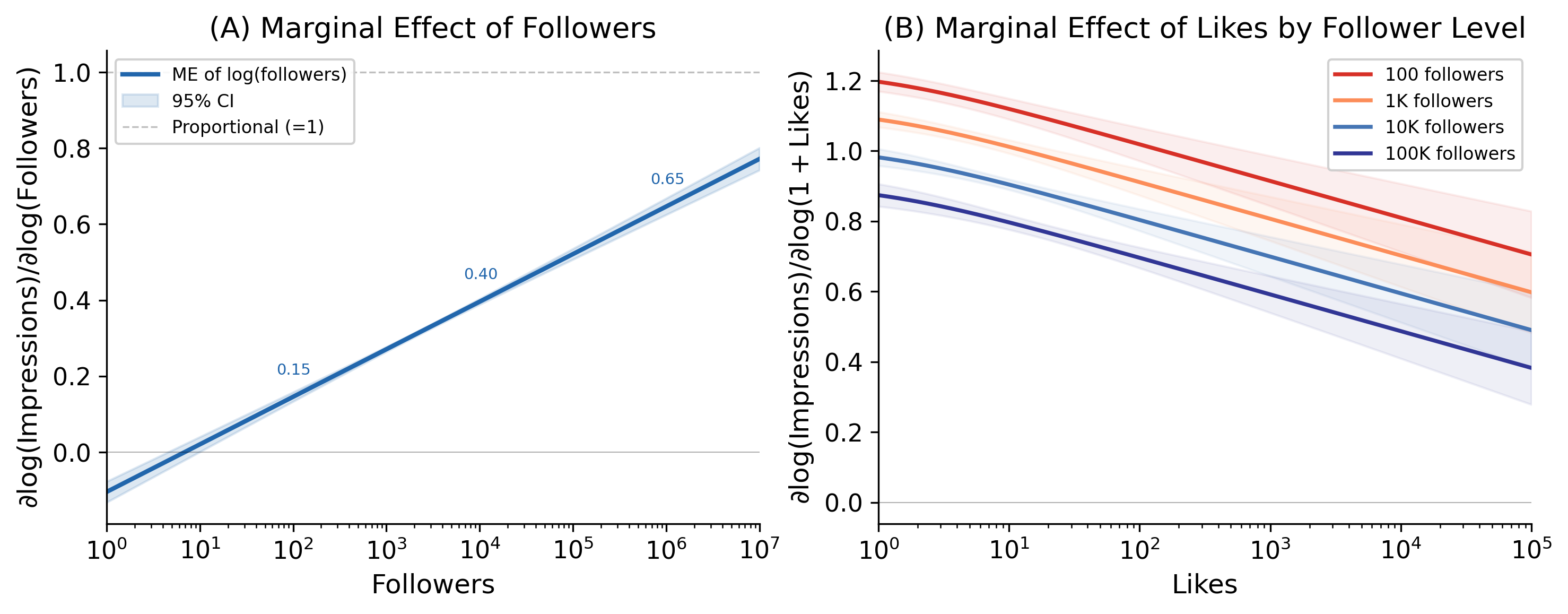
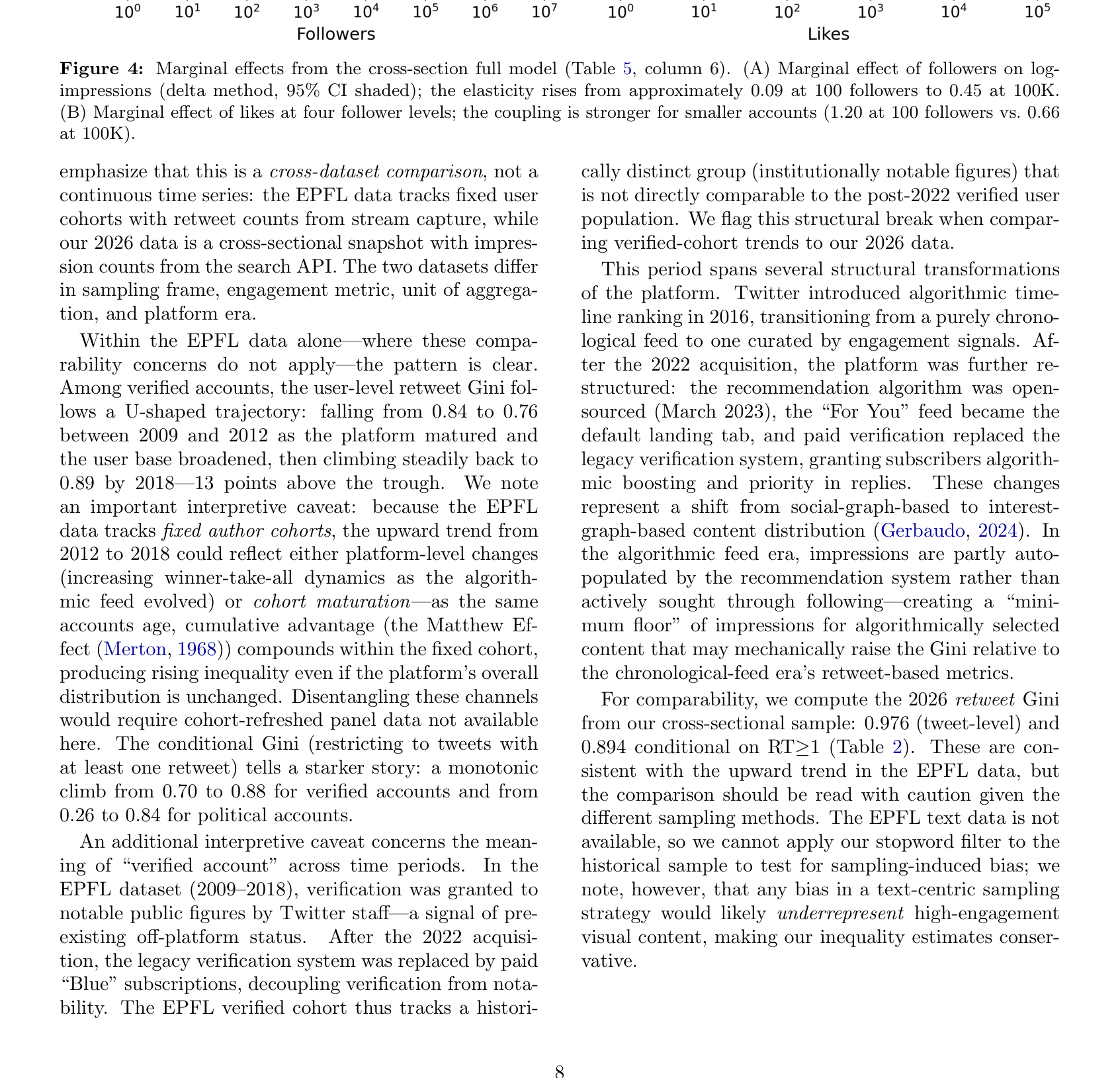
Figure 4: Marginal effects from the cross-section full model (Table 5, column 6). (A) Marginal effect of followers on log- impressions (delta method, 95% CI shaded); the elasticity rises from approximately 0.09 at 100 followers to 0.45 at 100K. (B) Marginal effect of likes at four follower levels; the coupling is stronger for smaller accounts (1.20 at 100 followers vs. 0.66 at 100K).
cally distinct group (institutionally notable figures) that is not directly comparable to the post-2022 verified user population. We flag this structural break when compar- ing verified-cohort trends to our 2026 data. This period spans several structural transformations of the platform. Twitter introduced algorithmic time- line ranking in 2016, transitioning from a purely chrono- logical feed to one curated by engagement signals. Af- ter the 2022 acquisition, the platform was further re- structured: the recommendation algorithm was open- sourced (March 2023), the “For You” feed became the default landing tab, and paid verification replaced the legacy verification system, granting subscribers algorith- mic boosting and priority in replies. These changes represent a shift from social-graph-based to interest- graph-based content distribution (Gerbaudo, 2024). In the algorithmic feed era, impressions are partly auto- populated by the recommendation system rather than actively sought through following—creating a “mini- mum floor” of impressions for algorithmically selected content that may mechanically raise the Gini relative to the chronological-feed era’s retweet-based metrics. For comparability, we compute the 2026 retweet Gini from our cross-sectional sample: 0.976 (tweet-level) and 0.894 conditional on RT≥1 (Table 2). These are con- sistent with the upward trend in the EPFL data, but the comparison should be read with caution given the different sampling methods. The EPFL text data is not available, so we cannot apply our stopword filter to the historical sample to test for sampling-induced bias; we note, however, that any bias in a text-centric sampling strategy would likely underrepresent high-engagement visual content, making our inequality estimates conser- vative.
emphasize that this is a cross-dataset comparison, not a continuous time series: the EPFL data tracks fixed user cohorts with retweet counts from stream capture, while our 2026 data is a cross-sectional snapshot with impres- sion counts from the search API. The two datasets differ in sampling frame, engagement metric, unit of aggrega- tion, and platform era. Within the EPFL data alone—where these compa- rability concerns do not apply—the pattern is clear. Among verified accounts, the user-level retweet Gini fol- lows a U-shaped trajectory: falling from 0.84 to 0.76 between 2009 and 2012 as the platform matured and the user base broadened, then climbing steadily back to 0.89 by 2018—13 points above the trough. We note an important interpretive caveat: because the EPFL data tracks fixed author cohorts, the upward trend from 2012 to 2018 could reflect either platform-level changes (increasing winner-take-all dynamics as the algorith- mic feed evolved) or cohort maturation—as the same accounts age, cumulative advantage (the Matthew Ef- fect (Merton, 1968)) compounds within the fixed cohort, producing rising inequality even if the platform’s overall distribution is unchanged. Disentangling these channels would require cohort-refreshed panel data not available here. The conditional Gini (restricting to tweets with at least one retweet) tells a starker story: a monotonic climb from 0.70 to 0.88 for verified accounts and from 0.26 to 0.84 for political accounts. An additional interpretive caveat concerns the mean- ing of “verified account” across time periods. In the EPFL dataset (2009–2018), verification was granted to notable public figures by Twitter staff—a signal of pre- existing off-platform status. After the 2022 acquisi- tion, the legacy verification system was replaced by paid “Blue” subscriptions, decoupling verification from nota- bility. The EPFL verified cohort thus tracks a histori-
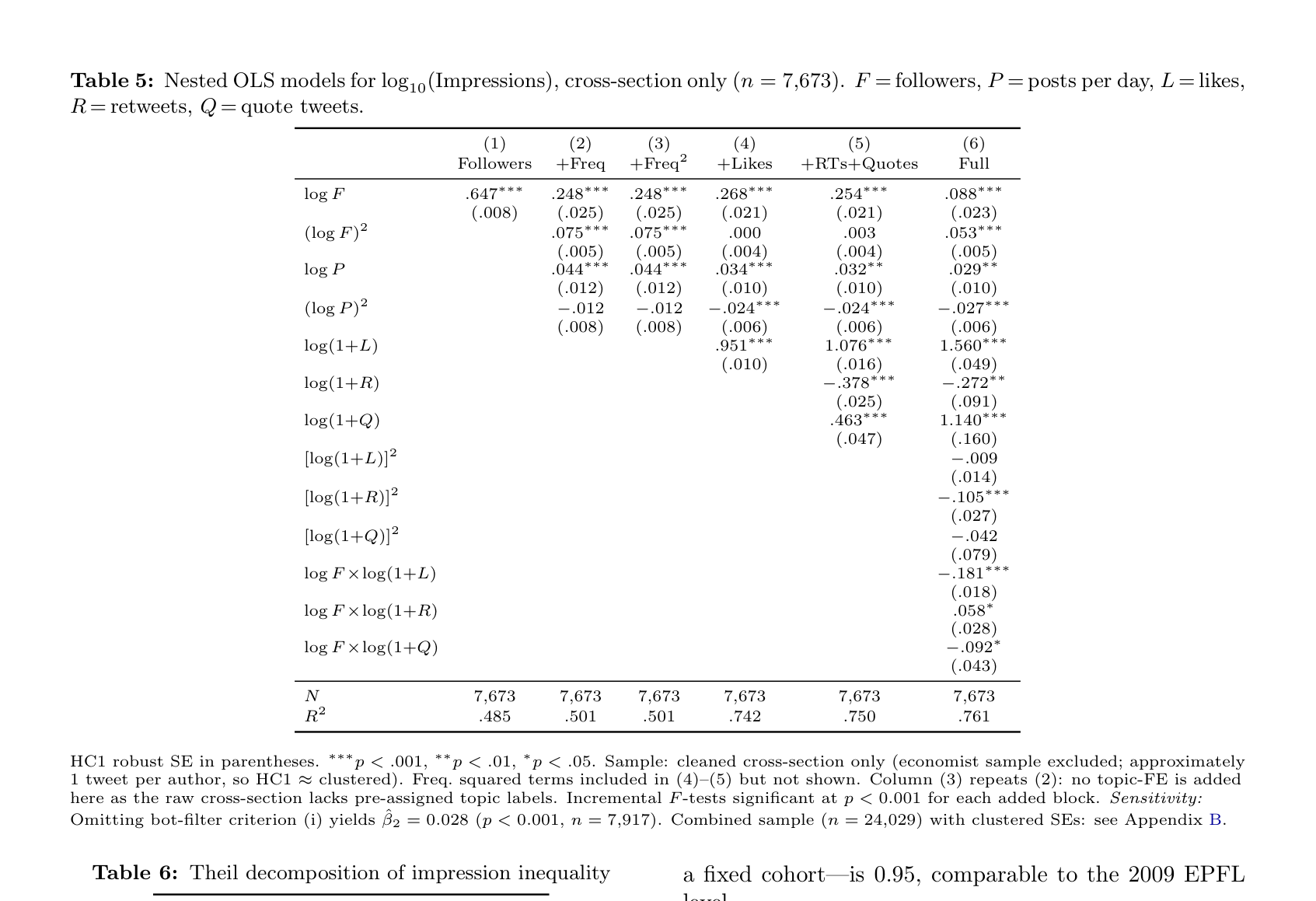
Table 5: Nested OLS models for log10(Impressions), cross-section only (n = 7,673). F = followers, P = posts per day, L = likes, R = retweets, Q = quote tweets.
(1) (2) (3) (4) (5) (6) Followers +Freq +Freq2 +Likes +RTs+Quotes Full
log F .647∗∗∗ .248∗∗∗ .248∗∗∗ .268∗∗∗ .254∗∗∗ .088∗∗∗
(.008) (.025) (.025) (.021) (.021) (.023) (log F )2 .075∗∗∗ .075∗∗∗ .000 .003 .053∗∗∗
(.005) (.005) (.004) (.004) (.005) log P .044∗∗∗ .044∗∗∗ .034∗∗∗ .032∗∗ .029∗∗
(.012) (.012) (.010) (.010) (.010) (log P )2 −.012 −.012 −.024∗∗∗ −.024∗∗∗ −.027∗∗∗
(.008) (.008) (.006) (.006) (.006) log(1+L) .951∗∗∗ 1.076∗∗∗ 1.560∗∗∗
(.010) (.016) (.049) log(1+R) −.378∗∗∗ −.272∗∗
(.025) (.091) log(1+Q) .463∗∗∗ 1.140∗∗∗
(.047) (.160) [log(1+L)]2 −.009 (.014) [log(1+R)]2 −.105∗∗∗
(.027) [log(1+Q)]2 −.042 (.079) log F ×log(1+L) −.181∗∗∗
(.018) log F ×log(1+R) .058∗
(.028) log F ×log(1+Q) −.092∗
(.043)
N 7,673 7,673 7,673 7,673 7,673 7,673 R2 .485 .501 .501 .742 .750 .761
HC1 robust SE in parentheses. ∗∗∗p < .001, ∗∗p < .01, ∗p < .05. Sample: cleaned cross-section only (economist sample excluded; approximately 1 tweet per author, so HC1 ≈clustered). Freq. squared terms included in (4)–(5) but not shown. Column (3) repeats (2): no topic-FE is added here as the raw cross-section lacks pre-assigned topic labels. Incremental F -tests significant at p < 0.001 for each added block. Sensitivity: Omitting bot-filter criterion (i) yields ˆβ2 = 0.028 (p < 0.001, n = 7,917). Combined sample (n = 24,029) with clustered SEs: see Appendix B.
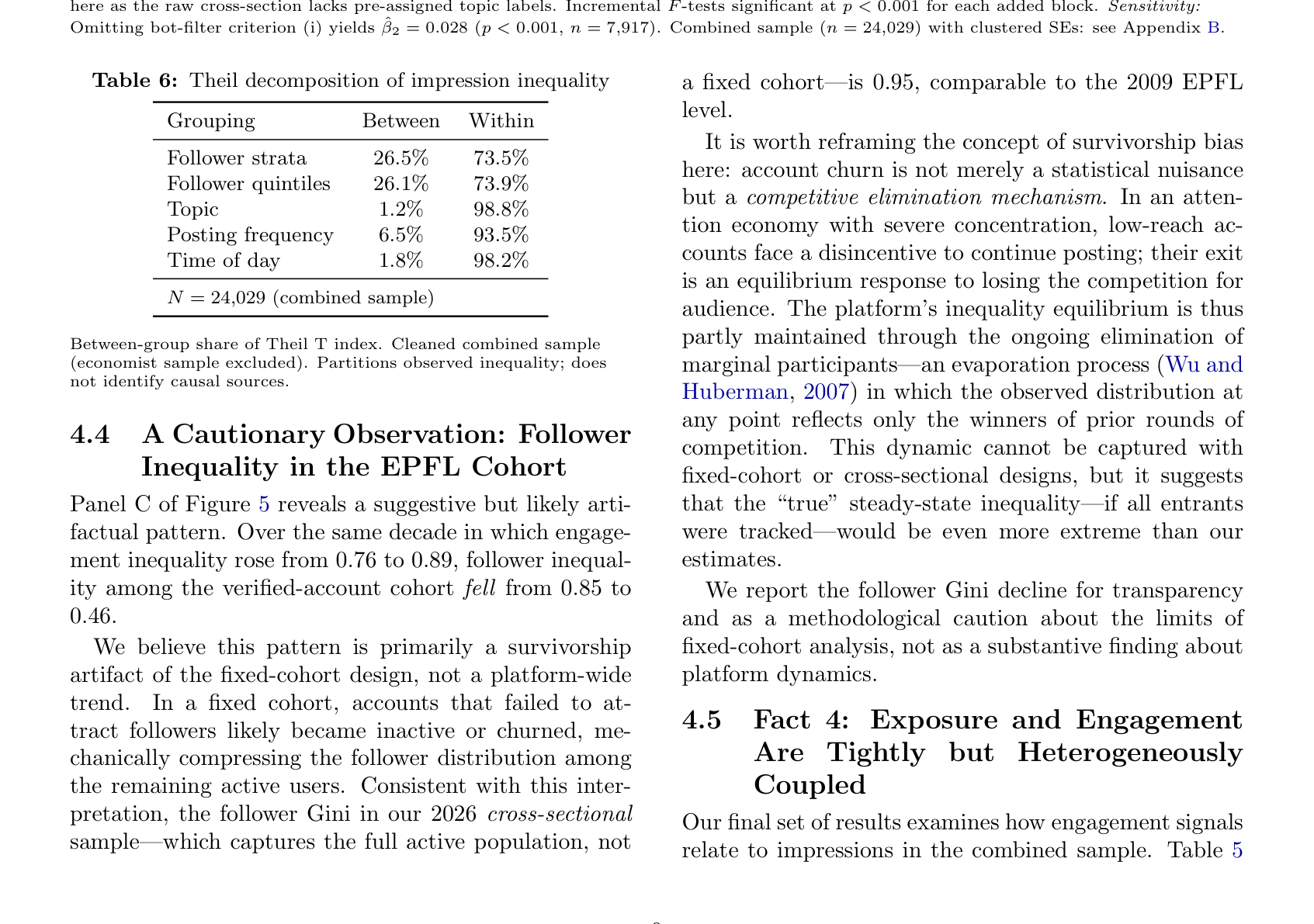
Table 6: Theil decomposition of impression inequality
a fixed cohort—is 0.95, comparable to the 2009 EPFL level. It is worth reframing the concept of survivorship bias here: account churn is not merely a statistical nuisance but a competitive elimination mechanism. In an atten- tion economy with severe concentration, low-reach ac- counts face a disincentive to continue posting; their exit is an equilibrium response to losing the competition for audience. The platform’s inequality equilibrium is thus partly maintained through the ongoing elimination of marginal participants—an evaporation process (Wu and Huberman, 2007) in which the observed distribution at any point reflects only the winners of prior rounds of competition. This dynamic cannot be captured with fixed-cohort or cross-sectional designs, but it suggests that the “true” steady-state inequality—if all entrants were tracked—would be even more extreme than our estimates. We report the follower Gini decline for transparency and as a methodological caution about the limits of fixed-cohort analysis, not as a substantive finding about platform dynamics.
Grouping Between Within
Follower strata 26.5% 73.5% Follower quintiles 26.1% 73.9% Topic 1.2% 98.8% Posting frequency 6.5% 93.5% Time of day 1.8% 98.2%
N = 24,029 (combined sample)
Between-group share of Theil T index. Cleaned combined sample (economist sample excluded). Partitions observed inequality; does not identify causal sources.
4.4 A Cautionary Observation: Follower Inequality in the EPFL Cohort
Panel C of Figure 5 reveals a suggestive but likely arti- factual pattern. Over the same decade in which engage- ment inequality rose from 0.76 to 0.89, follower inequal- ity among the verified-account cohort fell from 0.85 to 0.46. We believe this pattern is primarily a survivorship artifact of the fixed-cohort design, not a platform-wide trend. In a fixed cohort, accounts that failed to at- tract followers likely became inactive or churned, me- chanically compressing the follower distribution among the remaining active users. Consistent with this inter- pretation, the follower Gini in our 2026 cross-sectional sample—which captures the full active population, not
4.5 Fact 4: Exposure and Engagement Are Tightly but Heterogeneously Coupled
Our final set of results examines how engagement signals relate to impressions in the combined sample. Table 5
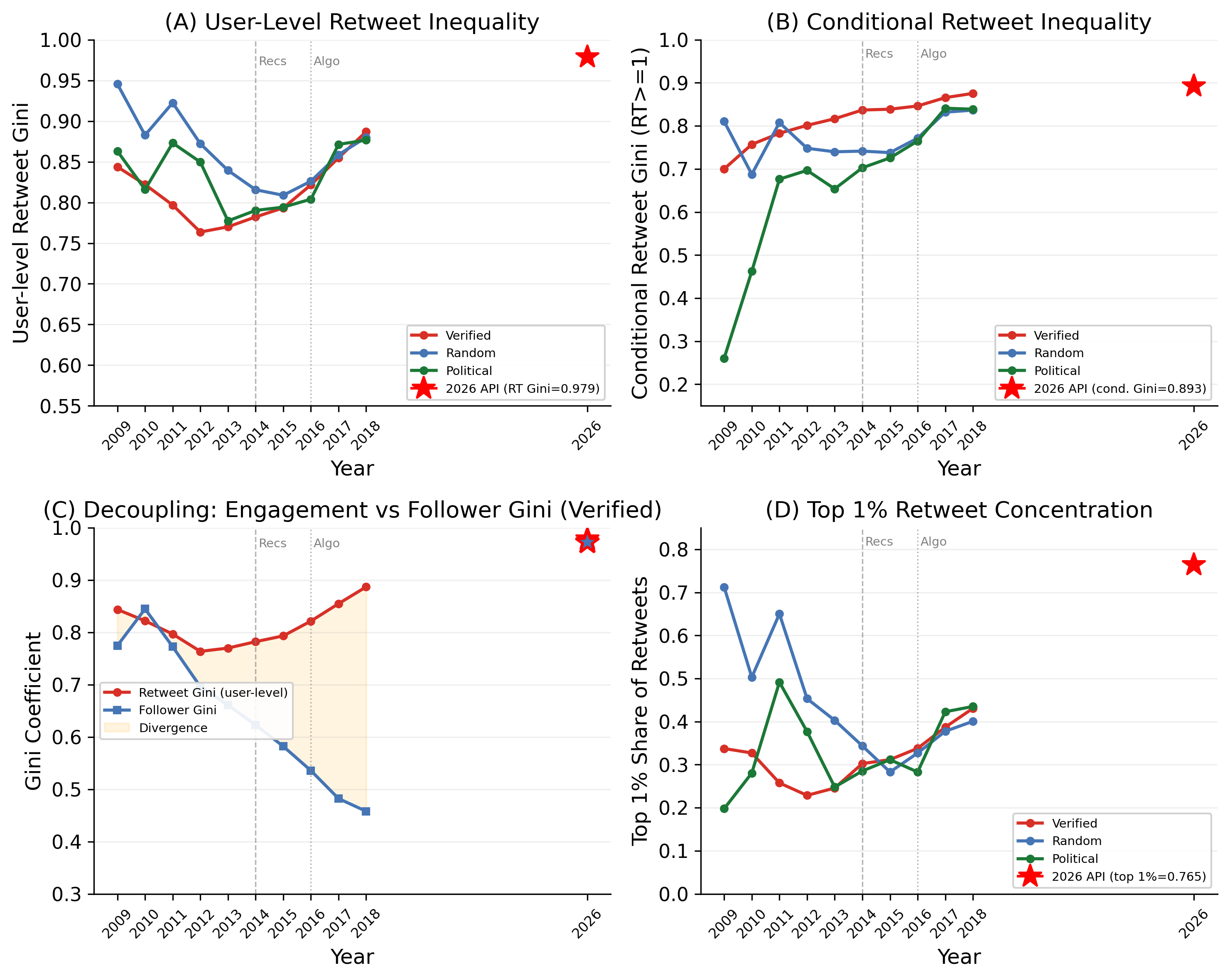
Figure 5: Temporal evolution of attention inequality, 2009–2018 (EPFL archive) with 2026 cross-dataset comparison (red star). Not a continuous time series—visual comparison across different samples and periods. Year labels are integers. (A) User- level retweet Gini. (B) Conditional Gini (RT≥1). (C) Engagement Gini rose while follower Gini fell among verified accounts. (D) Top 1% retweet concentration. Dashed lines: algorithmic feed milestones.
reports the full nested model (cross-section). Adding likes alone raises R2 from 0.501 to 0.742; adding retweets and quote tweets brings it to 0.750; the full model with squared and interaction terms reaches 0.761. This dra- matic increase reflects the tight equilibrium coupling be- tween engagement and exposure. We emphasize equi- librium: because impressions generate opportunities for likes and likes may trigger further algorithmic distribu- tion, the high R2 does not measure the causal contribu- tion of engagement. It measures how tightly the two are locked together in the platform’s steady state. Three patterns in the coupling are noteworthy. First, the likes–impressions coefficient is 1.532 (p < 0.001): posts with 1% more likes are associated with roughly 1.5% more impressions in the cross-sectional equilib- rium. Quote tweets show a similarly strong positive as- sociation (1.165, p < 0.001). These super-linear associa- tions are consistent with—but not proof of—algorithmic amplification; the reverse channel (more impressions
mechanically creating more opportunities for likes) is equally plausible. Second, the coupling is heterogeneous. The nega- tive interactions between followers and both likes (ˆα7 = −0.201, p < 0.001) and quotes (ˆα9 = −0.137, p < 0.001) mean that the conditional association of engagement with impressions is stronger for smaller accounts (Ta- ble 7). At 100 followers, an additional log-unit of likes is associated with a 1.16 log-unit difference in impres- sions; at 100,000 followers, this drops to 0.55. The pat- tern is similarly steep for quote tweets: 0.90 at 100 fol- lowers versus 0.49 at 100K. Several mechanisms could produce this pattern. Algorithmic discovery: the “For You” feed may give disproportionate visibility boosts to engagement signals from smaller accounts. Mechan- ical necessity: for a small account (e.g., 100 follow- ers) to have high likes, it must have achieved high impressions—likely via viral or algorithmic mechanics— since low-impression tweets mechanically cannot accu-
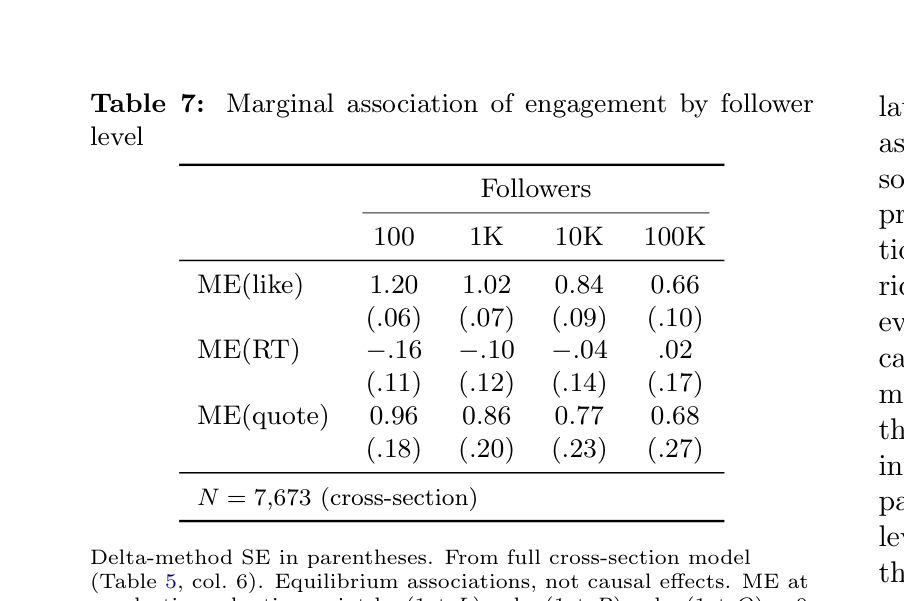
Table 7: Marginal association of engagement by follower level
lated followers generate cumulative advantage—as well as algorithmic gating mechanisms or a mixture of feed sources (Section 4). These two theories make different predictions: winner-take-all predicts discrete stratifica- tion between a talented few and the rest, while rich-get- richer predicts a smooth convex curve; our binscatter evidence is more consistent with the latter, though we cannot rule out a mixture. The secular rise in engage- ment inequality within the EPFL archive (Fact 3) shows this is not a static feature of the platform, though it co- incides with major platform structural changes and may partly reflect cohort maturation rather than platform- level evolution. The decline in follower inequality within the same cohort is likely a survivorship artifact. We are cautious about causal claims. Our data are observational and cross-sectional; the convex associa- tion between followers and impressions (Fact 2) captures a cross-sectional pattern in which larger accounts have disproportionately higher impressions, which may re- flect algorithmic amplification, network diffusion effects (larger accounts are more likely to be retweeted into new audiences), off-platform fame, content quality, or some combination. An important distinction is between demand-side explanations—audiences genuinely prefer high-follower accounts (Rosen, 1981)—and supply-side explanations—the recommendation algorithm gates vis- ibility behind engagement-velocity thresholds that high- follower accounts more easily clear, creating a mechani- cal floor for algorithmically promoted content. The ob- served convexity could be a mixture of both: the “Fol- lowing” feed distributes content roughly proportionally to followers, while the “For You” feed amplifies content that clears algorithmic thresholds. Our descriptive evi- dence cannot distinguish these channels; doing so would require feed-source attribution data or platform-side ex- perimentation (Husz´ar et al., 2022).
Followers
100 1K 10K 100K
ME(like) 1.20 1.02 0.84 0.66 (.06) (.07) (.09) (.10) ME(RT) −.16 −.10 −.04 .02 (.11) (.12) (.14) (.17) ME(quote) 0.96 0.86 0.77 0.68 (.18) (.20) (.23) (.27)
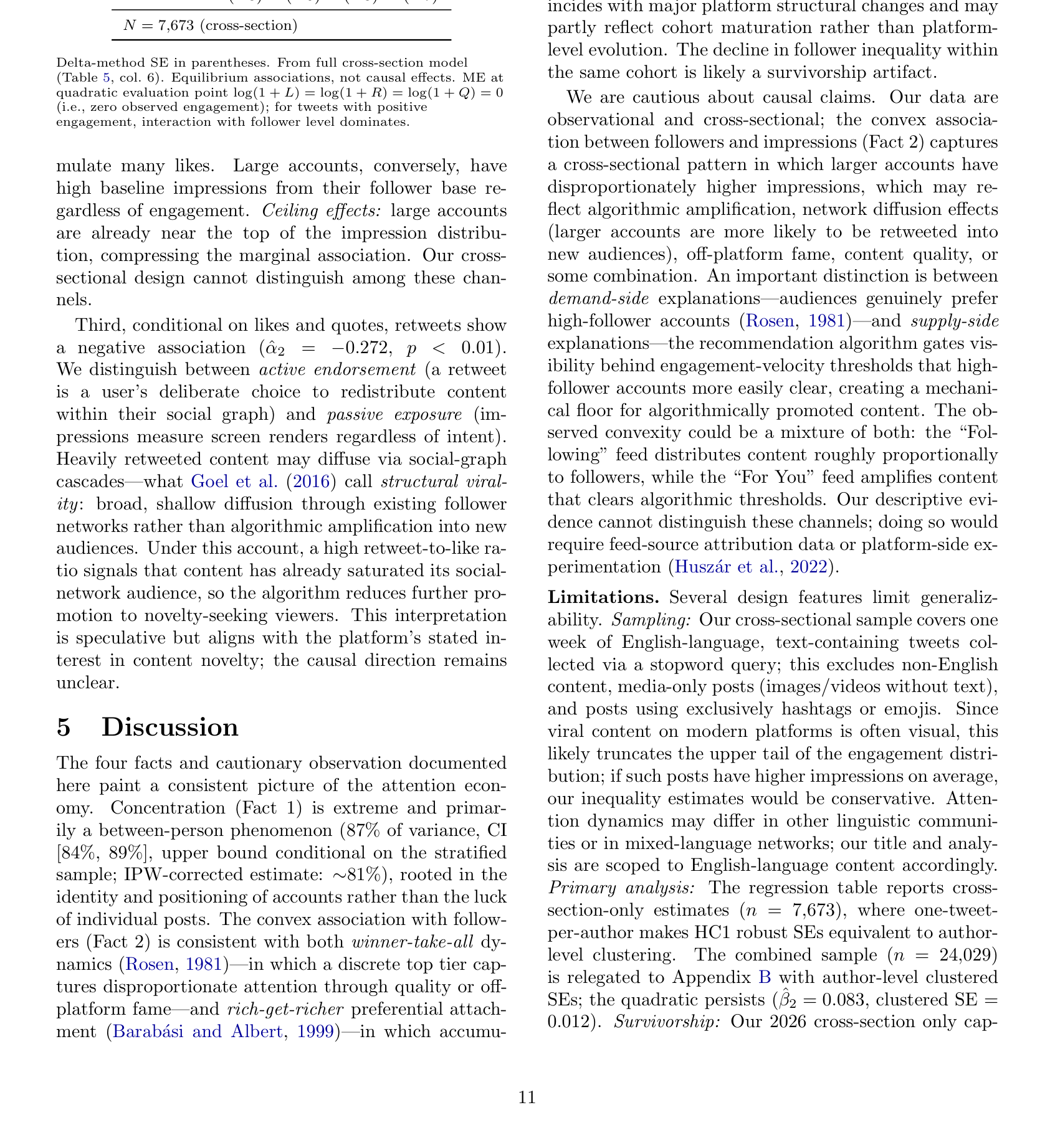
N = 7,673 (cross-section)
Delta-method SE in parentheses. From full cross-section model (Table 5, col. 6). Equilibrium associations, not causal effects. ME at quadratic evaluation point log(1 + L) = log(1 + R) = log(1 + Q) = 0 (i.e., zero observed engagement); for tweets with positive engagement, interaction with follower level dominates.
mulate many likes. Large accounts, conversely, have high baseline impressions from their follower base re- gardless of engagement. Ceiling effects: large accounts are already near the top of the impression distribu- tion, compressing the marginal association. Our cross- sectional design cannot distinguish among these chan- nels. Third, conditional on likes and quotes, retweets show a negative association (ˆα2 = −0.272, p < 0.01). We distinguish between active endorsement (a retweet is a user’s deliberate choice to redistribute content within their social graph) and passive exposure (im- pressions measure screen renders regardless of intent). Heavily retweeted content may diffuse via social-graph cascades—what Goel et al. (2016) call structural viral- ity: broad, shallow diffusion through existing follower networks rather than algorithmic amplification into new audiences. Under this account, a high retweet-to-like ra- tio signals that content has already saturated its social- network audience, so the algorithm reduces further pro- motion to novelty-seeking viewers. This interpretation is speculative but aligns with the platform’s stated in- terest in content novelty; the causal direction remains unclear.
Limitations. Several design features limit generaliz- ability. Sampling: Our cross-sectional sample covers one week of English-language, text-containing tweets col- lected via a stopword query; this excludes non-English content, media-only posts (images/videos without text), and posts using exclusively hashtags or emojis. Since viral content on modern platforms is often visual, this likely truncates the upper tail of the engagement distri- bution; if such posts have higher impressions on average, our inequality estimates would be conservative. Atten- tion dynamics may differ in other linguistic communi- ties or in mixed-language networks; our title and analy- sis are scoped to English-language content accordingly. Primary analysis: The regression table reports cross- section-only estimates (n = 7,673), where one-tweet- per-author makes HC1 robust SEs equivalent to author- level clustering. The combined sample (n = 24,029) is relegated to Appendix B with author-level clustered SEs; the quadratic persists (ˆβ2 = 0.083, clustered SE = 0.012). Survivorship: Our 2026 cross-section only cap-
5 Discussion
The four facts and cautionary observation documented here paint a consistent picture of the attention econ- omy. Concentration (Fact 1) is extreme and primar- ily a between-person phenomenon (87% of variance, CI [84%, 89%], upper bound conditional on the stratified sample; IPW-corrected estimate: ∼81%), rooted in the identity and positioning of accounts rather than the luck of individual posts. The convex association with follow- ers (Fact 2) is consistent with both winner-take-all dy- namics (Rosen, 1981)—in which a discrete top tier cap- tures disproportionate attention through quality or off- platform fame—and rich-get-richer preferential attach- ment (Barab´asi and Albert, 1999)—in which accumu-
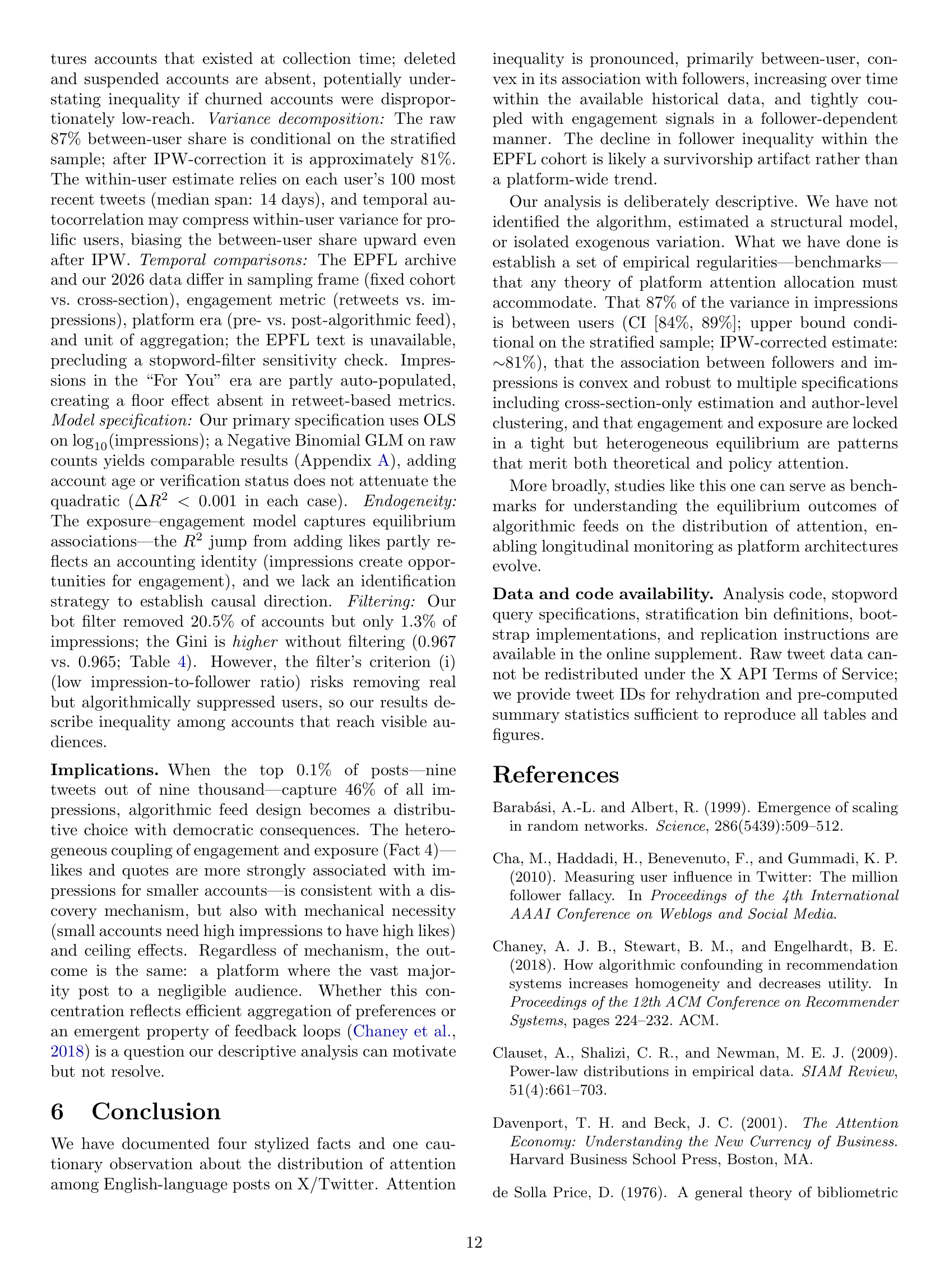
tures accounts that existed at collection time; deleted and suspended accounts are absent, potentially under- stating inequality if churned accounts were dispropor- tionately low-reach. Variance decomposition: The raw 87% between-user share is conditional on the stratified sample; after IPW-correction it is approximately 81%. The within-user estimate relies on each user’s 100 most recent tweets (median span: 14 days), and temporal au- tocorrelation may compress within-user variance for pro- lific users, biasing the between-user share upward even after IPW. Temporal comparisons: The EPFL archive and our 2026 data differ in sampling frame (fixed cohort vs. cross-section), engagement metric (retweets vs. im- pressions), platform era (pre- vs. post-algorithmic feed), and unit of aggregation; the EPFL text is unavailable, precluding a stopword-filter sensitivity check. Impres- sions in the “For You” era are partly auto-populated, creating a floor effect absent in retweet-based metrics. Model specification: Our primary specification uses OLS on log10(impressions); a Negative Binomial GLM on raw counts yields comparable results (Appendix A), adding account age or verification status does not attenuate the quadratic (∆R2 < 0.001 in each case). Endogeneity: The exposure–engagement model captures equilibrium associations—the R2 jump from adding likes partly re- flects an accounting identity (impressions create oppor- tunities for engagement), and we lack an identification strategy to establish causal direction. Filtering: Our bot filter removed 20.5% of accounts but only 1.3% of impressions; the Gini is higher without filtering (0.967 vs. 0.965; Table 4). However, the filter’s criterion (i) (low impression-to-follower ratio) risks removing real but algorithmically suppressed users, so our results de- scribe inequality among accounts that reach visible au- diences.
inequality is pronounced, primarily between-user, con- vex in its association with followers, increasing over time within the available historical data, and tightly cou- pled with engagement signals in a follower-dependent manner. The decline in follower inequality within the EPFL cohort is likely a survivorship artifact rather than a platform-wide trend. Our analysis is deliberately descriptive. We have not identified the algorithm, estimated a structural model, or isolated exogenous variation. What we have done is establish a set of empirical regularities—benchmarks— that any theory of platform attention allocation must accommodate. That 87% of the variance in impressions is between users (CI [84%, 89%]; upper bound condi- tional on the stratified sample; IPW-corrected estimate: ∼81%), that the association between followers and im- pressions is convex and robust to multiple specifications including cross-section-only estimation and author-level clustering, and that engagement and exposure are locked in a tight but heterogeneous equilibrium are patterns that merit both theoretical and policy attention. More broadly, studies like this one can serve as bench- marks for understanding the equilibrium outcomes of algorithmic feeds on the distribution of attention, en- abling longitudinal monitoring as platform architectures evolve.
Data and code availability. Analysis code, stopword query specifications, stratification bin definitions, boot- strap implementations, and replication instructions are available in the online supplement. Raw tweet data can- not be redistributed under the X API Terms of Service; we provide tweet IDs for rehydration and pre-computed summary statistics sufficient to reproduce all tables and figures.
Implications. When the top 0.1% of posts—nine tweets out of nine thousand—capture 46% of all im- pressions, algorithmic feed design becomes a distribu- tive choice with democratic consequences. The hetero- geneous coupling of engagement and exposure (Fact 4)— likes and quotes are more strongly associated with im- pressions for smaller accounts—is consistent with a dis- covery mechanism, but also with mechanical necessity (small accounts need high impressions to have high likes) and ceiling effects. Regardless of mechanism, the out- come is the same: a platform where the vast major- ity post to a negligible audience. Whether this con- centration reflects efficient aggregation of preferences or an emergent property of feedback loops (Chaney et al., 2018) is a question our descriptive analysis can motivate but not resolve.
References
Barab´asi, A.-L. and Albert, R. (1999). Emergence of scaling in random networks. Science, 286(5439):509–512.
Cha, M., Haddadi, H., Benevenuto, F., and Gummadi, K. P. (2010). Measuring user influence in Twitter: The million follower fallacy. In Proceedings of the 4th International AAAI Conference on Weblogs and Social Media.
Chaney, A. J. B., Stewart, B. M., and Engelhardt, B. E. (2018). How algorithmic confounding in recommendation systems increases homogeneity and decreases utility. In Proceedings of the 12th ACM Conference on Recommender Systems, pages 224–232. ACM.
Clauset, A., Shalizi, C. R., and Newman, M. E. J. (2009). Power-law distributions in empirical data. SIAM Review, 51(4):661–703.
6 Conclusion
Davenport, T. H. and Beck, J. C. (2001). The Attention Economy: Understanding the New Currency of Business. Harvard Business School Press, Boston, MA.
We have documented four stylized facts and one cau- tionary observation about the distribution of attention among English-language posts on X/Twitter. Attention
de Solla Price, D. (1976). A general theory of bibliometric
Kwak, H., Lee, C., Park, H., and Moon, S. (2010). What is Twitter, a social network or a news media? In Proceedings of the 19th International Conference on World Wide Web, pages 591–600. ACM.
and other cumulative advantage processes. Journal of the American Society for Information Science, 27(5):292–306.
Fleder, D. and Hosanagar, K. (2009). Blockbuster culture’s next rise or fall: The impact of recommender systems on sales diversity. Management Science, 55(5):697–712.
Merton, R. K. (1968). The Matthew effect in science. Sci- ence, 159(3810):56–63.
Garimella, K. and West, R. (2021). Evolution of retweet rates in Twitter user careers: Analysis and model. In Proceedings of the International AAAI Conference on Web and Social Media, volume 15, pages 1064–1068.
Muchnik, L., Aral, S., and Taylor, S. J. (2013). So- cial influence bias: A randomized experiment. Science, 341(6146):647–651.
Garz, M. and Dujeancourt, E. (2023). The effects of algo- rithmic content selection on user engagement with news on Twitter. The Information Society, 39(5):283–297.
Nielsen, J. (2006). Participation inequality: Encouraging more users to contribute. Nielsen Norman Group (Alert- box).
Gerbaudo, P. (2024). TikTok and the algorithmic transfor- mation of social media publics: From social networks to social interest clusters. New Media & Society.
Rosen, S. (1981). The economics of superstars. American Economic Review, 71(5):845–858.
Salganik, M. J., Dodds, P. S., and Watts, D. J. (2006). Ex- perimental study of inequality and unpredictability in an artificial cultural market. Science, 311(5762):854–856.
Goel, S., Anderson, A., Hofman, J., and Watts, D. J. (2016). The structural virality of online diffusion. Management Science, 62(1):180–196.
Simon, H. A. (1955). On a class of skew distribution func- tions. Biometrika, 42(3/4):425–440.
Goldhaber, M. H. (1997). The attention economy and the net. First Monday, 2(4).
Simon, H. A. (1971). Designing organizations for an information-rich world. In Greenberger, M., editor, Com- puters, Communications, and the Public Interest, pages 37–72. Johns Hopkins Press, Baltimore.
Hargittai, E. and Walejko, G. (2008). The participation di- vide: Content creation and sharing in the digital age. In- formation, Communication & Society, 11(2):239–256.
Hindman, M. (2009). The Myth of Digital Democracy. Princeton University Press, Princeton, NJ.
Theil, H. (1967). Economics and Information Theory. North- Holland Publishing Company, Amsterdam.
Husz´ar, F., Ktena, S. I., O’Brien, C., Belli, L., Schlaikjer, A., and Hardt, M. (2022). Algorithmic amplification of politics on Twitter. Proceedings of the National Academy of Sciences, 119(1):e2025334119.
Wu, F. and Huberman, B. A. (2007). Novelty and collec- tive attention. Proceedings of the National Academy of Sciences, 104(45):17599–17601.
IDEAS/RePEc (2022). Top economists on Twitter. IDEAS/RePEc Rankings, https://ideas.repec.org/ top/old/2212/top.person.twitter.html. Last updated December 2022; subsequently discontinued.
Zhu, L. and Lerman, K. (2016). Attention inequality in social media. arXiv preprint arXiv:1601.07200.
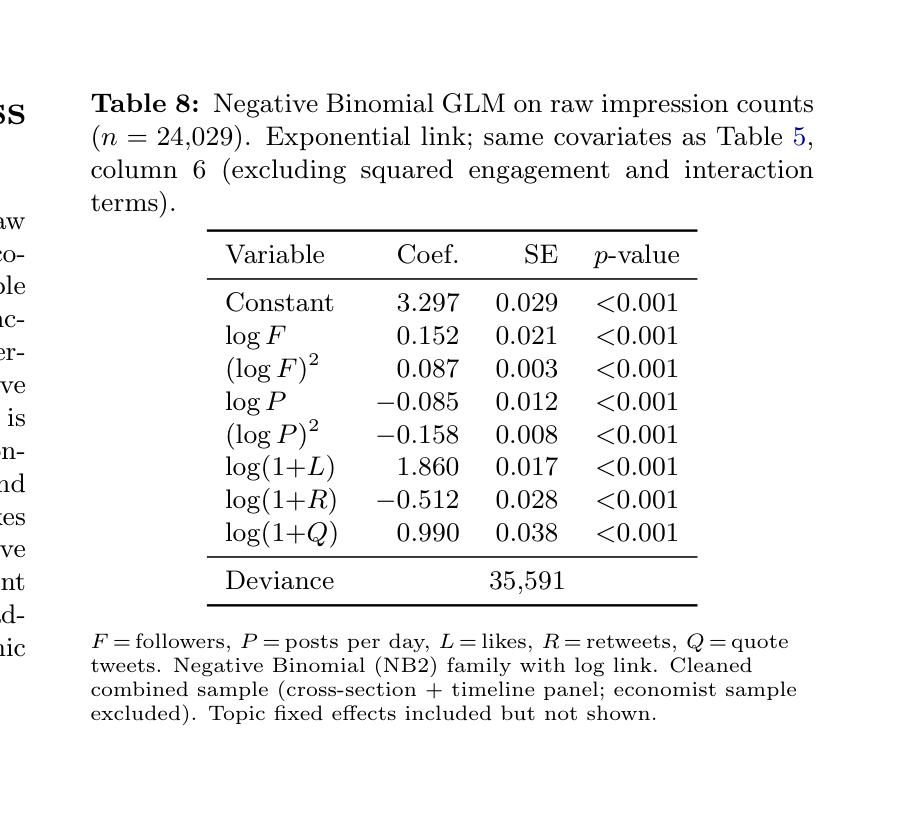
A Negative Binomial Robustness Check
Table 8: Negative Binomial GLM on raw impression counts (n = 24,029). Exponential link; same covariates as Table 5, column 6 (excluding squared engagement and interaction terms).
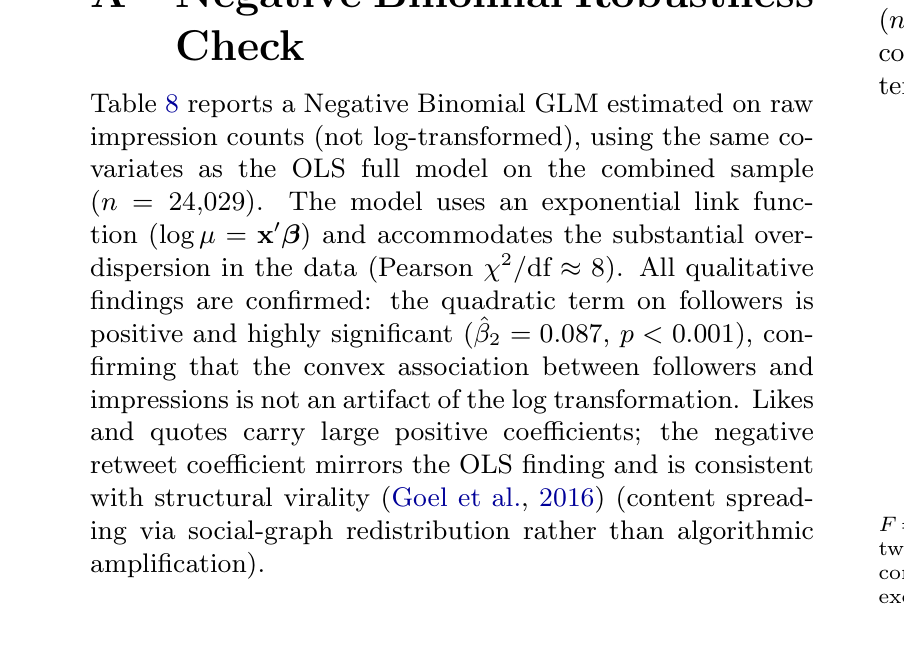
Table 8 reports a Negative Binomial GLM estimated on raw impression counts (not log-transformed), using the same co- variates as the OLS full model on the combined sample (n = 24,029). The model uses an exponential link func- tion (log µ = x′β) and accommodates the substantial over- dispersion in the data (Pearson χ2/df ≈8). All qualitative findings are confirmed: the quadratic term on followers is positive and highly significant (ˆβ2 = 0.087, p < 0.001), con- firming that the convex association between followers and impressions is not an artifact of the log transformation. Likes and quotes carry large positive coefficients; the negative retweet coefficient mirrors the OLS finding and is consistent with structural virality (Goel et al., 2016) (content spread- ing via social-graph redistribution rather than algorithmic amplification).
Variable Coef. SE p-value
Constant 3.297 0.029 <0.001 log F 0.152 0.021 <0.001 (log F)2 0.087 0.003 <0.001 log P −0.085 0.012 <0.001 (log P)2 −0.158 0.008 <0.001 log(1+L) 1.860 0.017 <0.001 log(1+R) −0.512 0.028 <0.001 log(1+Q) 0.990 0.038 <0.001
Deviance 35,591
F = followers, P = posts per day, L = likes, R = retweets, Q = quote tweets. Negative Binomial (NB2) family with log link. Cleaned combined sample (cross-section + timeline panel; economist sample excluded). Topic fixed effects included but not shown.
B Combined Model with Author-Clustered Standard Errors
The quadratic term on followers persists in all models: in the full specification, ˆβ2 = 0.083 (clustered SE = 0.012, p < 0.001). Standard errors on the linear follower term and on the retweet coefficient increase substantially relative to HC1, making those individual coefficients insignificant— but the convexity pattern (ˆβ2) remains strongly significant. Variance inflation factors for the simple engagement model (M5, no interactions) range from 1.76 to 3.78; including in- teraction terms raises VIFs mechanically to 32–104, which is expected.
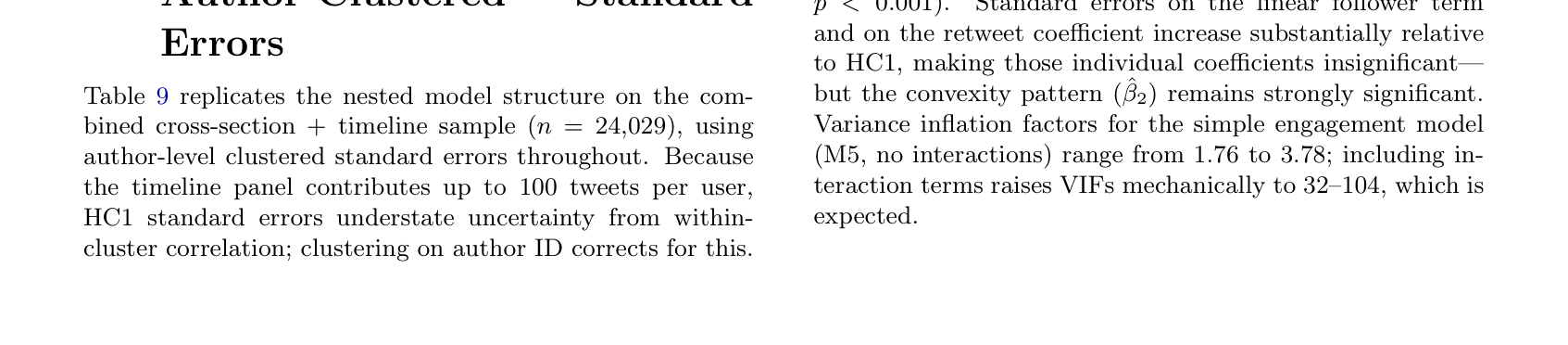
Table 9 replicates the nested model structure on the com- bined cross-section + timeline sample (n = 24,029), using author-level clustered standard errors throughout. Because the timeline panel contributes up to 100 tweets per user, HC1 standard errors understate uncertainty from within- cluster correlation; clustering on author ID corrects for this.
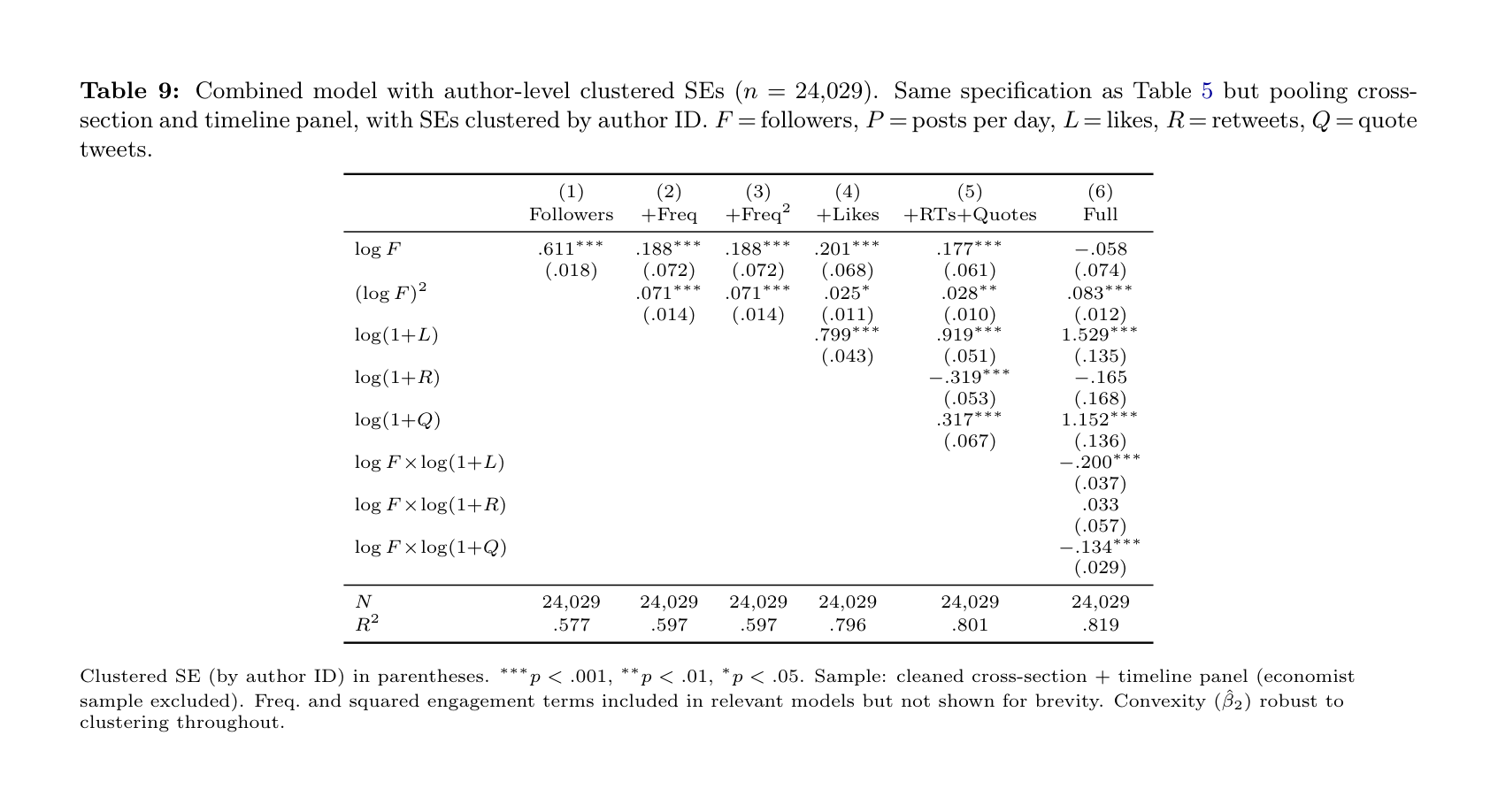
Table 9: Combined model with author-level clustered SEs (n = 24,029). Same specification as Table 5 but pooling cross- section and timeline panel, with SEs clustered by author ID. F = followers, P = posts per day, L = likes, R = retweets, Q = quote tweets.
(1) (2) (3) (4) (5) (6) Followers +Freq +Freq2 +Likes +RTs+Quotes Full
log F .611∗∗∗ .188∗∗∗ .188∗∗∗ .201∗∗∗ .177∗∗∗ −.058 (.018) (.072) (.072) (.068) (.061) (.074) (log F )2 .071∗∗∗ .071∗∗∗ .025∗ .028∗∗ .083∗∗∗
(.014) (.014) (.011) (.010) (.012) log(1+L) .799∗∗∗ .919∗∗∗ 1.529∗∗∗
(.043) (.051) (.135) log(1+R) −.319∗∗∗ −.165 (.053) (.168) log(1+Q) .317∗∗∗ 1.152∗∗∗
(.067) (.136) log F ×log(1+L) −.200∗∗∗
(.037) log F ×log(1+R) .033 (.057) log F ×log(1+Q) −.134∗∗∗
(.029)
N 24,029 24,029 24,029 24,029 24,029 24,029 R2 .577 .597 .597 .796 .801 .819
Clustered SE (by author ID) in parentheses. ∗∗∗p < .001, ∗∗p < .01, ∗p < .05. Sample: cleaned cross-section + timeline panel (economist sample excluded). Freq. and squared engagement terms included in relevant models but not shown for brevity. Convexity ( ˆβ2) robust to clustering throughout.
📝 About this HTML version
This HTML document was automatically generated from the PDF. Some formatting, figures, or mathematical notation may not be perfectly preserved. For the authoritative version, please refer to the PDF.