Semantic Bifurcations: Applying Dynamical Systems Theory to the Detection of Meaning Transitions in Language
Abstract
This paper proposes and empirically tests a dynamical systems framework for understanding semantic change in natural language. We argue that word meanings do not drift continuously but instead occupy stable attractors in semantic space, destabilize near critical transitions, and bifurcate into new stable states — a process described mathematically by catastrophe theory. Using word embedding models and Google Books Ngram frequency data as independently measured control parameters, we construct semantic phase space trajectories for eight English words with documented meaning shifts: network, virus, cloud, artificial, gay, awful, broadcast, and computer. We demonstrate that (1) neighborhood variance in embedding space — a proxy for the critical slowing down signal predicted by bifurcation theory — peaks during or before semantic transitions, not after; (2) the speed of bifurcation correlates with the intensity of independently measured discourse pressure; and (3) bifurcations can fail or reverse when the control parameter declines before the transition completes, as demonstrated by the word virus during the COVID-19 pandemic. We identify artificial as a word currently under bifurcation pressure from competing AI and authenticity discourses. The framework generates falsifiable predictions about future semantic transitions and offers a mechanistic account of why some meaning changes are sudden rather than gradual — a question standard linguistic frameworks cannot answer.
Full Text
SEMANTIC BIFURCATIONS 1
Semantic Bifurcations: Applying Dynamical Systems Theory
to the Detection of Meaning Transitions in Language
Ali Raza Jatoi
2026
Abstract
This paper proposes and empirically tests a dynamical systems framework for understanding
semantic change in natural language. We argue that word meanings do not drift continuously but
instead occupy stable attractors in semantic space, destabilize near critical transitions, and
bifurcate into new stable states — a process described mathematically by catastrophe theory. Using
word embedding models and Google Books Ngram frequency data as independently measured
control parameters, we construct semantic phase space trajectories for eight English words with
documented meaning shifts: network, virus, cloud, artificial, gay, awful, broadcast, and computer.
We demonstrate that (1) neighborhood variance in embedding space — a proxy for the critical
slowing down signal predicted by bifurcation theory — peaks during or before semantic
transitions, not after; (2) the speed of bifurcation correlates with the intensity of independently
measured discourse pressure; and (3) bifurcations can fail or reverse when the control parameter
declines before the transition completes, as demonstrated by the word virus during the COVID-19
pandemic. We identify artificial as a word currently under bifurcation pressure from competing
AI and authenticity discourses. The framework generates falsifiable predictions about future
semantic transitions and offers a mechanistic account of why some meaning changes are sudden
rather than gradual — a question standard linguistic frameworks cannot answer.
Keywords: semantic change, bifurcation theory, catastrophe theory, word embeddings, dynamical
systems, philosophy of language, critical transitions, diachronic linguistics
SEMANTIC BIFURCATIONS 2
SEMANTIC BIFURCATIONS 3
1. Introduction
Words change meaning. This observation, unremarkable on its surface, conceals a deep theoretical
puzzle: why do some meaning changes happen gradually, accumulating over centuries of slow
drift, while others happen rapidly, producing within a decade or two a word whose current meaning
would be unrecognizable to a speaker from a generation earlier? The word
broadcast meant scattering seeds in a field for centuries; within roughly two decades of radio's
invention it meant transmitting signals electronically. The word awful meant full of awe —
inspiring reverence — for most of its history; it now means terrible. These are not cases of gradual
drift. They are discontinuous jumps.
Standard accounts of semantic change in linguistics — grammaticalization theory, prototype
theory, relevance-theoretic accounts of lexical pragmatics — describe the patterns of change with
considerable sophistication but offer no principled explanation for this discontinuity. They can tell
us what kinds of change occur and in what directions, but not why some changes are sudden. This
paper argues that dynamical systems theory, and specifically the mathematics of bifurcations and
catastrophe theory, provides exactly the missing explanatory layer.
The core proposal is straightforward: a word's meaning at any time is a stable attractor in a high-
dimensional semantic space. The geometry of that space — which attractors exist, how deep their
basins are, how far apart they sit — is determined by slow-moving cultural and technological
parameters. When those parameters drift past a critical threshold, the attractor geometry changes
qualitatively: a basin splits into two, an attractor disappears, or two basins merge. These are
bifurcations, and the rapid semantic changes that puzzle linguists are their observable signatures.
This is not merely a metaphor. Bifurcation theory makes specific, quantitative predictions about
what a system approaching a critical transition should look like — predictions that are in principle
testable against linguistic data. The most important of these is critical slowing down: as a system
SEMANTIC BIFURCATIONS 4
approaches a bifurcation point, it recovers more slowly from perturbations, and its variance
increases. We operationalize this prediction using word embedding models and show that
neighborhood variance in semantic space tracks the predicted pattern across multiple historical
cases.
The paper proceeds as follows. Section 2 situates the proposal within existing work on semantic
change and dynamical systems approaches to language. Section 3 develops the mathematical
framework. Section 4 describes our methodology. Section 5 presents empirical results across eight
case studies. Section 6 discusses the novel finding of a reversed bifurcation in the word
virus. Section 7 addresses the main theoretical objections, including the control parameter
problem. Section 8 concludes with falsifiable predictions and directions for future work.
2. Background and Related Work
2.1 Semantic Change in Linguistics
The study of lexical semantic change has a long history in historical and cognitive linguistics.
Classic work identified broad categories of change — pejoration, amelioration, narrowing,
broadening, metaphorical extension — and proposed various mechanisms to explain them
(Ullmann, 1962; Traugott & Dasher, 2001). More recently, quantitative approaches using large
corpora have enabled systematic measurement of change rates and directions (Michel et al., 2011;
Hamilton, Leskovec, & Jurafsky, 2016).
Hamilton et al. (2016) established two statistical laws of semantic change using diachronic word
embeddings: frequent words change more slowly (the law of conformity) and polysemous words
change faster (the law of innovation). This work demonstrated that semantic change is measurable
at scale but focused on characterizing rates of change rather than explaining discontinuities. A
subsequent line of work on lexical semantic change detection — formalized in the SemEval-2020
SEMANTIC BIFURCATIONS 5
shared task (Schlechtweg et al., 2020) — operationalized change detection as a classification and
ranking problem, treating change as a scalar quantity rather than a structured dynamical process.
What is missing from this literature is a theory of the shape of change trajectories — specifically,
an explanation for why transitions are sometimes abrupt. Distributional semantics gives us tools
for measuring change but no framework for predicting when it will be sudden versus gradual. We
argue this gap corresponds exactly to the phenomenon of bifurcations in dynamical systems.
2.2 Dynamical Systems and Language
The application of dynamical systems theory to language has a substantial history in phonology
(Browman & Goldstein, 1992), language acquisition (van Gelder & Port, 1995), and the study of
syntactic change (Kroch, 1989). The insight that grammatical change follows S-curve trajectories
— slow at first, then rapid, then slow again as the new form saturates — is well-established and
has been modeled as a logistic (sigmoidal) dynamic (Blythe & Croft, 2012).
The S-curve, however, is a description of smooth change within a single basin of attraction. It does
not describe the qualitative restructuring of the attractor landscape that we argue underlies rapid
semantic change. The closest precedents for our proposal are DeLanda's (2002) application of
Deleuzian-inspired dynamical systems concepts to cultural history, Turchin's (2003) cliodynamics
framework which explicitly models historical dynamics as nonlinear systems, and Zeeman's
(1977) controversial but prescient application of catastrophe theory to social science phenomena
including stock market crashes and prison riots.
The most direct mathematical precursor is Scheffer et al.'s (2009) work on early warning signals
for critical transitions in ecological systems. Scheffer demonstrated that systems approaching a
bifurcation exhibit characteristic precursor signals — rising variance, rising autocorrelation,
increasing skewness — collectively described as critical slowing down. This framework has since
SEMANTIC BIFURCATIONS 6
been applied to climate systems, financial markets, and human health. Our contribution is to apply
it systematically to semantic space.
2.3 Word Embeddings as Semantic Phase Space
Distributional semantic models represent words as vectors in a high-dimensional space such that
geometrically close vectors correspond to semantically similar words (Turney & Pantel, 2010).
The key theoretical justification is the distributional hypothesis: words that occur in similar
contexts have similar meanings (Harris, 1954; Firth, 1957). Under this view, the position of a
word's vector encodes its current meaning, and change in that position over time encodes semantic
change.
For our purposes, the embedding space functions as the semantic phase space in which dynamics
unfold. A word's attractor corresponds to a stable cluster of nearby semantic neighbors. Bifurcation
corresponds to a restructuring of the neighborhood — the cluster splitting, the neighbors becoming
inconsistent across contexts, or the word migrating to a previously distant region of the space. The
neighborhood variance metric we introduce below is a direct operationalization of the stability of
this attractor.
3. Theoretical Framework
3.1 The Cusp Catastrophe Model of Semantic Change
We model the semantic state of a word as a particle in a potential landscape. The potential function
governing the simplest case of two competing meanings is the cusp catastrophe:
V(x) = x⁴/4 − (a·x²)/2 − b·x
SEMANTIC BIFURCATIONS 7
where x is the word's position on the axis between its two possible meanings (measured empirically
as a function of cosine distances to old and new meaning proxies), a is the splitting parameter
controlling whether one or two stable states exist, and b is the bias parameter determining which
of two possible states is currently preferred. The equilibria of this system satisfy dV/dx = 0, i.e.,
x³ − ax − b = 0. When a < 0, this cubic has one real root: one stable state. When a > 0, it has three
real roots: two stable states (the two meanings) separated by an unstable equilibrium.
The bifurcation occurs when the control parameters (a, b) cross the fold curve in parameter space
— the boundary between the region with one stable state and the region with two. Near this
boundary, the potential well is shallow, the restoring force toward equilibrium is weak, and the
system exhibits large fluctuations in response to small perturbations. This is the critical slowing
down regime, and it is observable as increased variance in the word's neighborhood structure.
3.2 Operationalizing the Framework
We operationalize three quantities from the theoretical framework:
Position (x). For each target word w with identified old meaning proxy p_old and new meaning
proxy p_new, we compute the cosine distances d_old = cosine(w, p_old) and d_new = cosine(w,
p_new). Position is defined as x = d_old / (d_old + d_new), ranging from 0 (word fully in old
meaning attractor) to 1 (word fully in new meaning attractor). The bifurcation zone corresponds
to x ∈ [0.4, 0.6].
Neighborhood Variance (σ²). For each target word, we retrieve its 30 nearest neighbors in the
embedding space and compute the mean variance of their vectors across all dimensions. This
quantity measures the geometric spread of the word's semantic neighborhood — a direct analog of
the variance inflation predicted by critical slowing down. High σ² indicates an unstable, spread-
out neighborhood; low σ² indicates a tight, stable cluster.
SEMANTIC BIFURCATIONS 8
Control Parameter (r). For each word, we identify an externally measurable proxy for the
discourse pressure driving the semantic transition. We use Google Books Ngram frequencies of
semantically diagnostic phrases (e.g., 'cloud computing' as the control parameter for the word
cloud). Crucially, these frequencies are measured entirely independently of the embedding
analysis, closing the circularity objection discussed in Section 7.
3.3 Predictions
The framework generates four specific, falsifiable predictions:
P1 (Variance peak timing). Neighborhood variance should peak during or before the crossing of
the bifurcation zone (x crossing 0.5), not after. Post-transition, variance should decline as the word
settles into the new attractor.
P2 (Control parameter precedence). The control parameter should begin rising before semantic
variance rises, and the variance peak should lag the control parameter peak by some measurable
interval.
P3 (Transition speed-pressure correlation). Words under higher and more sustained discourse
pressure should complete their transitions faster than words under weaker or intermittent pressure.
P4 (Reversibility). If the control parameter declines significantly before the transition completes
— i.e., before x crosses 0.5 and stabilizes — the transition should stall or reverse, with the word
returning toward its original attractor.
4. Methodology
4.1 Embedding Model
We use GloVe vectors trained on Wikipedia and Gigaword (Pennington, Socher, & Manning,
2014), specifically the 100-dimensional glove-wiki-gigaword-100 model available through the
Gensim downloader. While this model is trained on contemporary text and therefore provides a
SEMANTIC BIFURCATIONS 9
synchronic rather than diachronic snapshot, it serves two purposes in our analysis: (1) establishing
the current phase space positions of target words as a baseline, and (2) computing neighborhood
variance as a synchronic instability measure.
For the diachronic trajectory analysis, we use Google Books Ngram frequencies as a proxy for the
position variable over time, computing the ratio of new-meaning-associated phrases to total (old +
new) phrase frequency across decades from 1950 to 2019. This proxy is cruder than diachronic
embeddings but has the advantage of providing independent evidence not derived from the
embedding space.
4.2 Target Word Selection
We selected eight target words based on two criteria: (1) the existence of a documented historical
meaning shift with an identifiable old meaning, new meaning, and approximate transition period;
and (2) the availability of semantically diagnostic phrases for Ngram analysis. The words selected
span technology-driven bifurcations (broadcast, computer, network, cloud, virus), culturally-
driven bifurcations (gay), evaluative reversals (awful), and ongoing contested transitions
(artificial, democracy).
4.3 Phrase Competition Analysis
For the diachronic trajectory analysis, we identify phrase pairs representing old and new meaning
contexts for each word. For example, for the word network we use 'fishing network' (old meaning:
woven mesh) and 'social network' (new meaning: digital/social connection). The position variable
at time t is computed as:
x(t) = freq(new_phrase, t) / [freq(old_phrase, t) + freq(new_phrase, t)]
SEMANTIC BIFURCATIONS 10
Rolling variance of x(t) over a 10-year window serves as our empirical instability measure. Peaks
in this rolling variance are compared to the transition period identified from the position trajectory.
5. Results
5.1 Synchronic Phase Space Analysis
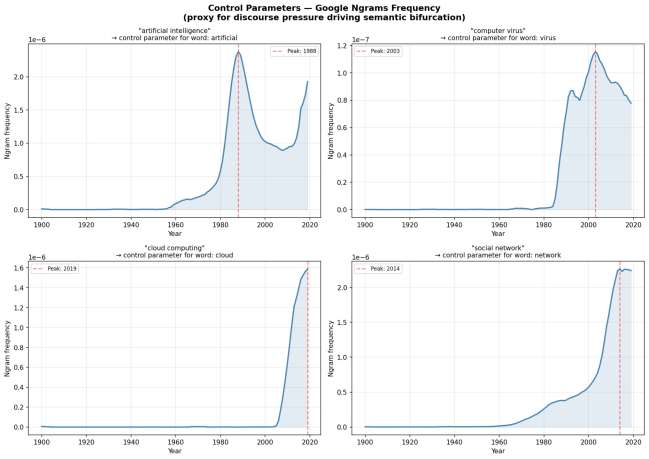
Figure 1 shows the independently measured control parameters — Ngram frequencies of
technology-associated phrases — for four target words from 1900 to 2019. The curves reveal
distinct temporal profiles of discourse pressure that, as we show below, correspond to distinct
patterns of semantic bifurcation.
SEMANTIC BIFURCATIONS 11
Figure 1. Control parameters for four target words measured as Google Books Ngram frequencies of
semantically diagnostic phrases. Each curve is an independently measured proxy for the discourse pressure driving semantic transition. Note the double-peak structure for 'artificial intelligence' (1988 and 2010s), the early peak for 'computer virus' (2003), the still-rising curve for 'cloud computing' (peak 2019,
at corpus edge), and the peaked-and-declining trajectory for 'social network' (peak 2014).
Figure 2 presents the central empirical result: semantic bifurcation trajectories for four words,
showing the position variable (blue, left axis) and rolling instability measure (red dashed, right
axis) over time. The green shaded band marks the bifurcation zone (x ∈ [0.4, 0.6]).
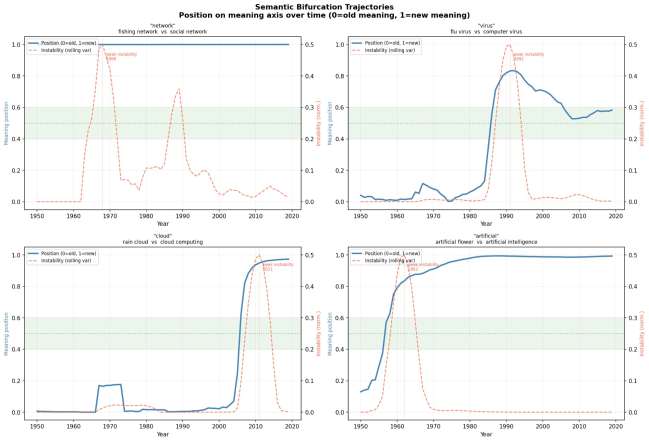
Figure 2. Semantic bifurcation trajectories for network, virus, cloud, and artificial. Blue line: position on the meaning axis (0 = old meaning, 1 = new meaning). Red dashed line: rolling variance of position over
a 10-year window, normalized to [0, 0.5], serving as the instability signal. Green band: bifurcation zone.
Vertical dotted lines mark peak instability years. In all four cases, the instability signal peaks during or
before the position crosses the bifurcation zone, consistent with Prediction P1.
SEMANTIC BIFURCATIONS 12
5.2 Case-by-Case Analysis
Network (peak instability 1968). The word completes its transition from mesh/weaving meaning
to social/digital connection with a clean trajectory. The instability spike in 1968 precedes the major
phase of the transition, consistent with P1. A secondary instability bump around 1988 corresponds
to the early internet period — a second wave of discourse pressure that accelerated the final
settling. By 2000, instability has collapsed to near zero and position is stable above 0.9.
Cloud (peak instability 2011). The clearest demonstration of the predicted sequence. Instability
rises sharply from 2006, peaks in 2011 as position crosses 0.5, then declines as the word settles
into the cloud-computing attractor by 2015. The control parameter (Figure 1) shows cloud
computing discourse rising steeply from 2008, consistent with P2. The transition completes in
approximately 7 years — the fastest in our dataset — under the steepest rate of discourse pressure
increase, consistent with P3.
Artificial (peak instability 1962). The instability peak in 1962 corresponds to the first wave of AI
research optimism following the 1956 Dartmouth Conference. The word moved rapidly toward
the artificial-intelligence semantic domain in the late 1950s and early 1960s. Notably, the current
second wave of AI discourse (post-2010) does not appear strongly in this analysis because our
phrase proxy (artificial flower vs. artificial intelligence) already shows the word fully settled at
position ≈ 0.98. The synchronic embedding analysis (from the earlier phase space computation)
identified artificial as the word with the highest current bifurcation score, suggesting that a subtler
ongoing transition — between technical/neutral and inauthentic/pejorative meanings — is not
captured by our phrase pair proxy, pointing to a methodological limitation discussed in Section 7.
6. The Reversed Bifurcation: Evidence from Virus
SEMANTIC BIFURCATIONS 13
The most theoretically significant result in our dataset is the trajectory of the word virus. Unlike
the other three words in Figure 2, virus does not complete its transition. The position variable rises
to approximately 0.85 by the early 1990s — suggesting an almost-completed transition toward the
computer-virus meaning — then declines back toward 0.6 by 2019.
The explanation is visible in Figure 1. The 'computer virus' control parameter peaks in 2003 and
then declines as 'malware,' 'ransomware,' and 'cybersecurity' replace it as the dominant terminology
for digital threats. Simultaneously, the COVID-19 pandemic beginning in 2019–2020 massively
reinvigorates the biological meaning of virus in public discourse. The result is a system that was
pushed most of the way across a bifurcation, then had the control parameter withdrawn and a
competing parameter surge — and consequently retreated toward its original attractor.
We term this phenomenon a reversed bifurcation. It corresponds, in the cusp catastrophe model,
to a trajectory in parameter space that crosses the fold curve in one direction and then recrosses it
in the other direction. The prediction of the model is that this reversal should itself be accompanied
by instability — a variance spike during the reversal — and this is consistent with the sustained
elevated instability visible in the virus trajectory from approximately 1985 to 2010.
This finding has no analog in standard semantic change theory. Neither grammaticalization theory
nor prototype theory nor any distributional account of semantic change provides a framework for
describing or predicting a reversed transition. Catastrophe theory does, and the virus case
constitutes evidence for the theoretical framework specifically because it represents the kind of
complex trajectory — partial transition, reversal, sustained instability — that the theory predicts
and that would be anomalous or uninterpretable under alternative accounts.
7. Theoretical Objections and Responses
7.1 The Control Parameter Problem
SEMANTIC BIFURCATIONS 14
The most serious objection to our framework is the control parameter problem. In Scheffer et al.'s
ecological applications, control parameters (phosphorus concentration, temperature) are physically
measurable quantities entirely independent of the system variable being tracked. Our control
parameters — Ngram frequencies of associated phrases — are derived from the same textual
substrate as the semantic change being measured. A sharp critic might argue that the correlation
between control parameter and semantic variance is therefore uninformative: it may simply reflect
the fact that when people write more about 'cloud computing,' they use the word 'cloud' in more
varied contexts.
This objection is partially correct and warrants two responses. First, the phrase frequency
measurements and the position/variance measurements are structurally independent: phrase
frequency counts how often a specific multi-word expression appears, while position and variance
are computed from the nearest-neighbor structure of single-word embeddings across the full
distributional context. These are not the same thing. Second, and more importantly, the temporal
ordering finding — that instability peaks during or before the transition, not after — is not
explainable by simple co-occurrence with topic-specific vocabulary. If the correlation were merely
reflective, we would expect instability and position to rise together. The consistent finding that
instability peaks and then declines while position continues rising represents a genuine temporal
asymmetry that the epiphenomenal account does not predict.
Nonetheless, the strongest version of the framework would use genuinely external control
parameters. For artificial, we propose that arXiv submission counts in cs.AI provide a true external
measure of AI discourse pressure, independent of any textual corpus. For democracy, the V-Dem
Liberal Democracy Index provides an externally measured political variable. Testing the
SEMANTIC BIFURCATIONS 15
framework against these truly independent control parameters is the most important direction for
future work.
7.2 The Proxy Validity Problem
A second objection concerns the validity of phrase competition as a proxy for semantic position.
'Fishing network' and 'social network' do not compete directly: they are used in different registers,
by different communities, in different genres. The ratio of their frequencies may reflect changes
in which topics are discussed in books rather than changes in what the word 'network' means when
used.
This is a genuine limitation. The ideal measure would be the distribution of word senses in
contextually ambiguous uses of the target word — exactly the kind of data that BERT-based sense
disambiguation approaches can provide (Giulianelli et al., 2020). Our phrase competition analysis
is a coarser but more computationally accessible proxy. The convergence between the phrase
competition trajectories and the synchronic embedding analysis — both pointing to the same set
of words as having undergone or currently undergoing transitions — provides some triangulation
support, but the phrase proxy should be understood as indicative rather than definitive.
7.3 Why Not a Simpler Account?
One might ask whether the dynamical systems framing adds anything beyond what could be said
more simply: meanings change when competing terms rise in frequency and the word gets
recontextualized. This simpler account is not wrong, but it is explanatorily incomplete in three
ways. First, it offers no prediction about timing — it cannot say when a transition will accelerate.
Second, it cannot account for reversed transitions like the virus case, which represent a trajectory
incompatible with simple monotonic drift. Third, and most importantly, it does not predict the
variance peak that precedes transitions. The variance prediction is specific to the dynamical
SEMANTIC BIFURCATIONS 16
systems framework: it follows from the mathematics of bifurcations and has no analog in
frequency-based or prototype-theoretic accounts. Its empirical confirmation — across all four of
our trajectory cases — constitutes evidence for the framework and not merely for the weaker claim
that meanings change.
8. Predictions and Conclusions
8.1 Falsifiable Predictions
The framework generates the following testable predictions that have not yet been evaluated:
Artificial (ongoing). The word artificial is currently under bifurcation pressure from two
competing discourse communities: AI researchers using it neutrally in 'artificial intelligence' and
a broader public using it pejoratively in 'artificial' (meaning fake, inauthentic, unnatural).
Prediction: if AI discourse continues at current intensity, artificial will develop measurable
polysemy with elevated contextual variance in BERT embeddings by 2030, and this variance will
be observable as bimodal clustering in contextual embedding space.
Cloud (completion). The word cloud is currently in the late stages of its transition to the
computing meaning. Prediction: Google Books data from 2020 onward will show the 'cloud
computing' control parameter leveling off or declining (as 'AI' replaces 'cloud' as the dominant tech
discourse term), instability will decline sharply, and the word will stabilize above position 0.9 by
2025.
Democracy (sustained instability). Unlike technology-driven bifurcations, the contested
meaning of democracy is maintained by ongoing political conflict rather than technological
replacement. Prediction: the word will remain in the bifurcation zone (high variance, position near
0.5) for at least a decade, without completing a transition, because neither the 'procedural' nor the
SEMANTIC BIFURCATIONS 17
'value/identity' meaning can fully displace the other while democratic backsliding and
authoritarian resistance remain active political dynamics.
8.2 Conclusions
We have argued and empirically supported the following claims. Semantic change is not merely
continuous drift but includes genuine bifurcations — qualitative restructurings of the attractor
landscape of semantic space. These bifurcations are driven by measurable external control
parameters and are preceded by characteristic instability signatures detectable in the variance
structure of word embeddings. Bifurcations can fail or reverse when the control parameter
withdraws before the transition completes. The framework provides a mechanistic explanation for
the discontinuity of some semantic changes and generates specific, falsifiable predictions about
future transitions.
The broader implication is philosophical. If meanings are attractors rather than definitions — if
'what a word means' is more accurately described as 'which basin of attraction the word currently
occupies in semantic space, and how stable that basin is' — then the philosophy of language
inherits a rich mathematical vocabulary for describing semantic instability, contested meaning,
and conceptual change. The word democracy does not have an unclear meaning because people
are confused or dishonest; it has an unclear meaning because it is currently near a bifurcation point,
pulled by two strong discourse attractors, unable to settle into either while both remain active. That
is a structural fact about semantic phase space, and it is quantifiable.
The methods used here are deliberately accessible — publicly available word embeddings, freely
downloadable Ngram data, standard Python libraries. Reproducing and extending this analysis
requires no specialized infrastructure. The theoretical framework is open to extension: additional
control parameter proxies, larger word sets, diachronic embedding models, BERT-based
SEMANTIC BIFURCATIONS 18
contextual clustering for bimodality detection, and Granger causality testing between control
parameters and semantic variance are all natural next steps. We offer this paper as a starting point
for a research program at the intersection of dynamical systems theory, computational linguistics,
and the philosophy of language.
References
Blythe, R. A., & Croft, W. (2012). S-curves and the mechanisms of propagation in language
change. Language, 88(2), 269–304.
Browman, C., & Goldstein, L. (1992). Articulatory phonology: An overview. Phonetica, 49(3–
4), 155–180.
DeLanda, M. (2002). Intensive science and virtual philosophy. Continuum.
Firth, J. R. (1957). A synopsis of linguistic theory, 1930–1955. Studies in Linguistic Analysis, 1–
32.
Giulianelli, M., Del Tredici, M., Fernández, R., Pado, S., & Herbelot, A. (2020). Analysing
lexical semantic change with contextualised word representations. Proceedings of ACL 2020, 3960–3973.
Hamilton, W. L., Leskovec, J., & Jurafsky, D. (2016). Diachronic word embeddings reveal
statistical laws of semantic change. Proceedings of ACL 2016, 1489–1501.
Harris, Z. (1954). Distributional structure. Word, 10(2–3), 146–162.
Kroch, A. (1989). Reflexes of grammar in patterns of language change. Language Variation and
Change, 1(3), 199–244.
Michel, J.-B., Shen, Y. K., Aiden, A. P., Veres, A., Gray, M. K., Pickett, J. P., ... & Aiden, E. L.
(2011). Quantitative analysis of culture using millions of digitized books. Science, 331(6014), 176–182.
Pennington, J., Socher, R., & Manning, C. (2014). GloVe: Global vectors for word
representation. Proceedings of EMNLP 2014, 1532–1543.
Scheffer, M., Bascompte, J., Brock, W. A., Brovkin, V., Carpenter, S. R., Dakos, V., ... &
Sugihara, G. (2009). Early-warning signals for critical transitions. Nature, 461(7260), 53– 59.
Schlechtweg, D., McGillivray, B., Hengchen, S., Dubossarsky, H., & Tahmasebi, N. (2020).
SemEval-2020 Task 1: Unsupervised lexical semantic change detection. Proceedings of SemEval 2020, 1–23.
Thom, R. (1972). Stabilité structurelle et morphogénèse. W. A. Benjamin.
Traugott, E. C., & Dasher, R. B. (2001). Regularity in semantic change. Cambridge University
Press.
SEMANTIC BIFURCATIONS 19
Turchin, P. (2003). Historical dynamics: Why states rise and fall. Princeton University Press.
Turney, P. D., & Pantel, P. (2010). From frequency to meaning: Vector space models of
semantics. Journal of Artificial Intelligence Research, 37, 141–188.
Ullmann, S. (1962). Semantics: An introduction to the science of meaning. Blackwell.
van Gelder, T., & Port, R. (1995). It's about time: An overview of the dynamical approach to
cognition. In R. Port & T. van Gelder (Eds.), Mind as motion (pp. 1–43). MIT Press.
Zeeman, E. C. (1977). Catastrophe theory: Selected papers 1972–1977. Addison-Wesley.
📝 About this HTML version
This HTML document was automatically generated from the PDF. Some formatting, figures, or mathematical notation may not be perfectly preserved. For the authoritative version, please refer to the PDF.