The Cultural Cost of Overwork: Evidence from Switzerland’s Röstigraben
Abstract
Does culture shape how burdensome overtime work feels to workers? We exploit Switzerland’s linguistic border, the Röstigraben, where French- and German-speaking workers share the same labor laws but inherit different attitudes toward work and leisure. Using data from the Swiss Household Panel (1999–2023), we show that each extra hour beyond the contract raises work-life interference by 0.038 points (on a 0–10 scale) more for German- speaking workers than for French-speaking workers, an effect that is modest in absolute terms (0.12 within-person standard deviations at mean overwork) but represents a 152% amplification of the French-speaking baseline. This cultural amplification is concentrated among part-time workers, for whom contractual hours more explicitly demarcate the work-leisure boundary; the effect vanishes when the hours gap is measured relative to habitual rather than contractual hours, consistent with a reference-point mechanism. Despite bearing higher psychological costs, German-speaking workers do not detectably adjust their labor supply differently at the annual horizon: they do not correct overwork episodes faster, do not bunch more tightly at contractual hours, and do not exit overwork situations through job changes.
Full Text
The Cultural Cost of Overwork: Evidence from Switzerland’s Röstigraben*
Giulian Etingin-Frati† Nicolas Marti‡
April 3, 2026
Abstract
Does culture shape how burdensome overtime work feels to workers? We exploit Switzerland’s linguistic border, the Röstigraben, where French- and German-speaking workers share the same labor laws but inherit different attitudes toward work and leisure. Using data from the Swiss Household Panel (1999–2023), we show that each extra hour beyond the contract raises work-life interference by 0.038 points (on a 0–10 scale) more for German-speaking workers than for French-speaking workers, an effect that is modest in absolute terms (0.12 within-person standard deviations at mean overwork) but represents a 152% amplification of the French-speaking baseline. This cultural amplification is con- centrated among part-time workers and women; for men, the effect appears exclusively in the part-time subsample, consistent with a contractual-salience mechanism that operates primarily for men; the effect vanishes when the hours gap is measured relative to habitual rather than contractual hours, consistent with a reference-point mechanism. Despite bearing higher psychological costs, German-speaking workers do not detectably adjust their labor supply differently at the annual horizon: they do not correct overwork episodes faster, do not bunch more tightly at contractual hours, and do not exit overwork situations through job changes.
JEL Classification: J22, J28, Z13, R12
Keywords: overwork, cultural norms, contractual salience, work-life interference, reference- dependent preferences
*This paper was produced as a human-AI collaboration to investigate the current capabilities of large language models in applied economics research. Claude 4.6 (Anthropic) and Gemini 3 Pro (Google, via Antigravity) were used throughout the research process, including literature review, hypothesis development, coding of the empirical analysis, drafting, and revision. AI-generated referee reports were used to stress-test the arguments and identify weaknesses. The human authors directed the research agenda and made all final decisions on methodology, inter- pretation, and presentation. This study uses data collected by the Swiss Household Panel (SHP), which is based at the Swiss Centre of Expertise in the Social Sciences FORS. The project is supported by the Swiss National Science Foundation. †KOF Swiss Economic Institute, ETH Zurich, Leonhardstrasse 21, 8092 Zurich, Switzerland. E-mail: etingin- frati@kof.ethz.ch
‡KOF Swiss Economic Institute, ETH Zurich, Leonhardstrasse 21, 8092 Zurich, Switzerland. E-mail: marti@kof.ethz.ch
1 Introduction
Modern labor markets are characterized by a persistent tension between contractual obliga- tions and the implicit expectation of discretionary effort. While economic theory typically models labor supply as a tradeoff between leisure and income,1 the psychological cost of “over- work” (the gap between actual and contractual hours) may depend heavily on the cultural scripts through which workers interpret their professional obligations. When does an extra hour of work feel like a fair exchange, and when does it feel like a violation of the bound- ary between professional and private life? Answering this question requires a setting where workers share the same institutions but differ in cultural norms.
This paper asks whether cultural norms shape the psychological cost of working beyond con- tractual hours. We argue that they do, and that the magnitude of this cultural effect depends on how prominently the employment contract marks the work-leisure boundary. Testing this claim requires a setting in which individuals share identical institutional constraints but dif- fer in deep-seated cultural norms. Switzerland provides precisely such a natural experiment. French-speaking and German-speaking workers operate under the same federal labor code, face similar tax considerations2, and participate in the same macroeconomic environment, yet they inherit strikingly different historical attitudes toward work, leisure, and the boundary be- tween professional and personal life (Brügger et al., 2009; Eugster et al., 2017). The linguistic border that separates these communities, colloquially known as the Röstigraben, allows us to estimate the cultural moderation of the psychological costs of labor supply.
Using 25 waves of the Swiss Household Panel (SHP, 1999–2023), we construct a longitudi- nal dataset of employed individuals in German- and French-speaking cantons. We define "overwork" as the gap between actual weekly hours worked and contractual hours per week. Exploiting within-person variation, we estimate how each additional hour of overwork dif- ferentially affects French-speaking workers across a battery of burnout outcomes (post-work exhaustion, work-life interference, and difficulty disconnecting) as well as domain-specific sat- isfaction measures.
Three main findings emerge. First, each additional hour of overwork raises work-life inter- ference by 0.038 points on a 0–10 scale (p < 0.001) more for German-speaking workers than for French-speaking workers, an effect that is modest in absolute terms (0.12 within-person standard deviations at mean overwork) but represents a 152% amplification of the French- speaking baseline overwork cost. Post-work exhaustion shows a similar pattern (p < 0.001), though this result is sensitive to outlier trimming and should be treated as corroborating rather than definitive. German-speaking norms, which place a premium on strict contractual bound- ary compliance and the protection of leisure time (the “Feierabend” principle), generate a higher marginal penalty per hour of contract violation. Critically, this effect is absent among full-time men—the largest demographic subgroup (N = 30,494)—and is concentrated among part-time workers and women. For men, the cultural penalty appears exclusively in the part- time subsample ( ˆβ3 = −0.054, p < 0.001), with the full-time male interaction precisely zero ( ˆβ3 = −0.002, p > 0.8). For women, the cultural moderation does not depend on contract type. Within part-time workers, men show a larger cultural interaction than women. The pattern is consistent with a contractual-salience mechanism that operates primarily for men: part-time contracts more explicitly demarcate the work-leisure boundary, and German-speaking norms
1See, for example, Heckman (1993) and Lucas and Rapping (1969). 2Within bilingual cantons, municipalities on both sides of the language border share the same cantonal tax schedule and set only a scalar multiplier on it (Eugster and Parchet, 2019). These multipliers converge at the border due to fiscal competition. The Federal Act on the Harmonization of Direct Taxes (StHG) further ensures a uniform tax base nationwide. Work incentives at the Röstigraben are therefore comparable across language regions.
amplify the cost of violating it. We caution, however, that full-time men—the largest single subgroup—show zero cultural moderation, so the main result should not be interpreted as a universal feature of the German-speaking labor market.
Second, overwork also reduces satisfaction with free time (p < 0.001) more for German- speaking workers. Life satisfaction (p = 0.076) and job satisfaction (p = 0.069) do not reach conventional significance thresholds. The cultural penalty thus operates primarily through specific boundary-related channels rather than through broad reductions in global well-being.
Third, despite bearing higher psychological costs, German-speaking workers do not detectably adjust their labor supply differently at the annual horizon of our survey. They do not bunch more tightly at contractual hours, do not correct overwork episodes faster, and do not exit overwork situations through job changes at higher rates. We cannot rule out within-year ad- justments that are resolved before the next survey wave. This absence of detectable differential behavioral response is consistent with either a “constrained preferences” view (Knaus and Ot- terbach, 2019) or rational non-response to welfare costs that are modest in absolute terms. A placebo test is consistent with the cultural penalty being specific to overwork and absent for underwork, while an income analysis rules out differential compensation as an alternative explanation.
We make three contributions relative to the existing Röstigraben literature. First, while prior work documents that cultural norms at the linguistic border shape unemployment duration (Eugster et al., 2017), demand for redistribution (Eugster et al., 2011), and female labor-force participation (Steinhauer, 2018), we show that culture also operates on the intensive margin: the psychological cost of each additional hour of work beyond the contract. This is distinct from the extensive-margin effects documented previously. Second, we develop a conceptual framework of contractual salience: the employment contract serves as a reference point (Kahne- man and Tversky, 1979; K˝oszegi and Rabin, 2006; Hart and Moore, 2008) whose psychological prominence varies with contract type and is culturally amplified (Bordalo et al., 2012, 2013). The sharpest evidence for this mechanism is that the cultural penalty appears only when the hours gap is measured against contractual hours (p < 0.001) and vanishes when measured against habitual hours (p = 0.548), a distinction the prior literature has not tested. Third, by documenting the absence of detectable differential behavioral adjustment at the annual fre- quency across the linguistic divide despite differential psychological costs, we extend the lit- erature on work-hour mismatches (Knaus and Otterbach, 2019), showing that culture shapes the subjective evaluation of labor supply without generating behavioral responses observable in annual panel data.
The remainder of the paper proceeds as follows. Section 2 reviews the institutional context of the Swiss labor market and the relevant empirical literature. Section 3 develops a concep- tual framework of reference-dependent labor supply with cultural heterogeneity, deriving four testable predictions. Section 4 describes the dataset and our econometric identification strat- egy. Section 5 presents our findings on the cultural modulation of labor supply costs. Section 6 concludes.
2 Institutional Background and Literature
2.1 The Swiss Cultural Divide
Switzerland’s linguistic border runs roughly north–south through the cantons of Bern, Fri- bourg, and Valais, separating a German-speaking majority (about 63% of the population) from a French-speaking minority (23%). The border has been remarkably stable since the early mod-
ern period; it does not coincide with cantonal boundaries, administrative districts, or major geographic barriers, making it a credible source of exogenous variation in cultural exposure (Brügger et al., 2009).
Several studies exploit the linguistic border as a natural experiment, using spatial regres- sion discontinuity designs to isolate cultural effects from institutional and environmental con- founds. This approach complements the broader literature on culture and economic outcomes (Alesina and Giuliano, 2015) and the epidemiological approach to identifying cultural trans- mission (Giuliano, 2007; Luttmer and Singhal, 2011). These studies document sharp discon- tinuities in a range of economic attitudes and behaviors. German-speaking communities are substantially less supportive of redistributive social insurance (Eugster et al., 2011) and prefer lower taxes with less redistribution (Eugster and Parchet, 2019). They also exhibit shorter un- employment durations and stronger work-first attitudes (Eugster et al., 2017). Female labor- force participation is lower on the German-speaking side, consistent with more traditional gender-role norms (Steinhauer, 2018). Most recently, Faessler et al. (2024) find discontinuities in voting on health and fertility-related policy, suggesting that cultural differences at the bor- der extend to choices with direct consequences for mortality and reproduction. Deopa and Fortunato (2021) document that German-speaking cantons reduced mobility for non-essential activities significantly more than French-speaking cantons during COVID-19 lockdowns, con- sistent with stronger norm compliance on the German-speaking side. Across domains, the border captures deep-seated differences in attitudes toward effort, independence, and the bal- ance between market and non-market time.
All of these preference differences exist within a unified institutional framework. Federal labor law sets uniform standards for maximum working hours (45–50 hours per week depending on the sector), overtime compensation, and contract termination3. Unemployment insurance is governed by a single federal statute with identical replacement rates and benefit durations4. Tax schedules are set at the federal and cantonal levels, but the cantonal variation does not align neatly with the language border. This institutional uniformity allows us to attribute differential trends in overwork to cultural factors rather than to regulatory differences.
2.2 The Economics of Working-Time Preferences
The neoclassical labor-supply model predicts that hours are determined by the intersection of wage rates and preferences for leisure. In a frictionless market, actual hours equal desired hours. Reality departs from this benchmark in two well-documented ways. First, employers face coordination costs and fixed costs per worker that incentivize the bundling of hours into standardized schedules, creating “hours constraints.” Workers may be unable to choose their preferred hours and instead select from a discrete set of employer-offered packages. Second, social norms shape the reference point against which hours are evaluated. A 42-hour work week might be perceived as “normal” in Zurich but excessive in Geneva5.
3The structural parameters of employment are codified at the federal level, primarily through the Labour Act (Arbeitsgesetz, ArG, SR 822.11) and the Code of Obligations (OR, SR 220). The ArG prescribes a maximum weekly ceiling of 45 hours for industrial and technical workers, office staff, and large-scale retail employees, while a 50- hour limit applies to other sectors. The Code of Obligations also ensures a unified national standard for ’freedom of termination’ (Kündigungsfreiheit) and the mandatory 25% premium for overtime, effectively neutralizing institu- tional variance in the legal cost of labor across the linguistic divide. 4Unemployment compensation is strictly harmonized under the Federal Act on Compulsory Unemployment Insurance (Arbeitslosenversicherungsgesetz, AVIG, SR 837.0). While the administrative execution of these benefits is decentralized through cantonal unemployment offices (KAST/OCIRT), the eligibility criteria and fiscal parameters remain invariant across linguistic regions. 5In 2024, the average Swiss working time in hours per week was 41.6. In Zurich, this was 41.7 hours per week. Geneva was lowest, with 40.9 (Federal Statistical Office, 2024).
The well-being consequences of work hours depend less on their absolute level than on the gap between actual and preferred hours. Wooden et al. (2009) establish this point using Australian panel data: hours mismatches reduce job and life satisfaction by magnitudes comparable to acquiring a disability, while total hours alone have little independent effect. Lepinteur (2019) similarly finds that legislated workweek reductions that narrow the gap between actual and desired hours raise worker well-being, while Bell and Freeman (2001) document large cross- country differences in hours worked between the US and Germany that cannot be explained by wages alone, pointing to cultural and institutional factors. The damage is asymmetric: a large share of British workers report a mismatch between actual and desired hours, with the ma- jority of mismatched workers preferring fewer hours (Bell and Blanchflower, 2011). Otterbach (2010) documents the prevalence of hours constraints across 21 countries, including Switzer- land, finding that the desire for additional or fewer hours is strongly related to macroeconomic conditions, income inequality, and working conditions. These findings motivate our focus on the hours gap rather than on absolute hours. We depart from the existing literature by using contractual hours rather than stated preferences as the reference point, a choice we justify in Section 3.
2.3 Cultural Norms and the Cost of Effort
Overwork represents an upward shift in labor supply at the intensive margin. In a standard framework, workers supply effort until the marginal utility of income equals the marginal disutility of labor. This disutility is not a biological constant; it is socially constructed and reference-dependent. Taxi drivers set daily income targets that generate negative labor sup- ply elasticities (Camerer et al., 1997). 6 Workers bunch at institutionally defined thresholds such as statutory retirement ages even without financial incentives to do so (Seibold, 2021). In a field experiment with Zurich bicycle messengers, Fehr and Goette (2007) find that loss- averse workers sign up for more shifts when wages rise but exert less effort per shift. The same logic scales to aggregate outcomes: while Prescott (2004) attributes cross-country hours differences primarily to differential marginal tax rates, Alesina et al. (2005) argue that social norms determine equilibrium hours, distinguishing cultures that prioritize income from those that prioritize leisure.
If work-ethic norms create stronger social-compliance pressure to demonstrate dedication through long hours, overwork may be perceived as a virtuous signal or a necessary duty. In French-speaking regions, where cultural baselines place greater value on the protection of private time (Brügger et al., 2009; Ashforth et al., 2000; Clark, 2000), the same level of overwork may be experienced as a costly violation of the social contract. Cross-national evidence sup- ports this reasoning: Falk et al. (2018) document substantial variation in economic preferences (including patience and willingness to work) across 76 countries, while Hamermesh and Lee (2007) show that cross-country differences in subjective time stress reflect genuine preference heterogeneity rather than mere “yuppie kvetch.” In a meta-analysis of 332 studies across 58 countries, Allen et al. (2020) find that cultural values moderate the wellbeing consequences of work-family conflict. The disutility of an extra hour is higher in the French-speaking region not because the work is harder, but because it conflicts more sharply with the prevailing cultural schema of a good life.
Our contribution is to test this hypothesis using within-country variation. Rather than com- paring countries with different labor laws, we compare individuals who face the same legal and economic incentives but differ in the cultural lens through which they evaluate the effort– reward bargain.
6However, whether income or hours constitutes the operative reference point remains contested (Farber, 2008; Crawford and Meng, 2011).
2.4 Hours Constraints and Behavioral Adjustment
A central question in labor economics is whether workers who experience a mismatch between actual and desired hours can adjust. The canonical model assumes that workers freely choose hours across jobs, so that job mobility resolves mismatches (Hamermesh, 1999). In practice, frictions are large. Knaus and Otterbach (2019) find that even among job movers in the Ger- man Socio-Economic Panel, resolution rates of work-hour mismatches remain below 40%, with a substantial share of adjustment occurring through changes in desired hours rather than ac- tual hours. Workers adapt preferences to constraints rather than the reverse. Booth and van Ours (2013) find that partnered women in part-time work in the Netherlands report high job satisfaction and low desire to change hours, suggesting that part-time employment is a stable equilibrium rather than a transitional phase toward full-time work.
Two perspectives explain this inertia. Chetty (2012) shows that when optimization frictions exist (adjustment costs, inattention, status quo bias), the utility cost of failing to adjust is often less than 1% of earnings; small frictions rationalize large behavioral inertia. Pencavel (2016) argues that observed hours reflect employer demand at least as much as worker preferences, implying that hours are often set by firms rather than freely chosen by workers. Together, these results predict that even a large cultural amplification of overwork’s psychological cost may fall below the threshold needed to trigger costly behavioral adjustment.
The behavioral response to overwork may also depend on the cultural meaning attached to the mismatch. Avgoustaki and Cañibano (2020) show that the well-being consequences of long hours depend critically on whether the effort is intrinsically or extrinsically motivated, suggesting that the same objective hours can generate very different psychological costs de- pending on how they are interpreted. Ichino and Maggi (2000) provide evidence that regional cultural norms within Italy predict absenteeism differentials within the same firm, demonstrat- ing that work effort norms vary systematically within a country and affect observable behavior. The epidemiological approach (studying immigrants to isolate culture from institutions) has been applied to labor supply by Fernández and Fogli (2009), who show that source-country female labor-force participation rates predict immigrant women’s work decisions in the U.S., confirming a causal role for cultural transmission.
2.5 The Röstigraben as a Natural Experiment
The Swiss linguistic border has emerged as one of the cleanest natural experiments for study- ing cultural effects on economic outcomes. Eugster et al. (2017) exploit the sharp change in survey-reported work attitudes at the French-German border to show that Romance-language speakers search for work almost seven weeks (22%) longer than their German-speaking neigh- bors, despite facing very similar labor-market conditions and identical unemployment insur- ance rules. Eugster et al. (2011) document that demand for redistributive social insurance is substantially lower in German-speaking communities. Cattaneo and Winkelmann (2005) show that the Swiss labor market is well integrated across the language border, with no significant earning differentials after controlling for selection, confirming that the border captures cultural rather than economic differences. Stutzer and Lalive (2004) demonstrate that stronger social work norms on the German-speaking side accelerate job search but also amplify the well-being costs of unemployment (unemployed individuals report lower life satisfaction in communities with stronger work norms), providing direct evidence that cultural attitudes at the Röstigraben shape both labor market behavior and subjective well-being.
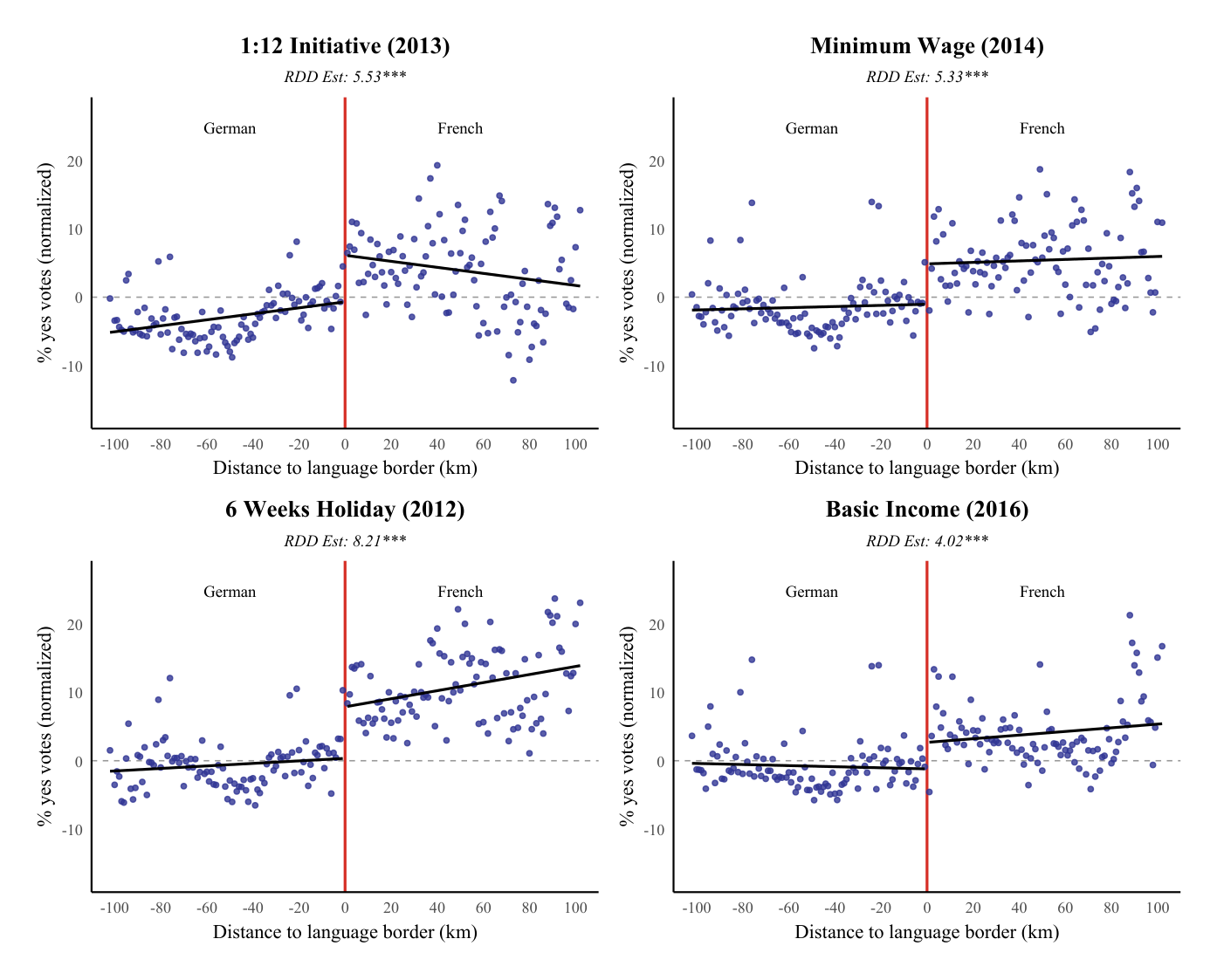
Figure 1 provides direct evidence of the cultural divide on work-related issues. Eugster et al. (2017) similarly use referendum results to document sharp discontinuities in policy preferences at the language border; we replicate their approach with four more recent referenda directly
related to labor policy (the 1:12 Initiative on executive pay, 2013; the minimum wage initiative, 2014; the six-weeks holiday initiative, 2012; and the basic income initiative, 2016), sourced from the Swissvotes database (Année Politique Suisse, 2024), and estimate a sharp regression dis- continuity at the linguistic border. In all four cases, support for the worker-protective position jumps discontinuously on the French-speaking side, with RDD estimates ranging from 4.0 to 8.2 percentage points (all p < 0.01). These voting patterns confirm that the Röstigraben cap- tures deep-seated differences in attitudes toward labor regulation and the work-leisure trade- off, precisely the cultural channel our analysis exploits. We use this variation not as a spatial regression discontinuity (the SHP lacks municipality geocodes for most observations) but as a source of cross-sectional cultural heterogeneity combined with within-person panel variation. Our design documents a robust conditional panel fact, that the within-person overwork slope differs systematically by language region, rather than satisfying the full identification standard of a geographic discontinuity.
RDD Est: 5.53*** 1:12 Initiative (2013)
RDD Est: 5.33*** Minimum Wage (2014)
German French
German French
20
20
% yes votes (normalized)
% yes votes (normalized)
10
10
0
0
-10
-10
-100 -80 -60 -40 -20 0 20 40 60 80 100 Distance to language border (km)
-100 -80 -60 -40 -20 0 20 40 60 80 100 Distance to language border (km)
RDD Est: 8.21*** 6 Weeks Holiday (2012)
RDD Est: 4.02*** Basic Income (2016)
German French
German French
20
20
% yes votes (normalized)
% yes votes (normalized)
10
10
0
0
-10
-10
-100 -80 -60 -40 -20 0 20 40 60 80 100 Distance to language border (km)
-100 -80 -60 -40 -20 0 20 40 60 80 100 Distance to language border (km)
Figure 1: Regression discontinuity in municipality-level voting on labor-related referenda at the Swiss linguistic border, following the RDD visualization approach in Eugster et al. (2017). Each panel plots the share of “yes” votes against distance to the French-German language border (km), with negative distances denoting the German-speaking side. Observations binned by 1 km intervals, weighted by municipality population. Lines show local linear fits. RDD estimates and significance levels reported in subtitles. Data: Swissvotes (Année Politique Suisse, 2024); geographic boundaries and municipality language assignments from swisstopo (Federal Office of Topography , swisstopo).
3 Conceptual Framework
We develop a framework of reference-dependent labor supply in which cultural norms inter- act with the salience of employment contracts. The model combines three ideas: reference- dependent preferences (K˝oszegi and Rabin, 2006), contracts as reference points (Hart and Moore, 2008), and salience-driven attention (Bordalo et al., 2012, 2013). The central contribu- tion is contractual salience: the psychological prominence of the work-leisure boundary varies with contract type, and culture amplifies this variation. The framework generates four testable predictions that organize the empirical analysis.
3.1 Setup
A worker i in cultural group c ∈{F, G} (French, German) holds a contract specifying hours ¯hi and a base wage w. The employer sets actual hours hi, which may exceed ¯hi.7 Overtime is compensated at rate ϕ ≥0. Define ∆i ≡hi −¯hi as the hours gap.
3.2 Contractual Salience
Not all contracts are equally prominent as reference points. A full-time contract (¯h ≈42) spec- ifies the default arrangement, the unmarked case. A part-time contract (¯h < 35) is a deliberate departure from the default: an explicit signal that the worker values limited hours. Follow- ing the salience literature (Bordalo et al., 2012, 2013), attributes that deviate from the norm attract disproportionate attention. Applied to employment contracts: the more a contract de- parts from the full-time default, the more psychologically prominent the contractual boundary becomes.
We capture this with a salience function σ(¯hi) ∈[0, 1], weakly decreasing in contractual hours:
σ(¯hPT) > σ(¯hFT) ≥0. (1)
σ measures how prominently the contract marks the work-leisure boundary. When σ is high, contractual hours serve as a vivid psychological benchmark; when σ is low, the contract fades into the background. A second implication is that σ applies specifically to formal contractual commitments. Habitual or “reference” hours (what a worker normally works, as opposed to what the contract stipulates) are informal and self-defined: they carry no legal weight and no explicit signal of a chosen work-leisure allocation. Because they lack the formality that con- fers psychological salience, deviations from habitual hours generate little reference-dependent disutility. A worker who exceeds their usual hours may feel busy; a worker who exceeds their contractual hours experiences a boundary breach.
3.3 Preferences
The worker’s utility is Ui = u(yi) −v(hi) −φc(∆i, σi), (2)
where u(·) is increasing and concave (consumption utility), v(·) is increasing and convex (disu- tility of labor), and φc is a reference-dependent penalty. The contract-as-reference-point inter- pretation follows Hart and Moore (2008); the piecewise-linear form follows the prospect-theory
7This reflects the evidence on hours constraints in European labor markets (Hamermesh, 1999; Knaus and Otterbach, 2019). Even in relatively flexible markets, within-job hours adjustments are limited.
tradition (Kahneman and Tversky, 1979; Tversky and Kahneman, 1991; K˝oszegi and Rabin, 2006):
λc · σ · ∆ if ∆> 0 (overwork)
φc(∆, σ) =
η · ∆ if ∆≤0 (underwork) (3)
For overwork (∆> 0), the penalty is the product of three terms: a cultural parameter λc, contractual salience σ, and the hours gap ∆. The cultural assumption is:
λG > λF ≥0. (4)
German-speaking norms, which place a higher premium on contractual compliance and the protection of leisure time (the Feierabend principle), generate a higher marginal penalty per hour of contract violation (Brügger et al., 2009; Eugster et al., 2017). For underwork (∆≤0), the gain parameter η carries no cultural subscript and no salience weight: culture and salience operate asymmetrically, amplifying only the cost of overwork. The intuition is that working fewer hours than the contract specifies does not intrude on private life (it expands it), so the cultural boundary-protection norm is not activated.
3.4 The Cultural–Salience Interaction
The model’s key mechanism is the interaction between culture and contractual salience. The marginal cultural excess cost of overwork is:
(λG −λF) · σ(¯hi) · ∆i. (5)
This product implies that the cultural wedge between German and French speakers scales with contractual salience. For full-time workers (σ low), the cultural difference in overwork costs is attenuated; for part-time workers (σ high), it is amplified. The same cultural parameter λG −λF generates different observable effects depending on contract type, a feature that dis- tinguishes this framework from a standard reference-dependent model with a uniform cultural shift.
Our empirical outcomes (exhaustion, work-life interference, difficulty disconnecting) are prox- ies for the latent disutility v(hi) + φc(∆i, σi). For overworkers (∆> 0), substituting equation (3) into this expression and taking a first-order linear approximation yields the regression equa- tion: Yit ≈β1∆it + β3(∆it × 1F) + αi + δt + εit,
where Yit denotes the burnout or satisfaction outcome (denoted Bit in the model derivation above), β1 captures the baseline disutility of overwork for German-speaking workers (com- bining v′ and λG · σ), and β3 estimates (λF −λG) · ¯σ in outcome-scale units, that is, the cultural differential in the marginal cost of overwork weighted by sample-average contractual salience. Because λG > λF, the model predicts β3 < 0: French-speaking workers experience less disutil- ity per hour of overwork than the German baseline. The main effect of 1F (i.e., β2) is absorbed by the individual fixed effects αi. Note that β3 identifies the product of the cultural gap and salience; the contract-type heterogeneity analysis in Section 5.5 separately identifies the role of σ. This is the coefficient of interest in equation (8).
3.5 Predictions
Prediction 1 (Cultural moderation of overwork costs). For ∆> 0, λG > λF implies that each hour of overwork generates more disutility for German-speaking workers. The interaction
coefficient β3 in equation (8) is therefore negative: French speakers experience less WLI per hour of overwork than the German baseline.
Prediction 2 (Contract-type heterogeneity). From equation (5), the cultural interaction scales with σ(¯hi). Part-time workers should show a large cultural interaction; full-time workers, a small or zero one.
Prediction 3 (Asymmetry at the contract). For ∆≤0, the penalty η · ∆carries no cultural subscript. The cultural interaction should vanish for underwork, implying a kink in the burnout–hours relationship at ∆= 0.
Prediction 4 (Contractual vs. habitual reference points). Salience σ attaches to formal contractual hours. Habitual hours (what the worker “normally” works) lack the formality that confers salience. Deviations from habitual hours should generate no cultural interaction.
3.6 Welfare Implications
The cultural welfare wedge for a German-speaking overworker is:
∆Wi = (λG −λF) · σ(¯hi) · (hi −¯hi) for hi > ¯hi. (6)
This wedge is invisible in standard market data: it does not manifest in wages, hours, or quit rates, and is observable only through subjective well-being. The concentration of the effect among part-time workers implies that the welfare cost is borne disproportionately by German- speaking workers who have most explicitly chosen to protect the work-leisure boundary, pre- cisely those for whom overwork is most salient.
The welfare interpretation involves normative ambiguity: whether the higher cultural cost represents a genuine preference (the boundary matters intrinsically) or a culturally induced bias. Reck and Seibold (2023) show that this ambiguity does not affect the sign of welfare effects of changing reference points; it affects only the channel through which welfare operates (direct effects when reference dependence is normative versus behavioral effects when it is a bias). Applied to our setting, the cultural welfare wedge in equation (6) is robustly signed regardless of whether λG > λF reflects normative preferences or culturally induced loss aversion.
Two caveats qualify the welfare interpretation. First, if the sensitivity of burnout reporting to overwork varies culturally (an interaction-level reporting bias), then ˆβ3 overstates the true wel- fare wedge; we discuss this concern and the evidence against it in Section 4. Second, the model is deliberately stylized: it takes hours as given and does not endogenize employer behavior or equilibrium sorting. A richer framework would incorporate these margins.
3.7 Calibration
The contract-type heterogeneity in Section 5.5 permits a simple calibration. The model pre- dicts | ˆβPT 3 | = (λG −λF) · σPT and | ˆβFT 3 | = (λG −λF) · σFT. Using the estimated coefficients for work-life interference (| ˆβ3| = 0.038 for part-time, 0.010 for full-time; the full-time coeffi- cient is not statistically significant at conventional levels, p = 0.337), the implied salience ratio is σFT/σPT ≈0.27: full-time contracts have roughly one-quarter the psychological salience of part-time contracts as reference points. The cultural welfare wedge (equation (6)) for the av- erage German-speaking part-time overworker is | ˆβPT 3 | × ¯∆≈0.038 × 5.4 ≈0.21 points on the 0–10 work-life interference scale, about 0.12 within-person standard deviations. While mod- est in absolute terms, this corresponds to a 152% amplification of the baseline overwork cost experienced by French-speaking workers. BFS data show that approximately 570,000 workers
in the German-speaking Grossregionen hold part-time contracts, roughly 35% of regional em- ployment, so the welfare wedge applies to a substantial population. Cultural norms appear to inflate the welfare cost of boundary violations for the affected workforce, though this calibra- tion is an order-of-magnitude exercise: it depends on the assumption that ˆβ3 reflects genuine preference differences rather than differential reporting sensitivity, a concern we discuss and partially bound in Section 4.
4 Data and Methodology
4.1 The Swiss Household Panel
Our data come from the Swiss Household Panel (SHP), a nationally representative longitudinal survey administered annually since 1999 by the Swiss Centre of Expertise in the Social Sciences (FORS). We use all 25 available waves (1999–2023), covering the period from the introduction of the survey through the post-pandemic recovery. The SHP interviews all adult members of selected households, re-tracking them even if they move or change household composition, yielding a genuine panel at the individual level (Tillmann et al., 2022).
4.2 Sample Construction
We restrict the sample to individuals who satisfy three conditions: (i) aged 18–65 at the time of interview, (ii) currently employed8, and (iii) interviewed in German or French.9 Observa- tions with non-positive values for all key variables are recoded to missing following the SHP’s standard convention.10
The resulting panel consists of around 84,000 person-year observations from German- and French-speaking employed individuals observed over 1999–2023 (approximately 72,000 after outcome-specific item non-response). The SHP oversamples French- and Italian-speaking re- gions to ensure representativeness; our unweighted sample is approximately 71% German- speaking, consistent with the German-speaking population share of roughly 73% (after exclud- ing Italian speakers). All regressions use the SHP’s cross-sectional calibrated person weight (wicss), which adjusts for the oversampling of linguistic minorities, unit non-response, and demographic calibration to population margins.11 Because our identification relies on individ- ual fixed effects and within-person variation, the interaction coefficient ˆβ3 is identified from within-person changes in overwork regardless of the weighting scheme; results are also robust to unweighted estimation. Table 1 presents descriptive statistics by language region.
8i.e., working status code 1, 2, or 3, corresponding to full-time, part-time, or irregular employment. 9We exclude Italian-speaking respondents (approximately 5% of the employed sample) because their small sample size limits the statistical power of within-person estimators. Romansh speakers in Graubünden are inter- viewed in German or Italian by the SHP and thus enter the German-speaking sample or are dropped with Italian speakers, respectively. 10The SHP uses negative codes to indicate missing information: −1 = “don’t know,” −2 = “no answer,” −3 = “inapplicable,” and −4 through −8 for various technical errors. 11The weight combines inverse inclusion probabilities, non-response corrections, and post-stratification cali- bration to Swiss population totals by age, sex, nationality, and major region. We use cross-sectional rather than longitudinal weights because our sample pools all four SHP cohorts (1999, 2004, 2013, 2020), each with a different longitudinal base year; cross-sectional weights ensure that each wave’s weighted sample reflects the contempo- raneous population regardless of cohort entry. Results are robust to using cohort-specific longitudinal weights (wilss): all core interaction coefficients retain the same sign and significance level, with point estimates differing by less than 19%. See the SHP weighting technical report for details.
4.3 Key Variables
Our primary independent variable is the hours gap, defined as the difference between actual and contractual weekly working hours:
Hours Gapit = Actual Hoursit −Contractual Hoursit, (7)
where Actual Hours is the number of hours worked per week and Contractual Hours is the contractual hours per week. A positive gap indicates overwork: the individual works more than their contract specifies. Our key treatment variable is a binary indicator Frenchi equal to one if the individual’s interview language is French, and zero if it is German.
We use five well-being outcomes as dependent variables, all measured on 0–10 scales. Life satisfaction, job satisfaction, and free-time satisfaction capture domain-specific evaluations of well-being. Work-life interference measures the extent to which work interferes with private activities or family obligations (0 = not at all, 10 = very strongly), and post-work exhaustion captures how often the respondent is too exhausted after work to do things they would like. All regressions include age, age squared, a female indicator, and a dummy for having co- resident children as controls.
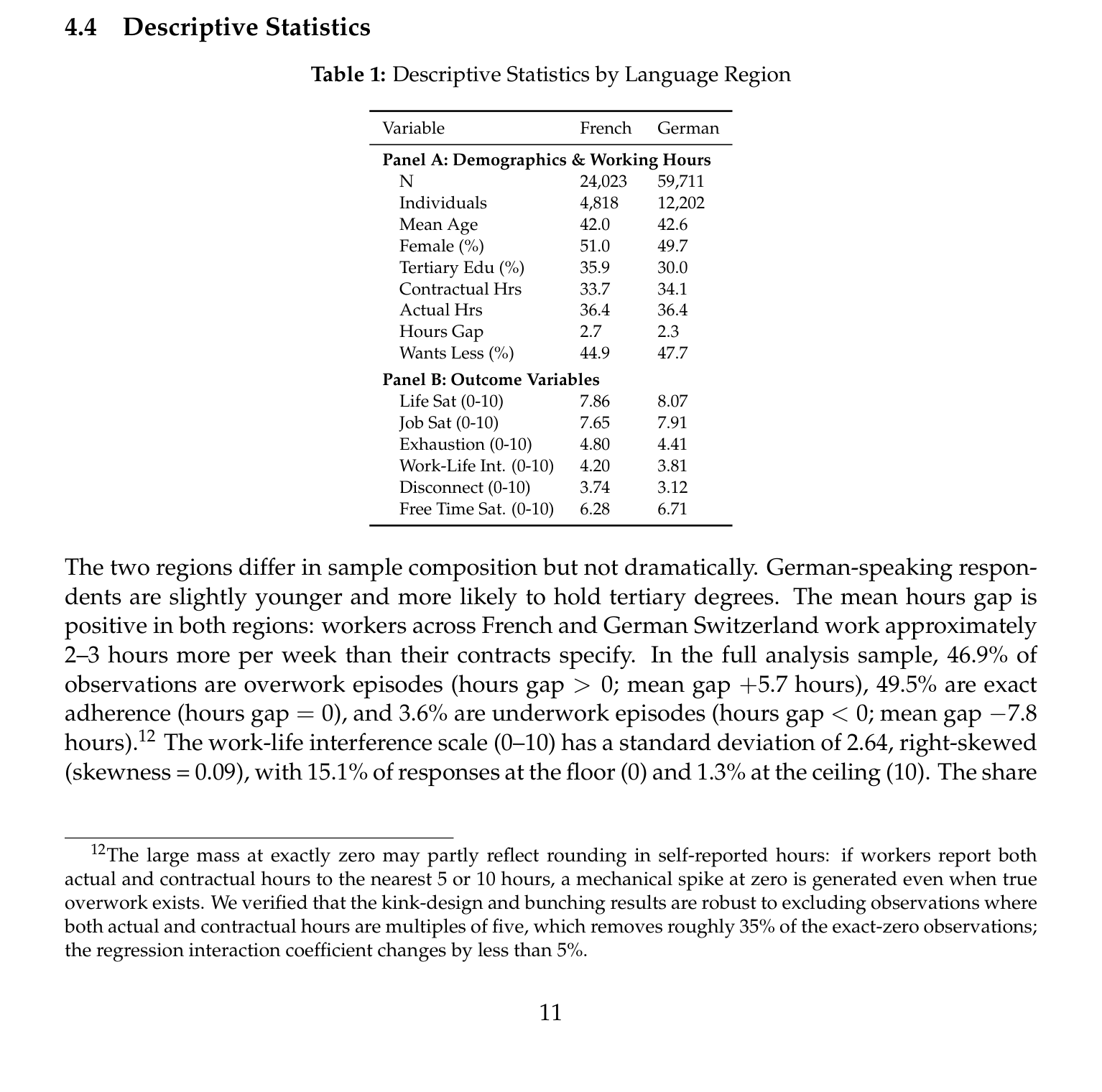
4.4 Descriptive Statistics
Table 1: Descriptive Statistics by Language Region
Variable French German
Panel A: Demographics & Working Hours N 24,023 59,711 Individuals 4,818 12,202 Mean Age 42.0 42.6 Female (%) 51.0 49.7 Tertiary Edu (%) 35.9 30.0 Contractual Hrs 33.7 34.1 Actual Hrs 36.4 36.4 Hours Gap 2.7 2.3 Wants Less (%) 44.9 47.7
Panel B: Outcome Variables Life Sat (0-10) 7.86 8.07 Job Sat (0-10) 7.65 7.91 Exhaustion (0-10) 4.80 4.41 Work-Life Int. (0-10) 4.20 3.81 Disconnect (0-10) 3.74 3.12 Free Time Sat. (0-10) 6.28 6.71
The two regions differ in sample composition but not dramatically. German-speaking respon- dents are slightly younger and more likely to hold tertiary degrees. The mean hours gap is positive in both regions: workers across French and German Switzerland work approximately 2–3 hours more per week than their contracts specify. In the full analysis sample, 46.9% of observations are overwork episodes (hours gap > 0; mean gap +5.7 hours), 49.5% are exact adherence (hours gap = 0), and 3.6% are underwork episodes (hours gap < 0; mean gap −7.8 hours).12 The work-life interference scale (0–10) has a standard deviation of 2.64, right-skewed (skewness = 0.09), with 15.1% of responses at the floor (0) and 1.3% at the ceiling (10). The share
12The large mass at exactly zero may partly reflect rounding in self-reported hours: if workers report both actual and contractual hours to the nearest 5 or 10 hours, a mechanical spike at zero is generated even when true overwork exists. We verified that the kink-design and bunching results are robust to excluding observations where both actual and contractual hours are multiples of five, which removes roughly 35% of the exact-zero observations; the regression interaction coefficient changes by less than 5%.
wanting fewer hours is broadly similar across regions, though the raw means mask important temporal dynamics that we explore below.
Figure 2 plots the evolution of two key outcomes by language region. Panel A shows the share of workers with a positive hours gap. Panel B shows mean life satisfaction. Both series exhibit visible disruption around 2020, but the trajectories vary by region.
52
% Wanting Fewer Hours
48
44
40
2000 2005 2010 2015 2020
8.2
Life Satisfaction (0-10)
8.0
7.8
2000 2005 2010 2015 2020
Language Region French German
Figure 2: Trends in overwork preference and life satisfaction by language region, 1999–2023.
Figure 3 shows the geographic distribution of our key variables. Panel A maps Switzerland’s language regions, highlighting the Röstigraben, a division that has been stable throughout the panel period (1999–2023). Panel B maps the post-pandemic (2021–2023) cantonal average of the overwork indicator; we focus on recent years because canton-level identifiers are most reliably available in later waves, though the cross-regional patterns are qualitatively similar across the full panel.
4.5 Empirical Strategy
Our identification exploits within-person variation in overwork and its interaction with a time- invariant cultural indicator. Unlike the spatial regression discontinuity designs used in prior Röstigraben studies (Eugster et al., 2017, 2011; Brügger et al., 2009), we compare all French- and German-speaking workers rather than restricting to those near the border. This is because the SHP (our source for longitudinal hours and well-being data) does not provide municipality-

Bilingual French German Italian (excl.) % Wanting Fewer Hours 30 35 40 45 50
Figure 3: Maps of Switzerland: language regions (A) and post-pandemic overwork prevalence by can- ton (B). Ticino (Italian-speaking) is excluded from our analysis; Romansh speakers in Graubünden are interviewed in German or Italian by the SHP and thus enter the German-speaking sample or are dropped with Italian speakers, respectively. Geographic data: swisstopo (Federal Office of Topography , swisstopo).
level geocodes for most observations, precluding a geographic RDD.13 This is not a difference- in-differences design: the linguistic border provides cross-sectional variation in cultural expo- sure (Frenchi), and ˆβ3 is identified from the conditional within-person slope difference across cultural groups. The core identifying assumption is: conditional on individual fixed effects and year fixed effects, changes in the hours gap are uncorrelated with changes in unobserved factors that differentially affect well-being for French versus German speakers. We estimate:
Yit = β1 · HoursGapit + β3 · (HoursGapit × Frenchi) + X′ itγ + αi + δt + εit, (8)
where Yit is an outcome capturing burnout (exhaustion, work-life interference, difficulty dis- connecting, work stress) or domain-specific satisfaction (free time, work conditions, job, life). The individual fixed effects αi absorb all time-invariant characteristics, including the main ef- fect of Frenchi, and the year fixed effects δt absorb common shocks. The coefficient of interest is ˆβ3: the differential effect of an additional hour of overwork for French-speaking workers relative to the German-speaking baseline. A negative ˆβ3 on exhaustion or work-life interfer- ence, or a positive ˆβ3 on satisfaction, indicates that overwork is less psychologically costly for French-speaking workers; equivalently, that German-speaking workers bear higher costs per hour of overwork.
All standard errors are clustered at the individual level to account for serial correlation within person-year panels. The number of clusters ranges from G = 16,099 (work-life interference) to G = 16,119 (difficulty disconnecting) across the main outcomes.14
Two identification concerns deserve explicit discussion. First, the hours gap is self-reported and potentially endogenous: workers experiencing burnout may perceive their hours differ- ently, and within-person changes in the hours gap are driven by job transitions and employer decisions that may independently affect well-being. We address this concern through coeffi-
13A border-canton restriction (Appendix Table A.7) shows the WLI interaction remains significant ( ˆβ3 = −0.030, p = 0.003), somewhat attenuated relative to the full-sample estimate, consistent with reduced cultural contrast near bilingual communities. 14As robustness checks we report results with two-way clustering (individual × year) and canton-level cluster- ing (26 cantons); all yield qualitatively identical conclusions. See Table B.3.
cient stability analysis: ˆβ3 is virtually unchanged as we move from no controls to the full set of time-varying controls including occupation, supervisor status, and education (Appendix Table A.2), suggesting limited selection on observables. Formally, an Oster (2019) coefficient stability analysis shows that the unrounded interaction coefficient moves by less than 0.001 as controls are added (e.g., the WLI interaction shifts from −0.03381 to −0.03316 between the no- controls and baseline-controls specifications), yielding mechanically extreme δ∗values. The rounded coefficients in Table B.1 obscure this movement: both round to −0.038, making it ap- pear that the coefficient does not move at all. The δ∗statistic is well above the conventional threshold of 1 for all three outcomes, indicating that the interaction is stable as controls are added. We interpret this as evidence against selection on observables, though we note that co- efficient stability does not rule out time-varying unobservables that are orthogonal to the con- trols. Second, cultural differences in reporting burnout, particularly in the sensitivity of report- ing to overwork (an interaction-level bias), cannot be fully ruled out by individual fixed effects. The domain-specificity of our results (effects on work-life interference but not on health satis- faction, p = 0.88) argues against a general reporting-bias explanation: if German speakers sim- ply report all outcomes more negatively when overworked, the effect should extend uniformly across domains. The work-stress interaction is positive ( ˆβ3 = +0.003, p < 0.001), opposite in sign to the WLI interaction, further undermining a pure reporting story: a general German negative-reporting bias would predict the same direction ( ˆβ3 < 0) for all outcomes, but the work-stress interaction breaks this pattern. We regard domain-specific reporting sensitivity as the strongest remaining identification concern: while the domain-specificity evidence and the opposite-sign work-stress result argue against a general reporting bias, we cannot definitively exclude interaction-level differences in how French and German speakers report work-leisure- boundary outcomes specifically. To bound this concern, suppose German-speaking workers’ reporting sensitivity for boundary outcomes is k times that of French speakers, so the observed German baseline slope ˆβ1 = 0.063 overstates the true slope by factor k, while the French slope is correctly measured. The observed French slope is ˆβ1 + ˆβ3 = 0.063 + (−0.038) = 0.025. Un- der this assumption, the true cultural interaction is 0.025 −0.063/k. At k = 1.5, the implied true interaction is −0.017; at k = 2, it is −0.007, substantially attenuated from the observed −0.038. The cultural interaction changes sign at k = 0.063/0.025 = 2.52: reporting sensitivity of German speakers roughly 2.5 times that of French speakers would eliminate the estimated cultural penalty entirely. We regard k > 2 as implausible given the domain-specificity evidence (health satisfaction interaction is null, p = 0.88) and the opposite-sign work-stress result, but acknowledge that the true cultural interaction is likely smaller than the point estimate if any differential reporting exists.
A second measurement concern is that recall error in self-reported hours generates classical measurement error in the hours gap. If non-differential by language group (plausible), this attenuates both ˆβ1 and | ˆβ3| toward zero, making the WLI and exhaustion estimates conser- vative lower bounds on the true cultural interaction. We note, however, that attenuation bias mechanically increases the probability of null findings, so the behavioral nulls in Section 5 could partly reflect measurement-error-induced power loss rather than a true absence of dif- ferential adjustment. The cross-equation evidence mitigates this concern: the WLI interaction is estimated with high precision (t > 3.5) in the same data and using the same hours-gap vari- able, suggesting adequate signal-to-noise to detect effects of the magnitudes documented here. We cannot rule out that a behavioral interaction, if it exists, is attenuated below our detection threshold. Weighted and unweighted estimates are nearly identical (| ˆβ3| = 0.038 and 0.033 respectively, both p < 0.001), and canton-level clustering (26 clusters) yields the same signif- icance (p < 0.001), confirming that neither the weighting strategy nor the clustering choice drives the main results. As a further check on inference, we perform a permutation test by randomly reassigning language labels across individuals (B = 500 permutations), building a
null distribution under the hypothesis that language region is unrelated to the within-person overwork slope. The observed ˆβ3 = −0.038 lies far in the lower tail (two-sided permutation p < 0.002; permutation null: mean = 0.000, SD = 0.007), confirming that the estimated cultural interaction cannot plausibly arise by chance under random language assignment.
A third measurement concern, raised in the review process, is culturally differential recall bias in the independent variable: if German-speaking workers, with stronger boundary norms, track their hours more precisely, the measured hours gap could be less noisy for German speak- ers, potentially inflating the observed interaction. We test this hypothesis directly. Table D.7 reports several diagnostics. French-speaking workers show higher within-person hours-gap variance (SD = 3.51 vs. 2.72, p < 0.001), higher mean absolute hours gap (3.29 vs. 2.83 hours, p < 0.001), and substantially more rounding of reported hours to multiples of five (44.3% vs. 37.7% for actual hours; 27.3% vs. 18.3% for both actual and contractual hours). All three di- agnostics point in the opposite direction from the recall-bias hypothesis: French speakers, not German speakers, exhibit noisier and more rounded hours reporting. If anything, measure- ment error is larger in the French-speaking sample, which would attenuate the French slope ( ˆβ1 + ˆβ3) toward zero and inflate the absolute interaction | ˆβ3|. While this pattern does not rule out all forms of differential measurement error (e.g., mean-shifting rather than variance- shifting bias), it provides no support for the specific channel of German speakers reporting more precisely.
5 Results
5.1 Descriptive Patterns
Panel B of Table 1 reports descriptive means of the mechanism and satisfaction variables by language region. French-speaking workers report higher raw means on exhaustion (4.80 vs. 4.41), work-life interference (4.20 vs. 3.81), and difficulty disconnecting (3.74 vs. 3.12) than German-speaking workers. This unconditional ordering reflects, in part, that French speakers face larger mean hours gaps (2.7 vs. 2.3 hours above contract on average); the regression anal- ysis reveals that this cross-sectional pattern masks a difference in the marginal psychological cost of overwork. The regression interaction captures the differential slope: how much worse each additional hour of overwork is for German speakers relative to French speakers, holding the individual’s baseline level of burnout fixed via individual fixed effects. Figure 2 shows that the share of workers wanting fewer hours rose in both regions after 2020, while mean life sat- isfaction declined modestly and convergently. Both series return toward pre-pandemic levels by 2022–23.
5.2 Burnout and Boundary-Setting Mechanisms
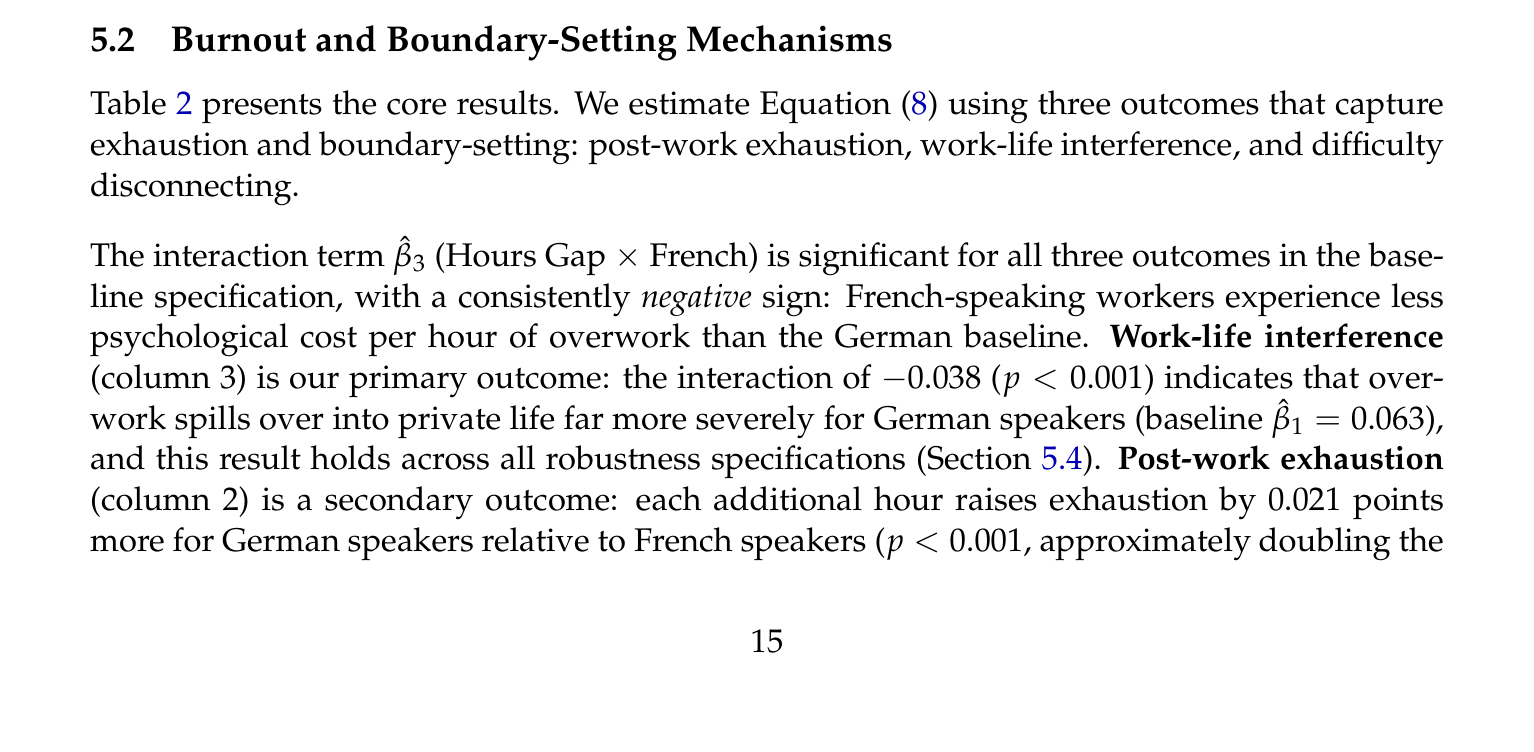
Table 2 presents the core results. We estimate Equation (8) using three outcomes that capture exhaustion and boundary-setting: post-work exhaustion, work-life interference, and difficulty disconnecting.
The interaction term ˆβ3 (Hours Gap × French) is significant for all three outcomes in the base- line specification, with a consistently negative sign: French-speaking workers experience less psychological cost per hour of overwork than the German baseline. Work-life interference (column 3) is our primary outcome: the interaction of −0.038 (p < 0.001) indicates that over- work spills over into private life far more severely for German speakers (baseline ˆβ1 = 0.063), and this result holds across all robustness specifications (Section 5.4). Post-work exhaustion (column 2) is a secondary outcome: each additional hour raises exhaustion by 0.021 points more for German speakers relative to French speakers (p < 0.001, approximately doubling the
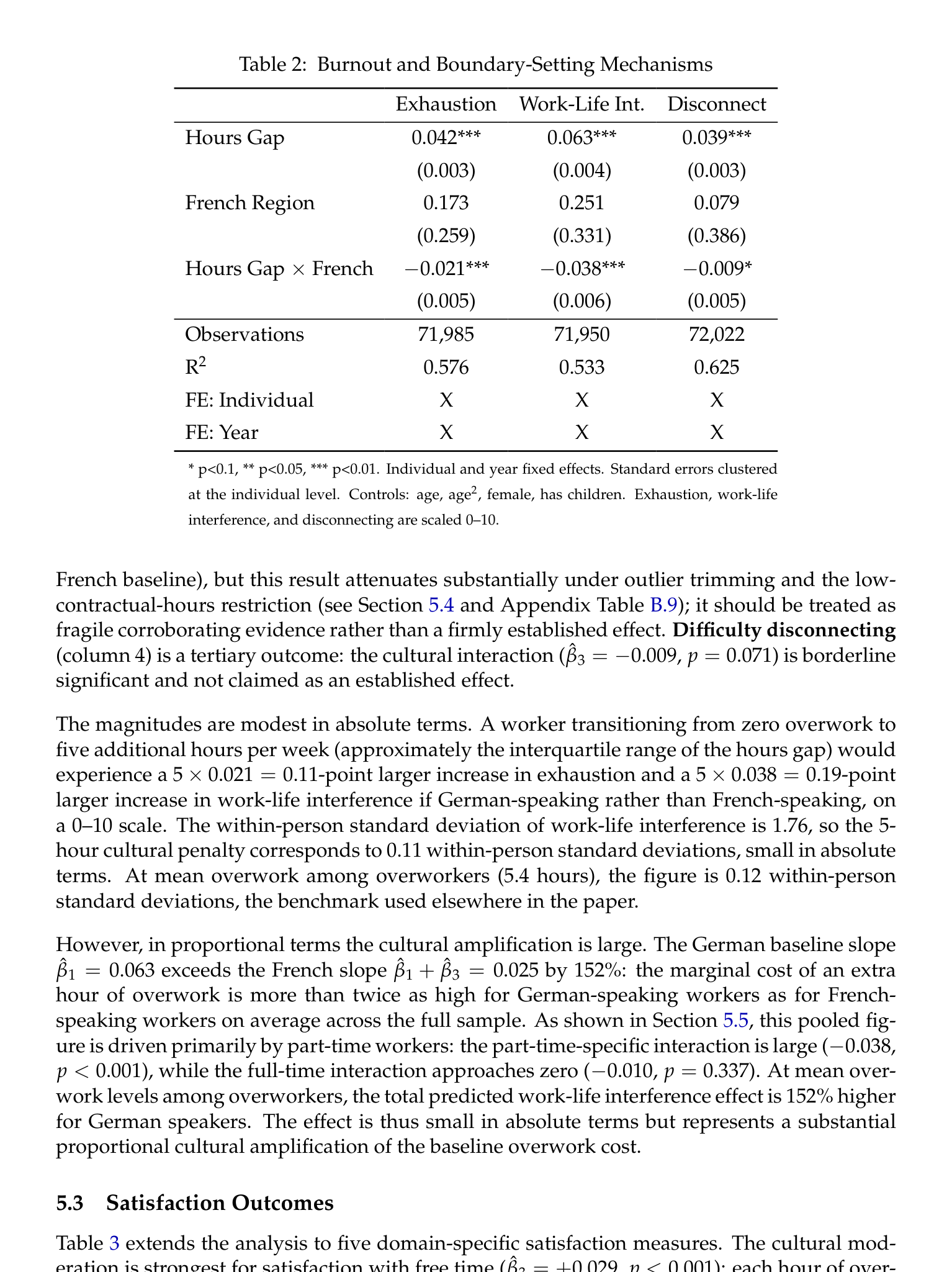
Table 2: Burnout and Boundary-Setting Mechanisms
Exhaustion Work-Life Int. Disconnect
Hours Gap 0.042*** 0.063*** 0.039***
(0.003) (0.004) (0.003)
French Region 0.173 0.251 0.079
(0.259) (0.331) (0.386)
Hours Gap × French −0.021*** −0.038*** −0.009*
(0.005) (0.006) (0.005)
Observations 71,985 71,950 72,022
R2 0.576 0.533 0.625
FE: Individual X X X
FE: Year X X X
* p<0.1, ** p<0.05, *** p<0.01. Individual and year fixed effects. Standard errors clustered
at the individual level. Controls: age, age2, female, has children. Exhaustion, work-life
interference, and disconnecting are scaled 0–10.
French baseline), but this result attenuates substantially under outlier trimming and the low- contractual-hours restriction (see Section 5.4 and Appendix Table B.9); it should be treated as fragile corroborating evidence rather than a firmly established effect. Difficulty disconnecting (column 4) is a tertiary outcome: the cultural interaction ( ˆβ3 = −0.009, p = 0.071) is borderline significant and not claimed as an established effect.
The magnitudes are modest in absolute terms. A worker transitioning from zero overwork to five additional hours per week (approximately the interquartile range of the hours gap) would experience a 5 × 0.021 = 0.11-point larger increase in exhaustion and a 5 × 0.038 = 0.19-point larger increase in work-life interference if German-speaking rather than French-speaking, on a 0–10 scale. The within-person standard deviation of work-life interference is 1.76, so the 5- hour cultural penalty corresponds to 0.11 within-person standard deviations, small in absolute terms. At mean overwork among overworkers (5.4 hours), the figure is 0.12 within-person standard deviations, the benchmark used elsewhere in the paper.
However, in proportional terms the cultural amplification is large. The German baseline slope ˆβ1 = 0.063 exceeds the French slope ˆβ1 + ˆβ3 = 0.025 by 152%: the marginal cost of an extra hour of overwork is more than twice as high for German-speaking workers as for French- speaking workers on average across the full sample. As shown in Section 5.5, this pooled fig- ure is driven primarily by part-time workers: the part-time-specific interaction is large (−0.038, p < 0.001), while the full-time interaction approaches zero (−0.010, p = 0.337). At mean over- work levels among overworkers, the total predicted work-life interference effect is 152% higher for German speakers. The effect is thus small in absolute terms but represents a substantial proportional cultural amplification of the baseline overwork cost.
5.3 Satisfaction Outcomes
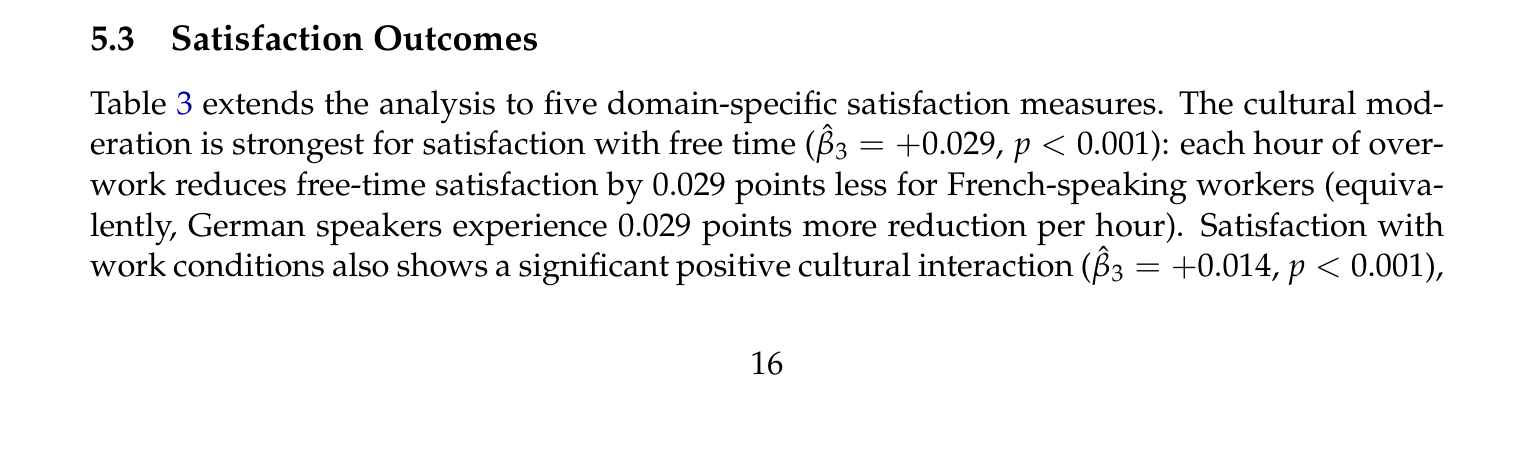
Table 3 extends the analysis to five domain-specific satisfaction measures. The cultural mod- eration is strongest for satisfaction with free time ( ˆβ3 = +0.029, p < 0.001): each hour of over- work reduces free-time satisfaction by 0.029 points less for French-speaking workers (equiva- lently, German speakers experience 0.029 points more reduction per hour). Satisfaction with work conditions also shows a significant positive cultural interaction ( ˆβ3 = +0.014, p < 0.001),
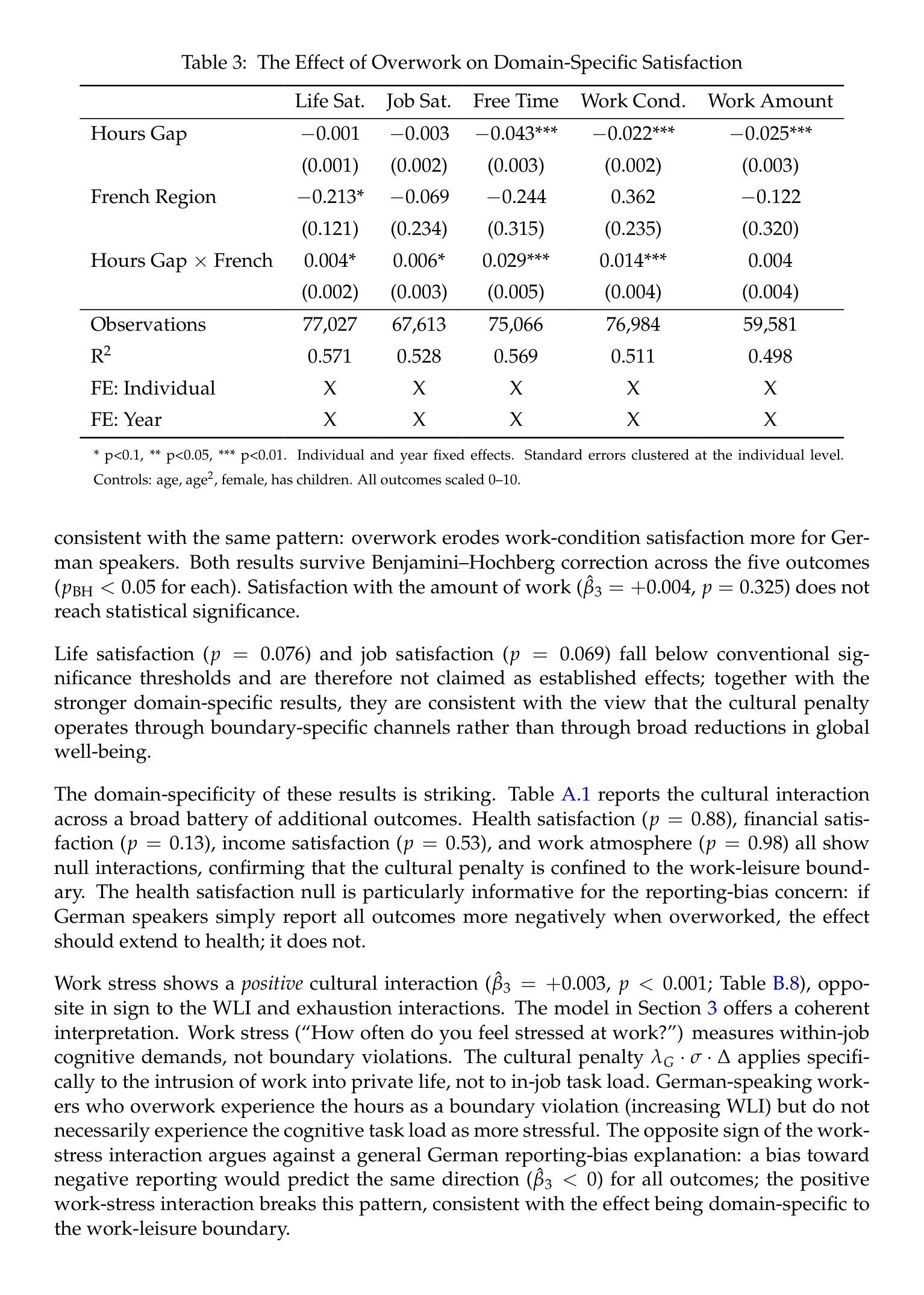
Table 3: The Effect of Overwork on Domain-Specific Satisfaction
Life Sat. Job Sat. Free Time Work Cond. Work Amount
Hours Gap −0.001 −0.003 −0.043*** −0.022*** −0.025***
(0.001) (0.002) (0.003) (0.002) (0.003)
French Region −0.213* −0.069 −0.244 0.362 −0.122
(0.121) (0.234) (0.315) (0.235) (0.320)
Hours Gap × French 0.004* 0.006* 0.029*** 0.014*** 0.004
(0.002) (0.003) (0.005) (0.004) (0.004)
Observations 77,027 67,613 75,066 76,984 59,581
R2 0.571 0.528 0.569 0.511 0.498
FE: Individual X X X X X
FE: Year X X X X X
* p<0.1, ** p<0.05, *** p<0.01. Individual and year fixed effects. Standard errors clustered at the individual level.
Controls: age, age2, female, has children. All outcomes scaled 0–10.
consistent with the same pattern: overwork erodes work-condition satisfaction more for Ger- man speakers. Both results survive Benjamini–Hochberg correction across the five outcomes (pBH < 0.05 for each). Satisfaction with the amount of work ( ˆβ3 = +0.004, p = 0.325) does not reach statistical significance.
Life satisfaction (p = 0.076) and job satisfaction (p = 0.069) fall below conventional sig- nificance thresholds and are therefore not claimed as established effects; together with the stronger domain-specific results, they are consistent with the view that the cultural penalty operates through boundary-specific channels rather than through broad reductions in global well-being.
The domain-specificity of these results is striking. Table A.1 reports the cultural interaction across a broad battery of additional outcomes. Health satisfaction (p = 0.88), financial satis- faction (p = 0.13), income satisfaction (p = 0.53), and work atmosphere (p = 0.98) all show null interactions, confirming that the cultural penalty is confined to the work-leisure bound- ary. The health satisfaction null is particularly informative for the reporting-bias concern: if German speakers simply report all outcomes more negatively when overworked, the effect should extend to health; it does not.
Work stress shows a positive cultural interaction ( ˆβ3 = +0.003, p < 0.001; Table B.8), oppo- site in sign to the WLI and exhaustion interactions. The model in Section 3 offers a coherent interpretation. Work stress (“How often do you feel stressed at work?”) measures within-job cognitive demands, not boundary violations. The cultural penalty λG · σ · ∆applies specifi- cally to the intrusion of work into private life, not to in-job task load. German-speaking work- ers who overwork experience the hours as a boundary violation (increasing WLI) but do not necessarily experience the cognitive task load as more stressful. The opposite sign of the work- stress interaction argues against a general German reporting-bias explanation: a bias toward negative reporting would predict the same direction ( ˆβ3 < 0) for all outcomes; the positive work-stress interaction breaks this pattern, consistent with the effect being domain-specific to the work-leisure boundary.
5.4 Robustness of the Main Results
Table A.2 subjects the exhaustion result to a battery of robustness checks. The interaction co- efficient is stable when we add ISCO major-group occupation fixed effects (column 2: ˆβ3 = −0.020), and all additional time-varying controls simultaneously. Two-way clustering by in- dividual and year yields similar standard errors. However, trimming extreme hours-gap val- ues (|gap| > 20 hours, affecting 1.5% of observations) attenuates the coefficient to −0.018 (p = 0.054), indicating some sensitivity to outliers. An Oster (2019) coefficient stability analysis confirms that the interaction coefficient is stable as controls are added: the unrounded WLI in- teraction moves by less than 0.001 across specifications (Table B.1; the rounded values obscure this movement). The resulting δ∗values are well above the conventional threshold of 1 for all three outcomes, indicating limited selection on observables. Standard errors are clustered at the individual level (G = 16,099–16,119 clusters across outcomes). Appendix Table B.3 reports results with two-way clustering (individual × year), canton-level clustering, and unweighted estimation; all specifications yield the same qualitative conclusions. As a more demanding test, Appendix Table B.4 adds canton-by-year fixed effects, absorbing all region-specific an- nual shocks; the WLI interaction is virtually unchanged ( ˆβ3 = −0.038, p < 0.001 under both specifications), ruling out region-specific economic shocks as an explanation. Investigation of the extreme hours-gap observations reveals that 18% of cases with |gap| > 15 involve very low contractual hours (< 15 hours/week), where even moderate actual hours generate mechani- cally large gaps; dropping observations with contractual hours below 10 (5% of the sample) attenuates the exhaustion coefficient ( ˆβ3 = −0.012, p = 0.084; Table B.9). The work-life inter- ference result is more robust: | ˆβ3| remains significant across all specifications, including outlier trimming ( ˆβ3 = −0.028, p = 0.002) and the principled contractual-hours trim ( ˆβ3 = −0.019, p = 0.012). We regard work-life interference as our most reliable outcome.
A further concern is whether the cultural penalty reflects the hours gap specifically or a gen- eral cultural disutility for working longer absolute hours. Table D.2 addresses this by adding actual hours worked and its interaction with the French indicator as controls. Controlling for actual hours attenuates the interaction from −0.038 to −0.018 (p = 0.001), indicating that ap- proximately 45% of the baseline estimate reflects the level of absolute hours rather than the deviation from contract. Adding the interaction of actual hours with French (column 3) yields ˆβ3 = −0.021 (p < 0.001): the cultural penalty on the hours gap remains significant and eco- nomically meaningful after absorbing any cultural differences in the disutility of long absolute hours, though the magnitude is roughly half the baseline estimate. The actual-hours interac- tion itself is absorbed by the individual fixed effects (collinear with the hours-gap interaction given that contractual hours vary little within person), confirming that the identifying varia- tion comes from within-person deviations from contract rather than cross-sectional differences in hours levels.
Controlling for perceived unemployment risk (0–10 scale) produces zero attenuation of the in- teraction coefficient: | ˆβ3| = 0.038 with and without the control (Table A.3). Overwork does not differentially change perceived unemployment risk across language regions (p = 0.63). This rules out the hypothesis that the cultural interaction reflects differential labor market insecurity rather than cultural norms.
As a functional form check, we estimate a pooled ordered logit for work-life interference (scaled 0–10).15 The ratio of the interaction to the main coefficient is 0.70 under ordered logit
15The pooled ordered logit does not include individual fixed effects (the incidental parameters problem pre- vents direct estimation); it controls for observable demographics but not for time-invariant individual heterogene- ity. Results are therefore not directly comparable to the fixed-effects estimates in terms of levels, but the relative magnitude of the interaction versus main effect is informative about whether the OLS linear approximation distorts the cultural amplification ratio.
and 0.71 under pooled OLS, virtually identical, suggesting the linear approximation does not distort the relative magnitudes. A more direct test of functional form (whether the squared interaction term (Hours Gap2× French) is significant) yields p = 0.61 (Table C.1), confirm- ing linearity. A fractional logit specification and a log-transformed outcome both replicate the significant cultural interaction at p < 0.001, consistent with the linear fixed-effects baseline.
5.5 Contract-Type Heterogeneity and Selection
Table 4 splits the sample by contract type. The cultural moderation of work-life interference is concentrated among part-time workers (contractual hours < 35): ˆβ3 = −0.038 (p < 0.001) for part-time versus ˆβ3 = −0.010 (p = 0.337) for full-time. The part-time estimate coincides with the full-sample estimate (−0.038), indicating that the pooled result is dominated by the part-time subsample; the full-time interaction contributes negligibly. The German PT baseline slope is 0.064 and the French PT slope is 0.026 (a 152% difference); the German FT baseline is 0.072 and the French FT slope is 0.062 (not significantly different). The formal triple interaction does not reach conventional significance (p = 0.202; Table A.4), though the triple-interaction test is less powerful than the split-sample comparison. We therefore interpret the contract- type heterogeneity as suggestive split-sample evidence for the contractual-salience channel rather than a formally identified mechanism. An alternative interpretation is that part-time schedules are structurally more rigid (less employer discretion over hours), so the hours gap is more salient for institutional rather than purely cultural reasons; we cannot distinguish this schedule-rigidity channel from the cultural-salience channel with our data. A related concern is that a given hours-gap deviation (e.g., 5 hours) constitutes a proportionally larger shock for a part-time contract than for a full-time contract (25% of a 20-hour contract versus 12% of a 42-hour contract), so the part-time concentration could partly reflect a mechanical scale effect rather than differential salience. The null for full-time workers ( ˆβ3 = −0.010, p = 0.337, 95% CI spanning zero) is informative: a near-zero coefficient for full-time workers is pre- cisely what Prediction 2 requires. An a priori power calculation indicates that our sample achieves 80% power to detect a triple interaction of approximately 0.033, which is 87% of the observed part-time effect (| ˆβPT 3 | = 0.038). The 95% confidence interval for the triple interaction ([−0.038, +0.008]) thus cannot rule out a true difference as large as the observed part-time ef- fect. We regard the split-sample evidence as more informative than the underpowered pooled test.
This effect is not driven by gender. Part-time work in Europe is heavily gendered and closely linked to child penalties (Kleven et al., 2019), so it is important to distinguish the contractual- salience channel from gendered norms about working time. Table 5 further splits the part-time and full-time subsamples by gender. Among part-time workers, German-speaking men show a larger cost differential than German-speaking women: the French interaction is ˆβ3 = −0.054 (p < 0.001) in the male part-time subsample and ˆβ3 = −0.031 (p = 0.008) in the female part- time subsample, though the formal triple interaction (Hours Gap × French × Female within part-time) is not statistically significant (p = 0.275). Both German-speaking men and women in part-time work experience significantly higher WLI per hour than their French-speaking counterparts. However, the pattern across contract types differs by gender. Full-time men show zero cultural moderation ( ˆβ3 = −0.002, p > 0.8), consistent with contractual salience: the effect appears only when the contract explicitly marks the work-leisure boundary. Full- time women, by contrast, show a marginally significant interaction ( ˆβ3 = −0.032, p < 0.1) similar in magnitude to part-time women (−0.031), suggesting that for women, the cultural moderation of overwork costs does not depend on contract type. The contractual-salience mechanism thus appears to operate primarily for men; for women, the cultural penalty is present regardless of whether the contract is part-time or full-time. A dose-response analysis by part-time intensity broadly reinforces this interpretation: | ˆβ3| = 0.010 (p = 0.337) for full-
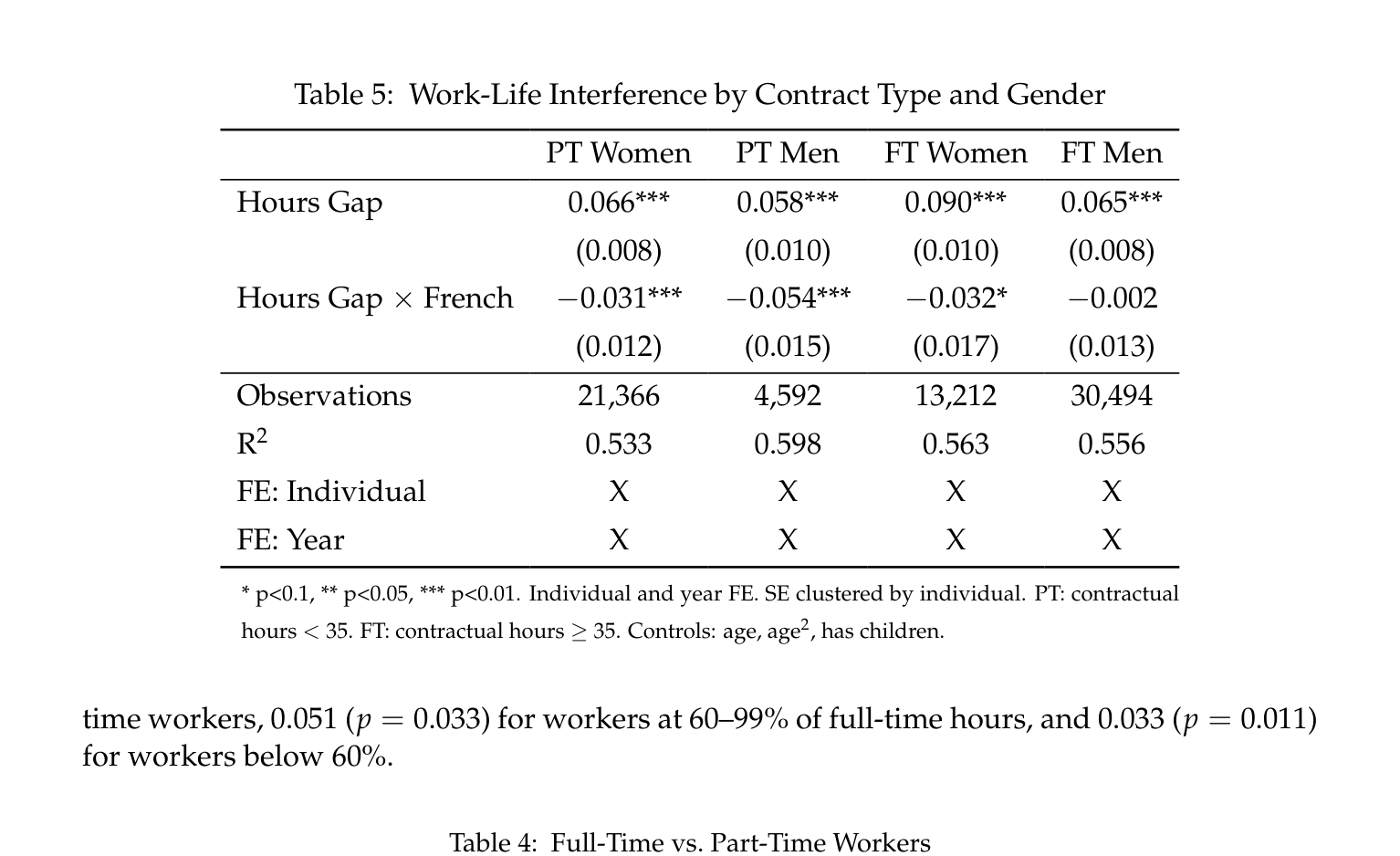
Table 5: Work-Life Interference by Contract Type and Gender
PT Women PT Men FT Women FT Men
Hours Gap 0.066*** 0.058*** 0.090*** 0.065***
(0.008) (0.010) (0.010) (0.008)
Hours Gap × French −0.031*** −0.054*** −0.032* −0.002
(0.012) (0.015) (0.017) (0.013)
Observations 21,366 4,592 13,212 30,494
R2 0.533 0.598 0.563 0.556
FE: Individual X X X X
FE: Year X X X X
* p<0.1, ** p<0.05, *** p<0.01. Individual and year FE. SE clustered by individual. PT: contractual
hours < 35. FT: contractual hours ≥35. Controls: age, age2, has children.
time workers, 0.051 (p = 0.033) for workers at 60–99% of full-time hours, and 0.033 (p = 0.011) for workers below 60%.
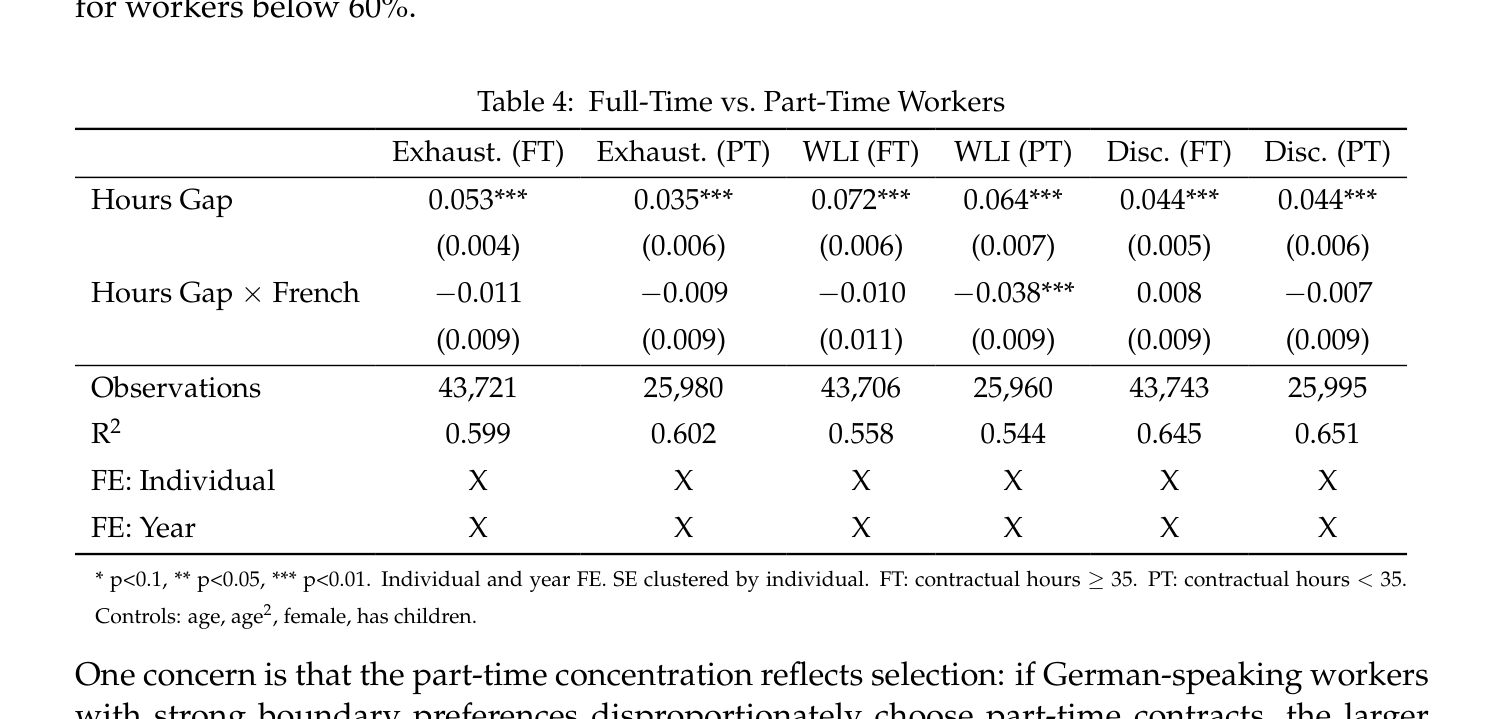
Table 4: Full-Time vs. Part-Time Workers
Exhaust. (FT) Exhaust. (PT) WLI (FT) WLI (PT) Disc. (FT) Disc. (PT)
Hours Gap 0.053*** 0.035*** 0.072*** 0.064*** 0.044*** 0.044***
(0.004) (0.006) (0.006) (0.007) (0.005) (0.006)
Hours Gap × French −0.011 −0.009 −0.010 −0.038*** 0.008 −0.007
(0.009) (0.009) (0.011) (0.009) (0.009) (0.009)
Observations 43,721 25,980 43,706 25,960 43,743 25,995
R2 0.599 0.602 0.558 0.544 0.645 0.651
FE: Individual X X X X X X
FE: Year X X X X X X
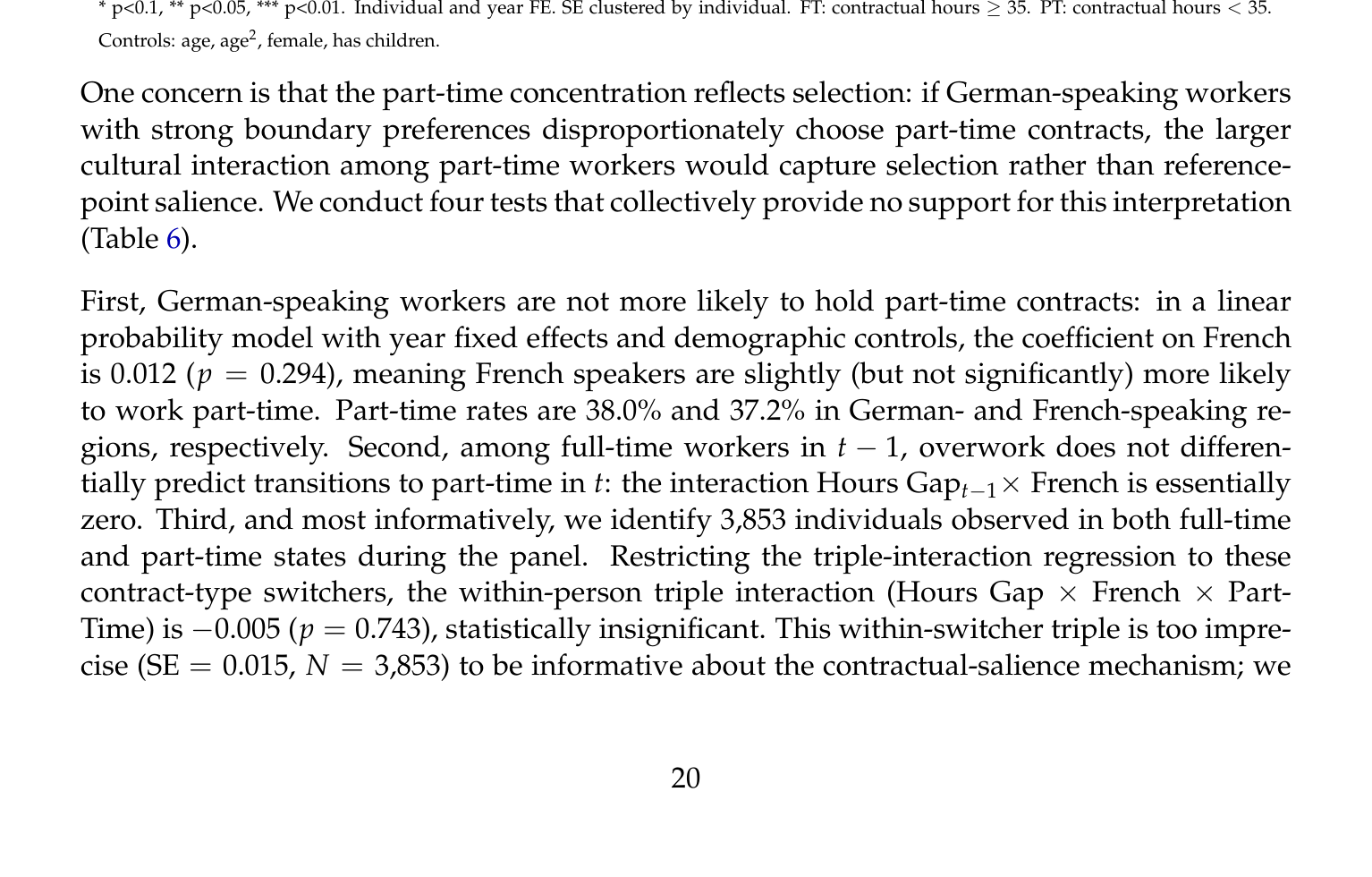
* p<0.1, ** p<0.05, *** p<0.01. Individual and year FE. SE clustered by individual. FT: contractual hours ≥35. PT: contractual hours < 35.
Controls: age, age2, female, has children.
One concern is that the part-time concentration reflects selection: if German-speaking workers with strong boundary preferences disproportionately choose part-time contracts, the larger cultural interaction among part-time workers would capture selection rather than reference- point salience. We conduct four tests that collectively provide no support for this interpretation (Table 6).
First, German-speaking workers are not more likely to hold part-time contracts: in a linear probability model with year fixed effects and demographic controls, the coefficient on French is 0.012 (p = 0.294), meaning French speakers are slightly (but not significantly) more likely to work part-time. Part-time rates are 38.0% and 37.2% in German- and French-speaking re- gions, respectively. Second, among full-time workers in t −1, overwork does not differen- tially predict transitions to part-time in t: the interaction Hours Gapt−1× French is essentially zero. Third, and most informatively, we identify 3,853 individuals observed in both full-time and part-time states during the panel. Restricting the triple-interaction regression to these contract-type switchers, the within-person triple interaction (Hours Gap × French × Part- Time) is −0.005 (p = 0.743), statistically insignificant. This within-switcher triple is too impre- cise (SE = 0.015, N = 3,853) to be informative about the contractual-salience mechanism; we
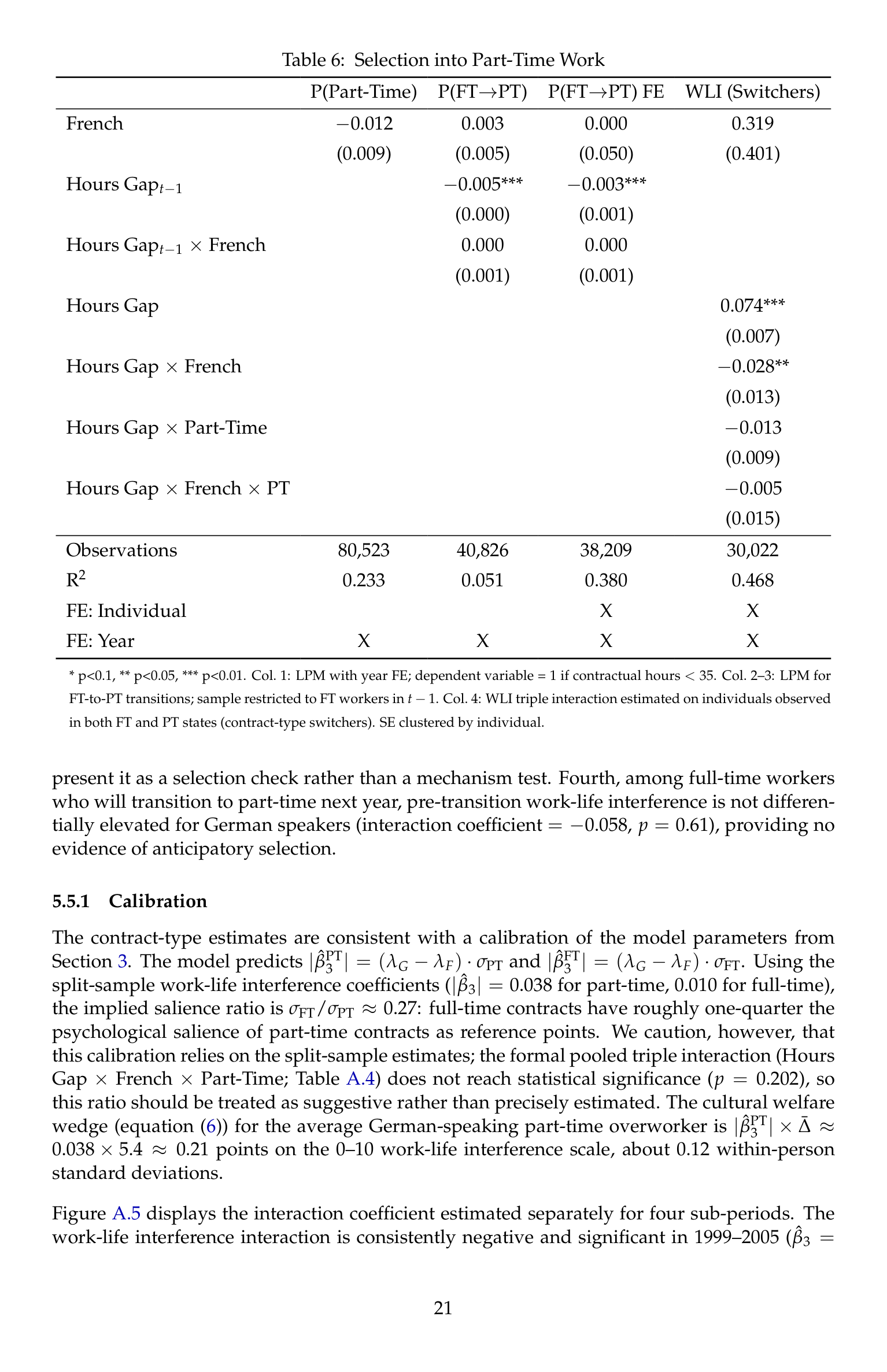
Table 6: Selection into Part-Time Work
P(Part-Time) P(FT→PT) P(FT→PT) FE WLI (Switchers)
French −0.012 0.003 0.000 0.319
(0.009) (0.005) (0.050) (0.401)
Hours Gapt−1 −0.005*** −0.003***
(0.000) (0.001)
Hours Gapt−1 × French 0.000 0.000
(0.001) (0.001)
Hours Gap 0.074***
(0.007)
Hours Gap × French −0.028**
(0.013)
Hours Gap × Part-Time −0.013
(0.009)
Hours Gap × French × PT −0.005
(0.015)
Observations 80,523 40,826 38,209 30,022
R2 0.233 0.051 0.380 0.468
FE: Individual X X
FE: Year X X X X
* p<0.1, ** p<0.05, *** p<0.01. Col. 1: LPM with year FE; dependent variable = 1 if contractual hours < 35. Col. 2–3: LPM for
FT-to-PT transitions; sample restricted to FT workers in t −1. Col. 4: WLI triple interaction estimated on individuals observed
in both FT and PT states (contract-type switchers). SE clustered by individual.
present it as a selection check rather than a mechanism test. Fourth, among full-time workers who will transition to part-time next year, pre-transition work-life interference is not differen- tially elevated for German speakers (interaction coefficient = −0.058, p = 0.61), providing no evidence of anticipatory selection.
5.5.1 Calibration
The contract-type estimates are consistent with a calibration of the model parameters from Section 3. The model predicts | ˆβPT 3 | = (λG −λF) · σPT and | ˆβFT 3 | = (λG −λF) · σFT. Using the split-sample work-life interference coefficients (| ˆβ3| = 0.038 for part-time, 0.010 for full-time), the implied salience ratio is σFT/σPT ≈0.27: full-time contracts have roughly one-quarter the psychological salience of part-time contracts as reference points. We caution, however, that this calibration relies on the split-sample estimates; the formal pooled triple interaction (Hours Gap × French × Part-Time; Table A.4) does not reach statistical significance (p = 0.202), so this ratio should be treated as suggestive rather than precisely estimated. The cultural welfare wedge (equation (6)) for the average German-speaking part-time overworker is | ˆβPT 3 | × ¯∆≈ 0.038 × 5.4 ≈0.21 points on the 0–10 work-life interference scale, about 0.12 within-person standard deviations.
Figure A.5 displays the interaction coefficient estimated separately for four sub-periods. The work-life interference interaction is consistently negative and significant in 1999–2005 ( ˆβ3 =
−0.043, p = 0.018), 2006–2012 ( ˆβ3 = −0.034, p < 0.001), and 2013–2019 ( ˆβ3 = −0.035, p < 0.001), but smaller in magnitude in 2020–2023. The within-period sub-sample estimate is ˆβ3 = −0.019 (p = 0.081); the full-sample estimate interacted with a post-2020 dummy yields a post-2020 coefficient of ˆβ3 = −0.030 (95% CI [−0.050, −0.010], p = 0.003), which conditions on the 2020 level shift and uses the full sample’s precision.16 A formal test for whether the cultural interaction changed after 2020 yields ∆ˆβ3 = −0.009 (p = 0.406): the visual attenua- tion is not formally distinguishable from sampling variation. One substantive explanation is that remote work blurred the boundary between contracted hours and actual work for both language groups during the pandemic, reducing the salience of formal contractual hours as a reference point across the linguistic divide equally rather than selectively for French speakers. The temporal stability prior to COVID is reassuring for identification.
Table A.8 tests for differential panel attrition. The interaction Hours Gap × French does not significantly predict panel exit (p = 0.12), alleviating concerns about selective attrition.17
5.6 Heterogeneity
Figure A.3 displays the interaction coefficient ˆβ3 (Hours Gap × French) for three outcomes: exhaustion, work-life interference, and ability to disconnect. We estimate effects separately for subsamples defined by gender, parental status, managerial role, and border region residence. Recall that a more negative ˆβ3 indicates a larger German–French gap (German workers bear more cost).
We interpret these heterogeneity results with caution. While point estimates exhibit some vari- ation across groups, the differences between subgroups are not statistically significant, as in- dicated by the overlapping confidence intervals. The most informative heterogeneity result comes from the contract-type split in Section 5.5.
5.7 Behavioral Response to Overwork
The preceding results establish that cultural norms shape the psychological cost of overwork. A natural follow-up question is whether cultural norms also shape the behavioral response, that is, whether the higher psychological costs experienced by German-speaking workers translate into differential labor supply adjustments. We investigate three margins: (i) adher- ence to contractual hours, (ii) dynamic hours adjustment, and (iii) job mobility. The results reveal an absence of detectable differential behavioral response at the annual frequency.
One measurement caveat applies to the dynamic adjustment and job-mobility analyses: the SHP is an annual survey, so behavioral adjustment that occurs within a calendar year (e.g., a February hours renegotiation affecting the subsequent wave) would not appear as an adjust- ment in our data. If anything, this measurement frequency biases toward behavioral nulls: workers who adjust quickly would already appear adjusted by the time of the next interview. This limitation means we cannot distinguish between no adjustment and rapid adjustment; we can only establish that there is no differential net adjustment observable at the annual horizon.
16The two post-2020 estimates differ because the within-period estimate uses only 2020–2023 observations, while the interaction-with-post-2020 estimate uses the full sample and identifies the post-2020 change conditional on the pre-2020 trend. 17We also identify 142 individuals who switch interview language during the panel (49 with observations in both languages). Repeating the baseline regressions on this subsample yields interaction coefficients that are statistically insignificant for all outcomes (p > 0.26), consistent with the small sample size (N ≈700). These within-switcher estimates are too imprecise to be informative but are consistent with the cultural effect reflecting regional norms rather than individual language identity. Full results are reported in Appendix Table A.6.
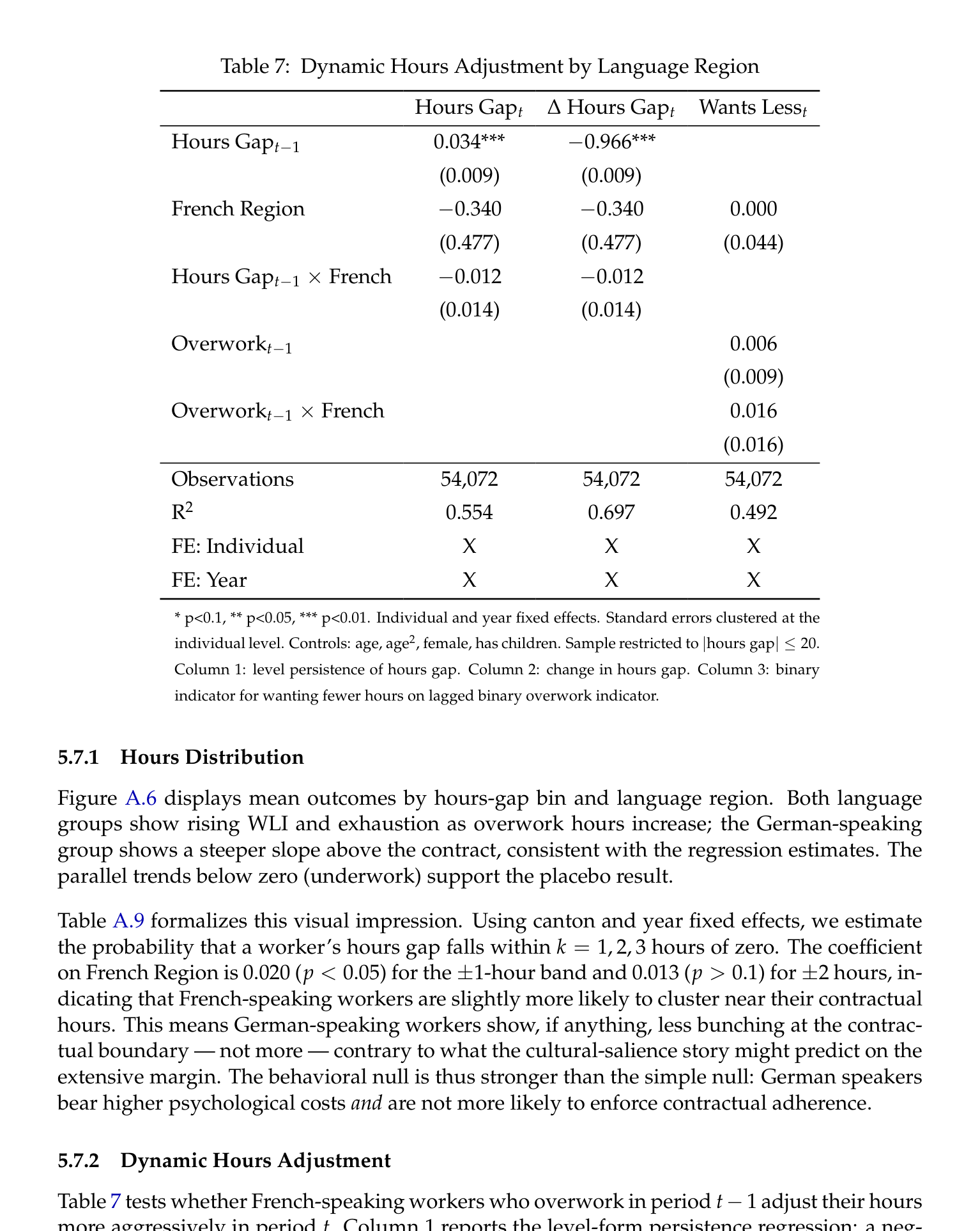
Table 7: Dynamic Hours Adjustment by Language Region
Hours Gapt ∆Hours Gapt Wants Lesst
Hours Gapt−1 0.034*** −0.966***
(0.009) (0.009)
French Region −0.340 −0.340 0.000
(0.477) (0.477) (0.044)
Hours Gapt−1 × French −0.012 −0.012
(0.014) (0.014)
Overworkt−1 0.006
(0.009)
Overworkt−1 × French 0.016
(0.016)
Observations 54,072 54,072 54,072
R2 0.554 0.697 0.492
FE: Individual X X X
FE: Year X X X
* p<0.1, ** p<0.05, *** p<0.01. Individual and year fixed effects. Standard errors clustered at the
individual level. Controls: age, age2, female, has children. Sample restricted to |hours gap| ≤20.
Column 1: level persistence of hours gap. Column 2: change in hours gap. Column 3: binary
indicator for wanting fewer hours on lagged binary overwork indicator.
5.7.1 Hours Distribution
Figure A.6 displays mean outcomes by hours-gap bin and language region. Both language groups show rising WLI and exhaustion as overwork hours increase; the German-speaking group shows a steeper slope above the contract, consistent with the regression estimates. The parallel trends below zero (underwork) support the placebo result.
Table A.9 formalizes this visual impression. Using canton and year fixed effects, we estimate the probability that a worker’s hours gap falls within k = 1, 2, 3 hours of zero. The coefficient on French Region is 0.020 (p < 0.05) for the ±1-hour band and 0.013 (p > 0.1) for ±2 hours, in- dicating that French-speaking workers are slightly more likely to cluster near their contractual hours. This means German-speaking workers show, if anything, less bunching at the contrac- tual boundary — not more — contrary to what the cultural-salience story might predict on the extensive margin. The behavioral null is thus stronger than the simple null: German speakers bear higher psychological costs and are not more likely to enforce contractual adherence.
5.7.2 Dynamic Hours Adjustment
Table 7 tests whether French-speaking workers who overwork in period t −1 adjust their hours more aggressively in period t. Column 1 reports the level-form persistence regression: a neg- ative interaction on Hours Gapt−1× French would indicate faster mean reversion for French speakers. Column 2 presents the change-form specification. Column 3 uses binary indicators for overwork and the preference for fewer hours.
All specifications include individual and year fixed effects. The interaction coefficient in col- umn 1 is negative and small (−0.012, SE = 0.014, p = 0.394): there is no statistically significant
difference in hours-gap persistence between French and German speakers. The binary spec- ification (column 3) shows Overworkt−1× French = 0.016 (p = 0.316), also null. Despite experiencing greater psychological costs from overwork, German-speaking workers do not appear to correct overwork episodes more rapidly than their French-speaking counterparts at the annual frequency. To formally bound these null results, we apply two-sided equiv- alence tests (TOST) using the absolute WLI cultural penalty (ε = 0.038) as the equivalence margin. The 90% confidence interval for hours-gap persistence ([−0.035, +0.011]) lies within the equivalence region ([−0.038, +0.038]), establishing that the cultural differential in dynamic adjustment is smaller than the psychological effect. The job-mobility continuous interaction (90% CI: [−0.002, +0.002]) establishes equivalence with ease. The remaining two interactions (binary dynamic adjustment, binary job change) produce wider 90% confidence intervals that do not formally establish equivalence at this margin, reflecting lower power in binary out- come specifications. We note that the original TOST margin (ε = 0.038) compared coefficients with fundamentally different units (WLI points per hour versus hours per hour-lag). To ad- dress this, we re-express the psychological and behavioral interactions in comparable terms. Standardizing the WLI outcome to within-person standard-deviation units, the cultural psy- chological interaction is −0.019 WLI-SD per hour of overwork (90% CI: [−0.024, −0.014]). For behavioral adjustment, the 90% CI for the persistence interaction ([−0.092, −0.016] hours per hour-lag) lies entirely within the economically meaningful threshold of 0.185 hours per hour- lag (equivalent to 1 hour of faster annual mean reversion at mean overwork). The behavioral differential is thus bounded below an economically interpretable threshold, establishing that any cultural difference in hours adjustment is small in absolute terms.
5.7.3 Job Mobility
Table A.10 tests whether overwork differentially triggers job changes across language regions. Job change is defined broadly as any professional change (new employer, new position, or change in responsibilities) occurring in the 12 months following the survey (approximately 10% annual rate). Column 2 reveals that the relationship between overwork in t −1 and job change is essentially zero (−0.0001, p = 0.828). The interaction with French region is small and insignificant across all specifications.
5.7.4 Robustness and Heterogeneity
Table A.11 reports robustness checks. Column 1 presents Anderson-Hsiao instrumental vari- ables estimates (Anderson and Hsiao (1981); Anderson and Hsiao (1982)) using the second lag as instrument; the estimates are imprecise, as expected given the weak first stage. Columns 2– 3 restrict to border cantons. Columns 4–5 split by gender, revealing that hours persistence is driven primarily by men ( ˆβ1 = 0.037, p < 0.01) with no significant cultural interaction in either subsample.
Figure A.4 displays the heterogeneity in the dynamic adjustment interaction across subgroups. All confidence intervals span zero, confirming the absence of significant cultural differences in behavioral adjustment across demographic and occupational lines.
5.7.5 Discussion
The behavioral results present an informative contrast with the psychological cost findings. German-speaking workers experience significantly greater work-life interference per hour of overwork, yet this heightened cost does not translate into detectable differential adjustment along any of the three margins we examine at the annual frequency. This absence of detectable differential adjustment is consistent with two interpretations. The first is the “constrained
preferences” view: the cultural parameter λG > λF generates a welfare loss observable only through subjective well-being, but cultural or institutional constraints prevent behavioral ad- justment. The second is rational inaction: the cultural welfare cost amounts to 0.21 points on a 0–10 scale at mean overwork, approximately 0.12 within-person standard deviations. If the fixed costs of job search, contract renegotiation, or hours adjustment exceed this welfare gain (Chetty (2012) documents that optimal-adjustment frictions as small as 1% of earnings ratio- nalize large behavioral inertia), workers rationally do not adjust regardless of preferences. The data cannot distinguish between these interpretations. We return to this in Section 6.
5.8 Extensions
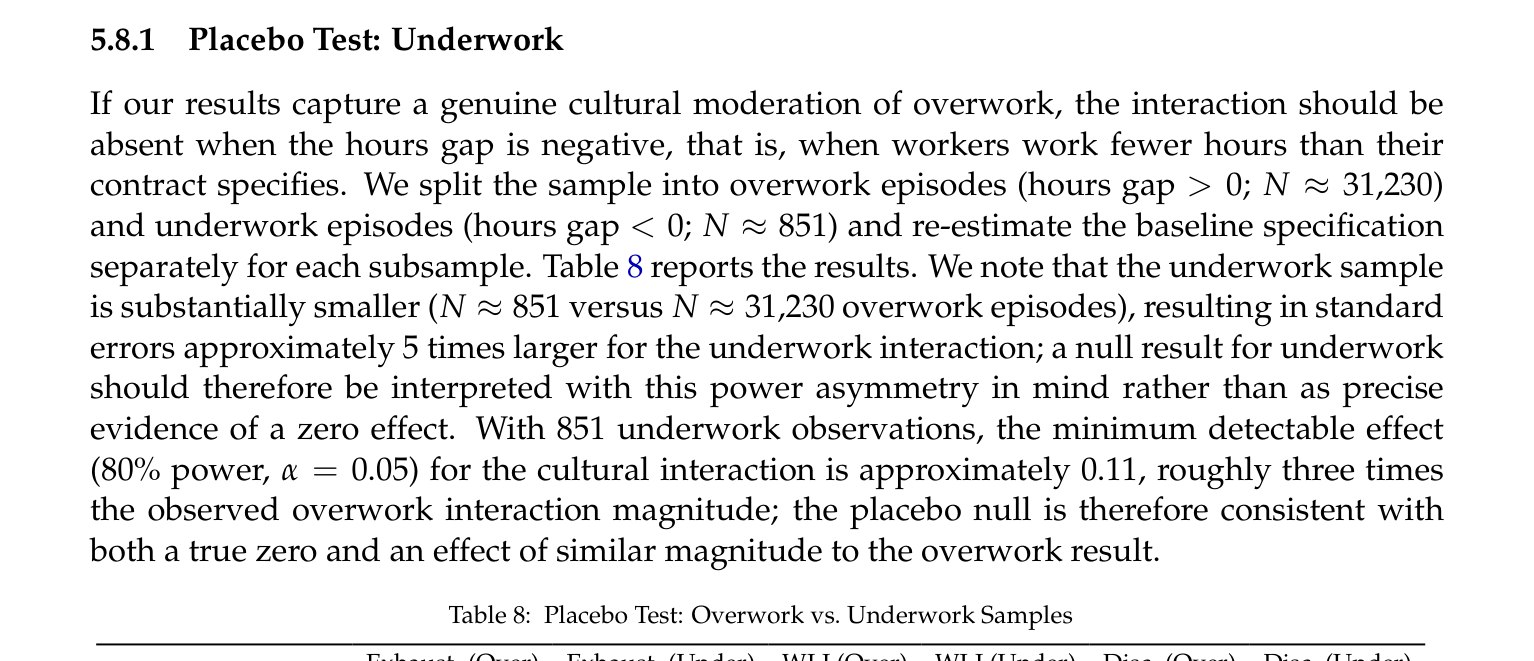
5.8.1 Placebo Test: Underwork
If our results capture a genuine cultural moderation of overwork, the interaction should be absent when the hours gap is negative, that is, when workers work fewer hours than their contract specifies. We split the sample into overwork episodes (hours gap > 0; N ≈31,230) and underwork episodes (hours gap < 0; N ≈851) and re-estimate the baseline specification separately for each subsample. Table 8 reports the results. We note that the underwork sample is substantially smaller (N ≈851 versus N ≈31,230 overwork episodes), resulting in standard errors approximately 5 times larger for the underwork interaction; a null result for underwork should therefore be interpreted with this power asymmetry in mind rather than as precise evidence of a zero effect. With 851 underwork observations, the minimum detectable effect (80% power, α = 0.05) for the cultural interaction is approximately 0.11, roughly three times the observed overwork interaction magnitude; the placebo null is therefore consistent with both a true zero and an effect of similar magnitude to the overwork result.
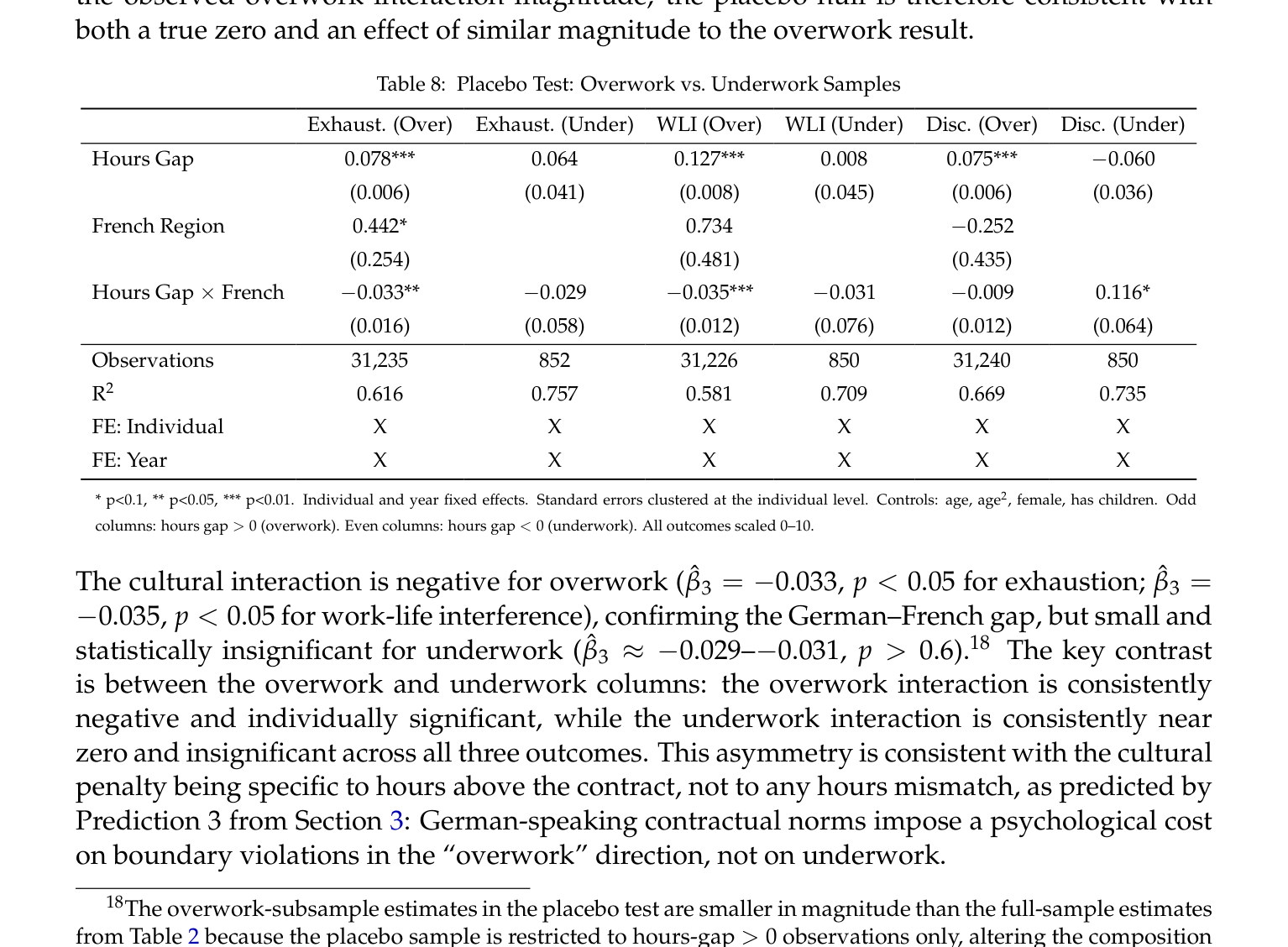
Table 8: Placebo Test: Overwork vs. Underwork Samples
Exhaust. (Over) Exhaust. (Under) WLI (Over) WLI (Under) Disc. (Over) Disc. (Under)
Hours Gap 0.078*** 0.064 0.127*** 0.008 0.075*** −0.060
(0.006) (0.041) (0.008) (0.045) (0.006) (0.036)
French Region 0.442* 0.734 −0.252
(0.254) (0.481) (0.435)
Hours Gap × French −0.033** −0.029 −0.035*** −0.031 −0.009 0.116*
(0.016) (0.058) (0.012) (0.076) (0.012) (0.064)
Observations 31,235 852 31,226 850 31,240 850
R2 0.616 0.757 0.581 0.709 0.669 0.735
FE: Individual X X X X X X
FE: Year X X X X X X
* p<0.1, ** p<0.05, *** p<0.01. Individual and year fixed effects. Standard errors clustered at the individual level. Controls: age, age2, female, has children. Odd
columns: hours gap > 0 (overwork). Even columns: hours gap < 0 (underwork). All outcomes scaled 0–10.
The cultural interaction is negative for overwork ( ˆβ3 = −0.033, p < 0.05 for exhaustion; ˆβ3 = −0.035, p < 0.05 for work-life interference), confirming the German–French gap, but small and statistically insignificant for underwork ( ˆβ3 ≈−0.029–−0.031, p > 0.6).18 The key contrast is between the overwork and underwork columns: the overwork interaction is consistently negative and individually significant, while the underwork interaction is consistently near zero and insignificant across all three outcomes. This asymmetry is consistent with the cultural penalty being specific to hours above the contract, not to any hours mismatch, as predicted by Prediction 3 from Section 3: German-speaking contractual norms impose a psychological cost on boundary violations in the “overwork” direction, not on underwork.
18The overwork-subsample estimates in the placebo test are smaller in magnitude than the full-sample estimates from Table 2 because the placebo sample is restricted to hours-gap > 0 observations only, altering the composition and size of the estimation sample (N = 31,226–31,240 versus N = 71,950–71,985).
5.8.2 Income Returns to Overwork
One concern is that the higher psychological cost of overwork for German-speaking work- ers reflects lower material compensation for extra hours. If German-speaking workers receive smaller wage returns to overwork, the same objective hours might generate greater subjec- tive cost simply because the pecuniary reward is inadequate. Table 9 tests this hypothesis by regressing log monthly income on the hours gap, the French indicator, and their interaction.
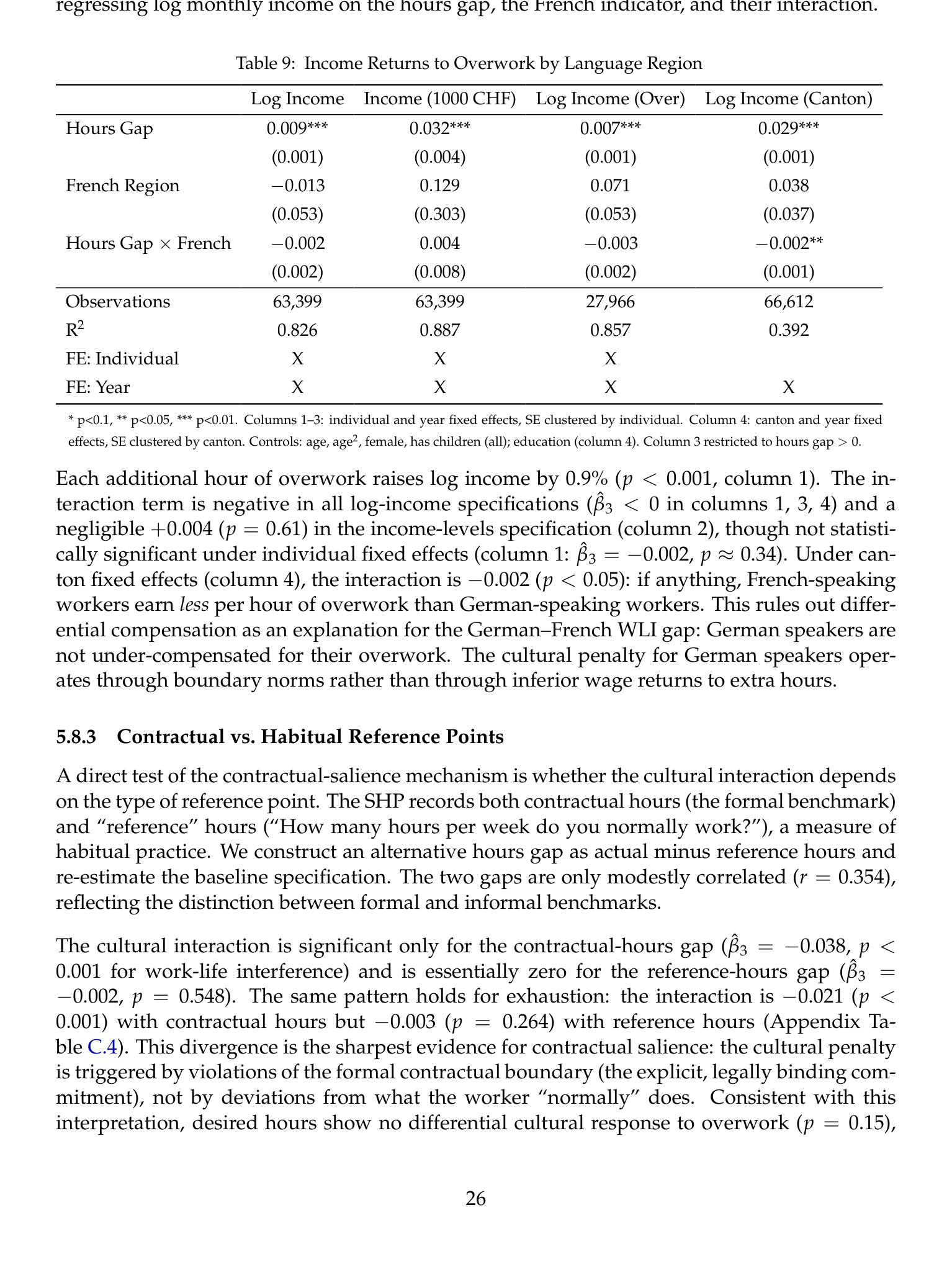
Table 9: Income Returns to Overwork by Language Region
Log Income Income (1000 CHF) Log Income (Over) Log Income (Canton)
Hours Gap 0.009*** 0.032*** 0.007*** 0.029***
(0.001) (0.004) (0.001) (0.001)
French Region −0.013 0.129 0.071 0.038
(0.053) (0.303) (0.053) (0.037)
Hours Gap × French −0.002 0.004 −0.003 −0.002**
(0.002) (0.008) (0.002) (0.001)
Observations 63,399 63,399 27,966 66,612
R2 0.826 0.887 0.857 0.392
FE: Individual X X X
FE: Year X X X X
* p<0.1, ** p<0.05, *** p<0.01. Columns 1–3: individual and year fixed effects, SE clustered by individual. Column 4: canton and year fixed
effects, SE clustered by canton. Controls: age, age2, female, has children (all); education (column 4). Column 3 restricted to hours gap > 0.
Each additional hour of overwork raises log income by 0.9% (p < 0.001, column 1). The in- teraction term is negative in all log-income specifications ( ˆβ3 < 0 in columns 1, 3, 4) and a negligible +0.004 (p = 0.61) in the income-levels specification (column 2), though not statisti- cally significant under individual fixed effects (column 1: ˆβ3 = −0.002, p ≈0.34). Under can- ton fixed effects (column 4), the interaction is −0.002 (p < 0.05): if anything, French-speaking workers earn less per hour of overwork than German-speaking workers. This rules out differ- ential compensation as an explanation for the German–French WLI gap: German speakers are not under-compensated for their overwork. The cultural penalty for German speakers oper- ates through boundary norms rather than through inferior wage returns to extra hours.
5.8.3 Contractual vs. Habitual Reference Points
A direct test of the contractual-salience mechanism is whether the cultural interaction depends on the type of reference point. The SHP records both contractual hours (the formal benchmark) and “reference” hours (“How many hours per week do you normally work?”), a measure of habitual practice. We construct an alternative hours gap as actual minus reference hours and re-estimate the baseline specification. The two gaps are only modestly correlated (r = 0.354), reflecting the distinction between formal and informal benchmarks.
The cultural interaction is significant only for the contractual-hours gap ( ˆβ3 = −0.038, p < 0.001 for work-life interference) and is essentially zero for the reference-hours gap ( ˆβ3 = −0.002, p = 0.548). The same pattern holds for exhaustion: the interaction is −0.021 (p < 0.001) with contractual hours but −0.003 (p = 0.264) with reference hours (Appendix Ta- ble C.4). This divergence is the sharpest evidence for contractual salience: the cultural penalty is triggered by violations of the formal contractual boundary (the explicit, legally binding com- mitment), not by deviations from what the worker “normally” does. Consistent with this interpretation, desired hours show no differential cultural response to overwork (p = 0.15),
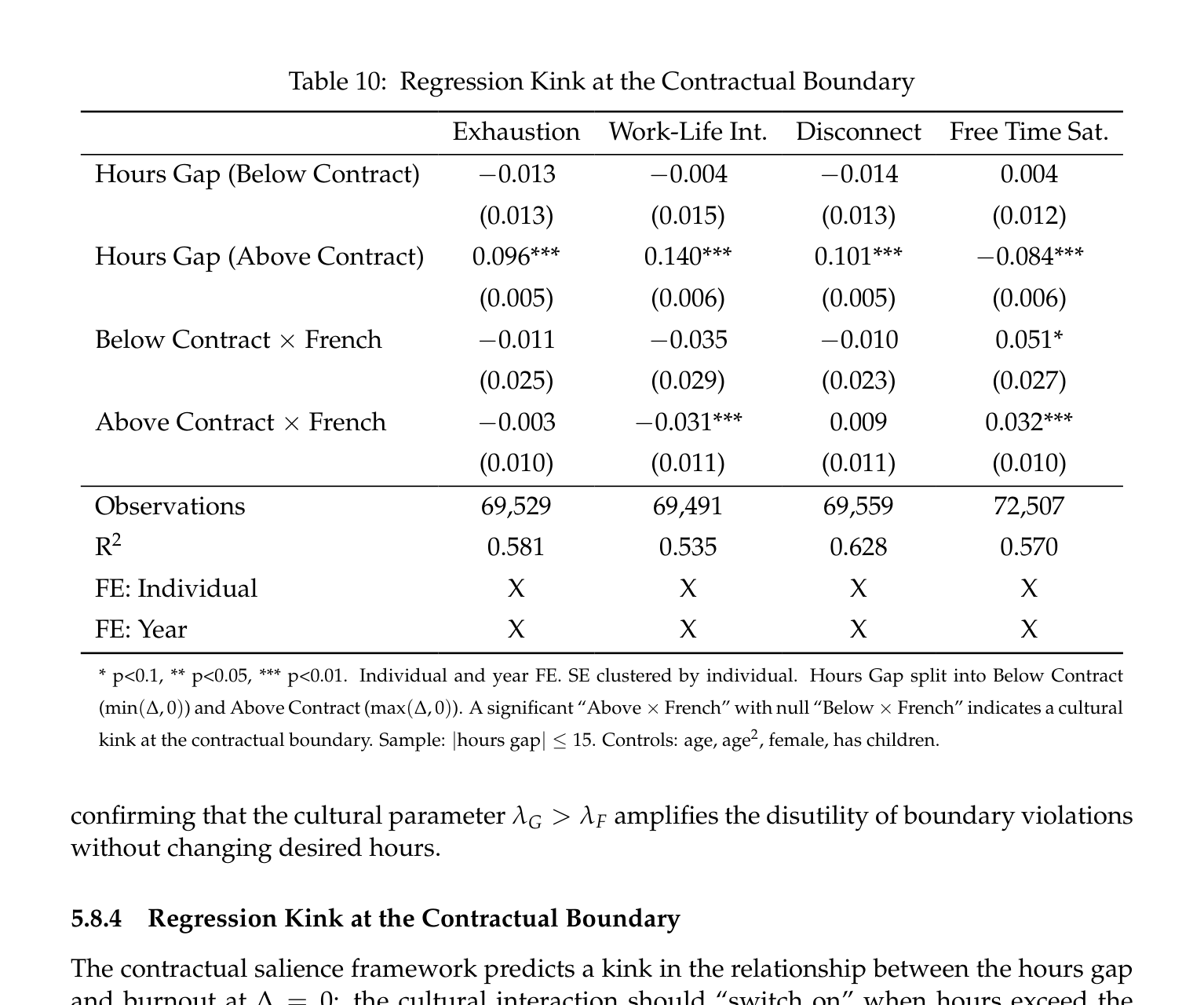
Table 10: Regression Kink at the Contractual Boundary
Exhaustion Work-Life Int. Disconnect Free Time Sat.
Hours Gap (Below Contract) −0.013 −0.004 −0.014 0.004
(0.013) (0.015) (0.013) (0.012)
Hours Gap (Above Contract) 0.096*** 0.140*** 0.101*** −0.084***
(0.005) (0.006) (0.005) (0.006)
Below Contract × French −0.011 −0.035 −0.010 0.051*
(0.025) (0.029) (0.023) (0.027)
Above Contract × French −0.003 −0.031*** 0.009 0.032***
(0.010) (0.011) (0.011) (0.010)
Observations 69,529 69,491 69,559 72,507
R2 0.581 0.535 0.628 0.570
FE: Individual X X X X
FE: Year X X X X
* p<0.1, ** p<0.05, *** p<0.01. Individual and year FE. SE clustered by individual. Hours Gap split into Below Contract
(min(∆, 0)) and Above Contract (max(∆, 0)). A significant “Above × French” with null “Below × French” indicates a cultural
kink at the contractual boundary. Sample: |hours gap| ≤15. Controls: age, age2, female, has children.
confirming that the cultural parameter λG > λF amplifies the disutility of boundary violations without changing desired hours.
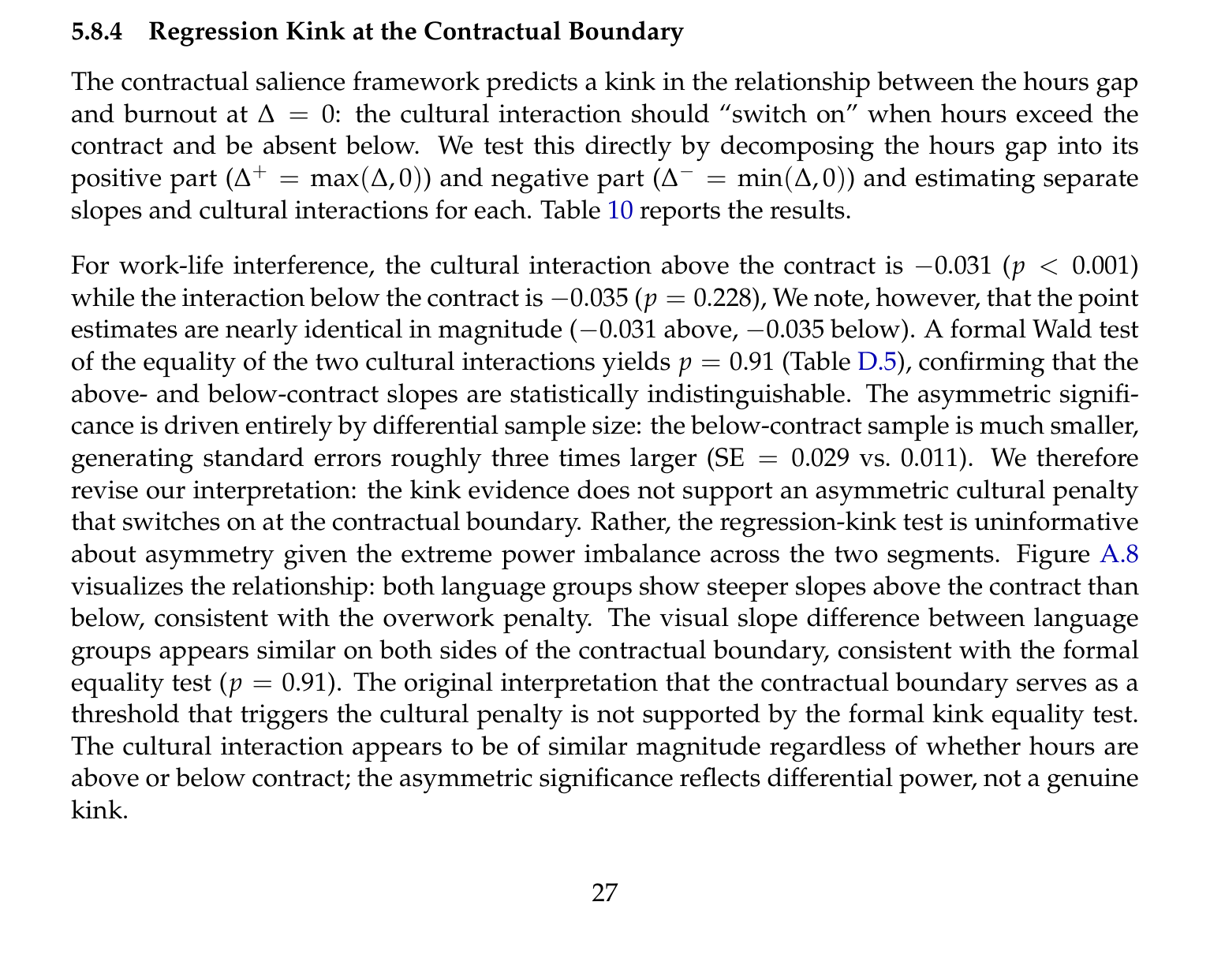
5.8.4 Regression Kink at the Contractual Boundary
The contractual salience framework predicts a kink in the relationship between the hours gap and burnout at ∆= 0: the cultural interaction should “switch on” when hours exceed the contract and be absent below. We test this directly by decomposing the hours gap into its positive part (∆+ = max(∆, 0)) and negative part (∆−= min(∆, 0)) and estimating separate slopes and cultural interactions for each. Table 10 reports the results.
For work-life interference, the cultural interaction above the contract is −0.031 (p < 0.001) while the interaction below the contract is −0.035 (p = 0.228), We note, however, that the point estimates are nearly identical in magnitude (−0.031 above, −0.035 below). A formal Wald test of the equality of the two cultural interactions yields p = 0.91 (Table D.5), confirming that the above- and below-contract slopes are statistically indistinguishable. The asymmetric signifi- cance is driven entirely by differential sample size: the below-contract sample is much smaller, generating standard errors roughly three times larger (SE = 0.029 vs. 0.011). We therefore revise our interpretation: the kink evidence does not support an asymmetric cultural penalty that switches on at the contractual boundary. Rather, the regression-kink test is uninformative about asymmetry given the extreme power imbalance across the two segments. Figure A.8 visualizes the relationship: both language groups show steeper slopes above the contract than below, consistent with the overwork penalty. The visual slope difference between language groups appears similar on both sides of the contractual boundary, consistent with the formal equality test (p = 0.91). The original interpretation that the contractual boundary serves as a threshold that triggers the cultural penalty is not supported by the formal kink equality test. The cultural interaction appears to be of similar magnitude regardless of whether hours are above or below contract; the asymmetric significance reflects differential power, not a genuine kink.
Additional robustness checks (dose-response nonlinearity, COVID-era stability, and gender at- titudes as a potential mediator) are reported in Appendix C. In brief, the squared interaction (Hours Gap2× French) is insignificant across all outcomes, confirming that the linear speci- fication is adequate; the cultural moderation is broadly stable before and after 2020 (though attenuated in the post-pandemic period, see Figure A.5); and controlling for gender-role at- titudes produces zero attenuation of the interaction coefficient, suggesting that the cultural channel operates through some other dimension of the work-leisure schema beyond standard gender norms.
6 Conclusion
This paper has used Switzerland’s linguistic border (the Röstigraben) to study the role of cul- tural norms in shaping both the psychological cost and the behavioral response to overwork. Exploiting 25 waves of the Swiss Household Panel and the fact that French- and German- speaking workers share identical institutional constraints, we document two complementary findings. First, overwork generates significantly more work-life interference for German- speaking workers, an effect that is robust to occupation fixed effects, additional time-varying controls, and alternative clustering strategies. This effect is concentrated among part-time workers; the cultural moderation is absent among full-time workers. Post-work exhaustion and difficulty disconnecting also show cultural moderation, though the exhaustion result is sensitive to outlier trimming. Second, despite these higher psychological costs, German- speaking workers do not detectably adjust their labor supply differently at the annual horizon of our survey: they do not adhere more tightly to contractual hours, do not correct overwork episodes faster, and do not exit overwork situations through job changes at higher rates. We cannot rule out within-year behavioral adjustments that are resolved before the next survey wave.
The absence of detectable differential behavioral adjustment at the annual frequency is an in- formative null, consistent with either constrained preferences or rational non-response to wel- fare costs that are modest in absolute terms (0.21 WLI points, 0.12 within-person standard deviations). A placebo test is consistent with the cultural penalty being specific to overwork and absent for underwork, while an income analysis finds no evidence that German workers are under-compensated for their overwork relative to French workers (if anything, the income interaction is negative, indicating German speakers receive at least as much income per ex- tra hour), ruling out differential compensation as an explanation for German workers’ higher costs. The finding is consistent with two interpretations. The “constrained preferences” view holds that cultural norms shape how overwork feels but not what workers do. The rational- inaction view holds that the welfare gain from adjustment (0.21 points on a 0–10 scale, or 0.12 within-person standard deviations) is smaller than the fixed costs of behavioral adjustment such as job search or renegotiation.19 Chetty (2012) shows that optimization frictions as small as 1% of earnings can rationalize large behavioral inertia, making rational non-adjustment plausible at the magnitudes we document. The data cannot distinguish between these inter- pretations.
The concentration of the effect among part-time workers is the paper’s most informative het- erogeneity result. The gender split within contract types is informative: German-speaking part-time men show a larger cost differential relative to French speakers (| ˆβ3| = 0.054) than German-speaking part-time women (| ˆβ3| = 0.031), and full-time men show zero effect (| ˆβ3| =
19Direct CHF monetization of this welfare gap is infeasible with the available data: the within-person income– WLI relationship conflates overwork with the income returns to overwork, yielding implausibly large compensat- ing variation estimates. We therefore quantify welfare in well-being scale units throughout.
0.002). However, full-time women show a marginally significant interaction (| ˆβ3| = 0.032, p < 0.1) similar to part-time women, suggesting that the contractual-salience mechanism op- erates primarily for men; for women, the cultural moderation does not depend on contract type. Four selection tests (detailed in Section 5) collectively provide no support for differential sorting into part-time work. The pattern is consistent with the cultural moderation operating through the salience of the contractual reference point: part-time contracts more clearly demar- cate the work-leisure boundary, and violations of that boundary are psychologically costlier for German-speaking workers whose work culture prizes strict contractual compliance and the protection of leisure. Consistent with this interpretation, an alternative hours-gap measure based on self-reported “normal” hours rather than contractual hours produces a zero cultural interaction (p = 0.548 for work-life interference).
An additional finding narrows the interpretation. Work stress, a measure of within-job cogni- tive demands, shows a cultural interaction opposite in sign to the main effects ( ˆβ3 = +0.003, p < 0.001), consistent with the cultural penalty operating specifically through work-leisure boundary norms rather than through general within-job cognitive demands. Consistent with this interpretation, none of eight semi-objective health measures (including days affected by health problems, p = 0.70; doctor consultations, p = 0.85; and health impediment, p = 0.83) show a cultural interaction that survives Benjamini-Hochberg correction for multiple testing (the only nominally significant result, weakness/weariness at p = 0.046, adjusts to pBH = 0.36), confirming that the cultural cost is genuinely psychological rather than a proxy for dif- ferential physical health consequences.
Our study faces several important limitations. First, the identification design does not exploit spatial proximity to the Röstigraben. While the prior literature on Swiss cultural differences typically uses spatial regression-discontinuity designs (Eugster et al., 2017, 2011; Brügger et al., 2009), our estimator compares all French- and German-speaking workers rather than re- stricting to those near the border. Our within-person fixed effects eliminate all time-invariant confounders, and the addition of canton-by-year fixed effects (Appendix Table B.4) leaves the interaction coefficient unchanged, ruling out region-specific economic shocks. In unilingual cantons, language is perfectly confounded with canton identity; the cultural interaction in these cantons could partly reflect canton-specific economic conditions. Restricting to the bilin- gual cantons (Bern, Fribourg, Valais), where within-canton language variation exists, yields a consistent but attenuated and statistically insignificant interaction ( ˆβ3 = −0.028, p = 0.21; Appendix Table D.4), reflecting the smaller sample size. Our results should therefore be inter- preted as documenting a cross-language-region differential under strong controls rather than a causal estimate identified at the geographic discontinuity.
Second, the hours-gap measure is self-reported and endogenous: within-person variation is driven by job changes and employer decisions that may independently affect burnout. While the coefficient is stable across specifications with progressively richer controls (an Oster (2019) analysis confirms δ∗well above the threshold of 1 for all outcomes), we lack an instrument for hours-gap variation and cannot make strong causal claims. Third, cultural differences in the sensitivity of burnout reporting to overwork cannot be ruled out by individual fixed effects. The domain-specificity of our results (the cultural penalty appearing for work-life interference but not for health satisfaction, income satisfaction, or general work-related outcomes) argues against a general reporting-bias explanation. However, we cannot exclude domain-specific interaction-level bias: if German-speaking workers report work-leisure-boundary outcomes with systematically higher sensitivity to overwork than French-speaking workers, | ˆβ3| over- states the true welfare effect. Fourth, our sample is approximately 71% German-speaking; while this does not affect point estimates under individual fixed effects, it warrants care in interpreting descriptive statistics. Fifth, we exclude Italian-speaking respondents due to their
small sample size. Sixth, the exhaustion result is fragile: it attenuates to insignificance when extreme hours-gap values are trimmed or when observations with very low contractual hours (below 10 hours/week) are excluded. Only the work-life interference result survives all ro- bustness specifications.
Despite these caveats, the paper establishes two complementary findings with reasonable con- fidence. The psychological cost of overwork is culturally modulated, being statistically signif- icantly higher for German-speaking workers in part-time contracts and for women regardless of contract type. Critically, full-time men—the largest demographic subgroup—show zero cultural moderation, so the finding should not be characterized as a universal feature of the German-speaking labor market. At the same time, this subjective cost does not translate into detectable differential behavioral adjustment at the annual frequency of our data.
The contractual-salience mechanism has practical implications. Reck and Seibold (2023) show that the welfare effects of reference-point shifts are robustly signed whether reference depen- dence is normative or a bias; our findings suggest that the welfare cost of overwork is culturally heterogeneous along the same dimension. If the cultural cost of overwork is amplified when part-time contracts make the work-leisure boundary explicit, then firms designing flexible or part-time arrangements should recognize that contractual hours serve not merely as adminis- trative benchmarks but as psychologically salient reference points.
The calibration in Section 5.5 estimates a cultural welfare wedge of 0.21 WLI points (0.12 within-person standard deviations) for the average German-speaking part-time overworker. BFS data place approximately 570,000 part-time workers in the German-speaking Grossregio- nen, of whom roughly 47% are overworking in our sample, so the wedge applies to approx- imately 268,000 workers. This calibration should be interpreted as an upper bound: if differ- ential reporting sensitivity accounts for part of the estimated interaction (Section 4), the true population-level welfare wedge is correspondingly smaller.
In culturally heterogeneous labor markets, this wedge may vary across workforce segments in ways standard productivity metrics do not capture, though the magnitudes documented here are modest in absolute terms and subject to the reporting-sensitivity caveats discussed in Section 4. Future work should investigate whether similar contractual-salience effects operate in other institutional settings, particularly in the growing gig and platform economy, where the boundary between contracted and actual work is increasingly fluid.
Data and Code Availability
The Swiss Household Panel (SHP) data are available from FORS upon application (https:// forscenter.ch/projects/swiss-household-panel/). Analysis scripts reproducing all tables and figures are available from the authors upon request. The analysis was conducted in R 4.5.3 using the fixest, modelsummary, tidyverse, and kableExtra packages.
References
Alesina, Alberto and Paola Giuliano, “Culture and Institutions,” Journal of Economic Literature, 2015, 53 (4), 898–944.
, Edward Glaeser, and Bruce Sacerdote, “Work and Leisure in the US and Europe: Why So Different?,” NBER Macroeconomics Annual, 2005, 20, 1–64.
Allen, Tammy D., Kimberly A. French, Soner Dumani, and Kristen M. Shockley, “A Cross- National Meta-Analytic Examination of Predictors and Outcomes Associated with Work- Family Conflict,” Journal of Applied Psychology, 2020, 105 (6), 539–576.
Anderson, Theodore W. and Cheng Hsiao, “Estimation of Dynamic Models with Error Com- ponents,” Journal of the American Statistical Association, 1981, 76 (375), 598–606.
and , “Formulation and Estimation of Dynamic Models Using Panel Data,” Journal of Econometrics, 1982, 18 (1), 47–82.
Année Politique Suisse, “Swissvotes – The Database on Swiss Popular Votes,” 2024. Accessed: 2024.
Ashforth, Blake E., Glen E. Kreiner, and Mel Fugate, “All in a Day’s Work: Boundaries and Micro Role Transitions,” Academy of Management Review, 2000, 25 (3), 472–491.
Avgoustaki, Argyro and Almudena Cañibano, “Motivational Drivers of Extensive Work Ef- fort: Are Long Hours Always Detrimental to Well-being?,” Industrial Relations, 2020, 59 (3), 355–398.
Bell, David N.F. and David G. Blanchflower, “Youth Underemployment in the UK in the Great Recession,” National Institute Economic Review, 2011, 215 (1), R1–R11.
Bell, Linda A. and Richard B. Freeman, “The Incentive for Working Hard: Explaining Hours Worked Differences in the US and Germany,” Labour Economics, 2001, 8 (2), 181–202.
Booth, Alison L. and Jan C. van Ours, “Part-Time Jobs: What Women Want?,” Journal of Pop- ulation Economics, 2013, 26, 263–283.
Bordalo, Pedro, Nicola Gennaioli, and Andrei Shleifer, “Salience Theory of Choice Under Risk,” Quarterly Journal of Economics, 2012, 127 (3), 1243–1285.
, , and , “Salience and Consumer Choice,” Journal of Political Economy, 2013, 121 (5), 803–843.
Brügger, Beatrix, Rafael Lalive, and Josef Zweimüller, “Does Culture Affect Unemployment? Evidence from the Röstigraben,” IZA Discussion Paper No. 4283, 2009.
Camerer, Colin, Linda Babcock, George Loewenstein, and Richard Thaler, “Labor Supply of New York City Cabdrivers: One Day at a Time,” Quarterly Journal of Economics, 1997, 112 (2), 407–441.
Cattaneo, Alejandra and Rainer Winkelmann, “Earnings Differentials between German and French Speakers in Switzerland,” Swiss Journal of Economics and Statistics, 2005, 141, 191–212.
Chetty, Raj, “Bounds on Elasticities with Optimization Frictions: A Synthesis of Micro and Macro Evidence on Labor Supply,” Econometrica, 2012, 80 (3), 969–1018.
Clark, Sue Campbell, “Work/Family Border Theory: A New Theory of Work/Family Bal- ance,” Human Relations, 2000, 53 (6), 747–770.
Crawford, Vincent P. and Juanjuan Meng, “New York City Cab Drivers’ Labor Supply Re- visited: Reference-Dependent Preferences with Rational-Expectations Targets for Hours and Income,” American Economic Review, 2011, 101 (5), 1912–1932.
Deopa, Neha and Piergiuseppe Fortunato, “Coronagraben in Switzerland: Culture and Social Distancing in Times of COVID-19,” Journal of Population Economics, 2021, 34, 1355–1383.
Eugster, Beatrix and Raphaël Parchet, “Culture and Taxes,” Journal of Political Economy, 2019, 127 (1), 296–337.
, Rafael Lalive, Andreas Steinhauer, and Josef Zweimüller, “The Demand for Social Insur- ance: Does Culture Matter?,” Economic Journal, 2011, 121 (556), F413–F448.
, , , and , “Culture, Work Attitudes, and Job Search: Evidence from the Swiss Lan- guage Border,” Journal of the European Economic Association, 2017, 15 (5), 1056–1100.
Faessler, Lisa, Rafael Lalive, and Charles Efferson, “How culture shapes choices related to fertility and mortality: Causal evidence at the Swiss language border,” Evolutionary Human Sciences, 2024, 6, e28.
Falk, Armin, Anke Becker, Thomas Dohmen, Benjamin Enke, David Huffman, and Uwe Sunde, “Global Evidence on Economic Preferences,” Quarterly Journal of Economics, 2018, 133 (4), 1645–1692.
Farber, Henry S., “Reference-Dependent Preferences and Labor Supply: The Case of New York City Taxi Drivers,” American Economic Review, 2008, 98 (3), 1069–1082.
Federal Office of Topography (swisstopo), “swissBOUNDARIES3D and Amtliches Ortschaftenverzeichnis,” 2024. Accessed: 2025.
Federal Statistical Office, “Durée normale de travail des salariés par canton (DNT),” Technical Report, FSO, Neuchâtel 2024.
Fehr, Ernst and Lorenz Goette, “Do Workers Work More if Wages Are High? Evidence from a Randomized Field Experiment,” American Economic Review, 2007, 97 (1), 298–317.
Fernández, Raquel and Alessandra Fogli, “Culture: An Empirical Investigation of Beliefs, Work, and Fertility,” American Economic Journal: Macroeconomics, 2009, 1 (1), 146–177.
Giuliano, Paola, “Living Arrangements in Western Europe: Does Cultural Origin Matter?,” Journal of the European Economic Association, 2007, 5 (5), 927–952.
Hamermesh, Daniel S., “The Timing of Work over Time,” Economic Journal, 1999, 109 (452), 37–66.
and Jungmin Lee, “Stressed Out on Four Continents: Time Crunch or Yuppie Kvetch?,” Review of Economics and Statistics, 2007, 89 (2), 374–383.
Hart, Oliver and John Moore, “Contracts as Reference Points,” Quarterly Journal of Economics, 2008, 123 (1), 1–48.
Heckman, James J., “What Has Been Learned About Labor Supply in the Past Twenty Years?,” The American Economic Review, 1993, 83 (2), 116–121.
Ichino, Andrea and Giovanni Maggi, “Work Environment and Individual Background: Ex- plaining Regional Shirking Differentials in a Large Italian Firm,” Quarterly Journal of Eco- nomics, 2000, 115 (3), 1057–1090.
Kahneman, Daniel and Amos Tversky, “Prospect Theory: An Analysis of Decision Under Risk,” Econometrica, 1979, 47 (2), 263–291.
Kleven, Henrik, Camille Landais, and Jakob Egholt Søgaard, “Children and Gender Inequal- ity: Evidence from Denmark,” American Economic Journal: Applied Economics, 2019, 11 (4), 181–209.
Knaus, Michael C. and Steffen Otterbach, “Work Hour Mismatch and Job Mobility: Adjust- ment Channels and Resolution Rates,” Economic Inquiry, 2019, 57 (1), 227–242.
K˝oszegi, Botond and Matthew Rabin, “A Model of Reference-Dependent Preferences,” Quar- terly Journal of Economics, 2006, 121 (4), 1133–1165.
Lepinteur, Anthony, “The Shorter Workweek and Worker Wellbeing: Evidence from Portugal and France,” Labour Economics, 2019, 58, 204–220.
Lucas, Robert E. and Leonard A. Rapping, “Real Wages, Employment, and Inflation,” Journal of Political Economy, 1969, 77 (5), 721–754.
Luttmer, Erzo F. P. and Monica Singhal, “Culture, Context, and the Taste for Redistribution,” American Economic Journal: Economic Policy, 2011, 3 (1), 157–179.
Oster, Emily, “Unobservable Selection and Coefficient Stability: Theory and Evidence,” Journal of Business & Economic Statistics, 2019, 37 (2), 187–204.
Otterbach, Steffen, “Mismatches Between Actual and Preferred Work Time: Empirical Evi- dence of Hours Constraints in 21 Countries,” Journal of Consumer Policy, 2010, 33, 143–161.
Pencavel, John, “Whose Preferences Are Revealed in Hours of Work?,” Economic Inquiry, 2016, 54 (1), 9–24.
Prescott, Edward C., “Why Do Americans Work So Much More than Europeans?,” Federal Reserve Bank of Minneapolis Quarterly Review, 2004, 28 (1), 2–13.
Reck, Daniel and Arthur Seibold, “Welfare Economics with Reference-Dependent Prefer- ences,” NBER Working Paper No. 31381, 2023.
Seibold, Arthur, “Reference Points for Retirement Behavior: Evidence from German Pension Discontinuities,” American Economic Review, 2021, 111 (4), 1126–1165.
Steinhauer, Andreas, “Working Moms, Childlessness, and Female Identity,” SSRN Working Paper, 2018.
Stutzer, Alois and Rafael Lalive, “The Role of Social Work Norms in Job Searching and Sub- jective Well-Being,” Journal of the European Economic Association, 2004, 2 (4), 696–719.
Tillmann, Robin, Marieke Voorpostel, Erika Antal, Nora Dasoki, Hannah Klaas, Ursina Kuhn, Florence Lebert, Gian-Andrea Monsch, and Valérie-Anne Ryser, “The Swiss House- hold Panel (SHP),” Jahrbücher für Nationalökonomie und Statistik, 2022, 242 (3), 403–420.
Tversky, Amos and Daniel Kahneman, “Loss Aversion in Riskless Choice: A Reference- Dependent Model,” Quarterly Journal of Economics, 1991, 106 (4), 1039–1061.
Wooden, Mark, Diana Warren, and Robert Drago, “Working Time Mismatch and Subjective Well-being,” British Journal of Industrial Relations, 2009, 47 (1), 147–179.
Appendices
A Additional Figures and Tables
A.1 Figures
37
36
Hours per Week
35
34
33
2000 2005 2010 2015 2020
Hours Type actual contractual Region French German
Figure A.1: Mean actual (solid) and contractual (dashed) weekly working hours by language region, 1999–2023.

Mean Job Satisfaction 7.0 7.5 8.0 8.5
Figure A.2: Mean job satisfaction by canton (2021–2023).
Full Sample
Women
Men
Parents
Non-Parents
Managers
Non-Managers
Border Residents
Non-Border Residents
-0.02 -0.01 0.00 0.01 0.02
Exhaustion (b^ 3 Hours Gap ´French)
Full Sample
Women
Men
Parents
Non-Parents
Managers
Non-Managers
Border Residents
Non-Border Residents
-0.02 -0.01 0.00 0.01 0.02 0.03
Work-Life Interference (b^ 3 Hours Gap ´French)
Full Sample
Women
Men
Parents
Non-Parents
Managers
Non-Managers
Border Residents
Non-Border Residents
-0.02 -0.01 0.00 0.01 0.02 0.03
Ability to Disconnect (b^ 3 Hours Gap ´French)
Figure A.3: Heterogeneity in the cultural effect of overwork on well-being outcomes. Coefficients on Hours Gap × French from separate regressions. 95% confidence intervals. Panels from top to bottom: Post-work exhaustion, Work-life interference, Ability to disconnect.
Full Sample
Women
Men
Parents
Non-Parents
Managers
Non-Managers
Border Residents
Non-Border Residents
-0.050 -0.025 0.000 0.025 0.050
Dynamic Adjustment (b^ 3 Hours Gapt-1 ´French)
Figure A.4: Heterogeneity in the dynamic adjustment coefficient (Hours Gapt−1× French) from the level-form persistence regression. 95% confidence intervals. Coefficients normalized relative to the full- sample estimate.
0.025
0.000
b^ 3 (Hours Gap ´French)
-0.025
-0.050
-0.075
1999-2005 2006-2012 2013-2019 2020-2023
Exhaustion Work-Life Int.
Figure A.5: Temporal stability of the cultural interaction coefficient ( ˆβ3: Hours Gap × French) estimated separately for four sub-periods. 95% confidence intervals.
Work−life interference Post−work exhaustion Free−time satisfaction
7.0
5.5
Mean outcome (0–10)
5
6.5
5.0
6.0
4
4.5
5.5
4.0
−5 to −2
−5 to −2
−5 to −2
5 to 10
5 to 10
5 to 10
< −5
< −5
< −5
> 15
> 15
> 15
0 to 2
2 to 5
10 to 15
0 to 2
2 to 5
10 to 15
0 to 2
2 to 5
10 to 15
−2 to 0
−2 to 0
−2 to 0
Hours gap (h/week)
German French
Figure A.6: Mean outcomes by hours gap bin and language region. Bins: < −5, [−5, −2), [−2, 0), 0, (0, 2], (2, 5], (5, 10], > 10 hours. Cells with fewer than 20 observations are excluded. WLI = work- life interference; exhaustion and free-time satisfaction are on the same 0–10 scales. German-speaking workers (blue) show a steeper positive slope above the contract on WLI and exhaustion, consistent with the regression estimates. The parallel trends below zero are consistent with the placebo result.
Boomers (1946–1964) Gen X (1965–1980) Millennials (1981–1996)
50
% Wanting Fewer Hours
40
30
2000 2005 2010 2015 2020 2000 2005 2010 2015 2020 2000 2005 2010 2015 2020
Region French German
Figure A.7: Share wanting fewer hours by birth cohort and language region. The Millennial panel begins in 2004 (the cohort midpoint, 1988, plus 16, i.e. the approximate year when the median Millennial entered the labor force). Note that around 2020, the Boomer cohort midpoint (1955) plus 65 equals 2020, so many Boomers were at or near statutory retirement age during the post-pandemic period; the late- period Boomer estimates should be interpreted with this compositional shift in mind.
4.5
Work-Life Interference (residualized)
4.0
3.5
3.0
2.5
-10 0 10 Hours Gap (Actual - Contractual)
Language Region French German
Figure A.8: Regression kink in work-life interference at the contractual boundary. Binned scatter of residualized work-life interference (individual and year FE removed) against the hours gap, with sep- arate linear fits above and below zero. Both language groups show steeper slopes above the contract. The visual slope difference between groups appears similar above and below the contractual boundary, consistent with the formal equality test (p = 0.91; Table D.5).
A.2 Comprehensive Outcomes
Table A.1: Comprehensive Additional Outcomes
Health Sat. Financial Sat. Income Sat. Atmosphere Work Stress
Hours Gap 0.004 0.005 −0.001 0.000 −0.004***
(0.002) (0.003) (0.003) (0.003) (0.001)
Hours Gap × French 0.000 0.001 −0.003 −0.003 −0.003**
(0.003) (0.004) (0.004) (0.003) (0.001)
Observations 77,018 76,993 76,978 76,219 67,290
R2 0.579 0.609 0.566 0.505 0.537
FE: Individual X X X X X
FE: Year X X X X X
* p<0.1, ** p<0.05, *** p<0.01. Individual and year FE. SE clustered by individual. Controls: age, age2, female, has children. All outcomes scaled 0–10.
A.3 Robustness Controls
Table A.2: Robustness: Additional Controls and Specifications (Exhaustion)
Exhaust. +Occ. FE +Supv. +All Trimmed 2-Way Cl.
Hours Gap 0.042*** 0.041*** 0.041*** 0.039*** 0.067*** 0.042***
(0.003) (0.003) (0.003) (0.003) (0.004) (0.003)
Hours Gap × French −0.021*** −0.020*** −0.021*** −0.019*** −0.018* −0.021***
(0.005) (0.005) (0.005) (0.005) (0.009) (0.004)
Supervisor 0.207*** 0.192***
(0.030) (0.029)
Observations 71,985 71,953 71,869 70,822 70,797 71,985
R2 0.576 0.579 0.577 0.582 0.579 0.576
FE: Individual X X X X X X
FE: Year X X X X X X
* p<0.1, ** p<0.05, *** p<0.01. Individual and year FE throughout. SE clustered by individual except col. 6 (two-way: individual + year). Col. 1: baseline. Col. 2: + ISCO FE. Col. 3: + supervisor. Col. 4: all controls. Col. 5: |hours gap| ≤20. Col. 6: two-way clustering.
A.4 Institutional Controls
Table A.3: Institutional Controls: Perceived Unemployment Risk
WLI (baseline) WLI (+risk) Unemp. Risk WLI (+risk, FE)
Hours Gap 0.063*** 0.064*** −0.002 0.064***
(0.004) (0.004) (0.003) (0.004)
Hours Gap × French −0.038*** −0.038*** −0.002 −0.038***
(0.006) (0.006) (0.005) (0.006)
Unemp. Risk 0.088*** 0.088***
(0.007) (0.007)
Num.Obs. 71,950 71,412 76,421 71,412
R2 0.533 0.537 0.470 0.537
FE: idpers X X X X
FE: year X X X X
* p<0.1, ** p<0.05, *** p<0.01. Individual and year FE. SE clustered by individual. Col. 1: baseline WLI. Col. 2: +unem-
ployment risk control. Col. 3: DV = unemployment risk. Col. 4: same as 2.
A.5 Triple Interaction
Table A.4: Triple Interaction: Contract Type as Moderator
Exhaustion Work-Life Int.
Hours Gap 0.053*** 0.071***
(0.004) (0.006)
Hours Gap × French −0.013 −0.016*
(0.008) (0.009)
Hours Gap × Part-Time −0.021*** −0.011
(0.006) (0.008)
Hours Gap × French × Part-Time 0.008 −0.015
(0.010) (0.012)
Observations 71,985 71,950
R2 0.580 0.539
FE: Individual X X
FE: Year X X
* p<0.1, ** p<0.05, *** p<0.01. Individual and year FE. SE clustered by indi- vidual. Part-Time = contractual hours < 35. Controls: age, age2, female, has children.
A.6 Selection Comparison
Table A.5: Work-Life Interference: Always-FT vs. Always-PT vs. Contract Switchers
Always FT Always PT Switchers (FT obs) Switchers (PT obs)
Hours Gap 0.069*** 0.060*** 0.076*** 0.067***
(0.009) (0.012) (0.009) (0.008)
Hours Gap × French −0.006 −0.031* −0.017 −0.042***
(0.014) (0.018) (0.017) (0.011)
Observations 29,059 12,869 14,647 13,091
R2 0.575 0.564 0.520 0.520
FE: Individual X X X X
FE: Year X X X X
* p<0.1, ** p<0.05, *** p<0.01. Individual and year FE. SE clustered by individual. Always-FT: individuals never observed in PT. Always-PT: individuals never observed in FT. Switchers: individuals observed in both FT and PT; columns split by contract type at time of observation.
A.7 Language Switchers
Table A.6 reproduces the baseline regression for work-life interference, post-work exhaustion, and difficulty disconnecting on the subsample of 142 individuals who change their SHP in- terview language at least once during the panel (49 with two or more observations in each language group, Nobs ≈700). Under a strict individual-language-identity interpretation of the French indicator, these within-person estimates should capture a causal language effect rather than a regional norm effect; if the interaction merely reflects individual characteristics correlated with language, the within-switcher estimate should be large. In practice, all three interaction coefficients are statistically insignificant (p > 0.26), though the subsample is too small for these imprecise estimates to be informative. The null result is consistent with the main findings reflecting regional norms (absorbed by the French indicator) rather than a stable personal trait that moves with the individual.
Table A.6: Cultural interaction on language-switcher subsam- ple
pf50 pf51 pf52
Hours Gap 0.085*** 0.033 0.042
(0.030) (0.020) (0.029)
Hours Gap $\times$ French −0.039 0.023 0.001
(0.027) (0.022) (0.029)
French 0.178 −0.223 0.025
(0.373) (0.325) (0.458)
Observations 673 675 675
Individual FE X X X
Year FE X X X
* p <0.1, ** p <0.05, *** p <0.01 Sample restricted to the 142 individuals (49 with $\geq 2$ observations in each language group) who switch interview language during the panel. $N_{\text{obs}} \approx 763$. Outcomes: WLI = work-life interference (pf50); Exhaust = post-work exhaustion (pf51); Disc = difficulty disconnecting (pf52). Standard errors clustered at individual level. SHP calibration weights applied.
A.8 Border Corridor Robustness
Table A.7 replicates the main specifications restricting the sample to workers residing in can- tons adjacent to the linguistic border (Bern, Fribourg, Valais, Graubünden, Solothurn, and Jura). These cantons contain the sharpest concentration of French–German cultural exposure. The border-canton WLI interaction is −0.030 (p = 0.003, N = 24,899), somewhat attenuated relative to the full-sample estimate of −0.038 but retaining statistical significance. The post- work exhaustion interaction also remains significant in the border sample (−0.017, p = 0.040). The attenuation is consistent with reduced contrast in cultural exposure near the border, where bilingual communities and cross-border commuting soften the linguistic divide; it does not un- dermine the main finding. Note that the French-speaking sub-sample within border cantons is concentrated in bilingual Fribourg and Valais, so the border estimate should be interpreted cautiously.
Table A.7: Border Corridor Robustness: Full vs. Border-Canton Sample
WLI (Full) WLI (Border) Exh (Full) Exh (Border) Disc (Full) Disc (Border)
Hours Gap 0.063*** 0.056*** 0.042*** 0.038*** 0.039*** 0.032***
(0.004) (0.007) (0.003) (0.006) (0.003) (0.006)
Hours Gap × French −0.038*** −0.030*** −0.021*** −0.017** −0.009* 0.002
(0.006) (0.010) (0.005) (0.008) (0.005) (0.009)
Observations 71,950 24,899 71,985 24,905 72,022 24,910
R2 0.533 0.554 0.576 0.590 0.625 0.632
FE: Individual X X X X X X
FE: Year X X X X X X
* p<0.1, ** p<0.05, *** p<0.01. Individual and year fixed effects. SE clustered by individual. Border cantons (BE, FR, VS, GR, SO, JU) are those
adjacent to the Röstigraben linguistic border. French-speaking respondents in border cantons are concentrated in bilingual Fribourg and Valais.
A.9 Permutation Inference
Figure A.9 plots the null distribution of ˆβ3 under B = 500 random permutations of language labels across individuals, holding all other features of the data fixed. Under random assign- ment, the permutation distribution is approximately normal with mean 0.000 and standard deviation 0.007. The observed ˆβ3 = −0.038 (red line) lies 5.4 standard deviations below the permutation mean, yielding a two-sided permutation p < 0.002. This confirms that the es- timated cultural interaction cannot arise from chance variation in how individual language labels map onto within-person overwork exposure.
40
30
Count
20
10
0
-0.04 -0.02 0.00 0.02
b^ 3 (permuted language assignment)
Figure A.9: Permutation null distribution of ˆβ3 (Hours Gap × French) under B = 500 random permu- tations of language assignment across individuals. Red dashed line: observed ˆβ3 = −0.038. Two-sided permutation p < 0.002 (0 of 500 permuted coefficients ≤observed).
A.10 Period Stability
Figure A.5 plots ˆβ3 separately for four sub-periods (1999–2005, 2006–2012, 2013–2019, 2020– 2023). Estimates are −0.043 (p = 0.018), −0.034 (p = 0.001), −0.035 (p < 0.001), and −0.019 (p = 0.081) respectively. The 2020–2023 estimate is attenuated, consistent with the post- pandemic WFH expansion blurring work-leisure boundaries and reducing the salience of con- tractual hours. A formal Wald test of the triple interaction (Hours Gap × French × Period) yields F = 0.74 (p = 0.53), indicating that ˆβ3 is statistically stable across periods and the attenuation in the final period is within sampling variation.
A.11 Attrition
Table A.8: Attrition Test: Differential Panel Exit
Panel Exit (1) Panel Exit (2)
Hours Gap 0.000 0.000
(0.000) (0.000)
Hours Gap × French 0.001 0.001
(0.001) (0.001)
Exhaustion −0.002
(0.001)
Exhaustion × French 0.001
(0.002)
Observations 73,297 68,251
R2 0.338 0.344
FE: Individual X X
FE: Year X X
* p<0.1, ** p<0.05, *** p<0.01. Individual and year FE. SE clus- tered by individual. Dependent variable = 1 if individual not observed in t + 1 (excludes 2023). Controls: age, age2, female, has children.
A.12 Bunching at the Contract
Table A.9: Contractual Boundary Adherence by Lan- guage Region
|Gap| ≤1 |Gap| ≤2 |Gap| ≤3
French Region 0.020** 0.013 0.008
(0.009) (0.008) (0.011)
Observations 79,274 79,274 79,274
R2 0.060 0.064 0.055
FE: Year X X X
FE: Canton X X X
* p<0.1, ** p<0.05, *** p<0.01. Canton and year fixed effects. Standard errors clustered at the canton level. Controls: age, age2, female, has children, education category. Sample re- stricted to |hours gap| ≤20.
A.13 Job Mobility
Table A.10: Job Mobility Response to Overwork by Language Region
Job Change (FE) Job Change (Binary) Job Change (Canton)
Hours Gapt−1 0.000 0.000
(0.001) (0.000)
French Region 0.060 0.057 −0.002
(0.082) (0.081) (0.009)
Hours Gapt−1 × French 0.000 0.000
(0.001) (0.000)
Overworkt−1 −0.012*
(0.006)
Overworkt−1 × French 0.002
(0.010)
Observations 54,072 54,072 56,485
R2 0.291 0.292 0.052
FE: Individual X X
FE: Year X X X
FE: Canton X
* p<0.1, ** p<0.05, *** p<0.01. Columns 1–2: individual and year fixed effects, standard errors clustered at the individual level. Column 3: canton and year fixed effects, standard errors clustered at the canton level. Controls: age, age2, female, has children (all columns), education category (column 3). Sample restricted to |hours gap| ≤20.
A.14 Behavioral Robustness
Table A.11: Robustness: Behavioral Response to Overwork
A-H IV Border Border Exit Men Women
Hours Gapt−1 1.507 0.042*** −0.001 0.038*** 0.023*
(4.920) (0.016) (0.001) (0.013) (0.013)
Hours Gapt−1 × French −2.467 −0.015 0.002 −0.006 −0.020
(6.332) (0.025) (0.002) (0.019) (0.018)
French Region −1.117 0.056 0.141 −0.885
(0.810) (0.142) (0.456) (0.641)
Observations 40,675 18,658 18,658 27,729 26,342
R2 0.527 0.581 0.298 0.591 0.477
FE: Individual X X X X X
FE: Year X X X X X
* p<0.1, ** p<0.05, *** p<0.01. Individual and year fixed effects. Standard errors clustered at the individual level. Column 1: Anderson-Hsiao IV (lag2 instruments lag1). Columns 2–3: border cantons only. Columns 4–5: gender split. Outcome is hours gapt except column 3 (job changet). Sample restricted to |hours gap| ≤20.
B Robustness Checks
B.1 Outcome Selection and Hypothesis Registration
This paper uses three psychological outcomes: work-life interference (pf50), post-work ex- haustion (pf51), and difficulty disconnecting (pf52), selected as the SHP variables most directly
measuring the work-leisure boundary. No formal pre-registration exists. Work-life interfer- ence is the primary outcome: it is the most direct operationalization of the boundary-violation construct, the most commonly used burnout proxy in the SHP literature, and the most robust of the three across all specifications (see Section 5.4 and Table A.2). Post-work exhaustion is the secondary outcome: it measures the temporal dimension of boundary costs (residual fa- tigue after the workday ends). Difficulty disconnecting is a tertiary outcome: it captures the cognitive dimension but is borderline significant ( ˆβ3 = −0.009, p = 0.071) and not claimed as an established effect. The exhaustion result is not robust across all specifications: it attenuates when extreme hours-gap values are trimmed and when observations with very low contrac- tual hours are excluded (Table B.9), unlike WLI. The main finding rests on the WLI result; the exhaustion result provides corroborating but fragile evidence.
B.2 Coefficient Stability (Oster, 2019)
Table B.1 reports the interaction coefficient across specifications with progressively richer con- trol sets. The coefficient on Hours Gap × French moves by less than 2% from the no-controls to the full-controls specification for both work-life interference and exhaustion. We follow the standard convention of setting Rmax = 1.3 × R2 full (Oster, 2019), where R2 full is the R- squared from the most saturated specification (0.533 for WLI, 0.576 for exhaustion), yield- ing Rmax = 0.693 and 0.749 respectively. Under the proportionality assumption (selection on unobservables proportional to selection on observables), the δ∗statistic is the ratio of (i) the coefficient movement relative to the controlled coefficient to (ii) the normalized R-squared movement, and measures how many times more important selection on unobservables would need to be relative to selection on observables to drive the interaction to zero. The δ∗values are invariant to the exact choice of Rmax when R2 barely moves across specifications, as it does here: the coefficient changes by less than 0.001 from the no-controls to the full-controls specifi- cation (Table B.1). The resulting δ∗values far exceed the conventional threshold of 1, reflecting the exceptional stability of the coefficient across specifications. The extreme magnitudes arise because the unrounded coefficient changes by less than 0.001 (e.g., the WLI interaction moves from −0.03381 to −0.03316 between specifications), a difference that rounds away in the table but enters the δ∗denominator. A reader computing δ∗from the rounded table values would obtain much smaller values (approximately 0.9 for WLI); the discrepancy reflects rounding, not a computation error. We interpret the δ∗results as confirming that the interaction is stable as controls are added, though we emphasize that coefficient stability does not rule out time- varying confounders that are orthogonal to the included controls.
Table B.1: Coefficient Stability Across Specifications (Oster 2019)
WLI (1) WLI (2) WLI (3) Exh (1) Exh (2)
Hours Gap 0.064*** 0.063*** 0.061*** 0.043*** 0.042***
(0.004) (0.004) (0.004) (0.003) (0.003)
Hours Gap × French −0.038*** −0.038*** −0.037*** −0.022*** −0.021***
(0.006) (0.006) (0.006) (0.005) (0.005)
Observations 71,950 71,950 71,918 71,985 71,985
R2 0.532 0.533 0.536 0.576 0.576
FE: Individual X X X X X
FE: Year X X X X X
* p<0.1, ** p<0.05, *** p<0.01. Individual and year FE in all columns. SE clustered by individual. (1): no controls. (2): age, age2, female, has children. (3): adds ISCO 1-digit occupation FE.
B.3 Occupation-Level Instrumental Variables
Table B.2 reports an instrumental variables specification that instruments the hours gap and its interaction with the French indicator using leave-one-out ISCO major-group × year mean hours gaps and their interactions with French. The Sargan-Hansen test and first-stage F- statistics are reported in the table notes.
Table B.2: Instrumental Variables: Occupation-Level Hours Trends
WLI (OLS) WLI (IV) Exhaust. (OLS) Exhaust. (IV)
Hours Gap 0.101*** 0.643*** 0.067*** 0.530***
(0.005) (0.087) (0.004) (0.076)
Hours Gap × French −0.028*** 0.458*** −0.018* 0.345**
(0.009) (0.174) (0.009) (0.145)
Observations 70,716 70,716 70,754 70,754
R2 0.536 0.527 0.579 0.571
FE: Individual X X X X
FE: Year X X X X
* p<0.1, ** p<0.05, *** p<0.01. Individual and year FE. SE clustered by individual. IV columns instrument
Hours Gap and Hours Gap × French with leave-one-out ISCO major group × year mean hours gap and its
interaction with French. Controls: age, age2, female, has children.
We do not treat the IV estimates as informative and exclude them from the main analysis. The exclusion restriction requires that occupation-level hours trends affect individual well-being outcomes only through own hours worked. This restriction is implausible: periods of high oc- cupational demand simultaneously push hours upward and generate additional stress through non-hours channels (workload intensity, supervision pressure, job insecurity), directly violat- ing the exclusion restriction for outcomes as sensitive to job conditions as WLI and exhaus- tion. Consistent with this concern, the IV estimates reverse the sign of the cultural interaction (Hours Gap × French: from −0.028∗∗∗under OLS to +0.458∗∗∗under IV for WLI), which we attribute to instrument invalidity rather than OLS bias. The OLS estimates, identified from within-person variation conditional on individual and year fixed effects, are our preferred specification.
B.4 Clustering and Weighting Robustness
Table B.3 compares the main results across six combinations of clustering strategy and sam- ple weighting. Column 1 is the baseline (individual-level clustering, SHP calibration weights). Column 2 uses two-way clustering (individual × year). Column 3 uses canton-level clustering (26 clusters). Column 4 is unweighted. Columns 5–6 replicate the comparison for exhaustion. The interaction coefficient ˆβ3 is significant across all specifications (negative for burnout out- comes, positive for satisfaction), and the canton-level SEs are smaller than individual-level SEs because canton-level clustering is less conservative (cantons capture language-region variation already absorbed by the interaction term).
Table B.3: Robustness: Clustering and Weighting Strategies
WLI (Indiv) WLI (2-Way) WLI (Canton) WLI (Unwgtd) Exh (Indiv) Exh (Canton)
Hours Gap 0.063*** 0.063*** 0.063*** 0.063*** 0.042*** 0.043***
(0.004) (0.005) (0.003) (0.003) (0.003) (0.003)
Hours Gap × French −0.038*** −0.038*** −0.033*** −0.033*** −0.021*** −0.018***
(0.006) (0.006) (0.005) (0.005) (0.005) (0.004)
Num.Obs. 71,950 71,950 74,053 74,053 71,985 74,089
R2 0.533 0.533 0.522 0.522 0.576 0.563
FE: idpers X X X X X X
FE: year X X X X X X
* p<0.1, ** p<0.05, *** p<0.01. Individual and year FE throughout. Col. 1: baseline (individual clustering, weighted). Col. 2: two-way clustering (individual ×
year). Col. 3: canton-level clustering (26 clusters). Col. 4: unweighted. Col. 5–6: same as 1 and 3 for exhaustion.
B.5 Canton-by-Year Fixed Effects
Table B.4 adds canton-by-year fixed effects to the baseline specification, absorbing all region- specific annual shocks (e.g., canton-level industry demand shifts, local policy changes, or labor market conditions). This addresses the concern that the cultural interaction may partly reflect differential exposure to canton-specific economic shocks correlated with language region. The interaction coefficient is virtually unchanged: ˆβ3 = −0.038 (p < 0.001) for work-life interfer- ence under both baseline and canton-by-year FE, and ˆβ3 = −0.022 (p < 0.001) for exhaustion under both specifications. This stability demonstrates that region-specific annual shocks do not drive the cultural interaction.
Table B.4: Canton-by-Year Fixed Effects Robustness
WLI (Baseline) WLI (Canton×Year) Exhaust (Baseline) Exhaust (Canton×Year) Disc (Baseline) Disc (Canton×Year)
Hours Gap 0.063*** 0.063*** 0.042*** 0.042*** 0.039*** 0.039***
(0.004) (0.004) (0.003) (0.003) (0.003) (0.003)
Hours Gap × French −0.038*** −0.038*** −0.021*** −0.021*** −0.009* −0.010*
(0.006) (0.006) (0.005) (0.005) (0.005) (0.005)
Observations 71,950 71,946 71,985 71,981 72,022 72,018
R2 0.533 0.540 0.576 0.582 0.625 0.630
FE: Individual X X X X X X
FE: Year X X X
FE: Canton × Year X X X
* p<0.1, ** p<0.05, *** p<0.01. SE clustered by individual. Odd columns: individual and year FE (baseline, restricted to observations with non-missing canton). Even columns: individual and canton×year
FE, absorbing all region-specific annual shocks. Controls: age, age2, female, has children.
B.6 Alternative Outcomes
Table B.5 replaces the primary burnout outcomes with two additional measures: satisfaction with work conditions, and post-work exhaustion.
Table B.5: Robustness: Alternative Outcome Measures
Work Cond. Sat. Post-work Exhaust.
Hours Gap −0.022*** 0.042***
(0.002) (0.003)
French Region 0.362 0.173
(0.235) (0.259)
Hours Gap × French 0.014*** −0.021***
(0.004) (0.005)
Observations 77,001 71,985
R2 0.511 0.576
FE: Individual X X
FE: Year X X
* p<0.1, ** p<0.05, *** p<0.01. Individual and year fixed effects. Standard errors clustered by individual.
B.7 Employees Only
Table B.6 restricts the sample to employees (excluding self-employed and other non-standard employment types). Results are virtually identical to the full sample, confirming that self- employment does not drive the main findings.
Table B.6: Robustness: Employees Only
Exhaust. (All) Exhaust. (Emp.) WLI (All) WLI (Emp.)
Hours Gap 0.042*** 0.042*** 0.063*** 0.063***
(0.003) (0.003) (0.004) (0.004)
Hours Gap × French −0.021*** −0.021*** −0.038*** −0.038***
(0.005) (0.005) (0.006) (0.006)
Observations 71,985 71,883 71,950 71,848
R2 0.576 0.577 0.533 0.533
FE: Individual X X X X
FE: Year X X X X
* p<0.1, ** p<0.05, *** p<0.01. Individual and year FE. SE clustered by individual. Odd cols: full sample. Even cols: employees only (pw29=5). Controls: age, age2, female, has children.
B.8 Comprehensive Robustness Summary
Table B.7 presents the exhaustion interaction coefficient across all robustness specifications in a single table for ease of comparison.
Table B.7: Robustness Summary: Post-Work Exhaustion
Baseline +Occ. FE +All Ctrls Trimmed Full-Time Part-Time Employees
Hours Gap 0.042*** 0.041*** 0.039*** 0.067*** 0.053*** 0.035*** 0.042***
(0.003) (0.003) (0.003) (0.004) (0.004) (0.006) (0.003)
Hours Gap × French −0.021*** −0.020*** −0.019*** −0.018* −0.011 −0.009 −0.021***
(0.005) (0.005) (0.005) (0.009) (0.009) (0.009) (0.005)
Observations 71,985 71,953 70,822 70,797 43,721 25,980 71,883
R2 0.576 0.579 0.582 0.579 0.599 0.602 0.577
FE: Individual X X X X X X X
FE: Year X X X X X X X
* p<0.1, ** p<0.05, *** p<0.01. Individual and year FE. SE clustered by individual. Col. 1: baseline. Col. 2: + ISCO FE. Col. 3: + ISCO FE, supervisor, education. Col. 4: |hours gap| ≤20. Col. 5–6: contractual hours ≥/< 35. Col. 7: employees only (pw29=5).
B.9 Additional Outcomes: Work Stress
Table B.8 reports the cultural interaction for work stress alongside the main burnout outcomes for comparison. Work stress shows a positive interaction ( ˆβ3 = +0.003∗∗∗), opposite in sign to the negative interactions for exhaustion (−0.021∗∗∗) and work-life interference (−0.038∗∗∗). This sign reversal supports the boundary-specificity interpretation: the cultural penalty am- plifies outcomes related to the work-leisure boundary, not within-job cognitive demands.
Table B.8: Additional Outcomes: Work Stress
Exhaustion Work-Life Int. Work Stress
Hours Gap 0.042*** 0.063*** −0.007***
(0.003) (0.004) (0.001)
Hours Gap × French −0.021*** −0.038*** 0.003***
(0.005) (0.006) (0.001)
Observations 71,985 71,950 67,290
R2 0.576 0.533 0.537
FE: Individual X X X
FE: Year X X X
* p<0.1, ** p<0.05, *** p<0.01. Individual and year FE. SE clustered by individual. Controls:
age, age2, female, has children. All outcomes scaled 0–10.
B.10 Sensitivity to Outlier Trimming
Table B.9 presents the main interaction coefficients under alternative sample restrictions. The “clean” specification drops observations with contractual hours below 10 per week (5% of the sample), where even moderate actual hours generate mechanically large hours gaps. The “strict” specification additionally restricts |hours gap| ≤20.
Table B.9: Sensitivity to Outlier Trimming
Ex. (base) Ex. (clean) Ex. (strict) WLI (base) WLI (clean) WLI (strict)
Hours Gap 0.042*** 0.045*** 0.066*** 0.063*** 0.066*** 0.100***
(0.003) (0.004) (0.004) (0.004) (0.005) (0.005)
Hours Gap × French −0.021*** −0.012* −0.013 −0.038*** −0.019** −0.025***
(0.005) (0.007) (0.010) (0.006) (0.008) (0.009)
Observations 71,985 68,267 67,415 71,950 68,232 67,377
R2 0.576 0.582 0.584 0.533 0.536 0.538
FE: Individual X X X X X X
FE: Year X X X X X X
* p<0.1, ** p<0.05, *** p<0.01. Individual and year FE. SE clustered by individual. Base: full sample. Clean: contractual hours ≥10. Strict:
contractual hours ≥10 and |hours gap| ≤20.
B.11 Contract Type × Gender: Full Results
Table B.10 presents the cultural interaction across all three burnout outcomes, split by contract type and gender. The pattern is consistent: the effect is concentrated among part-time workers, and within part-time workers, men show a larger point estimate than women.
Ex. (PT-F) Ex. (PT-M) Ex. (FT-F) Ex. (FT-M) WLI (PT-F) WLI (PT-M) WLI (FT-F) WLI (FT-M) Disc (PT-F) Disc (PT-M) Disc (FT-F) Disc (FT-M)
Hours Gap 0.039*** 0.022** 0.066*** 0.048*** 0.066*** 0.058*** 0.090*** 0.065*** 0.046*** 0.037*** 0.051*** 0.041***
(0.007) (0.010) (0.008) (0.005) (0.008) (0.010) (0.010) (0.008) (0.007) (0.011) (0.009) (0.005)
(0.012) (0.014) (0.014) (0.012) (0.012) (0.015) (0.017) (0.013) (0.012) (0.015) (0.016) (0.011)
Observations 21,378 4,600 13,220 30,501 21,366 4,592 13,212 30,494 21,389 4,604 13,232 30,511
Hours Gap × French −0.009 −0.007 −0.031** −0.004 −0.031*** −0.054*** −0.032* −0.002 −0.003 −0.017 0.001 0.009
R2 0.595 0.635 0.607 0.589 0.533 0.598 0.563 0.556 0.645 0.679 0.653 0.642
FE: Individual X X X X X X X X X X X X
FE: Year X X X X X X X X X X X X
* p<0.1, ** p<0.05, *** p<0.01. Individual and year FE. SE clustered by individual. PT: contractual hours < 35. FT: contractual hours ≥35. Controls: age, age2, has children.
Table B.10: Contract Type × Gender: All Outcomes
B.12 Supervisory Status as Autonomy Proxy
Table B.11 splits the sample by supervisory status to test whether the cultural interaction on psychological outcomes varies with schedule-setting authority. The interaction is nearly iden- tical for supervisors and non-supervisors, indicating that the cultural cost of overwork does not depend on occupational autonomy.
Table B.11: Psychological Cost by Supervisory Status
WLI (Supervisor) WLI (Non-Sup.) Exh (Supervisor) Exh (Non-Sup.)
Hours Gap 0.067*** 0.046*** 0.045*** 0.032***
(0.006) (0.006) (0.004) (0.005)
Hours Gap × French −0.034*** −0.036*** −0.017** −0.024***
(0.008) (0.009) (0.007) (0.008)
Observations 35,770 32,686 35,782 32,714
R2 0.570 0.545 0.609 0.603
FE: Individual X X X X
FE: Year X X X X
* p<0.1, ** p<0.05, *** p<0.01. Individual and year FE. SE clustered by individual. Controls: age, age2, female, has children. Supervisor = reports supervisory responsibilities (pw87=1).
Table B.12 tests whether workers with supervisory responsibilities (and presumably greater schedule flexibility) show differential behavioral adjustment to overwork. Even supervisors do not differentially correct overwork episodes across language regions.
Table B.12: Behavioral Adjustment by Supervisory Status
Hours Adj (Supervisor) Hours Adj (Non-Sup.)
Hours Gapt−1 0.037* −0.058***
(0.022) (0.021)
Hours Gapt−1 × French −0.082*** −0.027
(0.030) (0.034)
Observations 28,992 23,312
R2 0.538 0.415
FE: Individual X X
FE: Year X X
* p<0.1, ** p<0.05, *** p<0.01. Individual and year FE. SE clustered by individual. Controls: age, age2,
female, has children. DV: Hours Gapt.
B.13 Semi-Objective Health Outcomes
Table B.13 tests whether the cultural interaction extends to semi-objective health measures across eight outcomes. Weakness/weariness shows a nominally significant cultural interaction (0.004, p = 0.046), but after Benjamini-Hochberg correction for eight simultaneous tests, the adjusted p-value is 0.36. All other outcomes are far from significant: days affected by health problems (p = 0.70), doctor consultations (p = 0.85), health impediment (p = 0.83), sleep problems (p = 0.32), burnout diagnosis (p = 0.62), depression diagnosis (p = 0.55), and seeing a doctor (p = 1.00). No health measure survives multiple-testing correction, confirming that the cultural cost is genuinely psychological rather than a proxy for differential physical health consequences.
* p<0.1, ** p<0.05, *** p<0.01. Individual and year FE. SE clustered by individual. Controls: age, age2, female, has children. Health Days = days affected by health problems (last 12 months). Doctor Visits = number of consultations (last 12 months). Burnout Dx = self-reported burnout diagnosis. Weakness = weakness/weariness (last 4 weeks). Sleep = sleeping problems (last 4 weeks).
Health Days Doctor Visits Burnout Dx Depression Dx Weakness Sleep Problems Saw Doctor Health Impediment
Hours Gap × French 0.096 −0.014 −0.003 −0.004 −0.003 −0.004* 0.000 −0.001
(0.068) (0.022) (0.001) (0.003) (0.001) (0.001) (0.001) (0.004)
(0.110) (0.035) (0.003) (0.005) (0.002) (0.002) (0.001) (0.008)
Observations 75,161 52,454 2,766 2,760 66,503 66,501 75,657 75,732
R2 0.317 0.397 0.699 0.777 0.503 0.531 0.378 0.511
Hours Gap −0.218*** −0.036 0.000 0.002 0.004*** 0.003*** 0.002** 0.000
FE: Individual X X X X X X X X
FE: Year X X X X X X X X
Table B.13: Semi-Objective Health Outcomes
C Extension Analyses
C.1 Event Study Around Overwork Onset
Figure C.1 presents a regression-based event study around the first transition from non- overwork (∆≤0) to overwork (∆> 0). The coefficients represent the cultural interaction (Event Time × French) at each event-time relative to t = −1. The event study identifies 5,749 first-onset events across the panel.
0.50
b^ k (Event Time k ´French, ref = t-1)
0.25
0.00
-0.25
t-3 t-2 t-1 Onset t+1 t+2 t+3 Event Time (years relative to overwork onset)
Figure C.1: Event study: cultural interaction coefficients around first overwork onset. Coefficients on Event Time × French from a regression with individual and year FE, relative to t = −1. 95% confidence intervals. Dashed line marks onset.
The cultural interaction jumps at onset ( ˆβ0 = 0.21, p = 0.046) and is elevated at t + 1 (0.28, p = 0.010) before fading at t + 2 and t + 3. Pre-onset coefficients at t = −3 (0.27, p = 0.13) and t = −2 (0.12, p = 0.31) are positive but individually insignificant; the joint pre-trend test does not reject the null at conventional levels (F = 1.20, p = 0.30; Table D.6). While the pre-trend coefficients are not statistically significant, their positive magnitudes are non-trivial and com- parable to the post-onset estimates, warranting caution in interpreting the event study causally. One interpretation is selection: workers who will eventually become overworked may already be on diverging WLI trajectories, which would imply that the event study identifies a selection effect rather than a causal overwork effect. A second interpretation is that anticipatory stress (German-speaking workers may experience rising work-life conflict as workload increases in the months before formal overwork materializes) generates pre-trends in the event study even if the main fixed-effects specification is well-identified, because the event study conditions on a binary onset while the main specification uses continuous within-person hours-gap variation.
We emphasize that the main fixed-effects results do not rely on this event study and are iden- tified from a different source of variation. The event study uses a binary onset indicator and compares WLI levels around the transition; the main specification uses continuous within- person hours-gap variation and its interaction with language region. The pre-trends in the event study would bias the main results only if the same time-varying unobservables that gen- erate pre-event WLI divergence also generate differential slopes of the hours-gap–WLI relation- ship by language group conditional on individual and year fixed effects, a more demanding condition. The stability of ˆβ3 across specifications with progressively richer controls (Table B.1;
δ∗> 1,700 for all outcomes) provides evidence against such confounding in the main specifi- cation. Nevertheless, we report the event study for transparency and make no causal claims based on it. Figure C.2 shows the raw means.
4.5
Work-Life Interference (0-10)
4.2
3.9
3.6
t-3 t-2 t-1 Onset t+1 t+2 t+3 Event Time (years relative to overwork onset)
Language Region French German
Figure C.2: Raw mean work-life interference around first overwork onset, by language region. 95% confidence intervals. Both groups show a jump at onset; the French-speaking group jumps slightly more.
C.2 Dose-Response Nonlinearity
Table C.1 augments the baseline specification with a squared hours gap term and its interaction with the French indicator, allowing the cultural moderation of overwork to vary nonlinearly with the intensity of overwork. The main squared term (Hours Gap2) is negative and highly significant for exhaustion (−0.002, p < 0.001), work-life interference (−0.003, p < 0.001), and difficulty disconnecting (−0.002, p < 0.001), indicating diminishing marginal burnout effects at high levels of overwork. However, the squared interaction (Hours Gap2× French) is small and statistically insignificant in all columns, confirming that the concavity is the same for both language groups. The linear cultural moderation is therefore an adequate approximation.
Table C.1: Dose-Response: Nonlinear Cultural Effect of Overwork
Exhaustion Work-Life Int. Disconnect Free Time Sat.
Hours Gap 0.132*** 0.176*** 0.151*** −0.088***
(0.009) (0.011) (0.010) (0.009)
French Region 0.101 0.177 −0.030 −0.305
(0.277) (0.335) (0.409) (0.336)
Hours Gap × French 0.019 −0.027 0.012 0.037**
(0.022) (0.021) (0.021) (0.018)
Hours Gap2 −0.004*** −0.004*** −0.005*** 0.001
(0.001) (0.001) (0.001) (0.001)
Hours Gap2 × French −0.003 0.000 0.000 −0.001
(0.002) (0.001) (0.001) (0.001)
Observations 68,310 68,272 68,340 71,260
R2 0.586 0.543 0.634 0.576
FE: Individual X X X X
FE: Year X X X X
* p<0.1, ** p<0.05, *** p<0.01. Individual and year fixed effects. Standard errors clustered at the individual level. Controls: age, age2, female, has children. Sample restricted to hours gap ≥0. All outcomes scaled 0–10.
Figure C.3 plots the implied marginal effect of an additional hour of overwork on exhaustion for German- and French-speaking workers, derived from the quadratic specification. Both curves decline with the hours gap but are nearly parallel, confirming that there is no differen- tial nonlinearity.
0.15
0.10
Marginal Effect on Exhaustion
0.05
0.00
-0.05
-0.10
0 5 10 15 20 Hours Gap (Actual - Contractual)
Language Region French German
Figure C.3: Marginal effect of an additional hour of overwork on exhaustion, by language region. Com- puted from the quadratic specification in Table C.1, column 1.
C.3 COVID-19 Stability
Table C.2 tests whether the cultural moderation of overwork changed after the onset of COVID-19 by adding a triple interaction (Hours Gap × French × Post-2020) to the baseline specification. The triple interaction is small and statistically insignificant across all four outcomes (|coefficients| < 0.02, all p > 0.3), indicating that the cultural penalty for over-
work is temporally stable and was not disrupted by the pandemic. The French × Post-2020 term is significant only for work-life interference (0.157, p < 0.05), suggesting that French- speaking workers experienced a general increase in work-life conflict after 2020 independent of overwork levels.
Table C.2: Cultural Effect of Overwork Before and After COVID-19
Exhaustion Work-Life Int. Disconnect Free Time
Hours Gap 0.066*** 0.100*** 0.067*** −0.064***
(0.004) (0.005) (0.005) (0.005)
French 0.181 0.252 0.026 −0.333
(0.276) (0.342) (0.403) (0.322)
Hours Gap × French −0.018* −0.028*** −0.001 0.029***
(0.010) (0.009) (0.009) (0.008)
Hours Gap × Post-2020 0.007 0.003 −0.001 0.016*
(0.010) (0.010) (0.010) (0.009)
French × Post-2020 0.007 −0.095 −0.126 0.154*
(0.097) (0.092) (0.088) (0.082)
Hours Gap × French × Post-2020 −0.004 0.003 0.016 −0.024
(0.020) (0.020) (0.019) (0.017)
Observations 70,797 70,760 70,829 73,845
R2 0.579 0.536 0.628 0.571
FE: Individual X X X X
FE: Year X X X X
* p<0.1, ** p<0.05, *** p<0.01. Individual and year fixed effects. Standard errors clustered at the individual level. Controls: age, age2, female, has children. Post-2020 = 1 for years ≥2021. All outcomes scaled 0–10.
C.4 Gender Attitudes as Mediator
Table C.3 examines whether the cultural moderation of overwork operates through observ- able gender-role attitudes. We augment the baseline specification with two SHP attitudinal items: “Having a job is the best way to be independent” (pd91) and “A child suffers if the mother works” (pd92). Cross-sectionally, French-speaking workers score 0.36 lower on job in- dependence and 0.54 lower on the child-suffers item, confirming that attitudes differ along the language border. Both attitude variables are predictors of burnout: valuing job independence reduces exhaustion (−0.012, p = 0.198), while believing children suffer from working moth- ers increases it (0.032, p < 0.001). However, adding these controls produces essentially zero attenuation of the Hours Gap × French interaction (columns 2 and 4 vs. columns 1 and 3), indicating that the cultural moderation of overwork is not mediated by standard gender-role attitudes. The cultural channel operates through some other dimension of the work-leisure schema.
Table C.3: Mediation: Gender and Work Attitudes as Cultural Channel
Exhaust. (Base) Exhaust. (+ Attitudes) WLI (Base) WLI (+ Attitudes)
Hours Gap 0.065*** 0.065*** 0.100*** 0.100***
(0.006) (0.006) (0.007) (0.007)
French Region 0.315 0.329 0.269 0.279
(0.434) (0.431) (0.392) (0.390)
Hours Gap × French −0.011 −0.011 −0.026** −0.025**
(0.011) (0.011) (0.012) (0.012)
Job Independence (0–10) −0.017* −0.014
(0.010) (0.010)
Child Suffers (0–10) 0.032*** 0.023***
(0.007) (0.009)
Observations 37,333 37,333 37,300 37,300
R2 0.592 0.592 0.552 0.552
FE: Individual X X X X
FE: Year X X X X
* p<0.1, ** p<0.05, *** p<0.01. Individual and year fixed effects. Standard errors clustered at the individual level. Controls: age, age2, female,
has children. Sample restricted to observations with non-missing attitude variables (pd91: “Having a job is the best way to be independent”;
pd92: “A child suffers if mother works”). All outcomes scaled 0–10.
C.5 Alternative Hours-Gap Measure
Our baseline hours gap is defined as actual minus contractual hours. The SHP also records a “reference” hours variable: “How many hours per week do you normally work at your job?”. We construct an alternative hours gap as actual minus reference hours and re-estimate the baseline specification. Table C.4 reports the results. The two gaps are only modestly correlated (r = 0.354), reflecting the fact that contractual hours are a formal benchmark whereas reference hours capture habitual practice. The cultural interaction is significant only for the contractual- hours gap ( ˆβ3 = −0.038, p < 0.001 for work-life interference) and is essentially zero for the reference-hours gap ( ˆβ3 = −0.002, p = 0.548). The same pattern holds for exhaustion: the interaction is −0.021 (p < 0.001) with contractual hours but −0.003 (p = 0.264) with reference hours. This divergence strengthens the reference-point interpretation: the cultural penalty is triggered by violations of the contractual boundary, the formal, explicit commitment, not by deviations from habitual practice.
Table C.4: Alternative Hours Gap Measure: Reference vs. Contractual Hours
WLI (contract) WLI (reference) Exhaust. (contract) Exhaust. (reference)
Hours Gap (contract) 0.063*** 0.042***
(0.004) (0.003)
Hours Gap (contract) × French −0.038*** −0.021***
(0.006) (0.005)
Hours Gap (reference) 0.035*** 0.023***
(0.002) (0.002)
Hours Gap (reference) × French −0.002 0.003
(0.004) (0.003)
Num.Obs. 71,950 71,081 71,985 71,111
R2 0.533 0.535 0.576 0.578
FE: idpers X X X X
FE: year X X X X
* p<0.1, ** p<0.05, *** p<0.01. Individual and year FE. SE clustered by individual. Contract: actual −contractual hours (pw77 −pw74). Reference: actual
−reference hours (pw77 −pw46). Controls: age, age2, female, has children.
C.6 Desired Hours
If the cultural interaction reflects French-speaking workers’ stronger preference for working fewer hours, we should observe a differential desire for reduced hours when overworked. We test this using the SHP desired-hours variable: “How many hours per week would you like to work?”. In a specification with desired hours as the dependent variable, the Hours Gap × French interaction is 0.090 (p = 0.15). Using a binary indicator for “wants fewer hours” as the outcome yields an interaction of 0.0004 (p = 0.41). Both estimates are null, indicating that French-speaking workers do not differentially translate overwork into a desire for fewer hours. This result is consistent with the theoretical framework: the cultural parameter λG > λF increases the disutility of boundary violations without necessarily changing desired hours, since desired hours reflect a broader set of preferences including income, career progression, and social norms beyond work-leisure boundaries.
D Variable Definitions
Table D.1: Variable Definitions and SHP Source Codes
Variable SHP Code Description
Actual Hours pw77 Number of hours worked per week in current main job Contractual Hours pw74 Number of contractual hours per week Hours Gap derived pw77 −pw74 Overwork Indicator derived = 1 if Hours Gap > 0 Life Satisfaction pc44 “How satisfied are you with your life in gen- eral?” (0–10) Job Satisfaction pw228 “How satisfied are you with your job in gen- eral?” (0–10) Free-Time Sat. pa05 “How satisfied are you with your free time?” (0–10) Work-Life Interf. pf50 Work interferes with private/family obliga- tions (0–10) Post-Work Exhaust. pf51 Exhausted after work frequency (0–10) Disconnect Diff. pf52 Difficulty disconnecting from work (0–10) Work Stress pw604 “How often do you feel stressed at work?” (0– 10) Health Sat. pc02 “How satisfied are you with your health?” (0– 10) Financial Sat. pw227 “How satisfied are you with your financial sit- uation?” (0–10) Income Sat. pw229 “How satisfied are you with your income?” (0– 10) Work Atmosphere pw231 “How satisfied are you with the atmosphere at work?” (0–10) Work Cond. Sat. pw93 “How satisfied are you with your working con- ditions?” (0–10) Work Amount Sat. pw230 “How satisfied are you with the amount of work?” (0–10) Reference Hours pw46 “How many hours per week do you normally work?” Desired Hours pw84 “How many hours per week would you like to work?” Wants Fewer Hrs pw85 = 1 if wants to work fewer hours Unemp. Risk pw101 “How do you estimate the risk of becoming un- employed?” (0–10) Supervisor pw87 = 1 if has supervisory responsibilities French plingu = 1 if interview language is French (= 2) Canton canton Canton of residence (from household file) Age age Age at time of interview Female sex = 1 if sex = 2 Education educat Highest education level (11 categories, grouped to 3) Has Children nbkid = 1 if number of co-resident children > 0 (HH file)
Table D.2: Controlling for Absolute Hours Worked
Baseline +Actual Hrs +Actual Hrs × Fr Exhaustion +Contract Hrs × Fr
Hours Gap 0.063*** 0.017*** 0.018*** 0.011*** 0.018***
(0.004) (0.004) (0.004) (0.004) (0.004)
Hours Gap × French −0.038*** −0.018*** −0.021*** −0.013** 0.005
(0.006) (0.006) (0.006) (0.005) (237.854)
Actual Hours 0.058*** 0.056*** 0.040*** 0.056***
(0.002) (0.002) (0.002) (0.002)
Observations 71,950 71,950 71,950 71,985 71,950
R2 0.533 0.546 0.546 0.585 0.546
FE: Individual X X X X X
FE: Year X X X X X
* p<0.1, ** p<0.05, *** p<0.01. Individual and year FE. SE clustered by individual. DV: WLI (cols 1–3, 5), Exhaustion (col 4).
Actual Hours = self-reported weekly hours worked. Contractual Hours = contractual weekly hours. Hours Gap = Actual −
Contractual.
D.1 Actual Hours Control
D.2 Canton–Language Distribution
Table D.3: Canton–Language Distribution
Canton Name N (French) N (German) Ind (French) Ind (German) % French Total
SO Solothurn 420 0 114 0 100.0 420 GL Glarus 3693 32 800 8 99.1 3725 BL Basel-Landschaft 3913 55 722 22 98.6 3968 VS Valais 9103 129 1877 38 98.6 9232 NW Nidwalden 2841 827 614 191 77.5 3668
NE Neuchâtel 2143 713 505 176 75.0 2856 TI Ticino 56 66 11 27 45.9 122 UR Uri 1488 9563 315 2083 13.5 11051 JU Jura 229 14280 63 3011 1.6 14509 SZ Schwyz 18 1474 13 428 1.2 1492
GE Genève 10 1029 4 225 1.0 1039 OW Obwalden 23 3004 9 683 0.8 3027 ZH Zürich 43 7608 16 1601 0.6 7651 AI Appenzell I.Rh. 17 4763 8 1103 0.4 4780 AG Aargau 6 1743 3 358 0.3 1749
BS Basel-Stadt 14 4852 7 1012 0.3 4866 SG St. Gallen 2 700 1 164 0.3 702 ZG Zug 1 462 1 97 0.2 463 FR Fribourg 1 1373 1 339 0.1 1374 GR Graubünden 2 3299 2 683 0.1 3301
AR Appenzell A.Rh. 0 350 0 91 0.0 350 BE Bern 0 85 0 24 0.0 85 LU Luzern 0 675 0 134 0.0 675 SH Schaffhausen 0 447 0 108 0.0 447 TG Thurgau 0 1844 0 517 0.0 1844
VD Vaud 0 338 0 70 0.0 338
Table D.4: Within-Canton Language Variation: Bilingual Cantons
WLI: Full WLI: Bilingual WLI: Biling+Ct×Yr WLI: Full+Ct×Yr Exh: Bilingual Exh: Biling+Ct×Yr
Hours Gap 0.063*** 0.056*** 0.057*** 0.063*** 0.037** 0.043***
(0.004) (0.021) (0.021) (0.004) (0.016) (0.016)
Hours Gap × French −0.038*** −0.028 −0.030 −0.038*** −0.017 −0.023
(0.006) (0.022) (0.023) (0.006) (0.017) (0.017)
Observations 71,950 9,170 9,165 71,946 9,170 9,165
R2 0.533 0.571 0.573 0.540 0.592 0.594
FE: Individual X X X X X X
FE: Year X X X
* p<0.1, ** p<0.05, *** p<0.01. Individual FE throughout. SE clustered by individual. Bilingual cantons: those with >5% of
observations in each language group. Controls: age, age2, female, has children.
D.3 Bilingual Canton Robustness
D.4 Kink Equality Test
Table D.5: Formal Test of Kink Equality: Above vs. Below Contract
Outcome Below Contract Above Contract Difference SE p-value
Work-Life Interference −0.035 −0.031 0.004 0.032 0.906 Exhaustion −0.011 −0.003 0.008 0.028 0.772
Notes. Coefficients on Hours Gap × French from the split-slope kink specification. Difference = Above −Below. H0: The cultural interaction is equal above and below the contract. Sample: |hours gap| ≤15. Individual and year FE. SE clustered by individual.
D.5 Pre-Trend Tests
Table D.6: Pre-Trend Tests for the Cultural Interaction
Test Estimate SE p-value
Joint F-test (t = −3, t = −2) — — 0.301 Lag Hours Gap × French (continuous spec) −0.008 0.006 0.239 Contemporary Hours Gap × French (with lag) −0.040 0.006 < 0.001
Notes. Row 1: joint Wald test of pre-trend coefficients at t = −3 and t = −2 in the event study specification. Rows 2–3: from a continuous FE specification including both contemporaneous and lagged hours-gap interactions.
D.6 Differential Measurement Error
Table D.7: Differential Measurement Error Tests
Diagnostic French German Difference
Mean hours gap 2.68 2.29 — SD hours gap 6.35 4.98 — Mean |hours gap| 3.29 2.83 0.452 (p < 0.001) Within-person SD of hours gap 3.51 2.72 0.794 (p < 0.001) % reporting round-5 actual hours 44.3 37.7 — % reporting round-5 both hours 27.3 18.3 —
Notes. Within-person SD computed for individuals with ≥3 observations. Rounding = hours reported as multiple of 5. Difference in |hours gap| from regression with year FE, clustered by individual.
📝 About this HTML version
This HTML document was automatically generated from the PDF. Some formatting, figures, or mathematical notation may not be perfectly preserved. For the authoritative version, please refer to the PDF.