Computational Agriculture and Economic Complexity: Agriculture as a cyber-physical capability system for innovation, resilience, and development
Abstract
Agriculture is entering a phase in which biological production is increasingly organized through digital observation, predictive modeling, and algorithmic coordination. What was historically a craft of seasonal intelligence is becoming a dense cyber-physical system in which ecological processes, field operations, sensor networks, machine learning, robotic actuation, and market infrastructures continuously interact. This paper develops the argument that computational agriculture should be understood not only as a productivity upgrade, but as a structural transformation in economic complexity. When farms become information-rich decision environments, they generate capabilities that spill across biotechnology, agricultural machinery, environmental services, logistics, finance, and rural innovation. The farm shifts from a traditional production site to an experimental and operational node within a broader capability network. Understanding this transformation requires an interdisciplinary synthesis joining agronomy, systems thinking, artificial intelligence, infrastructure studies, and innovation economics.
Full Text
LUXURY CONCEPT PAPER
Computational Agriculture and Economic Complexity
Agriculture as a cyber-physical capability system for innovation, resilience, and development
Core proposition
This concept paper expands the supplied thesis into a structured argument: once farms integrate sensing, models, automation, and interoperable data, they do not only become more efficient production sites. They become capability-building nodes inside a wider innovation ecosystem.
Prepared for Joaquim A. Machado Co-created with OpenAI GPT-5.4 Thinking

Agriculture is entering a phase in which biological production is increasingly organized through digital observation, predictive modeling, and algorithmic coordination. What was historically a craft of seasonal intelligence is becoming a dense cyber-physical system in which ecological processes, field operations, sensor networks, machine learning, robotic actuation, and market infrastructures continuously interact. This paper develops the argument that computational agriculture should be understood not only as a productivity upgrade, but as a structural transformation in economic complexity. When farms become information-rich decision environments, they generate capabilities that spill across biotechnology, agricultural machinery, environmental services, logistics, finance, and rural innovation. The farm shifts from a traditional production site to an experimental and operational node within a broader capability network. Understanding this transformation requires an interdisciplinary synthesis joining agronomy, systems thinking, artificial intelligence, infrastructure studies, and innovation economics.
Interpretive key
The decisive change is not that farms use more sensors and algorithms. It is that biological production becomes legible to continuous feedback, making the farm increasingly comparable to an operating system built across ecology, machinery, data, and institutions.
AI platforms, models, and agents
Digital sensing and data
Field operations
Biological systems
Ecology and climate
Figure 1. The farm as a layered cyber-physical system.
Extended concept paper 2
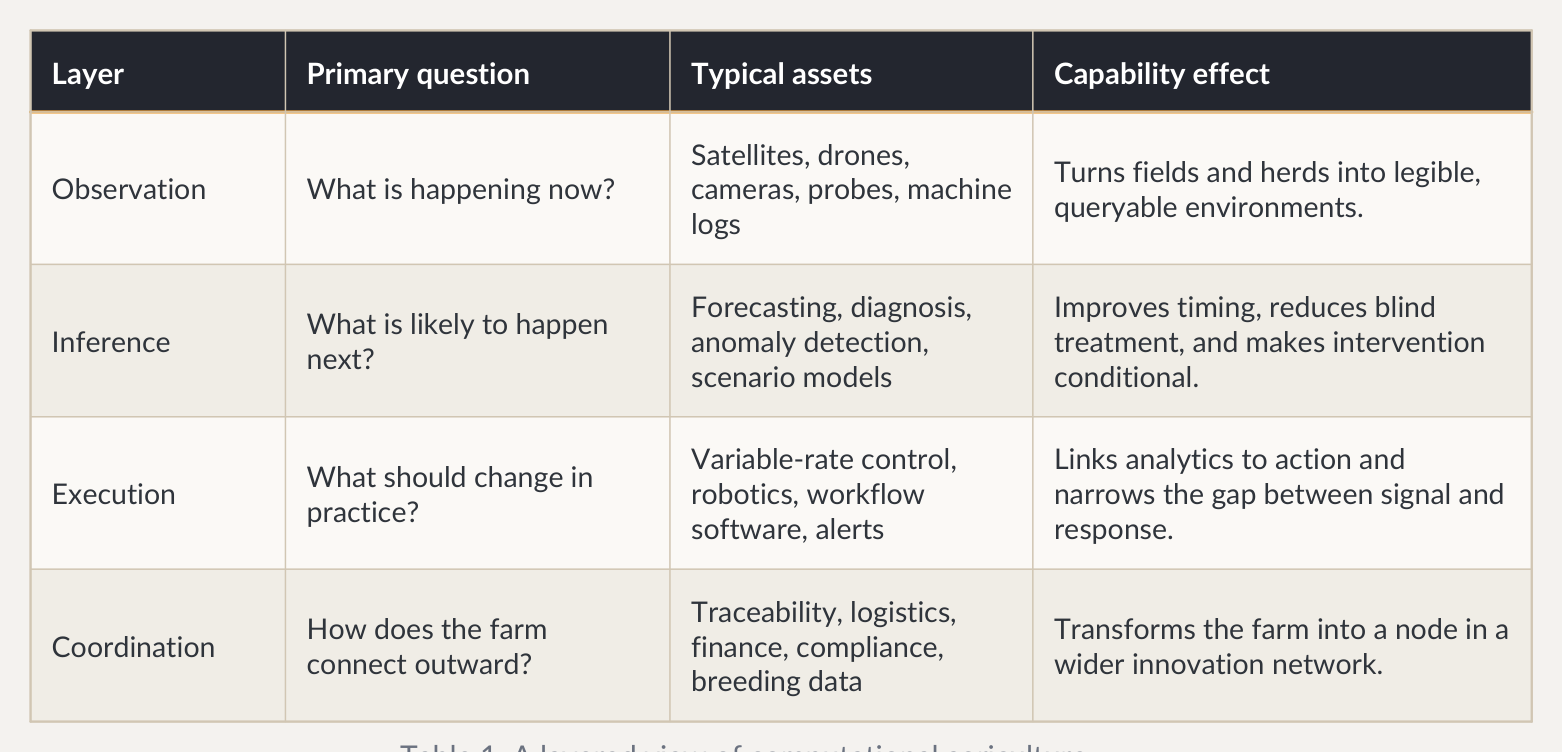
Layer Primary question Typical assets Capability effect
Satellites, drones, cameras, probes, machine logs
Turns fields and herds into legible, queryable environments.
Observation What is happening now?
Forecasting, diagnosis, anomaly detection, scenario models
Improves timing, reduces blind treatment, and makes intervention conditional.
Inference What is likely to happen next?
Variable-rate control, robotics, workflow software, alerts
Links analytics to action and narrows the gap between signal and response.
Execution What should change in practice?
Traceability, logistics, finance, compliance, breeding data
Coordination How does the farm connect outward?
Transforms the farm into a node in a wider innovation network.
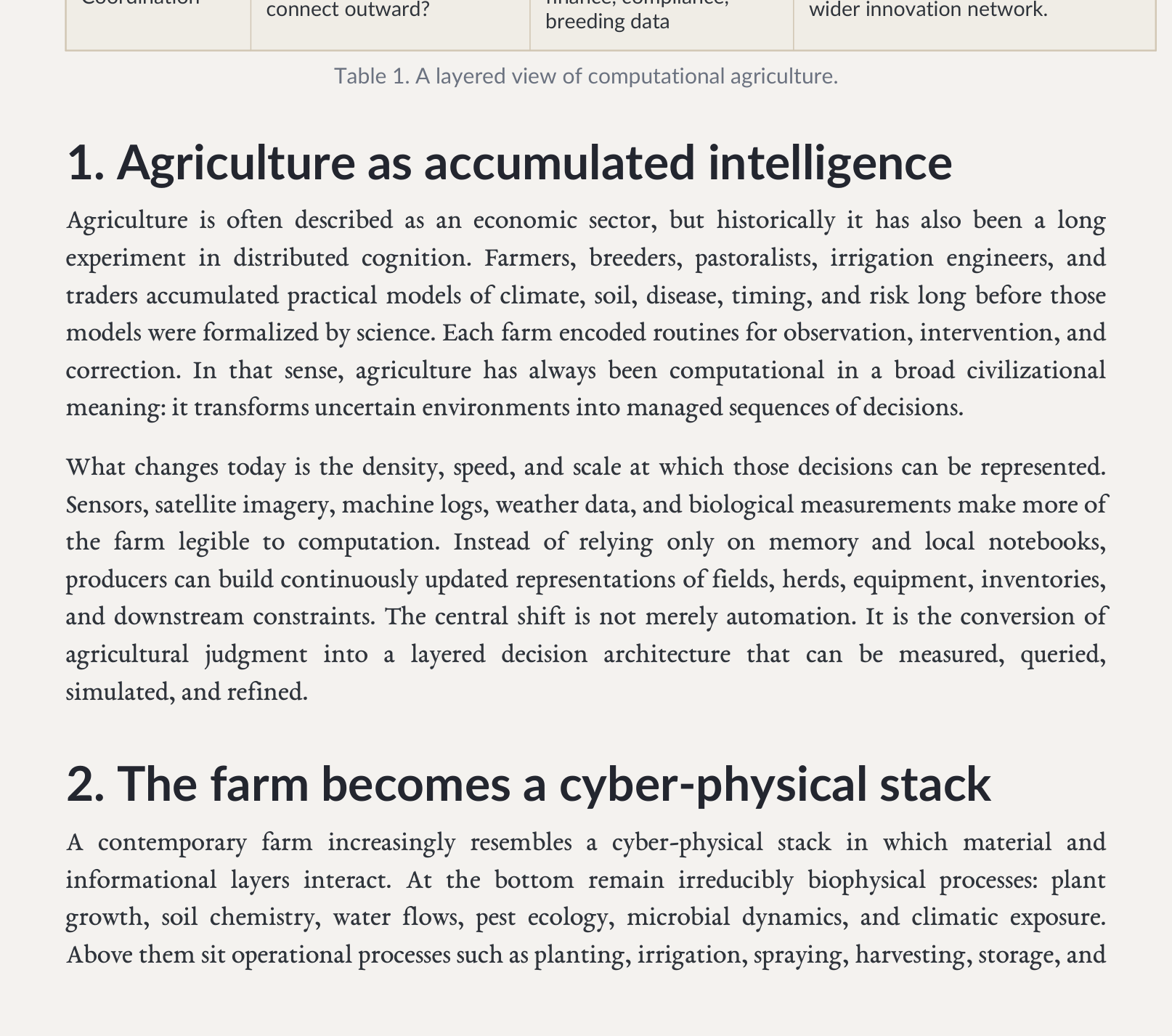
Table 1. A layered view of computational agriculture.
1. Agriculture as accumulated intelligence
Agriculture is often described as an economic sector, but historically it has also been a long experiment in distributed cognition. Farmers, breeders, pastoralists, irrigation engineers, and traders accumulated practical models of climate, soil, disease, timing, and risk long before those models were formalized by science. Each farm encoded routines for observation, intervention, and correction. In that sense, agriculture has always been computational in a broad civilizational meaning: it transforms uncertain environments into managed sequences of decisions.
What changes today is the density, speed, and scale at which those decisions can be represented. Sensors, satellite imagery, machine logs, weather data, and biological measurements make more of the farm legible to computation. Instead of relying only on memory and local notebooks, producers can build continuously updated representations of fields, herds, equipment, inventories, and downstream constraints. The central shift is not merely automation. It is the conversion of agricultural judgment into a layered decision architecture that can be measured, queried, simulated, and refined.
2. The farm becomes a cyber-physical stack
A contemporary farm increasingly resembles a cyber-physical stack in which material and informational layers interact. At the bottom remain irreducibly biophysical processes: plant growth, soil chemistry, water flows, pest ecology, microbial dynamics, and climatic exposure. Above them sit operational processes such as planting, irrigation, spraying, harvesting, storage, and
Extended concept paper 3
transport. Above those layers sit data pipelines, analytics, interfaces, and increasingly, AI agents that help interpret signals and coordinate responses.
This stacked view matters because failures often arise at the interfaces between layers rather than within a single layer. A good disease model is of little value if imagery is inconsistent, if intervention windows are missed, or if labor and machinery cannot execute treatment in time. Likewise, a fleet of machines without reliable agronomic models can automate error at scale. Computational agriculture succeeds when measurement, inference, and execution are aligned as parts of one operating system for the field.
Design implication
In a computational farm, value appears when the stack is coherent. Sensing without workflow creates dashboards. Automation without agronomy scales error. Modeling without reliable data erodes trust.
3. From observation to live sensing
Traditional agriculture relied on episodic observation: a field walk, a weather note, a visual diagnosis, a seasonal memory. Digital agriculture increases both temporal resolution and spatial granularity. Optical and radar satellites, drones, fixed cameras, soil probes, weather stations, telemetry from tractors, and supply chain platforms convert the farm into a site of near-continuous signal production. The result is not simply more data, but a different relationship to time. Biological processes that were once noticed after damage can now be monitored while they are unfolding.
Recent scientific work highlights this transition from passive sensing toward active intervention. Xiaobo Yin's 2025 Science commentary frames the frontier as a movement from observation alone to systems that can couple sensing with robotic or targeted response. That framing is important because agriculture does not benefit equally from all information. The highest value often emerges when sensing is directly linked to a timely action: a nutrient correction, a localized spray, a harvest decision, or a logistics rerouting that protects quality and margin.
4. AI as a decision multiplier
Artificial intelligence enters agriculture not as a single technology but as a family of techniques serving different decision horizons. Computer vision supports plant counting, weed discrimination, fruit grading, and disease recognition. Time-series models support yield estimation, irrigation scheduling, price forecasting, and anomaly detection. Optimization models help route machinery, tune inputs, or synchronize planting with market and climate windows.
Extended concept paper 4
Large language interfaces increasingly sit on top of these systems, making technical insights easier to query in operational language.
The practical effect is a multiplication of managerial attention. A farm manager cannot inspect every square meter, compare every scenario, or continuously integrate agronomic, climatic, and market information. AI can do parts of this comparison work at high frequency. Yet the most valuable systems are rarely fully autonomous. They act as structured amplification for human judgment, helping a manager move from intuition-rich but sparse monitoring to evidence-rich and selectively automated action.
Managerial implication
AI should be treated as a decision multiplier rather than an all-purpose substitute for agronomic judgment. The highest-value systems amplify scarce managerial attention.
5. Biological variability changes the logic of software
Agriculture is unlike many industrial settings because the underlying substrate is living matter. Fields change with weather, genotypes, pathogens, and seasonal stage. Livestock respond to stress, disease pressure, nutrition, and handling in ways that are not mechanically uniform. This means agricultural software cannot be treated as if it were controlling a stable production line. It must remain probabilistic, contextual, and adaptive.
For that reason, model design in agriculture often benefits from hybrid approaches that combine data-driven learning with process knowledge. Pure pattern recognition may work well under narrow conditions and then degrade when climates shift, new varieties are introduced, or stressors interact. More robust systems often blend agronomic priors, remote sensing signals, historical baselines, and localized calibration. The goal is not prediction in the abstract; it is decision support under biological uncertainty.
Extended concept paper 5
6. Digital twins and foundation models
Two recent conceptual developments help clarify where computational agriculture may be heading. The first is the spread of digital twin thinking: building dynamic virtual counterparts of fields, greenhouses, herds, or machinery fleets that can integrate sensing, prediction, and simulation. Recent reviews in the Journal of Agricultural and Food Chemistry, Agriculture, and Green Technologies and Sustainability argue that digital twins can unify monitoring, scenario testing, and operations across irrigation, crop management, controlled environments, and agricultural machinery.
The second development is the discussion of foundation models specialized for agriculture. Recent work from Wageningen and collaborators argues that models trained broadly on earth observation or climate data are promising but insufficient for the domain-specific structure of agricultural tasks such as crop type mapping, phenology estimation, and yield estimation. This matters because agriculture is multimodal and seasonal: it requires models that understand spatial texture, temporal sequence, agronomic context, and management history together. In the longer run, digital twins may become the stateful operational layer, while foundation models become the representation layer that generalizes across crops, geographies, and sensing modalities.
Software Climate
Robotics
Finance
Farm
Logistics
Biotech
Traceability
Sensing
Figure 2. Capability spillovers from the computational farm into adjacent industries.
7. Robotics and selective mechanization
Robotics has long been associated with labor substitution, but its strategic meaning is broader. In agriculture, robots extend precision into domains where human observation is expensive, inconsistent, or dangerous. Autonomous or semi-autonomous platforms can inspect rows, detect weeds, pick fruit, monitor animal health, or apply inputs at finer spatial scales than conventional broadcasting. Their value is especially high where the biological object is heterogeneous and where intervention accuracy affects both cost and environmental burden.
Extended concept paper 6
Still, the economics of agricultural robotics are uneven. Full autonomy across all field conditions remains difficult, and capital intensity can exceed the value of the tasks being automated. The most realistic near-term pattern is selective mechanization: narrow, high-value automation embedded in broader decision workflows. OECD's 2026 review of AI uptake in EU agriculture points in this direction by emphasizing robots, predictive analytics, and monitoring as complementary rather than interchangeable capabilities.
8. The farm as a capability engine
Economic complexity theory offers a productive lens for interpreting these changes. In that view, development depends on the accumulation and recombination of capabilities distributed across organizations, infrastructures, and institutions. Products and sectors reveal what a region knows how to do. When agriculture integrates sensing, data engineering, model development, robotics, biotechnology, traceability systems, and advanced logistics, it ceases to be a supposedly simple sector. It becomes a site where sophisticated capabilities are assembled and tested in demanding real-world environments.
This reclassification matters analytically and politically. If agriculture is seen only as commodity production, digital investment looks like a narrow productivity upgrade. If it is understood as a capability engine, the same investment appears as an expansion of national and regional know-how. The field becomes a place where software meets biology, where machine design meets environmental uncertainty, and where statistical learning meets public infrastructure. That is exactly the kind of capability recombination emphasized by Hidalgo, Hausmann, Balland and others in the complexity literature.
9. Spillovers across adjacent industries
Computational agriculture produces spillovers because its core problems overlap with adjacent sectors. Remote sensing expertise spills into environmental monitoring and insurance. Traceability infrastructures spill into compliance systems, carbon accounting, and premium food logistics. Agricultural robotics contributes components and software that can travel into warehousing, forestry, or municipal inspection. Biotechnology and phenotyping tools built for crops improve broader capacities in biological measurement, image analysis, and applied genomics.
These spillovers are economically significant because they thicken the local innovation ecosystem. A region that learns to integrate field data, satellite layers, device telemetry, and biological models acquires transferrable coordination skills. Rural innovation policy increasingly acknowledges this point. OECD's 2025 work on rural innovation pathways argues that innovation allows rural territories to transform agricultural expertise, natural resource management, and local assets into
Extended concept paper 7
higher-value activities. Computational agriculture is one of the clearest mechanisms through which that transformation can occur.
Complexity perspective
Economic complexity helps reinterpret agriculture. Once farms integrate software, sensing, robotics, and biological analytics, agriculture is no longer a low-information sector. It becomes a demanding site of capability recombination.
10. Governance, standards, and responsible AI
As agriculture becomes more data-intensive, governance moves from a peripheral concern to a production variable. Questions of data ownership, interoperability, benchmarking, liability, model transparency, and cyber security all shape whether digital tools produce durable value. Fragmented pilots can create islands of functionality that do not scale, while proprietary lock-in can prevent farms from assembling coherent data histories across equipment, platforms, and seasons.
This is why the recent FAO digital agriculture and AI innovation roadmap is notable. It frames the challenge not merely as technology diffusion but as ecosystem design: common governance tools, reusable assets, contextual adaptation, and trusted pathways from experimentation to scaled deployment. Responsible AI in agriculture is therefore not a rhetorical add-on. It is the institutional architecture that determines whether digital agriculture becomes a cumulative public-good-rich system or a patchwork of disconnected vendor solutions.
11. Infrastructure as destiny
Computational agriculture depends on hidden infrastructures that are easy to underestimate. Reliable connectivity, cloud and edge computing, geospatial basemaps, calibration standards, extension services, maintenance capacity, and affordable devices all determine whether algorithms can function in practice. Public weather and cadastral data, for example, can be as important as private AI models because they create common informational ground for innovation.
This dependence on enabling infrastructure has distributive consequences. Wealthier regions may capture disproportionate gains because they already possess the digital, institutional, and educational substrate required for rapid adoption. Emerging economies, however, also have opportunities to leapfrog. Where agricultural sectors are large and ecologically diverse, investments in digital public goods, interoperable platforms, and applied research can generate broad spillovers. The question is less whether AI can technically work on farms than whether the surrounding system can absorb and reuse what AI makes possible.
Extended concept paper 8
12. A staged roadmap for adoption
The most robust path into computational agriculture is usually staged rather than totalizing. The first stage is visibility: digitizing records, instrumenting key operations, and creating a usable baseline of field conditions. The second stage is analytical: building models that compare scenarios, identify anomalies, and estimate consequences. The third stage is selective automation: using machines or software agents where timing, repetition, or spatial precision create clear returns. The fourth stage is ecosystem integration: connecting the farm to breeding data, finance, logistics, compliance, insurance, and downstream demand.
This sequence matters because premature automation without data quality disappoints, while abundant data without operational translation often creates dashboards rather than value. A good maturity model preserves coherence between observation, interpretation, and execution. In effect, the farm does not become computational in a single leap. It becomes computational by progressively tightening the loop between what it can sense, what it can infer, and what it can actually change.
1. Visibility 2. Prediction 3. Selective automation 4. Ecosystem integration
Figure 3. A staged pathway from visibility to ecosystem integration.
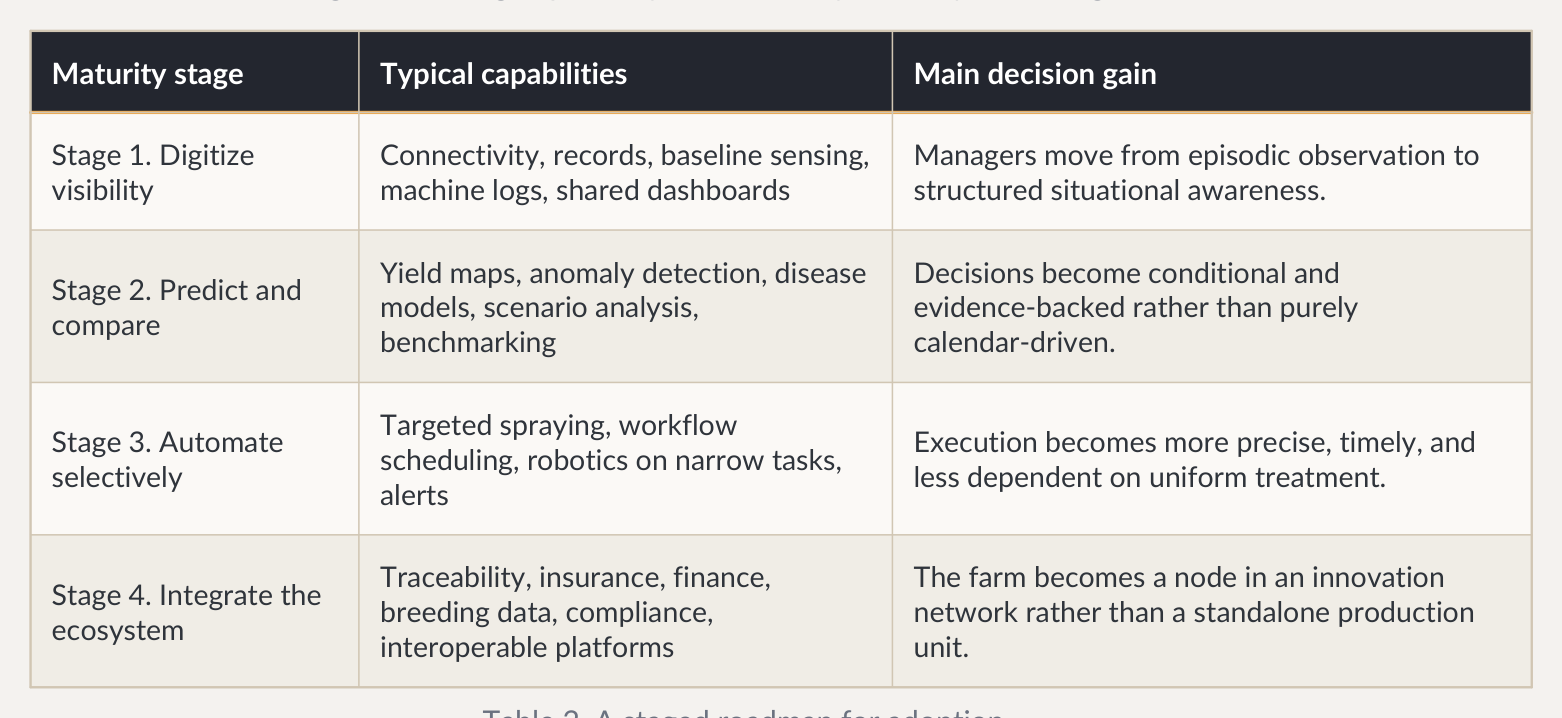
Maturity stage Typical capabilities Main decision gain
Stage 1. Digitize visibility
Connectivity, records, baseline sensing, machine logs, shared dashboards
Managers move from episodic observation to structured situational awareness.
Yield maps, anomaly detection, disease models, scenario analysis, benchmarking
Decisions become conditional and evidence-backed rather than purely calendar-driven.
Stage 2. Predict and compare
Targeted spraying, workflow scheduling, robotics on narrow tasks, alerts
Stage 3. Automate selectively
Execution becomes more precise, timely, and less dependent on uniform treatment.
Traceability, insurance, finance, breeding data, compliance, interoperable platforms
The farm becomes a node in an innovation network rather than a standalone production unit.
Stage 4. Integrate the ecosystem
Table 2. A staged roadmap for adoption.
Extended concept paper 9
13. Why this matters for development strategy
For countries and regions seeking higher-value growth, computational agriculture offers an especially important strategic opportunity. It can upgrade one of the oldest sectors by embedding new capabilities into existing productive landscapes rather than requiring a full industrial reboot. It mobilizes agronomy, software, electronics, genomics, logistics, and finance around concrete problems whose solutions can then travel outward. In development terms, it is a route for capability deepening anchored in place-based realities.
This helps explain why the topic should interest not only farmers and agribusinesses, but also ministries of science, universities, infrastructure planners, and innovation agencies. A digitally upgraded farm sector can become a distributed laboratory for rural modernization. It can expand the sophistication of what an economy produces, how it coordinates knowledge, and how it translates biological intelligence into industrial and technological competence.
14. Conclusion
Computational agriculture should not be reduced to smart gadgets in the field. It is a structural shift in how agriculture is known, governed, and economically positioned. The farm becomes legible as a layered system in which ecology, biology, machinery, data, models, and institutions interact. Artificial intelligence intensifies that transformation by turning more of the agricultural environment into analyzable and actionable information.
Seen through the lens of economic complexity, this transformation carries implications far beyond yield improvement. A farm equipped with sensing, analytics, selective automation, and interoperable data systems becomes a node in a broader innovation web. It accumulates capabilities that can spill into biotechnology, robotics, logistics, finance, environmental services, and regional development. The resulting agricultural system is not only more efficient. It is more inventive, more connected, and potentially more developmentally generative.
Extended concept paper 10
15. Research agenda and strategic priorities
A serious program in computational agriculture also requires a serious research agenda. Benchmark datasets must represent real agronomic variability rather than only ideal conditions. Models need transparent evaluation across crops, climates, and management systems, with attention to robustness, calibration, and failure modes. Interoperability standards need to mature so that farms can preserve long historical memory across equipment cycles and software vendors. And extension systems must evolve from one-way recommendation channels into translation institutions that help producers interpret digital signals in local context.
Strategically, the field now faces four linked priorities: build reliable observation infrastructure, create reusable data and governance layers, develop domain-specific models and twins that respect biological uncertainty, and ensure that automation remains selective and economically grounded. Where those priorities advance together, computational agriculture can become not only an instrument of efficiency but a durable architecture for rural innovation, public learning, and productive diversification.
A complementary priority is evaluation in deployment. Agricultural systems should be judged not only by benchmark accuracy but by whether they improve timing, reduce waste, preserve optionality under uncertainty, and remain understandable to operators. In other words, the mature metric is not merely prediction quality. It is whether the socio-technical loop between data, model, agronomy, machinery, and management becomes more coherent over time.
Closing synthesis
The strategic stake is therefore larger than farm productivity. Computational agriculture can become a platform through which biological knowledge, digital infrastructure, and economic diversification reinforce one another.
Selected References
Elbehri, A., and Chestnov, R., eds. (2021). Digital Agriculture in Action - Artificial Intelligence for Agriculture. FAO and ITU. DOI: 10.4060/cb7142en.
FAO. (2025). Digital Agriculture and AI Innovation Roadmap. Food and Agriculture Organization of the United Nations.
Elouafi, I. (2026). Stewarding AI in agriculture research. Science, 391(6786), eaef0964. DOI: 10.1126/science.aef0964.
Yin, X. (2025). Let there be light: From passive agricultural sensing to active intervention. Science, 388(6754), eadz1676. DOI: 10.1126/science.adz1676.
OECD. (2026). Progress in Implementing the European Union Coordinated Plan on Artificial Intelligence (Volume 2): Uptake in High-Impact Sectors. OECD Publishing. DOI: 10.1787/3ac96d41-en.
Extended concept paper 11
OECD. (2025). Rural Innovation Pathways: Connecting People, Places and Ideas. OECD Rural Studies. OECD Publishing. DOI: 10.1787/c86de0f4-en.
OECD and FAO. (2025). OECD-FAO Agricultural Outlook 2025-2034. OECD Publishing.
Escriba-Gelonch, M., Liang, S., van Schalkwyk, P., Fisk, I., Long, N. V. D., and Hessel, V. (2024). Digital Twins in Agriculture: Orchestration and Applications. Journal of Agricultural and Food Chemistry, 72(19), 10737-10752. DOI: 10.1021/acs.jafc.4c01934.
Subeesh, A., and Chauhan, N. (2025). Agricultural digital twin for smart farming: A review. Green Technologies and Sustainability, 4(2), 100299. DOI: 10.1016/j.grets.2025.100299.
Zhang, R., Zhu, H., Chang, Q., and Mao, Q. (2025). A Comprehensive Review of Digital Twins Technology in Agriculture. Agriculture, 15(9), 903. DOI: 10.3390/agriculture15090903.
Nedungadi, V., Xiong, X., Potze, A. N., van Bree, R. J., Lin, T., Russwurm, M., and Athanasiadis, I. N. (2025). From General to Specialized: The Need for Foundational Models in Agriculture. arXiv. DOI: 10.48550/arXiv.2507.05390.
Balland, P.-A., Broekel, T., Diodato, D., Giuliani, E., Hausmann, R., O'Clery, N., and Rigby, D. (2022). The new paradigm of economic complexity. Research Policy, 51(3), 104450. DOI: 10.1016/j.respol.2021.104450.
Hidalgo, C. A., and Hausmann, R. (2009). The building blocks of economic complexity. Proceedings of the National Academy of Sciences, 106(26), 10570-10575. DOI: 10.1073/pnas.0900943106.
UNCTAD. (2025). Technology and Innovation Report 2025: Inclusive Artificial Intelligence for Development. United Nations Conference on Trade and Development.
Extended concept paper 12
📝 About this HTML version
This HTML document was automatically generated from the PDF. Some formatting, figures, or mathematical notation may not be perfectly preserved. For the authoritative version, please refer to the PDF.