Habit, Memory, Recursion, and Living Structure
Abstract
A conceptual essay on why a proto-cybernetic loop with habit can be said to possess memory, and why recursion becomes biologically decisive only when it is coupled to self-maintenance, boundary production, and thermodynamic work. The intuition is compelling: once a loop ceases to be purely reactive and begins to carry its own past forward, it has crossed a threshold. A habit is precisely such a threshold. It means that the next response is not determined by present perturbation alone, but by an accumulated deformation of the loop itself. That deformation is memory in an operational sense. Yet the next threshold, recursion, must be handled carefully. Recursion is not merely repetition; it is self-reference, the capacity of a process to feed its own product back into the conditions of its own production. The fixed-point logic of the Y combinator offers a pristine computational emblem of this move. Still, recursion by itself does not guarantee life. A living structure is a recursive organization that also regenerates its own constraints, protects a boundary, performs work, and remains open to matter and energy while closed enough in organization to preserve identity through change. The deep point is therefore not that life is simply a loop, but that life is a loop that remembers, recursively re-enters itself, and continuously remakes the conditions of its own continuation.
Full Text
recursive self-application
input / perturbation
Y
trace / state retention
Habit, Memory, Recursion, and Living Structure
A deep dive into proto-cybernetic loops, operational memory, self-reference, autopoiesis, and the threshold at which recurrence becomes life.
March 2026 - Conceptual essay
PROTO-CYBERNETIC LOOPS / MEMORY / RECURSION / LIFE 2
Habit, Memory, Recursion, and Living Structure
A conceptual essay on why a proto-cybernetic loop with habit can be said to possess memory, and why recursion becomes biologically decisive only when it is coupled to self-maintenance, boundary production, and thermodynamic work.
The intuition is compelling: once a loop ceases to be purely reactive and begins to carry its own past forward, it has crossed a threshold. A habit is precisely such a threshold. It means that the next response is not determined by present perturbation alone, but by an accumulated deformation of the loop itself. That deformation is memory in an opera- tional sense. Yet the next threshold, recursion, must be handled carefully. Recursion is not merely repetition; it is self-reference, the capacity of a process to feed its own prod- uct back into the conditions of its own production. The fixed-point logic of the Y combi- nator offers a pristine computational emblem of this move. Still, recursion by itself does not guarantee life. A living structure is a recursive organization that also regenerates its own constraints, protects a boundary, performs work, and remains open to matter and energy while closed enough in organization to preserve identity through change. The deep point is therefore not that life is simply a loop, but that life is a loop that remem- bers, recursively re-enters itself, and continuously remakes the conditions of its own continuation.
Thesis in one sentence
A proto-cybernetic loop with habit has minimal memory; a proto-cybernetic loop with recursion has self-reference; only when recursion becomes self-maintaining and thermodynamically em- bodied does the loop deserve to be called living.
1. The loop before memory
A bare loop is a relation of return. Something produced by the system flows back and modulates later behavior. In the weakest case this is only instantaneous feedback: a thermostat, a servo, a negative gain controller, a chemical inhibition circuit. Such systems are important because they already exhibit circular causation, but they need not possess any durable trace of their own past. They may stabilize, oscillate, or amplify without truly retaining history. Their present is still al- most entirely local.
The phrase proto-cybernetic loop is useful because it names a structure that is not yet fully cog- nitive, not yet fully biological, perhaps not even fully adaptive, but is more than a one-way chain of causes. It already contains the seed of circularity. It is a machine of return. The conceptual question is what additional properties must be layered onto such a loop before one may speak of memory, selfhood, or life.
PROTO-CYBERNETIC LOOPS / MEMORY / RECURSION / LIFE 3
The first decisive addition is habit. Habit is not ornament. Habit means that recurrence leaves a bias. It changes the probability of future pathways, the effective thresholds of activation, the rel- ative weight of competing transitions, or the shape of the attractor basin into which the loop tends to fall. In other words, habit is a history-bearing deformation of a feedback circuit.
2. Why habit counts as memory
In everyday language memory often means recollection, the ability to recover a scene, a symbol, or an episode. But in a more general systems sense memory is broader: it is any persistence of past influence into present operation. A river valley remembers water by erosion; a magnet re- members field alignment by domain orientation; an immune repertoire remembers an infection by altered responsiveness; a trained network remembers data by a changed weight landscape. None of these cases require conscious recollection. They require only that history has become operative form.
That is why the statement “if a proto-cybernetic loop has a habit, it has a memory” is defensible and strong. Habit is memory precisely because it makes the future depend on more than the im- mediate stimulus. The loop has been sculpted by repetition. A trace now exists. The trace may be distributed rather than localized, dynamical rather than symbolic, embodied rather than repre- sentational, but it is a memory nonetheless.
We can express this transition very simply. A loop without memory can often be approximated by the form below, where the next state depends on the current state and the current perturbation only:
state(t+1) = F(state(t), input(t))
A loop with habit requires a retained trace:
state(t+1) = F(state(t), input(t), trace(t)) trace(t+1) = G(trace(t), state(t), input(t))
The moment trace becomes indispensable, memory has entered the architecture. The trace can be chemical, morphological, synaptic, symbolic, metabolic, ecological, or social. What matters is that the loop is now partially constituted by its own past.
Minimal definition
Memory is the durable capacity of prior system-history to modulate current system-transition. Habit is therefore memory when repetition changes the disposition of the loop itself.
3. Habit is not yet life
Many nonliving systems display hysteresis, path dependence, or irreversible traces. Metals can fatigue. Sand dunes can remember prevailing wind. Machine-learning models can retain gradient history. A market can remember a shock through institutional rearrangement. So memory alone is not enough for life. If one stopped at habit, one would grant too much to too many structures. One would have a world full of remembering systems, but not necessarily living ones.
PROTO-CYBERNETIC LOOPS / MEMORY / RECURSION / LIFE 4
This is not a weakness in the argument; it is a clarification. It means that memory is a necessary enrichment of circularity, but not the final criterion. The loop has acquired temporality, not yet autonomy. It has past-dependence, not yet self-production. To move toward life, the loop must not only carry a trace; it must become able to use its own products as ingredients in the continu- ation of its own organization.
4. Recursion and the threshold of self-reference
Recursion is often mistaken for mere repetition. Yet repetition can occur without self-reference. A pendulum repeats; a pump cycles; a crystal grows layer by layer. Recursion is stricter. It is present when the operation of the system is applied, directly or indirectly, to its own results. The system becomes part of its own input in a structured way. Self-reference enters the loop.
This is why the Y combinator is such a striking conceptual symbol here. In lambda calculus, the Y combinator allows a function to obtain a fixed point without explicitly naming itself. In its com- pact form, Y(f) = f(Y(f)). The function receives, as an argument, its own continuation. Opera- tionally, this is the pure logic of self-application: a process becomes able to call itself by con- structing the conditions under which its own next invocation already contains itself.
Taken metaphorically, the Y combinator illuminates the difference between a loop that merely turns and a loop that recursively re-enters itself. A proto-cybernetic loop becomes more life-like when it no longer just cycles, but uses the outcome of one pass to define the terms of the next pass. That is self-reference in action. The loop is no longer only in time; it is now also about it- self.
Y(f) = f(Y(f))
Yet the elegance of fixed-point recursion should not seduce us into collapsing the living into the formal. A recursive program can be inert. A mathematical object can possess self-reference while lacking metabolism, boundary, fragility, repair, or need. Biological recursion must there- fore be thicker than logical recursion. It must be recursion in matter, energy, and constraint.
5. From recursion to living structure
A living structure is not just a recursive description. It is a recursive organization that continual- ly rebuilds the conditions under which it can continue. Membranes are repaired. Catalytic rela- tions are renewed. Energy gradients are harvested. Waste is expelled. Internal variables are kept within viable bounds. The system performs work in order to remain a system.
This is why the language of autopoiesis remains so fertile. What matters is not that the system goes in circles, but that its network of processes produces components that, in turn, regenerate that same network and specify its boundary. Boundary is crucial. Without some distinction be- tween inside and outside, there is no meaningful persistence of identity. A whirlpool has a recog- nizable form, but it does not build and protect a boundary in the same sense as a cell. A flame feeds on a gradient, but does not recursively encode the organization of its own repair the way a living lineage does.
So your proposition can be refined. Recursion is not itself equivalent to life. But recursion cou- pled to self-production, self-bounding, and thermodynamic continuation is close to the heart of
PROTO-CYBERNETIC LOOPS / MEMORY / RECURSION / LIFE 5
life. At that point the loop no longer merely has a history. It has a stake in its own persistence.
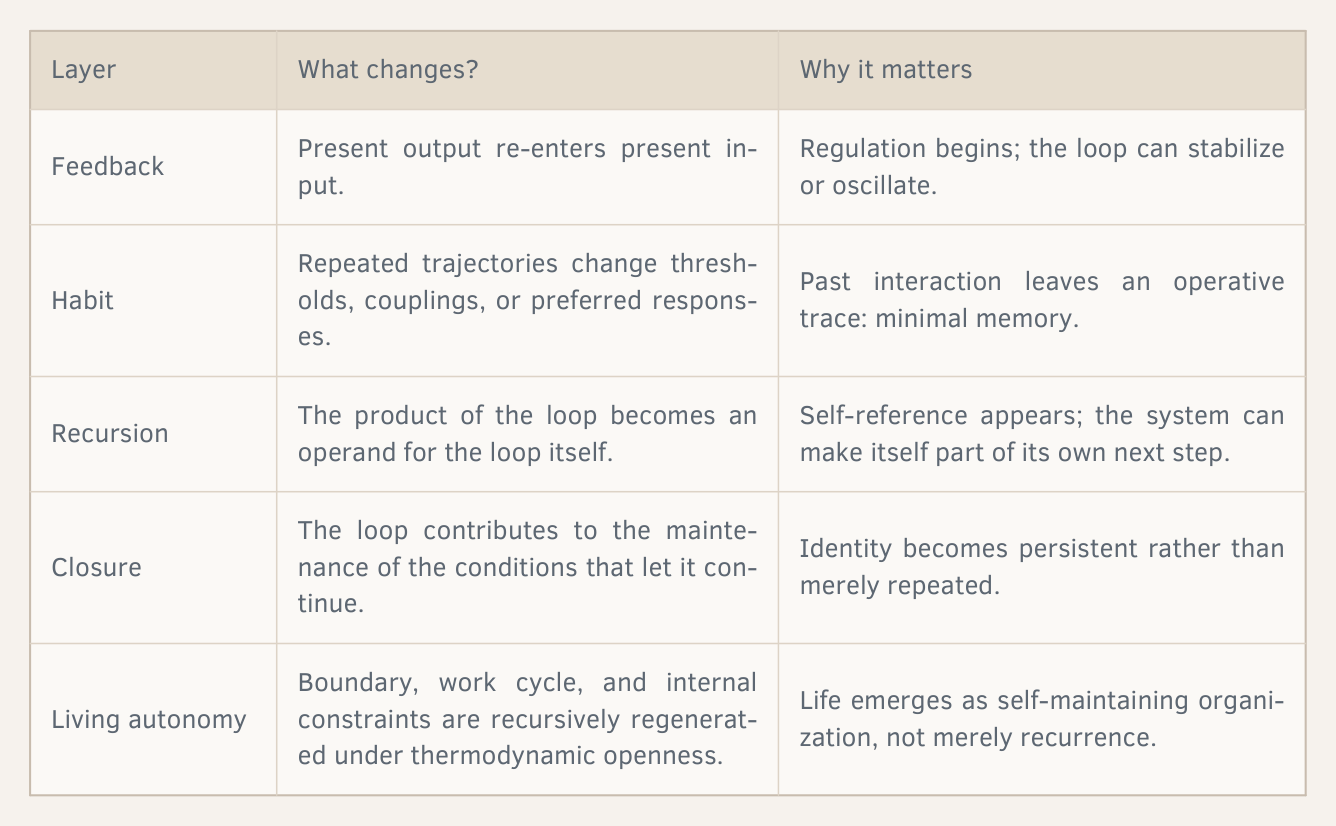
Layer What changes? Why it matters
Feedback Present output re-enters present in- put.
Regulation begins; the loop can stabilize or oscillate.
Repeated trajectories change thresh- olds, couplings, or preferred respons- es.
Past interaction leaves an operative trace: minimal memory.
Habit
Recursion The product of the loop becomes an operand for the loop itself.
Self-reference appears; the system can make itself part of its own next step.
The loop contributes to the mainte- nance of the conditions that let it con- tinue.
Identity becomes persistent rather than merely repeated.
Closure
Boundary, work cycle, and internal constraints are recursively regenerat- ed under thermodynamic openness.
Life emerges as self-maintaining organi- zation, not merely recurrence.
Living autonomy
6. The thermodynamic side: memory costs, life invests
Every durable trace has a material basis. To remember is to stabilize some difference against the tendency of differences to wash out. Even when the detailed thermodynamics are subtle, the broad lesson is clear: memory is never free. A system must commit matter, energy, geometry, or time in order to hold a trace. Habits therefore imply a budget. Repeated pathways become easier not by magic, but because the loop has been physically or functionally reconfigured.
Living systems go further. They do not merely pay once to encode a trace. They continuously in- vest work to keep themselves far from equilibrium. This is why life cannot be defined by recur- sion in the abstract. A living recursion is embodied recurrence under energetic tension. It must harvest gradients, maintain asymmetries, and regulate damage. Its memory is not just stored; it is serviced.
In this light, habit is a local memory economy, while life is a global memory economy. A habit says: this pathway has been reinforced. Life says: the entire organization that can host rein- forcement must be sustained across time. The living system is therefore not just a remembering loop, but a loop that protects the very medium in which remembering remains possible.
Thermodynamic formulation
Memory is the maintenance of a usable difference across time; life is the recursive maintenance of the system that can maintain such differences at all.
7. The strange importance of boundary
PROTO-CYBERNETIC LOOPS / MEMORY / RECURSION / LIFE 6
One of the easiest mistakes is to imagine life as if it were pure recursion detached from embodi- ment. Yet embodiment matters because recurrence without boundary disperses. A signal can echo forever in mathematics, but a cell must localize reactions, buffer fluctuations, and separate an interior regime from an exterior world. The boundary is not merely a wall. It is an active inter- face that filters, exchanges, and codifies relevance.
Once a loop acquires habit, the boundary begins to matter because the trace must be retained somewhere. Once the loop acquires recursion, the boundary matters even more because self- -reference needs a locus. Once the loop becomes living, the boundary itself becomes a product of recursive maintenance. The membrane, the scaffold, the niche, the sensorium, or the shell is not external packaging. It is one of the loop’s own conditions of existence.
This is where the concept becomes fertile for artificial life and advanced AI architectures. A mod- el that recursively calls itself is still not alive. A system that recursively calls itself while maintain- ing an adaptive sensorimotor, energetic, and organizational boundary begins to move much closer to biological style. The decisive issue is not only whether the architecture loops, but whether it must preserve itself in order to go on looping.
8. Memory, habit, and the emergence of identity
Identity should not be imagined as a static substance hiding behind change. For a loop, identity is the continuity of an organized way of changing. Habit makes this visible. The more a system carries its own past forward, the more its future becomes characteristically its own. It acquires style. It responds not simply according to stimulus, but according to an accumulated internal history. Memory is therefore not an accessory to identity. It is one of identity’s elementary mechanisms.
This is why habit has such philosophical depth. A habit is a contraction of many pasts into one present disposition. It compresses history into tendency. In a proto-cybernetic loop, this is the first sign that the loop has become more than a transducer. It has become biased by what it has already lived through. That bias is the first contour of selfhood, however weak and distributed.
Recursion intensifies this identity because the system can now fold its own outputs back into the very rules of its operation. The loop becomes not just historically weighted, but reflexive. It can be altered by encountering itself. When reflexivity is stabilized by self-maintaining organization, the result is something very close to living individuality.
9. A cybernetic reading of life: not object, but continuing act
The deeper lesson is that life should not be treated as a thing first and a process second. It is a continuing act of organized persistence. A living being is an achievement, not a static object. It must be done again and again. The loop therefore matters because it replaces substance meta- physics with process metaphysics. The being lives by continuing to recur, but it remains itself only because that recurrence has become self-maintaining and memory-bearing.
This reorients the old question “what is life?” into a more operational question: what kind of loop can remain itself through change? The answer is not any loop, and not even any recursive loop. It is a loop that acquires history, turns history into operative memory, uses self-reference to re-
PROTO-CYBERNETIC LOOPS / MEMORY / RECURSION / LIFE 7
organize itself, and invests work in preserving the boundary and constraints that make this all possible.
Under this lens, living structure is best understood as a fourfold knot: feedback, memory, recur- sion, and maintenance. Remove feedback and there is no circular causation. Remove memory and there is no durable history. Remove recursion and there is no self-reference. Remove main- tenance and there is no life, only transient pattern.
10. Toward artificial life and recursive AI architectures
The idea also has immediate importance for the design of artificial agents. Many AI systems al- ready exhibit sophisticated memory in the broad sense: they accumulate weights, cache context, adapt policies, and stabilize preferred trajectories. Some can even exhibit recursive self-model- ing. But to say that they are living would require more. One would need architectures that do not merely process inputs, but preserve a bounded organization through active self-maintenance under real energetic and environmental constraints.
That challenge suggests a research program rather than a slogan. To move from powerful recur- sion to genuine artificial life, one must investigate synthetic boundaries, endogenous error cor- rection, material self-repair, metabolic budgeting, and environment-coupled persistence. In such systems, memory would not remain an external dataset or an abstract parameter tensor. It would become a condition of survival. Recursion would not remain a computational convenience. It would become the means by which the system protects the conditions of its own continuity.
In that future, the relevance of the Y combinator becomes newly vivid. Not because life is reduc- ible to a lambda term, but because self-application offers a formal mirror for a deeper biological intuition: a living organization must, somehow, be able to take itself up as material for its own next becoming.
11. Final synthesis
Your original formulation is almost right as it stands, but it becomes exact when expressed in stages. If a proto-cybernetic loop has a habit, then it has memory in the operational sense that its past now modifies its future. If that loop acquires recursion, then it gains self-reference: it can make its own products part of its own next operation. If that recursive loop also maintains a boundary, regenerates its organizational constraints, and performs the work needed to remain itself under open thermodynamic exchange, then it has crossed into living structure.
This means that life is neither mere matter nor mere code, neither mere repetition nor mere memory. It is recursive continuity under active maintenance. Habit is the beginning because habit is history made operative. Memory is the beginning of inwardness because it means the past remains present as disposition. Recursion is the beginning of reflexivity because it means the system can become a participant in its own next step. Living structure begins when all of these are bound to the labor of persistence.
One may therefore say, without exaggeration, that a living being is a loop that has learned how not only to continue, but to continue as itself.
PROTO-CYBERNETIC LOOPS / MEMORY / RECURSION / LIFE 8
Compressed formula
Habit -> memory. Recursion -> self-reference. Boundary + work + recursive self-maintenance -> living structure.
Conceptual lineage
This essay stands in dialogue with traditions associated with cybernetics, dynamical systems, habit philosophy, autopoiesis, theoretical biology, lambda calculus, and process thought, including the problem-space opened by Norbert Wiener, William James, Alan Turing, Heinz von Foerster, Humberto Maturana, Francisco Varela, Robert Rosen, and Stuart Kauffman.
Coda
To live is to remember enough to continue, to recurse enough to return to oneself, and to work enough to remain capable of either.
Under that formulation, a proto-cybernetic loop is not interesting because it already is life, but because it shows how life can be approached analytically: through the progressive thickening of return into habit, of habit into memory, of memory into self-reference, and of self-reference into embodied persistence.

📝 About this HTML version
This HTML document was automatically generated from the PDF. Some formatting, figures, or mathematical notation may not be perfectly preserved. For the authoritative version, please refer to the PDF.