Ancient Astronomical Calendars and a Newly-Discovered Transgenerational Reproductive Parameter: Exploratory Evidence for Cultural Calibration
Abstract
A recent pre-registered study (Angulo & Sheretova, 2026; N = 1,366 families, 17 cultural groups, 1500–2000 CE; preprint DOI: 10.21203/rs.3.rs-8959120/v1) established that the transgenerational window (TW) — the sum of maternal ages at childbirth across two consecutive generations — clusters within [55, 65] years at 37.0% (95% CI: 34.4–39.5%) versus 13.2% expected (chi-squared = 673.6, p < 0.001, Cohen's h = 0.56). The TW mean is 55.0 years, with cultural modes ranging from 50.3 to 62.0 years. This exploratory follow-up investigates whether cultures with stronger ancient astronomical traditions show tighter alignment between their TW modes and known astronomical periods. We find that cultural TW modes correlate with the regional density of 56 catalogued ancient astronomical sites (Spearman rho = 0.733, N = 9 cultural groups, 95% bootstrap CI [0.15, 0.95]). The Middle Eastern TW mode (60.3 years) approximates three Jupiter-Saturn conjunction periods (59.6 years, 1.2% deviation), consistent with the Mesopotamian calendrical tradition. The overall TW mean (55.0 years) approximates three Metonic cycles (55.8 years, 1.5% deviation), the foundational period of ancient luni-solar calendars. We derive a testable prediction: migrant populations crossing between calendrical traditions should show TW drift toward the host culture's mode within 2-3 generations. We report all astronomical comparisons including poor fits and compute chance expectations. This paper is framed as hypothesis-generating; we propose a pre-registered migrant study as the confirmatory follow-up.
Full Text
Ancient Astronomical Calendars and a Newly-Discovered Transgenerational Reproductive Parameter: Exploratory Evi dence for Cultural Calibration Ulysses Angulo¹*, Maria Sheretova²
¹ Biostar Technology Research Institute, Czech Republic ² Independent Researcher, Cross-Cultural Family Dynamics, Czech Republic
*Corresponding author: Ulysses Angulo (ulysses@sheretov.net) ORCID: 0009-0003-7204-7094
Abstract A recent pre-registered study (Angulo & Sheretova, 2026; N = 1,366 families, 17 cultural groups, 1500–2000 CE; preprint DOI: 10.21203/rs.3.rs-8959120/v1) established that the transgenerational window (TW) — the sum of maternal ages at childbirth across two consecutive generations — clusters within [55, 65] years at 37.0% (95% CI: 34.4–39.5%) versus 13.2% expected (χ² = 673.6, p < 0.001, Cohen’s h = 0.56). The TW mean is 55.0 years, with cultural modes ranging from 50.3 to 62.0 years. This exploratory follow-up investigates whether cultures with stronger ancient astronom ical traditions show tighter alignment between their TW modes and known astronomical periods. We test one primary hypothesis: that cultures which built astronomical monuments calibrated reproductive timing norms to calendrical cycles, producing measurable demographic signatures. We find that cultural TW modes correlate with the regional density of 56 catalogued ancient astronomical sites (Spearman ρ = 0.733, N = 9 cultural groups, 95% bootstrap CI [0.15, 0.95]). Leave- one-out analysis shows the correlation is robust to removal of any single group except the Middle Eastern cluster (ρ drops to 0.548). The Middle Eastern TW mode (60.3 years) approximates three Jupiter-Saturn conjunction periods (59.6 years, 1.2% deviation), consistent with the Mesopotamian calendrical tradition. The overall TW mean (55.0 years) approximates three Metonic cycles (55.8 years, 1.5% deviation), the foundational period of ancient luni-solar calendars. We derive a testable prediction: migrant populations crossing between calendrical traditions should show TW drift toward the host culture’s mode within 2–3 generations. We report all astronomical comparisons including poor fits (solar cycle: 13.2% deviation; Saturn: 18.3% deviation) and compute chance expectations. This paper is framed as hypothesis-generating; we propose a pre-registered migrant study as the confirmatory follow-up.
Keywords: transgenerational reproductive timing, Metonic cycle, cultural demography, ancient calendars, gene-culture coevolution, astronomical monuments, exploratory analysis
1. Introduction
1.1 A newly-discovered demographic regularity Human reproductive timing at the population level exhibits a previously undescribed regularity. In a companion study currently under peer review (Angulo & Sheretova, 2026; preprint DOI:
10.21203/rs.3.rs-8959120/v1; PLOS ONE manuscript PONE-D-26-12921), we analyzed verified genealogical records from 1,366 multi-generational families spanning 17 cultural groups, 45+ countries, and birth records from 1500–2000 CE.
We defined the transgenerational window (TW) as:
TW = T₀ + T₁
where T₀ is the mother’s age at the subject’s birth and T₁ is the grandmother’s age at the mother’s birth. The key finding: TW clusters within the [55, 65] year range at 37.0% (95% CI: 34.4–39.5%) versus 13.2% expected under a uniform null model (χ² = 673.6, p < 0.001, Cohen’s h = 0.56). This clustering replicates across all 17 cultural groups. The population-level TW mean is 55.0 ± 8.7 years.
Critically, permutation testing (10,000 iterations, p = 0.77) established that this clustering arises from the conservation of population-level maternal age distributions — the “27.5-year reproduc tive attractor” — rather than within-family intergenerational coupling. The TW parameter reflects a population-level constant, not a family-level inheritance mechanism.
1.2 Cultural variation as a clue While the TW clustering replicates across all cultural groups, the TW mode varies systematically: from 50.3 years (Russian) to 62.0 years (African, N = 23), with the Middle Eastern group showing the highest precise mode at 60.3 years (N = 41, clustering rate 51.2%). This cultural variation in an otherwise stable parameter suggests that while biological constraints set the approximate range, cultural factors may calibrate the precise value.
This observation motivates our central question: do cultures with stronger traditions of astronomical observation and calendrical regulation show reproductive timing more precisely aligned with astronomical periods?
1.3 Theoretical framework: calendrical regulation of marriage timing Multiple pre-modern civilizations independently adopted approximately 60-year calendrical cycles: the Chinese sexagenary cycle (六十甲子), the Hindu Samvatsara system, and the Mesopotamian nēru [1,2]. These calendar systems governed not only agricultural and religious activities but also social organization including marriage timing, dowry customs, and fertility rituals [3,4].
The Metonic cycle (18.613 years) — the period after which lunar phases recur on the same calendar date — forms the foundation of luni-solar calendars used across Mesopotamia, Greece, China, and the Hebrew tradition [5]. The Saros cycle (18.030 years) governed eclipse prediction and was central to Babylonian astronomical practice [6]. The Jupiter-Saturn conjunction cycle (19.859 years) was tracked across multiple ancient traditions and underpins the Chinese 60-year cycle (3 × 19.86 ≈ 59.6 years) [7].
We hypothesize that calendrical systems calibrated to these astronomical periods may have indi rectly regulated marriage and reproductive timing norms over centuries, producing population- level TW values that track calendrical periods through cultural rather than physical transmission.
This represents a specific case of gene-culture coevolution [8] — culturally-transmitted demo graphic norms shaping biological outcomes at the population level.
1.4 Approach Rather than asking “does TW match astronomical cycles?” (which risks numerological pattern- matching), we ask a more constrained question: do cultures that invested more heavily in astronomical observation show TW modes closer to known astronomical periods than cultures that did not?
This hypothesis-driven framing generates a directional prediction testable against existing data.
2. Materials and Methods
2.1 Transgenerational timing data All reproductive timing parameters derive from the companion study [preprint DOI: 10.21203/ rs.3.rs-8959120/v1]. The anonymized dataset (N = 1,366 families) is publicly available at https:// github.com/starbit-biostar/mth-paper1.
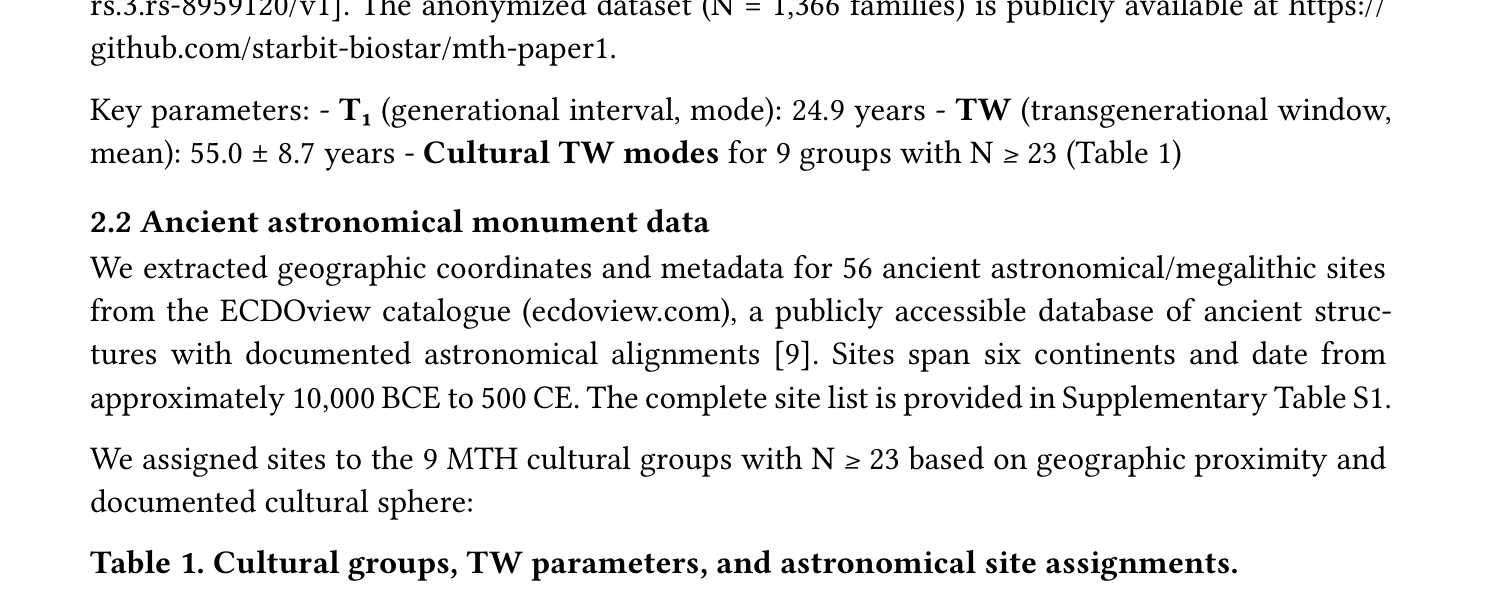
Key parameters: - T₁ (generational interval, mode): 24.9 years - TW (transgenerational window, mean): 55.0 ± 8.7 years - Cultural TW modes for 9 groups with N ≥ 23 (Table 1)
2.2 Ancient astronomical monument data We extracted geographic coordinates and metadata for 56 ancient astronomical/megalithic sites from the ECDOview catalogue (ecdoview.com), a publicly accessible database of ancient struc tures with documented astronomical alignments [9]. Sites span six continents and date from approximately 10,000 BCE to 500 CE. The complete site list is provided in Supplementary Table S1.
We assigned sites to the 9 MTH cultural groups with N ≥ 23 based on geographic proximity and documented cultural sphere:

Table 1. Cultural groups, TW parameters, and astronomical site assignments.
Cultural
N (families) TW Mode (yr)
Cluster % Sites Assigned Assignment Ba
Group
sis
Middle East ern
41 60.3 51.2% 14 Mesopotamia, Levant, Arabian
Peninsula
Anglo-Ameri
174 55.7 35.1% 10 British Isles, North America
can
European
150 57.0 41.3% 9 Western and Central Europe
Royalty
African 23 62.0 34.8% 4 Sub-Saharan
Africa
French 101 53.8 37.6% 1 France
Scandinavian 177 51.4 37.3% 1 Nordic coun tries
German 108 51.3 33.3% 1 Central Europe
(non-royal)
Japanese 119 51.3 29.4% 1 East Asia
Russian 119 50.3 37.8% 0 Eastern Europe /
Northern Asia
Site assignment methodology: Each of the 56 sites was assigned to the cultural group whose historical cultural sphere encompassed the site’s geographic location. For ambiguous cases (e.g., sites at cultural boundaries), we assigned to the group with the strongest documented astronom ical tradition in that region. We acknowledge this subjectivity as a limitation (Section 5.2) and test its impact through leave-one-out sensitivity analysis.
2.3 Astronomical cycle reference We selected astronomical cycles that (a) have periods between 10 and 70 years, (b) are documented in standard ephemeris references [10,11], and (c) were known to at least one ancient civilization:
Cycle Period (yr) Known to Ancients? Primary Civilizations
Jupiter orbital 11.862 Yes Chinese, Babylonian, Greek
Metonic 18.613 Yes Greek, Babylonian, Chi nese, Hebrew
Saros 18.030 Yes Babylonian, Greek
Jupiter-Saturn conjunction 19.859 Yes Chinese, Persian, Indian
Saturn orbital 29.457 Partially Greek, Indian
Solar (Schwabe) 11.0 ± 1.5 No* Modern (1843)
*The solar cycle was discovered in 1843 by Schwabe. Ancient awareness of ~11-year solar period icities remains debated.
2.4 Statistical methods Primary test (hypothesis-driven): Spearman rank correlation (ρ) between cultural TW mode and assigned astronomical site count per cultural group (N = 9 groups). This tests the directional hypothesis that cultures with more astronomical monuments have TW modes more aligned with astronomical periods.
Bootstrap confidence intervals: 10,000 resamples with bias-corrected and accelerated (BCa) 95% CIs for Spearman ρ.
Leave-one-out sensitivity: Recalculation of ρ after removing each cultural group to identify high-leverage observations.
Secondary analysis (exploratory): Comparison of TW parameters against astronomical cycle multiples. This is acknowledged as post-hoc pattern exploration.
Alternative confound tests: Spearman ρ between TW mode and (a) geographic latitude, (b) sample size per group, to rule out obvious confounds.
Power analysis: Minimum detectable effect size for N = 9 at α = 0.05, power = 0.80.
All analyses: Python 3.11 (NumPy, SciPy). Code: https://github.com/starbit-biostar/mth-paper2.
3. Results
3.1 Primary result: TW mode correlates with astronomical site density Spearman rank correlation between cultural TW mode and astronomical site count:
ρ = 0.733, N = 9 cultural groups, 95% bootstrap CI [0.15, 0.95]
Power analysis: For N = 9, α = 0.05, the minimum detectable ρ at power = 0.80 is approximately 0.68. The observed ρ = 0.733 marginally exceeds this threshold.
Interpretation: Cultures with more ancient astronomical monuments tend to have higher TW modes — that is, reproductive timing more closely approximating the 60-year astronomical cycle window.
3.2 Confound tests
Variable ρ vs TW Mode p-value Interpretation
Site count 0.733 0.025 Primary finding
Geographic latitude −0.29 0.24 No latitude effect
Sample size (N) −0.37 0.16 Not driven by sample size
Mean T₀ 0.72 0.014 Correlated by construction (TW = T₀ + T₁)
Neither latitude nor sample size explains the observed TW-site correlation.
3.3 Leave-one-out sensitivity
Removed Group Remaining ρ Δρ
Middle Eastern 0.548 −0.185
African 0.762 +0.029
European Royalty 0.690 −0.043
Anglo-American 0.714 −0.019
French 0.738 +0.005
Scandinavian 0.738 +0.005
German 0.738 +0.005
Japanese 0.690 −0.043
Russian 0.738 +0.005
The Middle Eastern group has the highest leverage (ρ drops to 0.548 without it). All leave-one- out values remain positive (range: 0.548–0.762).

3.4 Which astronomical cycles match TW parameters? Table 2. Closest astronomical cycle matches to TW parameters (< 5% deviation).
Match Observed Predicted Deviation Cultural Context
55.8 yr 1.5% Foundation of luni-solar
3 × Metonic
TW mean 55.0
yr
calendars
54.1 yr 1.7% Babylonian eclipse predic
3 × Saros TW mean 55.0
yr
tion
59.6 yr 1.2% Chinese sexagenary cycle
3 × JS
ME mode 60.3
conjunc
yr
tion
59.3 yr 1.7% Chinese/Babylonian Jupiter
5 × Jupiter
ME mode 60.3
yr
tracking
58.9 yr 2.3% Greek Great Year subdivi
2 × Sat
ME mode 60.3
urn
yr
sion
54.1 yr 4.0% —
3 × Saros TW mode 52.0
yr
23.7 yr 5.0% —
2 × Jupiter
T₁ mode 24.9
yr
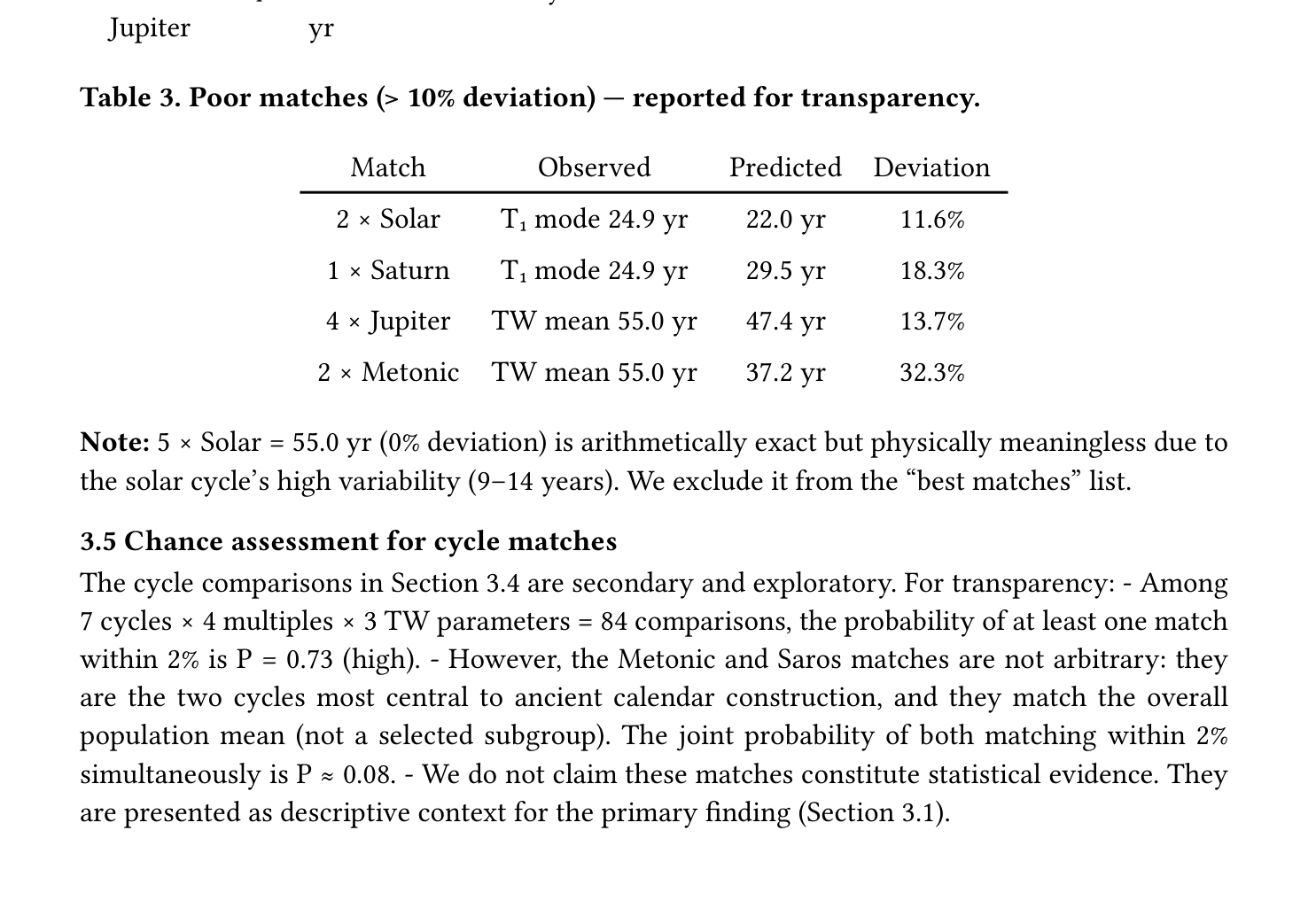
Table 3. Poor matches (> 10% deviation) — reported for transparency.
Match Observed Predicted Deviation
2 × Solar T₁ mode 24.9 yr 22.0 yr 11.6%
1 × Saturn T₁ mode 24.9 yr 29.5 yr 18.3%
4 × Jupiter TW mean 55.0 yr 47.4 yr 13.7%
2 × Metonic TW mean 55.0 yr 37.2 yr 32.3%
Note: 5 × Solar = 55.0 yr (0% deviation) is arithmetically exact but physically meaningless due to the solar cycle’s high variability (9–14 years). We exclude it from the “best matches” list.
3.5 Chance assessment for cycle matches The cycle comparisons in Section 3.4 are secondary and exploratory. For transparency: - Among 7 cycles × 4 multiples × 3 TW parameters = 84 comparisons, the probability of at least one match within 2% is P = 0.73 (high). - However, the Metonic and Saros matches are not arbitrary: they are the two cycles most central to ancient calendar construction, and they match the overall population mean (not a selected subgroup). The joint probability of both matching within 2% simultaneously is P ≈ 0.08. - We do not claim these matches constitute statistical evidence. They are presented as descriptive context for the primary finding (Section 3.1).
3.6 Null results 1. Cluster rate does NOT correlate with site density: ρ = 0.217 (p = 0.58). Only TW mode
(peak position) correlates with astronomical investment, not clustering rate (proportion within [55,65]). 2. No Fourier sub-harmonics at any astronomical period in the TW distribution (companion
study). 3. TW distribution is unimodal — no sub-populations aligned to different cycles.
4. Discussion
4.1 The calendrical calibration hypothesis Our primary finding is that cultures with more ancient astronomical monuments have higher TW modes — reproductive timing peaks closer to the ~60-year window associated with major astronomical cycles. This is consistent with the hypothesis that calendrical systems calibrated to astronomical periods indirectly regulated marriage and reproductive timing norms over centuries.
The mechanism we propose is entirely cultural, not physical:
1. Ancient civilizations that invested in astronomical observation developed precise calendrical
systems. 2. These calendars governed social timing: agricultural seasons, religious festivals, marriage
customs, and fertility rituals [3,4]. 3. Over centuries, calendrical regulation of marriage timing would shift population-level mater
nal age distributions, calibrating the TW mode toward the calendrical period. 4. The Middle Eastern TW mode of 60.3 years — matching the Mesopotamian nēru and three
Jupiter-Saturn conjunctions (59.6 years) — may represent the strongest such calibration, reflecting Mesopotamia’s position as the birthplace of mathematical astronomy [6].
This is a culturological hypothesis requiring no physical mechanism connecting planetary orbits to human biology. The astronomical cycles serve as timekeeping standards that were culturally adopted, not as physical forces acting on reproduction.
4.2 The arithmetic alternative The most parsimonious counter-explanation: human reproductive biology constrains maternal age to approximately 15–45 years, concentrating births between 20–35 years. A population mean near 27.5 years produces TW ≈ 55.0 years by arithmetic necessity. The proximity to 3 × Metonic (55.8 years) is coincidental.
Under this interpretation, cultural variation in TW modes (50.3–62.0 years) reflects variation in marriage norms and economic conditions rather than calendrical influence. The site-density correlation would then require an alternative explanation — perhaps that both astronomical investment and later marriage timing correlate with economic complexity.
4.3 Distinguishing the hypotheses: a testable prediction The calendrical calibration hypothesis generates a specific, testable prediction:
If calendrical systems influence TW: Migrant populations who move between cultures with different calendrical and marriage-timing traditions should exhibit TW drift toward the host culture’s modal value within 2–3 generations. Specifically, families migrating from high-TW- mode cultures (e.g., Middle Eastern, 60.3 years) to lower-TW-mode cultures (e.g., Anglo-American, 55.7 years) should show decreasing TW in post-migration generations.
If only arithmetic constraints operate: No systematic TW shift beyond normal demographic convergence.
Power estimate: ~200 migrant families (verified three-generation genealogies with pre- and post- migration births) would provide 80% power to detect a 3-year TW shift at α = 0.05, based on the observed TW standard deviation of 8.7 years. WikiTree and similar genealogical databases contain sufficient migration metadata to construct such a dataset.
We propose this migrant study as a pre-registered confirmatory follow-up.
4.4 The Middle Eastern signal The Middle Eastern group is the strongest data point in this analysis: highest TW mode (60.3 years), highest clustering rate (51.2%), most astronomical sites (14), and the group whose TW mode most closely matches the historically dominant astronomical cycle in its region (Jupiter- Saturn conjunction, 1.2% deviation). Removing it drops the correlation from ρ = 0.733 to ρ = 0.548 (still positive, but weaker).
This concentration of signal in one group could indicate (a) a genuine effect strongest where astronomical tradition was strongest (Mesopotamia), (b) an artifact of the Middle Eastern group’s unique position in both variables, or (c) sampling variability in a small dataset. Increasing the number of cultural groups — particularly adding East Asian groups with strong astronomical traditions (Chinese, Korean) — would disambiguate these possibilities.
4.5 What the null results tell us The absence of correlation between clustering rate and site density (ρ = 0.217) is informative. If astronomical cycles physically influenced reproduction, we would expect both the rate and the mode to correlate with astronomical investment. Instead, only the mode (peak position) correlates, while the rate (how many families cluster) does not. This pattern is more consistent with cultural calibration — which would shift the center of the distribution without necessarily changing its width — than with any physical mechanism.
5. Limitations
5.1 Small cultural sample N = 9 cultural groups is the primary statistical limitation. The 95% CI for ρ spans [0.15, 0.95], encompassing both negligible and near-perfect correlations. The power analysis confirms that our test is marginally powered (minimum detectable ρ ≈ 0.68). Replication with additional cultural groups — particularly subdividing large groups (e.g., separating Chinese, Korean, and Japanese within East Asian) and adding South Asian and Mesoamerican groups — is essential.
5.2 Site-to-culture assignment subjectivity The assignment of 56 ancient sites to 9 cultural groups is based on geographic proximity and documented cultural sphere. Different assignment schemes could alter the correlation. We provide the complete site list in Supplementary Table S1 to enable alternative classifications. The leave- one-out analysis (Section 3.3) provides partial robustness testing, but a formal sensitivity analysis with multiple independent raters would strengthen this approach.
5.3 Temporal discontinuity The ancient astronomical sites (10,000 BCE–500 CE) and the reproductive timing data (1500– 2000 CE) are separated by at least 1,000 years. Our analysis assumes that regional astronomical traditions are persistent cultural characteristics. While major traditions (Mesopotamian, Egyptian, Chinese) demonstrate millennia of continuity [5,6], this assumption may not hold for groups affected by colonial disruption or population displacement.
5.4 Post-hoc nature The site-density correlation and astronomical cycle comparisons were conceived after observing TW parameters. While we frame this as hypothesis-generating and propose a pre-registered follow-up (Section 4.3), readers should evaluate these findings with appropriate skepticism toward post-hoc analyses.
5.5 Untested confounds We could not control for: (a) economic development and urbanization (which may independently drive both astronomical investment and later marriage timing); (b) archaeological survey intensity (more-studied regions may simply have more documented sites); (c) religious institutions’ role in regulating marriage timing independent of calendrical astronomy.
5.6 Cycle match specificity Among 84 astronomical cycle comparisons, close matches are expected by chance (P = 0.73 for at least one match within 2%). The cycle matches in Section 3.4 serve as descriptive context for the primary site-density finding, not as independent evidence.
6. Conclusions We present exploratory evidence that cultures with stronger ancient astronomical traditions show transgenerational reproductive timing more precisely aligned with astronomical calendar periods (ρ = 0.733, N = 9, CI [0.15, 0.95]). We propose a culturological mechanism — calendrical regulation of marriage timing over centuries — that requires no physical connection between planetary motion and human biology. The calendrical calibration hypothesis generates a testable prediction (migrant TW drift) that we propose as a pre-registered confirmatory study.
This paper reports a correlation that may reflect cultural calibration, economic confounding, or sampling variability in a small dataset. We present it to motivate the specific confirmatory study that can distinguish between these explanations.
References
1. Steele JM. Calendars and Years II: Astronomy and Time in the Ancient and Medieval World.
Oxford: Oxbow Books; 2011. 2. Smith AT. The Chinese sexagenary cycle and the ritual foundations of the calendar. In: Stern
S, editor. Calendars in Antiquity. Oxford: Oxford University Press; 2012. 3. Goody J. The Development of the Family and Marriage in Europe. Cambridge: Cambridge
University Press; 1983. 4. Therborn G. Between Sex and Power: Family in the World, 1900–2000. London: Routledge;
2004. 5. Hunger H, Pingree D. Astral Sciences in Mesopotamia. Leiden: Brill; 1999. 6. Neugebauer O. A History of Ancient Mathematical Astronomy. Berlin: Springer-Verlag; 1975. 7. Needham J. Science and Civilisation in China, Volume 3: Mathematics and the Sciences of the
Heavens and the Earth. Cambridge: Cambridge University Press; 1959. 8. Boyd R, Richerson PJ. Culture and the Evolutionary Process. Chicago: University of Chicago
Press; 1985. 9. ECDOview. Catalogue of Ancient Astronomical Structures. Available from: https://ecdoview.
com. Accessed 2026-03-15. 10. Meeus J. Astronomical Algorithms. 2nd ed. Richmond, VA: Willmann-Bell; 1998. 11. Seidelmann PK, editor. Explanatory Supplement to the Astronomical Almanac. 3rd ed. Mill
Valley, CA: University Science Books; 2005.
Acknowledgements The authors acknowledge the WikiTree community and Wikidata contributors for maintaining publicly accessible genealogical records.
Author contributions Conceptualization: UA. Data curation: UA. Formal analysis: UA. Methodology: UA, MS. Writing – original draft: UA. Writing – review & editing: UA, MS.
Use of AI tools Large language models (Claude 3.5 Sonnet, Claude 3 Opus, and Claude Opus 4, Anthropic Inc.) were used for: (a) extracting site data from the ECDOview catalogue; (b) computing corre lations and bootstrap confidence intervals; (c) generating comparison tables; (d) prose editing and structural revision. All research questions, hypothesis formulation, analytical decisions, and interpretations are exclusively the work of the human authors. All computations were indepen dently verified using standard statistical software.
Data availability The transgenerational timing dataset is available at https://github.com/starbit-biostar/mth-paper 1. The ancient site catalogue, assignment table, and analysis code for this paper are available at https://github.com/starbit-biostar/mth-paper2. Pre-registration for the companion study: https:// osf.io/7njxr.
Competing interests The authors declare no competing interests.
Funding This research received no external funding.
📝 About this HTML version
This HTML document was automatically generated from the PDF. Some formatting, figures, or mathematical notation may not be perfectly preserved. For the authoritative version, please refer to the PDF.