The Cell as an Executable Worls
Abstract
A new 4D whole-cell model of the minimal bacterium JCVI-syn3A does more than simulate a microorganism. It hints at a new scientific regime in which living systems become runnable, interrogable and increasingly designable inside computational loops.
Full Text
SCIENTIFIC AMERICAN-STYLE MONOGRAPH The Cell as an Executable World
Why a 4D simulation of a minimal bacterium matters - and why it may become a cornerstone of the AGI era
Focus
Minimal cells as biological operating systems, executable biology, autonomous labs and AGI-scale scientific loops.
Joaquim A. Machado March 2026
Conceptual analysis essay · Co-created with OpenAI GPT-5.4 Thinking
The Cell as an Executable World 2
BIOLOGY, COMPUTATION AND THE AGI ERA The Cell as an Executable World
A new 4D whole-cell model of the minimal bacterium JCVI-syn3A does more than simulate a microorganism. It hints at a new scientific regime in which living systems become runnable, interrogable and increasingly designable inside computational loops.
By Joaquim A. Machado · Co-created with OpenAI GPT-5.4 Thinking
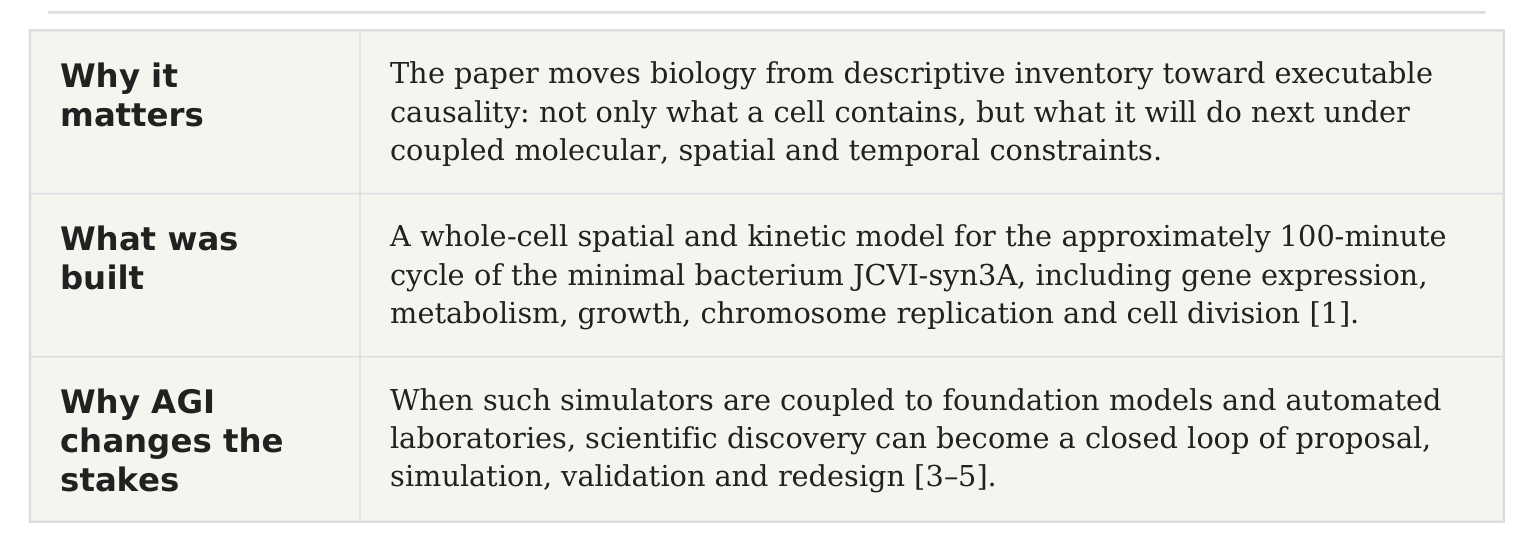
The paper moves biology from descriptive inventory toward executable causality: not only what a cell contains, but what it will do next under coupled molecular, spatial and temporal constraints.
Why it matters
A whole-cell spatial and kinetic model for the approximately 100-minute cycle of the minimal bacterium JCVI-syn3A, including gene expression, metabolism, growth, chromosome replication and cell division [1].
What was built
When such simulators are coupled to foundation models and automated laboratories, scientific discovery can become a closed loop of proposal, simulation, validation and redesign [3–5].
Why AGI changes the stakes
There are scientific papers that solve a local problem, and there are papers that alter the grammar of a field. The new Cell study on the genetically minimal bacterium JCVI-syn3A belongs to the second category. Its authors present a whole-cell spatial and kinetic model for the approximately 100-minute life cycle of a minimal bacterium and simulate the complete cell cycle in four dimensions—space and time—while integrating genetic information processes, metabolism, growth and cell division [1]. The accomplishment is striking not because it delivers a glossy animation of life, but because it makes a living system partially runnable.
That distinction matters. Modern biology is extraordinary at describing. It sequences, annotates, counts, maps and correlates. But living systems do not merely sit in inventories. They transform. Molecules move, membranes deform, chromosomes segregate, ribosomes translate and metabolic pools constrain what happens next. A useful scientific representation of such a system must therefore do more than summarize its ingredients. It must support counterfactual reasoning about dynamics. This is the conceptual threshold the minimal-cell paper crosses.
The cell chosen for this effort is uniquely revealing. JCVI-syn3A is not a typical bacterium but a synthetic minimal cell with a single circular chromosome of 493 genes—small enough to reduce the causal clutter, yet rich enough to remain authentically alive [1,2]. In the model, growth is constrained by fluorescence-imaging data, replication rates respond to metabolic dNTP pools and chromosome behavior is governed through structural-maintenance and topoisomerase dynamics. The simulation reportedly recovers experimentally measured observables such as doubling time, messenger-RNA half-lives, ribosome counts, protein distributions and the origin-to-terminus DNA ratio [1]. This is not mere visual theater. It is an executable causal scaffold.
The Cell as an Executable World 3
“A successful account of the cell is starting to look less like a catalog and more like a simulation you can run.”
Interpretive conclusion drawn from the paper’s architecture and validation strategy
From Descriptive Biology to Executable Causality
The result is still computationally expensive. The Illinois team reported that chromosome replication required a dedicated graphics processing unit while another GPU handled the remaining cellular dynamics, allowing the roughly 105-minute cycle to be simulated in about six days of compute time; repeated runs landed, on average, within roughly two minutes of the observed biological cycle [2]. Yet the cost is part of the message. Biology is becoming computationally legible not because it is simple, but because our representational tools are becoming sophisticated enough to carry its moving complexity.
For more than a century, biology advanced by turning the invisible into the legible. Microscopes made cells visible. Sequencing made genomes readable. High-throughput assays made regulation measurable at scale. The present paper suggests the next representational shift: making the cell executable. That phrase should be used carefully. The authors do not claim an atom-by-atom reconstruction of life, and the model still averages over many underlying molecular details [2]. But execution, in the scientifically meaningful sense, means that a representation can be run forward to generate time-bound states whose internal couplings correspond to observed reality. In that sense, the work is exemplary.
The importance of such execution becomes clearer when one considers the poverty of static snapshots. Genomics can tell us which genes are present. Transcriptomics can tell us which transcripts are abundant. Proteomics can estimate protein counts. Imaging can reveal structure. Yet a cell cycle is a choreography, not a list. Growth alters geometry; geometry alters diffusion and crowding; crowding affects reaction timing; metabolism constrains replication; replication feeds back into partitioning and division. A mechanistic model that joins these layers does not simply compress data. It alters what counts as explanation.
That is why minimal cells matter so much. Their virtue is not that they are trivial, but that they offer the cleanest presently available biological operating system. With only 493 genes, JCVI-syn3A stands near the lower bound of autonomous cellular life while preserving growth and robust division [1,2]. In philosophy-of-science terms, the minimal cell functions as an experimentally tractable ontology: simple enough to model at whole-cell scale, yet not so simplified that life has disappeared. It is a precious midpoint between toy abstraction and unmanageable complexity.
One can sense, here, the beginnings of a new style of biological thought. Instead of asking only, “What components matter?” we begin to ask, “What executable state-space does this living system inhabit, and how do interventions redirect its trajectory?” Such a question is more engineering-like than classical descriptive biology, but it is not anti-biological. On the contrary, it may be the most faithful way to respect the cell as a dynamical entity.
The Cell as an Executable World 4
JCVI-syn3A paper, therefore, lies not only in its biological details but in the epistemic role it enables: it supplies a sandbox where hypotheses can fail before they reach the wet lab.
A plausible AGI-biology discovery loop
Foundation models Whole-cell simulator Robotic lab Wet world
Validation and error maps Design of next experiment
Pattern recognition proposes; mechanistic simulation adjudicates; experiment re-anchors reality.
Three AGI-era consequences
What AGI Changes
1. Simulation-first biology. Before expensive experiments are run, candidate interventions can be explored in silico to expose likely bottlenecks, compensation pathways and failure modes.
The AGI era does not merely promise faster science. It changes the architecture of science. Contemporary AI already excels at extracting regularities from enormous datasets and at surfacing patterns that would overwhelm unaided human attention. In cell biology, this tendency is visible in the rise of large foundation models trained on single-cell data. One notable recent example, CellFM, was trained on a dataset of about 100 million human cells with 800 million parameters and reported strong performance across tasks such as cell annotation, perturbation prediction, gene-function prediction and gene-gene relationship capture [3]. Such models are powerful pattern engines.
2. Tighter design loops. Whole-cell models make it easier to couple prediction, intervention and measurement into an iterative cycle that learns faster from fewer experiments.
3. More meaningful digital twins. A biological “twin” becomes more than a statistical likeness when it can be driven forward under intervention and compared against real outcomes.
The Coming Closed Loop of Discovery
Yet pattern engines alone do not constitute scientific agency. They are strongest when they can be checked against a world model. This is where whole-cell simulation becomes strategically important. A foundation model can suggest which perturbations look promising, which latent states cluster together or which interventions seem likely to shift phenotype. A mechanistic simulator can ask whether those suggestions survive contact with space, metabolism, geometry and time. In a future AGI stack, the two capabilities are not rivals. They are complements. One proposes; the other adjudicates.
The most consequential implication emerges when whole-cell simulation is combined with automation. In 2025, a Nature Communications paper described an autonomous enzyme-engineering platform that integrates machine learning and large language models with biofoundry automation, achieving a 90-fold improvement in substrate preference for one enzyme and a 26-fold activity improvement for another in four rounds over four weeks, with fewer than 500 variants built and tested for each case [4]. Although enzyme engineering is not whole-cell modeling, the design logic is highly relevant. The laboratory becomes a cybernetic loop rather than a linear pipeline.
This complementarity is especially important because biological systems are notoriously rich in spurious correlations. A purely statistical model can easily discover regularities that are operationally useless once the system is perturbed. Mechanistic execution changes the standard of credibility. An explanation must now survive being run. The significance of the
Once that loop is generalised, a plausible AGI-biology architecture comes into focus. A foundation model parses the literature and large multimodal datasets. A mechanistic simulator runs candidate
The Cell as an Executable World 5
morphology and division can be modeled as one coupled process [1].
interventions forward in time. A robotic laboratory executes only the most informative experiments. Measurements return to the models, which then redesign the next perturbation. Scientific labor is redistributed: humans set goals, interpret stakes and audit meaning; machine systems increasingly compress the search over possibility space.
One should notice the philosophical shift embedded in that possibility. Classical biology treated life as something to be observed and explained. Synthetic biology added the ambition to build. Executable minimal-cell models add a third layer: life as a navigable design space. Once that space can be explored computationally before intervention, the tempo of invention changes. Biology becomes not only knowable and engineerable, but rehearsable.
Under that architecture, the simulator is not an ornamental extra. It is the inner rehearsal chamber of the laboratory. It allows the future experiment to be partially experienced before it is physically performed. This is one reason minimal-cell work feels so important. It supplies one of the first convincing templates for how biological world models can become operational components inside machine-guided discovery.
Caution: What This Breakthrough Is Not
It is important not to mythologize the result. The JCVI-syn3A model is not a universal model of life, nor a near-term digital twin of human cells. It works in part because the organism is extraordinarily reduced and unusually well characterized. It is also computationally demanding, and it remains an averaged model rather than a complete atomistic reconstruction [2]. Any serious interpretation of the paper should preserve this restraint.
Minimal Cells as Biological Operating Systems
There is another reason the minimal-cell model matters in the AGI era: it suggests a different way to think about synthetic biology itself. A minimal cell is not merely a stripped organism. It is also a chassis whose causal inventory is unusually inspectable. In engineering terms, fewer hidden interactions mean cleaner debugging. In strategic terms, such cells may become preferred substrates for machine-guided design because their response surfaces are easier to characterize than those of heavily evolved, densely redundant organisms.
Even so, one can acknowledge limitation without diminishing significance. A Wright brothers aircraft was not a modern airliner, yet it changed the category of the possible. In a similar sense, the minimal-cell model is important because it demonstrates a coherent form of executable biological realism at whole-cycle scale. It is an early prototype of a new epistemic instrument, not the finished endpoint.
This possibility reaches beyond simulation. A future design stack might search the space of added genes, metabolic rewiring, membrane changes or division-control variants in a minimal chassis, with AGI systems ranking modifications according to objectives such as biosensing, materials production, targeted biomanufacturing or controllable ecological behavior. That future is not here yet. But the paper under discussion strengthens the substrate on which such a future could be built: a cell whose metabolism, information flow,
This distinction matters politically as well as scientifically. As AI and synthetic biology converge, the same loops that accelerate beneficial design can reduce the friction of misuse. A 2025 review in npj Biomedical Innovations emphasizes that AI-synthetic biology convergence simultaneously accelerates discovery and lowers barriers in ways that intensify dual-use concerns, governance gaps and the risks of reduced human oversight [5]. The more capable our
The Cell as an Executable World 6
design-and-simulation systems become, the more important it is to decide who can run them, under what safeguards and toward which ends.
There is also a subtler risk: over-trusting simulation. Advanced AI systems can optimize brilliantly inside a model while drifting from what real biology permits. The answer is not to distrust models, but to keep them tightly anchored to experimental ground truth. The minimal-cell work is exemplary in that regard precisely because its claims are repeatedly checked against imaging, sequencing and other empirical measurements [1,2]. In the AGI era, this discipline will become essential.
Conclusion
My view is that this paper will eventually be remembered less as a spectacular simulation than as a pivot in scientific style. It points toward a world in which biology is no longer only observed, catalogued and interpreted, but also run. The cell begins to appear as a negotiable dynamical system inside a larger human-machine intelligence loop. When that loop is coupled to foundation models, robotic laboratories and increasingly agentic AI, science does not merely accelerate; it acquires a new operating logic.
The minimal cell is therefore more than a reduced bacterium. It is a conceptual beachhead. It suggests that the future of biological understanding may lie in a hybrid regime where pattern recognition, mechanistic execution and experimental intervention form one cybernetic architecture. In such a regime, the decisive question is no longer simply whether life can be described. It is whether life can be rendered executable enough to support responsible foresight. The JCVI-syn3A paper offers one of the strongest demonstrations yet that the answer may be yes.
The Cell as an Executable World 7
Selected References
[1] Thornburg, Z. R. et al. “Bringing the genetically minimal cell to life on a computer in 4D.” Cell (2026). PubMed abstract reports a whole-cell spatial and kinetic model for the approximately 100-minute cell cycle of JCVI-syn3A, including growth, metabolism, chromosome replication and cell division.
[2] University of Illinois News Bureau. “Team simulates a living cell that grows and divides.” March 2026. Reports the dedicated-GPU setup, approximately six-day compute time for a 105-minute cycle and average timing close to the biological cycle.
[3] Zeng, Y. et al. “CellFM: a large-scale foundation model pre-trained on transcriptomics of 100 million human cells.” Nature Communications 16, 2025. Describes an 800-million-parameter single-cell foundation model trained on 100 million human cells.
[4] Singh, N. et al. “A generalized platform for artificial intelligence-powered autonomous enzyme engineering.” Nature Communications 16, 2025. Describes an AI-plus-biofoundry platform with strong performance gains in four rounds over four weeks.
[5] Groff-Vindman, C. S. et al. “The convergence of AI and synthetic biology: the looming deluge.” npj Biomedical Innovations 2, 2025. Discusses opportunities, dual-use risks, governance gaps and oversight challenges at the AI-synthetic biology interface.
Note on method
This monograph is an original interpretive essay written in a popular-science register. It combines factual reporting from the cited sources with analytical extrapolation about likely AGI-era implications. Analytical judgments and future-facing inferences are clearly presented as interpretation rather than as direct claims of the cited authors.
📝 About this HTML version
This HTML document was automatically generated from the PDF. Some formatting, figures, or mathematical notation may not be perfectly preserved. For the authoritative version, please refer to the PDF.