BitCell-AA is imagined as a battery that stores more than charge. In the concept, it stores usable energy, machine-readable pattern, and the conditions required to organize matter from supplied feedstock. The device therefore behaves not merely as a power cell but as a compact reservoir of ordered potential. This is not a claim about a real laboratory device. It is a disciplined speculative design: a way of thinking about whether information thermodynamics, reversible computation, and programmable matter could someday converge in a single portable architecture
Executive concept
BitCell-AA is imagined as a battery that stores more than charge. In the concept, it stores usable energy, machine-readable pattern, and the conditions required to organize matter from supplied feedstock. The device therefore behaves not merely as a power cell but as a compact reservoir of ordered potential.
This is not a claim about a real laboratory device. It is a disciplined speculative design: a way of thinking about whether information thermodynamics, reversible computation, and programmable matter could someday converge in a single portable architecture.
Core proposition Energy can be treated as mobilized information; information as constrained energy; and matter as stabilized architecture built from patterned energy acting on feedstock.
Why the AA battery silhouette matters
The familiar cylindrical form is strategic. A device that looks almost ordinary but implies a different ontology has more symbolic power than a futuristic black box. The copper cap and graphite body signal continuity with the history of batteries; the hidden architecture suggests a next step in how civilization may store and deploy order.
Three operating modes
| Mode | What it does | What changes internally |
|---|---|---|
| Battery mode | Releases electrical work to an attached system. | Stored gradients are converted into ordinary output power. |
| Memory mode | Preserves exact encoded state patterns. | Energetic minima are used as durable informational wells. |
| Matter-seeding mode | Guides assembly of supplied atoms or molecules into organized form. | Pattern and energy are spent together to impose structure on feedstock. |
Internal architecture
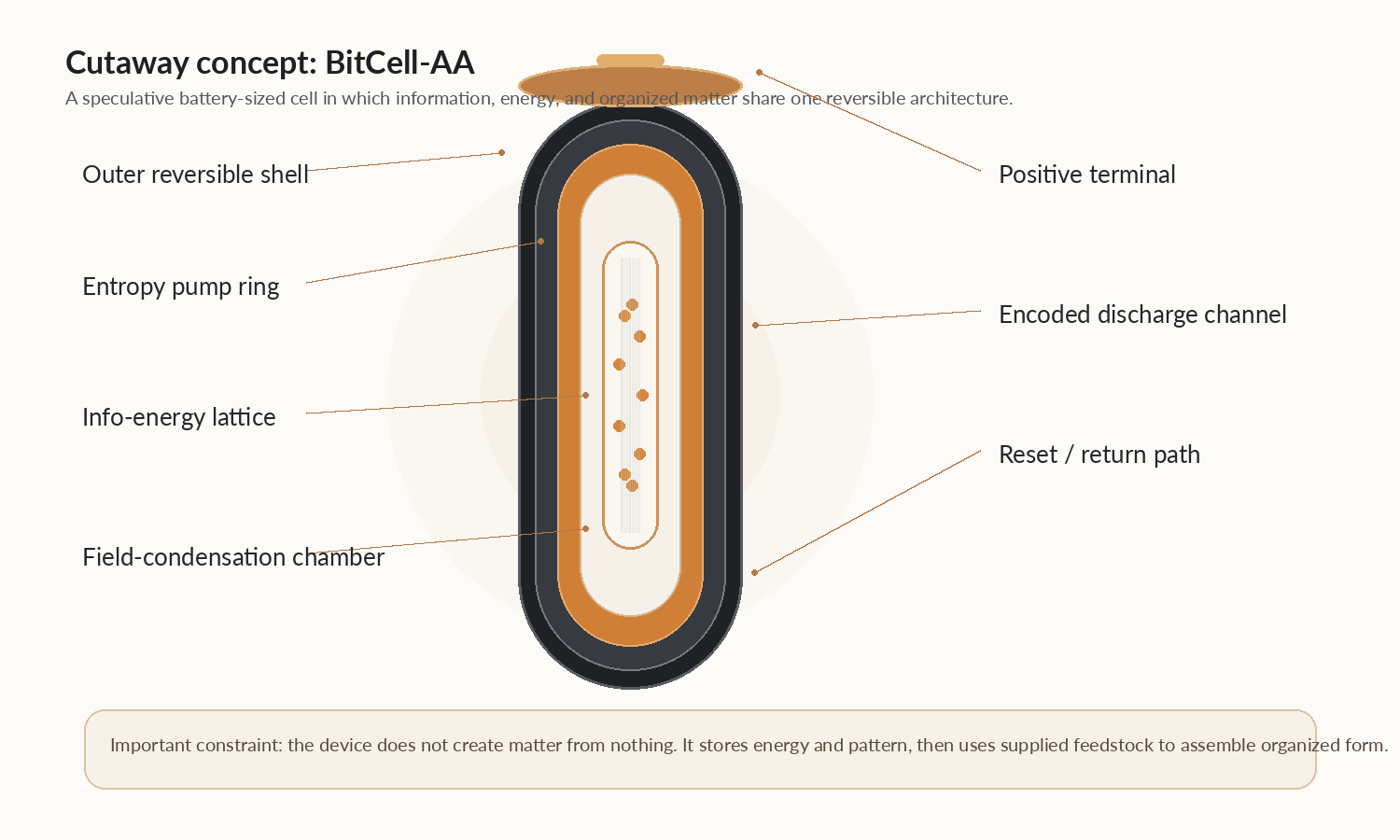
Cutaway concept: BitCell-AA. A speculative battery-sized cell in which information, energy, and organized matter share one reversible architecture. Important constraint: the device does not create matter from nothing. It stores energy and pattern, then uses supplied feedstock to assemble organized form.
Functional interpretation
| Outer reversible shell | A programmable skin that limits thermal loss, filters noise, and preserves the integrity of encoded states. |
| Entropy pump ring | A control layer that tries to keep state transitions as close to reversible as possible, minimizing wasted heat. |
| Info-energy lattice | A dense field of switching elements whose logical state and energetic state are co-defined. |
| Field-condensation chamber | A region where the stored pattern biases assembly from ambient or supplied feedstock rather than creating matter ex nihilo. |
The triadic claim
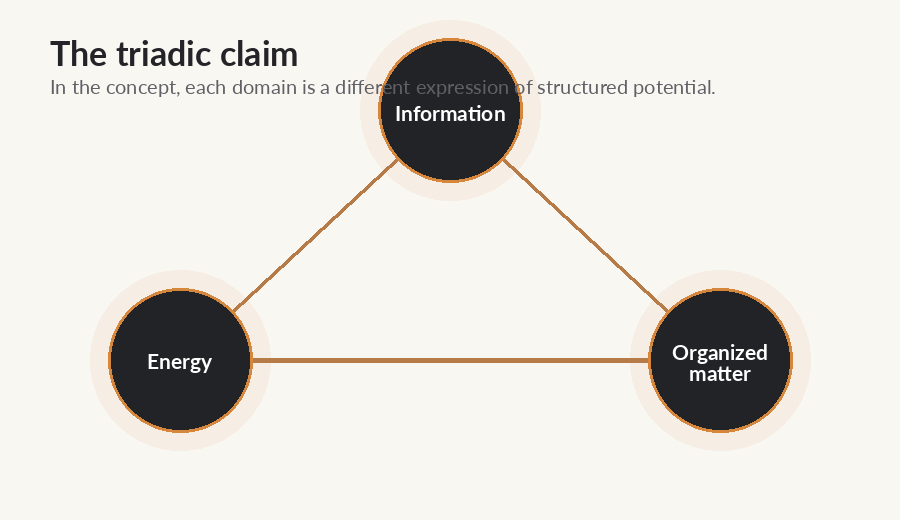
The triadic claim. In the concept, each domain is a different expression of structured potential.
Scientific themes that make the concept intellectually coherent
| Mass-energy equivalence | Matter and energy are not separate substances in fundamental physics, though practical conversion remains extremely constrained. |
| Information thermodynamics | Erasing, writing, and preserving information carry energetic consequences, making information physically consequential rather than abstract. |
| Reversible computation | If logic operations can approach reversibility, computation can be tied more intimately to stored work instead of dissipating it as waste heat. |
| Programmable matter and self-assembly | Complex form may emerge when energetic landscapes and informational templates guide available feedstock into higher-order structures. |
Constraints, honesty, and philosophical reach
Important honesty note The concept is intentionally speculative. A real AA-sized device cannot presently perform full matter-energy-information interchange in the literal sense. The most defensible interpretation is that the cell stores energy and pattern, then organizes external feedstock into material form.
That constraint does not weaken the idea; it sharpens it. The device becomes a compact engine of ordered transformation rather than a magical matter creator. Its true novelty lies in the ambition to merge power storage, memory, and fabrication logic inside a single micro-architecture.
Potential long-horizon applications
| Autonomous robotics | Cells that carry both power and task memory could reduce the distance between computation and actuation. |
| Extreme environments | A storage medium that preserves pattern under stress could serve as both energy reserve and mission archive. |
| Nanofabrication | Portable field-biased assembly could turn the battery from an energy source into a micro-foundry of organized structure. |
| Philosophy of technology | The device serves as a thought experiment for civilizations that increasingly value order, pattern, and control of entropy. |
Design language
The luxury industrial language is deliberate: matte graphite body, copper terminal, thin amber index band, micro-typographic side marking, and a discreet triadic loop icon. It should look plausible enough to feel familiar, yet strange enough to imply a deeper ontology of stored order.
Closing statement
A conventional battery stores the possibility of work.
BitCell-AA stores the possibility of work, memory, and form.
In that sense it is less a battery than a civilizational symbol: a portable unit of organized potential.
Tagline
The battery that stores power, memory, and form.
Compact specification
| External form | AA-like cylindrical cell with copper cap and graphite body |
| Internal thesis | Information, energy, and organized matter are states of one reversible architecture |
| Most plausible near-future reading | An energy-memory-assembly device that acts on supplied feedstock |
| Document status | Speculative concept memorandum - not a fabrication guide |
No comments yet. Be the first to comment!