AAC Physics: Structure-Preserving Framework for Exact, Reversible Discrete-Time Convolutions
Abstract
Memory-dependent discrete-time systems arise across physics, engineering, and machine learning—from viscoelasticity and control to differentiable programming. Standard recursive approaches accelerate convolution computation but suffer from drift, unstable backward passes, and numerical errors. (note: this paper was written using AI based on MY idea)
Full Text
AAC Physics: Structure-Preserving Framework for Exact, Reversible Discrete-Time Convolutions
Proprietary IP — Rich C. Young (Guru#1)
https://www.youtube.com/@GuruOne
Abstract
Memory-dependent discrete-time systems arise across physics, engineering, and ma- chine learning—from viscoelasticity and control to differentiable programming. Stan- dard recursive approaches accelerate convolution computation but suffer from drift, unstable backward passes, and numerical errors. AAC Physics introduces a structure-preserving, algebraically exact framework for discrete convolutions with exponential-like memory kernels. The method achieves:
• Exact equivalence to full discrete convolution (no drift),
• O(N) computational scaling with modest state storage,
• Algebraic reversibility, enabling machine-precision recovery of input sequences,
• Broad applicability across physics simulations, control systems, Neural ODEs, and gradient-based optimization.
1 Motivation and Background
Discrete convolutions with memory kernels appear in:
• Viscoelasticity: Stress–strain histories modeled via Prony-series exponentials.
• Control systems: Feedback with non-Markovian dynamics.
• Neural ODEs: Backpropagation through time with history-dependent states.
Challenges with existing methods:
• Naive summation is O(N 2) and infeasible for long sequences.
• Recursive approximations introduce drift and reduce forward/backward accuracy.
• Standard recursive methods are often non-invertible, limiting exact adjoint calcula- tions.
2 Core Concept: AAC Physics Framework
AAC Physics uses abstract, IP-protected functions to preserve structure and reversibil- ity:
• Forward update staten+1 = F(staten, inputn)
• Output computation outputn = G(staten, inputn)
• Backward recovery inputn = H(staten+1, staten)
• State step-back staten = I(staten+1, inputn)
Key properties:
1. Machine-precision equivalence to full discrete convolution.
2. Linear O(N) scaling for computation and memory.
3. Algebraic reversibility for exact backward reconstruction.
4. Proprietary coefficients protected within abstract functions F, G, H, I.
3 Performance and Accuracy
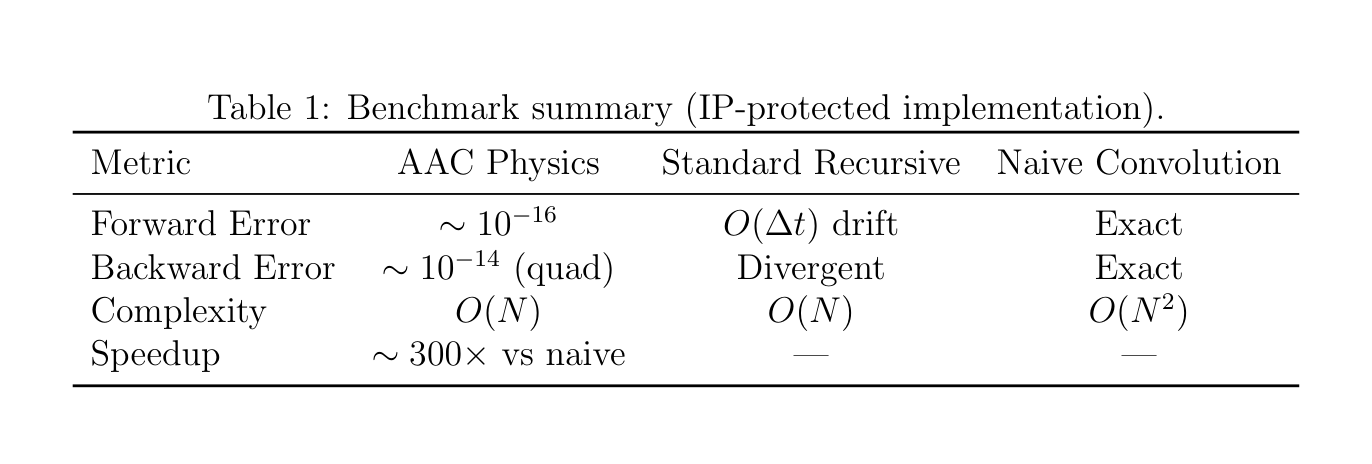
Table 1: Benchmark summary (IP-protected implementation).
Metric AAC Physics Standard Recursive Naive Convolution
Forward Error ∼10−16 O(∆t) drift Exact Backward Error ∼10−14 (quad) Divergent Exact Complexity O(N) O(N) O(N 2) Speedup ∼300× vs naive — —
4 Multi-Mode Exponential Kernel Architecture
Mode 2 Exponential kernel
Input sequence {vn}
Structure-preserving forward update
Mode 1 Exponential kernel
Output Backward rec
Mode 3 Exponential kernel
Figure 1: Multi-mode exponential kernel processing. Each kernel mode is updated indepen- dently and combined through a structure-preserving forward operator.
5 Forward and Backward Reversible Workflow
n = 0, . . . , N −1
Input {vn}
Forward update staten+1 = F(staten, vn)
Output computation yn = G(staten, vn)
Backward recovery vn = H(staten+1, staten)
State step-back staten = I(staten+1, vn)
Figure 2: Structure-preserving forward and backward workflow. Algebraic reversibility en- ables exact recovery of input samples without storing full state histories.
6 Abstract Pseudocode
Forward pass: for n = 0 .. N-1: state[n+1] = F(state[n], input[n]) output[n] = G(state[n], input[n])
Backward pass: for n = N-1 .. 0: input[n] = H(state[n+1], state[n]) state[n] = I(state[n+1], input[n])
7 Applications
• Physics simulations: viscoelasticity, fractional operators.
• Control and signal processing: non-Markovian feedback.
• Machine learning: Neural ODEs, adjoint computations.
• Industrial software: high-precision, memory-efficient simulations.
8 Summary
• O(N) efficient, drift-free, machine-precision forward computation.
• Algebraic reversibility enables exact backward reconstruction.
• Broad applicability across physics, control, and machine learning.
• Fully IP-protected while transparently demonstrating performance and accuracy.
📝 About this HTML version
This HTML document was automatically generated from the PDF. Some formatting, figures, or mathematical notation may not be perfectly preserved. For the authoritative version, please refer to the PDF.