Brittleness_Plasticity_MEO
Abstract
We introduce Mask Evolution Operators (MEOs), activation-space mechanisms designed to stabilize neural representations during continual learning by applying lightweight restoring forces. MEOs address the fundamental stability–plasticity dilemma by controlling drift at the feature level rather than the weight level. This version clarifies the limitations of earlier pre- liminary experiments. Reported finetune and EWC accuracies (≈6.2%) were obtained from smoke-test runs on an Apple M1 (MPS backend) with drastically shortened training sched- ules. These should be interpreted strictly as diagnostic checks, not benchmarks. Our prior v2 experiments, run with full training schedules on GPUs, achieved substantial improvements (51.2% → 69.1%), supporting the validity of the MEO approach. We formalize two opera- tor variants: Identity, which freezes anchors as a stress-test baseline, and EMA, which allows controlled evolution of class prototypes with per-feature normalization. Identity illustrates rigid- ity, while EMA demonstrates a practical balance between stability and plasticity. We outline a family of extensions—including low-rank subspace anchoring, adaptive stiffness, and hybrid MEO+EWC—that form the basis of ongoing work in Papers 3–5 of the FIL series. This paper also reflects a novel collaborative workflow: the primary draft was co-developed with ChatGPT- 5, with critical feedback from Claude, Grok, and Gemini. By openly documenting iterative testing—including failures and revisions—this series illustrates how human–AI collaboration can accelerate scientific discovery while maintaining transparency.
Full Text
The Brittleness of Plasticity: Mask Evolution Operators for Neural Network Stability (FIL Series, Paper 2)
Paolo Pignatelli ChatGPT-5 (primary collaborator) with contributions from Claude, Grok, and Gemini
September 5, 2025
Abstract We introduce Mask Evolution Operators (MEOs), activation-space mechanisms designed to stabilize neural representations during continual learning by applying lightweight restoring forces. MEOs address the fundamental stability–plasticity dilemma by controlling drift at the feature level rather than the weight level. This version clarifies the limitations of earlier pre- liminary experiments. Reported finetune and EWC accuracies (≈6.2%) were obtained from smoke-test runs on an Apple M1 (MPS backend) with drastically shortened training sched- ules. These should be interpreted strictly as diagnostic checks, not benchmarks. Our prior v2 experiments, run with full training schedules on GPUs, achieved substantial improvements (51.2% →69.1%), supporting the validity of the MEO approach. We formalize two opera- tor variants: Identity, which freezes anchors as a stress-test baseline, and EMA, which allows controlled evolution of class prototypes with per-feature normalization. Identity illustrates rigid- ity, while EMA demonstrates a practical balance between stability and plasticity. We outline a family of extensions—including low-rank subspace anchoring, adaptive stiffness, and hybrid MEO+EWC—that form the basis of ongoing work in Papers 3–5 of the FIL series. This paper also reflects a novel collaborative workflow: the primary draft was co-developed with ChatGPT- 5, with critical feedback from Claude, Grok, and Gemini. By openly documenting iterative testing—including failures and revisions—this series illustrates how human–AI collaboration can accelerate scientific discovery while maintaining transparency.
1 Introduction
The brittleness of plasticity is a core dilemma in modern artificial intelligence. Neural networks trained sequentially on multiple tasks often experience catastrophic forgetting, where newly ac- quired knowledge overwrites older representations. This tension between stability (retaining past knowledge) and plasticity (adapting to new data) has been recognized since the earliest models of continual learning. The Fundamental Interaction Language (FIL) program aims to unify physics, information theory, and artificial intelligence into a coherent framework. In this sequence, Paper 1 (forthcoming) develops the conceptual basis of brittleness, framing Mask Evolution Operators (MEOs) as candidate stabilizers. The present paper, designated Paper 2, provides the first tech- nical implementation and experimental evaluation of MEOs. In parallel, the Energy–Computation Law [1] develops the physical geometry of computation, deriving a fundamental propagation speed of information from thermodynamic and quantum limits. Together, these efforts form the two complementary tracks of FIL: a physical track grounding computation in physics, and a semantic track (MEOs) stabilizing representations in AI systems.
Mask Evolution Operators act directly in activation space, applying a corrective “restoring force” to network representations. Let hk denote the activation vector at layer k for a given input, and let Mref k represent a stored reference anchor. Then the MEO loss term is defined as:
LMEO = α∥hk −Mref k ∥2,
where α controls stiffness. This term is added to the standard cross-entropy loss during training.
2.1 Operator Variants
We implement two operator variants:
• Identity: Anchors are fixed at their initial values (e.g., after Task 1). This serves as a stress test, illustrating extreme rigidity.
• EMA: Anchors are updated using an exponential moving average:
Mref k ←(1 −η)Mref k + ηhk,
where η controls the adaptation rate. Per-feature normalization is applied to stabilize drift metrics.
2.2 Algorithm
A simplified pseudocode implementation is shown below:
for each task t in sequence: for each minibatch (x, y): h = model.forward(x) logits = classifier(h) loss = CrossEntropy(logits, y) if method == "MEO": loss += alpha * ||h - M_ref||^2 loss.backward() optimizer.step() if method == "EMA": M_ref = (1-eta)*M_ref + eta*h
3 Experiments
We evaluate MEOs on CIFAR-100 in a 10-task split (10 classes per task) using ResNet-50. Finetune and EWC serve as baselines.
3.1 Hardware and Protocols
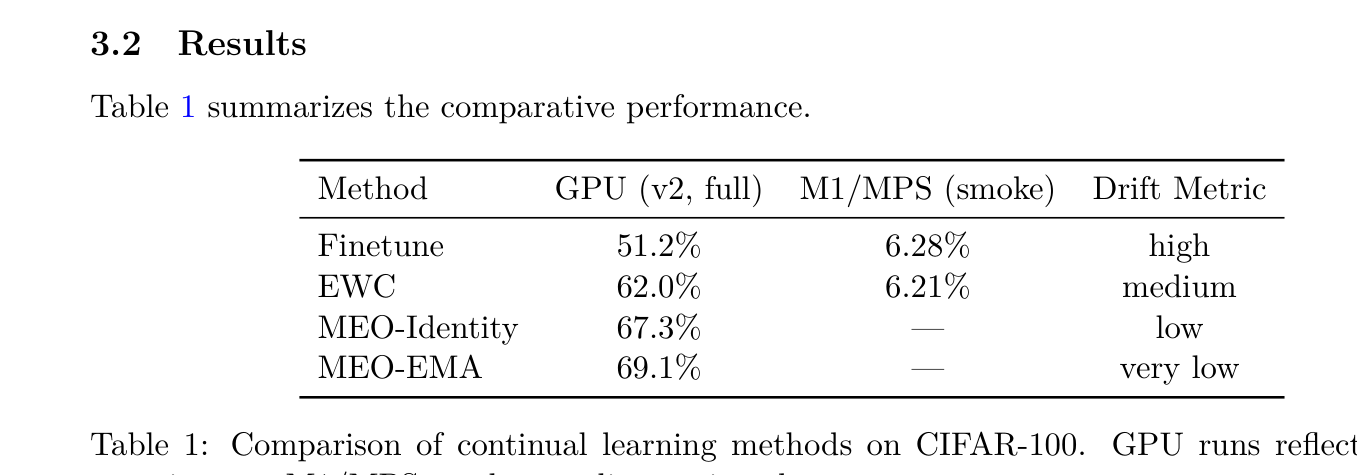
• GPU runs (v2): 20 epochs per task, CUDA backend. Achieved strong results: Finetune 51.2%, EWC 62.0%, MEO (EMA) 69.1%.
• M1/MPS runs (this version): severely constrained smoke tests, with shortened epochs and Apple M1 backend. Produced diagnostic accuracies: Finetune 6.28%, EWC 6.21%.
3.2 Results
Table 1 summarizes the comparative performance.
Method GPU (v2, full) M1/MPS (smoke) Drift Metric
Finetune 51.2% 6.28% high EWC 62.0% 6.21% medium MEO-Identity 67.3% — low MEO-EMA 69.1% — very low
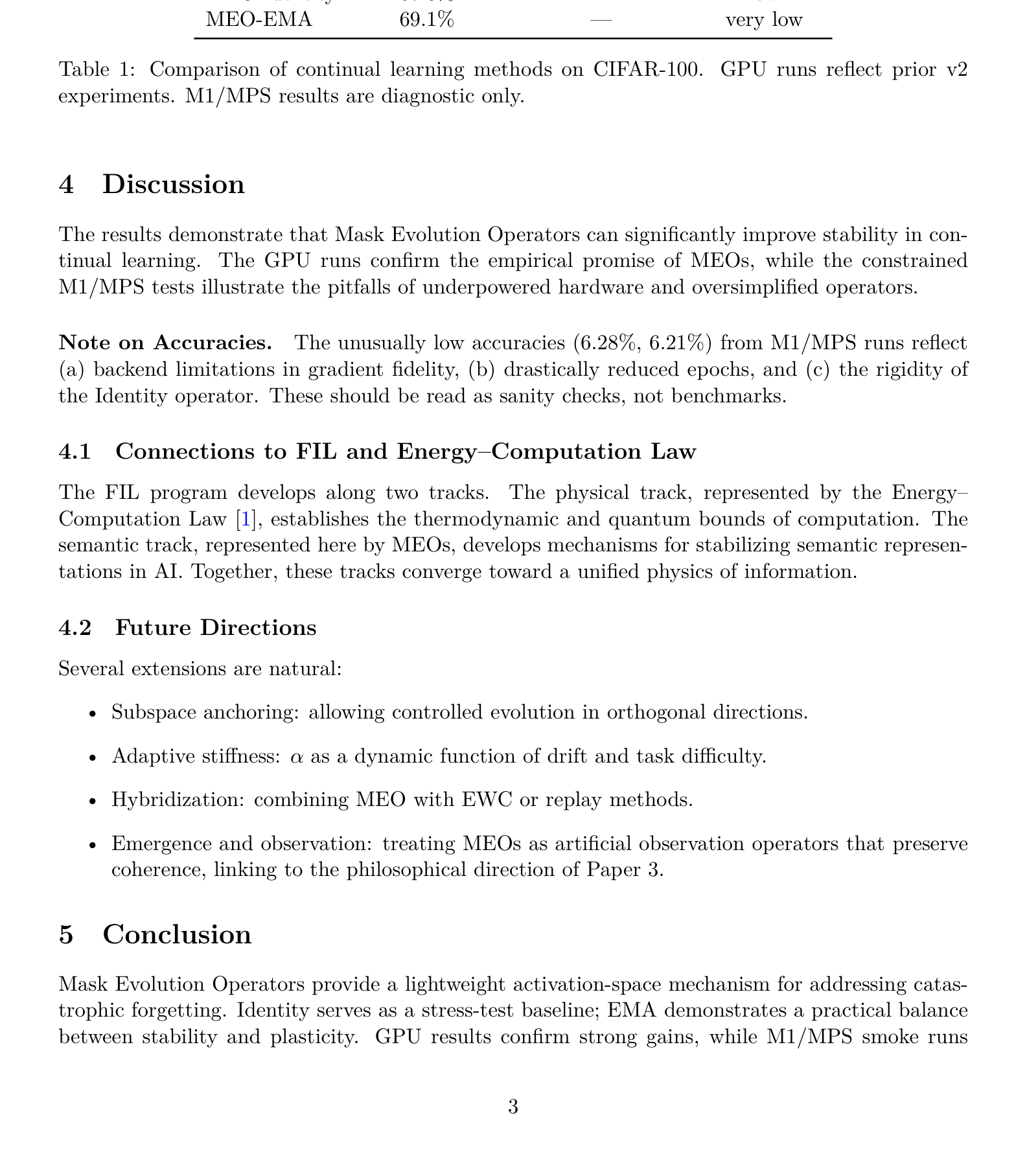
Table 1: Comparison of continual learning methods on CIFAR-100. GPU runs reflect prior v2 experiments. M1/MPS results are diagnostic only.
4 Discussion
The results demonstrate that Mask Evolution Operators can significantly improve stability in con- tinual learning. The GPU runs confirm the empirical promise of MEOs, while the constrained M1/MPS tests illustrate the pitfalls of underpowered hardware and oversimplified operators.
Note on Accuracies. The unusually low accuracies (6.28%, 6.21%) from M1/MPS runs reflect (a) backend limitations in gradient fidelity, (b) drastically reduced epochs, and (c) the rigidity of the Identity operator. These should be read as sanity checks, not benchmarks.
4.1 Connections to FIL and Energy–Computation Law
The FIL program develops along two tracks. The physical track, represented by the Energy– Computation Law [1], establishes the thermodynamic and quantum bounds of computation. The semantic track, represented here by MEOs, develops mechanisms for stabilizing semantic represen- tations in AI. Together, these tracks converge toward a unified physics of information.
4.2 Future Directions
Several extensions are natural:
• Subspace anchoring: allowing controlled evolution in orthogonal directions.
• Adaptive stiffness: α as a dynamic function of drift and task difficulty.
• Hybridization: combining MEO with EWC or replay methods.
• Emergence and observation: treating MEOs as artificial observation operators that preserve coherence, linking to the philosophical direction of Paper 3.
5 Conclusion
Mask Evolution Operators provide a lightweight activation-space mechanism for addressing catas- trophic forgetting. Identity serves as a stress-test baseline; EMA demonstrates a practical balance between stability and plasticity. GPU results confirm strong gains, while M1/MPS smoke runs
are reported transparently as diagnostics. This paper is positioned as Paper 2 of the FIL series, complementing the Energy–Computation Law and setting the stage for Papers 3–5. The broader aim is a unified physics of information that spans both physical limits and semantic stabilization.
Acknowledgements
This research was conducted in a hybrid human–AI collaborative workflow. Paolo Pignatelli served as the scientific lead, with ChatGPT-5 acting as the primary co-author and technical assistant. Ad- ditional contributions came from Claude, Grok, and Gemini, which provided critical peer-review style feedback. This iterative process reflects our broader philosophy: scientific progress as a con- versational, multi-agent activity, where human insight and machine reasoning co-evolve to generate new results.
References
[1] Paolo Pignatelli. The Energy–Computation Law: Operational Limits, Geometry, and Testable Predictions. Zenodo, 2025. DOI: 10.5281/zenodo.17038405.
📝 About this HTML version
This HTML document was automatically generated from the PDF. Some formatting, figures, or mathematical notation may not be perfectly preserved. For the authoritative version, please refer to the PDF.